
Ridgeline Supply, a $14 million outdoor apparel brand on Shopify, watched a channel that used to bring in 40 percent of its new customers quietly stop working. "Our organic sessions dropped 22 percent in a single quarter," founder Marcus Delgado told Ecommerce Times on August 25. "The traffic didn't go to a competitor. It just stopped. Google answered the question itself and nobody clicked through."
That sentence describes what Google's AI Overviews are now doing to millions of small commercial websites, including the ones a small business in Makassar or Surabaya spends real money to build. Similarweb data cited in the same report puts AI Overviews above roughly 58 percent of U.S. search queries as of July 2026, and Ahrefs benchmark data shows click-through rates on informational queries falling from 4.2 percent to 2.7 percent year over year among ecommerce sites. The same week, Search Engine Roundtable's Barry Schwartz documented ranking volatility that never really settled after Google's third confirmed spam update of the year finished on August 21. Two forces are compressing organic visibility from opposite directions at once: an answer layer that keeps more searches on Google's own page, and a spam crackdown reshuffling who remains visible below it.
📊 What Changed This Week, In Numbers
- AI Overviews now sit above an estimated 58 percent of U.S. search queries, per Similarweb data cited August 2026.
- Click-through on informational queries fell from 4.2 percent to 2.7 percent year over year, per Ahrefs benchmark data published June 2026.
- Google's third 2026 spam update finished rolling out August 21, and independent tracking tools (AWR, Sistrix, Mozcast, Semrush Sensor) still showed elevated ranking volatility on August 26.
- Google Shopping CPCs for apparel rose 19 percent year over year in H1 2026, per Tinuiti's August benchmark report, as advertisers compete harder for a shrinking pool of paid clicks.
- Structured data (Product, Review, FAQPage schema) correlates with a measurably higher citation rate inside AI Overviews, according to platform-level data reported by Online Store News.
🔍 What an AI Overview Actually Does to a Click
An AI Overview is the generated answer block Google now places above the traditional list of blue links for many searches. When someone searches something like "cara pilih platform kasir untuk warung kecil," Google increasingly tries to answer the question directly on the results page, using content it has crawled and judged trustworthy enough to summarize. If the answer is good enough, the reader never scrolls down to the site that supplied the facts.
This is not the same problem as ranking badly. A page can rank on page one and still lose the click, because the answer already sits above it. Lily Ray, VP of SEO Strategy at Amsive, has tracked the pattern across more than 200 ecommerce domains since AI Overviews began scaling in late 2025. "The damage is concentrated in the top of funnel," she said in reporting published by Ecommerce Times on August 25. "Brands that relied on informational content to introduce themselves to cold audiences are seeing that pipeline cut off at the source."
For a business that built its whole growth story on a blog post ranking for "cara" or "rekomendasi" queries, that is the exact traffic AI Overviews intercept first: the reader asking a general question, not yet ready to buy, who used to land on a site and later become a customer.

🧭 Why the Spam Update Makes This Worse Before It Gets Better
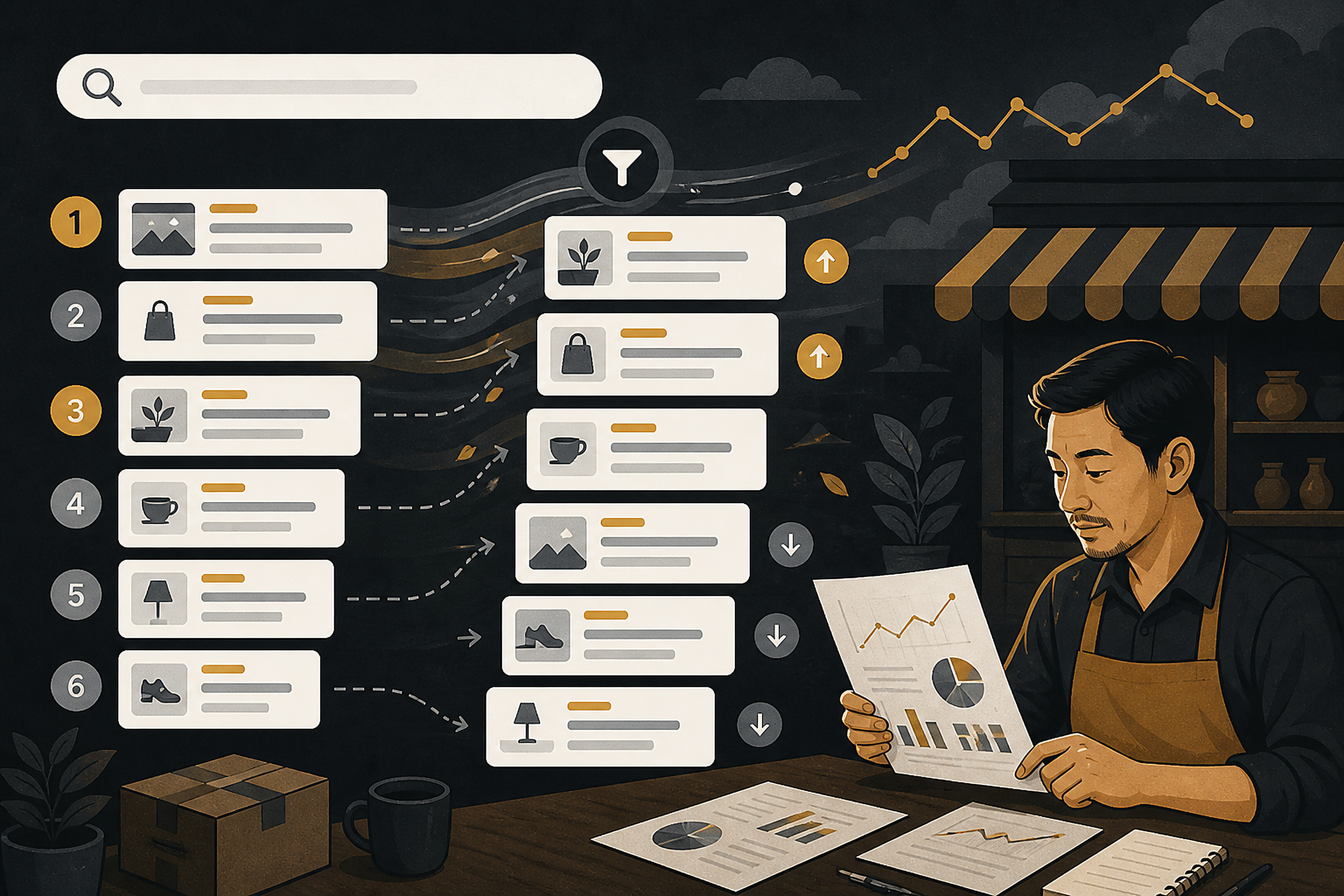
Google's August 2026 spam update, its third confirmed action of the year, finished rolling out on August 21 at 4:50am Pacific. But the ranking volatility did not calm down afterward. Barry Schwartz documented in an August 26 report that tools including AWR, Sistrix, Mozcast, and Semrush Sensor were still registering unusual shuffling five days after the update concluded, describing it as "like Google is pushing out a new ranking update post-spam update and did not announce it."
For a site owner, that timing matters because two different explanations can look identical in an analytics dashboard: a genuine ranking loss from the spam update, and traffic that simply moved into an AI Overview the reader never clicked through. Confusing the two leads to the wrong fix. A site punished for thin, mass-produced content needs a content overhaul. A site losing clicks to an AI Overview despite still ranking well needs a different answer entirely: content written to be a citable source, and a stronger reason for the reader to visit the actual page rather than stop at the summary.
Google's own John Mueller has repeatedly stressed, most recently reported by Aergos on August 24, that the company does not roll out updates before announcing them, and separately warned that AI-generated content sits outside the spam definition specifically when it goes through real human review before publishing. Content built by a person, even with AI assistance, and checked before it goes live is treated differently from unreviewed content produced at scale purely to fill search results.
🛍️ What Still Works: Google Shopping and Structured Product Data
Not every channel is shrinking. Google Shopping ad carousels sit in a placement that AI Overviews mostly do not displace, and merchants with clean, well-structured product feeds are still converting reliably through them. The tradeoff is cost: Tinuiti's August 2026 benchmark report found Google Shopping CPCs for apparel up 19 percent year over year in H1 2026, and home goods up 14 percent, as more advertisers compete for a smaller pool of organic-driven traffic and shift budget into paid placements instead.
The same structured-data logic that helps a Shopping feed also helps a site earn a citation inside an AI Overview instead of losing to one. Online Store News reported in August that Shopify merchants using Product, Review, and FAQPage schema markup are being cited inside AI Overviews at a measurably higher rate than merchants without it. Google's own systems pull structured, clearly attributed content to build its answers; a page that already states its facts in a machine-readable format is easier for that system to trust and credit.
For a small business that cannot compete on ad spend, this is the more realistic lever: making the site's existing product pages, FAQ sections, and reviews legible to the systems doing the summarizing, rather than trying to outbid larger competitors for Shopping placements.

🏪 What This Means for an Indonesian UMKM Website
A warung, a jasa titip service, or a small clinic in Indonesia is not competing for the same high-volume English-language queries as Ridgeline Supply. But the same mechanism applies to Indonesian-language searches. Someone searching "cara pesan katering untuk acara kantor" or "harga jasa desain logo UMKM" is increasingly served a generated answer before they see any business's actual page, and that answer is built from whichever sites Google's systems judge clear and trustworthy enough to summarize.
The businesses least exposed to this shift share a few traits. Their websites answer the reader's actual question in the first two sentences of a page, not after several paragraphs of scene-setting. Their product or service pages list specific facts (price ranges, availability, coverage area, process steps) in plain text a machine can parse, not only inside a photo or a PDF. And they give the reader a reason to click through anyway: a way to check real-time availability, message the business directly, place an order, or read something an AI summary cannot substitute, such as recent customer photos or a direct WhatsApp contact.

💬 The Owned-Channel Answer Nobody Can Take Away
Every report on this shift points to the same fallback: channels a business actually owns instead of rents. Klaviyo's Q2 2026 earnings commentary, cited by Online Store News, found that stores with a post-purchase SMS flow retained 31 percent more customers through a 90-day window than stores relying on email alone. For an Indonesian business, the equivalent owned channel is usually a WhatsApp Business number, a Telegram channel, or a customer list a business can message directly, none of which depend on Google deciding to send a click.
This does not mean abandoning a website. It means treating the site less as a lottery ticket for search traffic and more as the place that owned-channel traffic lands on to complete an order, check details, or see proof of work. A business that already gets a steady stream of repeat customers through WhatsApp status updates or a Telegram channel is less exposed to a single week of Google volatility than one that depends entirely on cold search traffic finding a blog post.
⚖️ What Remains Unconfirmed
Some connections being drawn this week are informed analysis, not confirmed fact. Google has not published exact AI Overview click-through-rate loss figures by industry; the 58 percent AI Overview presence figure and the 4.2-to-2.7-percent decline both come from third-party analytics vendors (Similarweb and Ahrefs), not Google's own disclosures. Google has also not confirmed that the ongoing post-spam-update volatility documented on August 26 is a distinct, unannounced ranking change rather than residual settling from the spam update itself; that interpretation comes from independent SEO trackers, not an official Google statement. Treat both as informed tracking, not certainty, and check a site's own Search Console data before drawing conclusions about a specific ranking change.
✅ Three Concrete Steps for This Week
- Open the site's product, service, or FAQ pages and rewrite the first two sentences of each to answer the reader's likely question directly, in plain text, before any marketing language.
- Add basic structured data (Product, Review, or FAQPage schema, depending on the page type) so Google's systems can read the page's facts cleanly. Google's Rich Results Test is free and shows whether the markup is present and valid.
- Point at least one action on every page (WhatsApp order button, availability check, contact form) toward a channel the business owns, so a reader who does click through has an immediate next step instead of only more information.
None of these steps requires a large budget or a developer team. They require rewriting existing pages and adding a few lines of markup, work that a small business can do with its existing website or ask its web partner to add during routine maintenance.
🧾 What It Means for the Reader
The organic search traffic that used to be nearly free is not disappearing entirely, but it is getting harder to earn and easier to lose to a generated summary. The businesses adapting fastest are not abandoning content, they are making it more directly useful to both readers and the systems now reading it first. For a small business owner deciding where to spend a limited web budget this month, the highest-leverage move is not a bigger ad budget. It is making sure the site's existing pages actually answer the question being asked, and giving the reader a reason to visit anyway.
A useful audit starts with a single real customer question. Write down the question a customer asks by WhatsApp, at a counter, or in a sales call. Then search it without being logged in. Does the page that represents the business give a precise answer? Can a visitor see the service area, price basis, lead time, return condition, or booking route without opening five tabs? If the answer is no, the problem existed before AI Overviews. The new answer layer simply makes the cost of that missing clarity visible.
A business should also separate its pages by job. A service page should explain the offer and make contact easy. A price page should state what is included, what changes the estimate, and how someone requests a quote. An FAQ should answer the questions that repeatedly slow down a sale. A case study should show work, client permission where relevant, and a result that can be checked. Trying to make one generic article serve every job leaves the reader with a broad summary and no reason to continue.
The first sentence matters because generated search systems favor compact, factual passages that can stand on their own. That does not mean every page needs robotic language. It means the business should lead with the answer, then add the explanation, proof, and personality a prospective customer needs. A bakery can say which delivery areas it serves and what the minimum order is before telling its origin story. A design studio can say what a landing-page project includes before discussing its creative method. Clear sequence helps people and machines for the same reason: neither needs to hunt for the basic fact.
There is a measurement change too. Sessions alone are no longer a sufficient scorecard. Watch impressions, clicks, query groups, and landing pages in Search Console, but pair those with actual business signals: WhatsApp starts, quote requests, completed checkouts, booked consultations, and returning customers. A page may get fewer visits while bringing more qualified visitors. The reverse is also possible: an AI Overview may preserve an impression count while taking away the click that previously led to a mailing-list signup. A monthly dashboard should show both search visibility and the actions that sustain the business.
Do not make a panic decision from one volatile week. Search Engine Roundtable's August 26 article records community chatter and third-party tool signals, not a formal announcement of a second update. Google ranking systems can move, tracking tools can disagree, and seasonal demand can affect clicks. Compare at least several weeks of data, annotate the August 18 to 21 spam-update window, and inspect the exact queries that moved. A service page losing clicks on a question that now triggers an AI answer requires one conversation. A product page no longer appearing for its own brand name requires a different, more urgent investigation.
For teams using AI to draft website content, the practical rule is plain: do not publish the first output merely because it fills a page. A staff member who knows the business should check every price, service limitation, delivery promise, legal claim, and local detail. They should remove invented specifics, add the experience that only the business can provide, and make the next action accurate. Google can summarize public facts. It cannot reliably replace a current availability check, a signed quote, a service-area confirmation, or a customer relationship handled well.
The shift also changes the value of an editorial calendar. Instead of publishing dozens of adjacent articles that rephrase the same basic question, pick fewer questions where the business has evidence, a clear point of view, or an operational answer. Update the pages that already attract impressions. Combine near-duplicate posts when they confuse visitors. Give each remaining page a stated owner who knows when its information becomes old. This is slower than generating a large content batch, but it creates a site a customer can use and a search system can distinguish.
Finally, keep the business reachable outside search. Put the website address on packaging, receipts, social profiles, email signatures, and physical signage. Invite past customers to save the business number with consent and offer a reason to return, such as a restock notice or a useful seasonal guide. None of these activities guarantees rankings. They reduce the business consequence when rankings shift. Search can still introduce a new customer, but it should not be the only road to one.
The new SEO reality is less flattering than the old promise that a handful of articles could produce durable free traffic forever. It is also more grounded. A business that states its facts clearly, keeps its website current, captures direct relationships ethically, and measures real enquiries has work it can control. That is a sturdier position than betting each month on one result page sending the same clicks it sent last year.
One final operational check is worth adding: make the website fast and usable on the phone that customers actually carry. A direct answer and valid schema cannot repair a form that fails to submit, a catalogue that takes too long to load, or a WhatsApp button hidden beneath a banner. Test the top pages on an ordinary mobile connection. Ask someone who did not build the site to find a price, a service detail, and a contact route. Record where they hesitate. Those observations are not a substitute for Search Console data, but they expose the friction that analytics alone often misses. When an AI Overview reduces casual clicks, every visitor who does arrive becomes more valuable. The page should earn that visit with accurate information, a credible human voice, and one clear way to proceed. Review the same pages after each material price, service, staffing, or delivery change, because an outdated answer creates a worse customer experience than no answer at all.
Sources: Ecommerce Times (August 25, 2026), Online Store News (August 2026), Search Engine Roundtable (August 26, 2026), Aergos Blog (August 24, 2026), Tinuiti H1 2026 benchmark report as cited by Ecommerce Times.