
Salesforce and Anthropic announced Claudeforce on August 26, 2026. The name sounds like enterprise marketing, but the first product is specific: Salesforce in Claude, a plugin that gives Claude 37 prebuilt sales skills to read live revenue context, prepare meetings, review deal health, update pipelines, and take actions through Salesforce rules.
A small business in Indonesia cannot buy it today. Salesforce says the release is for selected pilot customers, with an open beta planned for September. Still, the announcement matters because it changes the useful question about business AI. The question is no longer only which chatbot writes best. It is which system may act on business information, and whose rules govern that action.
🤝 What Salesforce and Anthropic actually announced
Claudeforce connects Claude’s reasoning with Salesforce data, workflows, business logic, actions, and governance. Its first release, Salesforce in Claude, runs as a Claude plugin. A seller can ask for meeting preparation, a pipeline-health review, or a record update without moving through several CRM screens.
Salesforce says the plugin starts with 37 prebuilt sales skills. That does not mean 37 independent digital workers can make unrestricted decisions. The skills package specific sales tasks such as reading account context, summarizing information, and passing an action back to the record system. Any action that touches business data is still routed through Salesforce.
The relationship also works in the other direction. Claude is available in Agentforce as a reasoning model for the Atlas Reasoning Engine, Agentforce Vibes, Agentforce Coworker, and Agent Builder. Salesforce says customers using Amazon Bedrock can run Claude inside the Salesforce Trust Boundary, an important point for organizations with stricter security and compliance requirements.

For a non-technical reader, picture the previous routine. A salesperson opens the CRM, finds the account, reads conversation history, checks Slack, drafts an email, then updates the deal stage. Claudeforce promises that the person can begin with a question in Claude while the facts and actions still come from the business system that already serves as the company’s record.
🧠 The difference between answering and acting
Generative AI can already summarize email and write a proposal. Those uses feel safe because they do not require direct access to live systems. An AI that has permission to see a sales pipeline, read internal messages, or change a customer record is a different category of tool.
That difference determines the risk. A bad draft can be edited before it leaves the company. A bad pipeline update can damage a forecast, a commission calculation, or another employee’s follow-up. An email sent to the wrong person can disclose customer information. Claudeforce is therefore not being presented as another writing feature.
Salesforce says Claude actions run through the existing Salesforce permissions and business rules. Its product page says each user can see only what they are already authorized to see and do only what they are already authorized to do. An administrator connects Salesforce once, then manages authentication and permissions centrally.
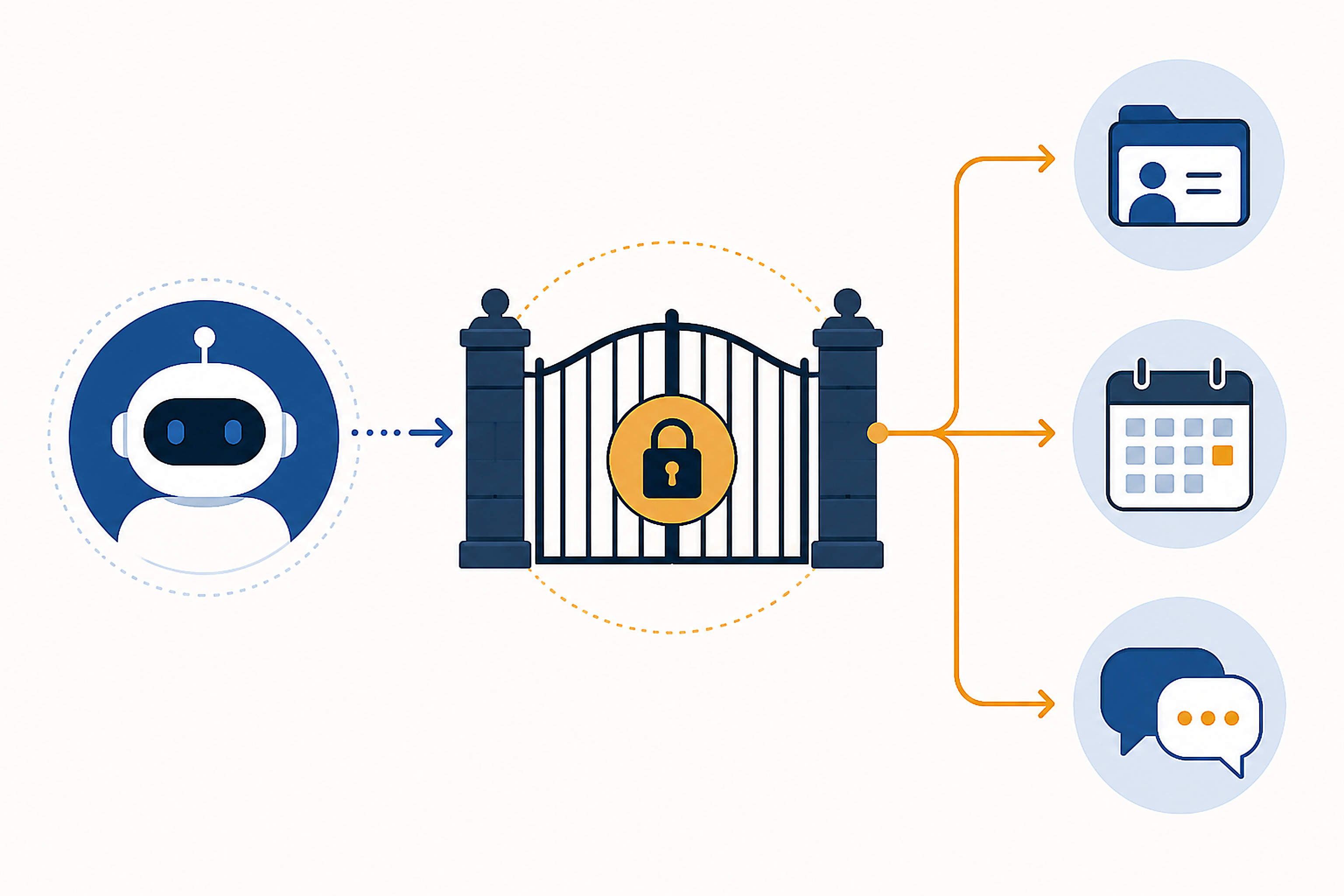
That is more useful than a feature list. AI should not become a new superadmin account. It needs a user identity, a defined data boundary, and a clear audit trail. If a tool asks for full access to customer folders, inboxes, and financial information just to create summaries, a business owner should pause and reassess the request.
📊 Why an enterprise release matters to small teams
Most small businesses do not use Salesforce. They may run on WhatsApp Business, spreadsheets, marketplaces, point-of-sale apps, online-store tools, or a smaller CRM. Yet the pattern Claudeforce targets exists in a small team too: customer information is scattered, follow-ups are delayed, sales notes are incomplete, and one owner carries the context for every important transaction.
Salesforce’s State of Commerce report describes the pressure from a larger-company perspective. The company says agentic search as the first step in a shopping journey grew 200 percent year over year. It also reports that 86 percent of commerce leaders believe AI is raising customer expectations, while 61 percent say meeting those expectations is becoming harder. These are not Indonesia-specific figures and they are not proof that every small business should purchase AI. They do explain why software companies are racing to connect AI to daily business systems.
A small business does not primarily lack chatbots. It often lacks clean records and owned processes. AI placed on duplicate customer data will accelerate confusion. AI allowed to send messages without review will accelerate mistakes. AI that reads a clean catalogue and a maintained FAQ can save time without assuming high risk.

Start with recurring work, not product names. An online seller can record the most frequent customer questions for two weeks. A service business can map the path from first inquiry to sent quotation. Then it can choose one narrow task to test.
🧱 Data and business rules are the real product
Claudeforce is not only about bringing Claude closer to Salesforce. Salesforce describes its foundation as AIforce and Headless 360, a way to expose data, apps, workflows, and governance to agents through MCP servers, APIs, and command-line tools without building an expensive bespoke integration for every interface.
The technical language may feel distant from a small business. The basic idea is not. A business system’s value does not live only in a dashboard. It lives in customer information, prices, inventory, discount rules, approval flows, and transaction history. If an AI can call those resources safely, conversation can become a new interface. If the records are chaotic, a conversational interface will produce confident-sounding chaos.
Salesforce does not promise unlimited autonomy. Its Claudeforce page says a company decides the degree of autonomy on the writing side, including whether to require a check before an email goes outside the company. This detail matters. Speed is not always the right metric. For payments, price changes, contracts, deleted data, and customer commitments, human approval is part of service quality.
🛡️ Governance cannot wait until after launch
The announcement arrives as companies activate agents faster. Salesforce’s Agentic Enterprise Index says the average number of activated agents per organization rose nearly threefold during the fiscal year it analyzed, while average creation-to-use time fell 53 percent. Fast activation is not the same as mature deployment.
The same report says employee engagement with agents has increased and escalation to people has held at 32 percent even as conversation volume grew. For a small business, the important number is not threefold or 32 percent. The question is where the AI must stop and a person must decide.
Set that point before connecting any system. For low-risk internal work, AI can draft a stock summary or a reply. For money, pricing, contracts, customer data, or commitments to a buyer, a person should review and approve. Record who approved access and when it is removed. A short policy that the team actually follows beats a long governance document nobody reads.
💬 What Claudeforce does not prove
Claudeforce is not evidence that traditional CRM software will vanish. The announcement bets on the opposite: an AI model needs trusted records, permissions, and rules if it is going to take useful action. Salesforce wants to govern the action layer while Claude supplies the reasoning and conversational language.
It is also not a general-access feature today. Salesforce says it is available to selected pilot customers and plans an open beta for September 2026. Pricing and packaging can change, and regional availability is subject to customer agreements. A small business should not open an enterprise account because of this headline.
There is no evidence in the announcement that agents will raise sales for every business. Salesforce cites internal productivity and customer examples, but every company has different data, processes, and customers. A small test with a clear success measure is more reasonable than a generic savings claim.
🧾 Three tests a small business can run now
First, map the action. List five tasks that most often delay the team, then label each one as read-only, draft-only, or a task that changes something. The last category needs the strongest control.
Second, clean one source of truth. Pick a product catalogue, an FAQ, or an order-status list. Remove obvious duplicates, assign one person to update it, and do not give an AI access to data it does not need. This work remains useful even if the business never adopts an agent.
Third, run a reversible test for one or two weeks. For example, let AI draft first replies to product-size questions while a staff member approves every reply before it goes out. Measure time saved, corrections required, and questions still needing a human. Do not measure only how much text the system produced.
Large organizations have not solved measurement either. Salesforce reports that only 32 percent of organizations have fully defined AI success metrics and KPIs. That is a healthy warning. Prompt volume, reply volume, and automation count are not business outcomes if customers still wait or errors rise.
For a small business, the measures can remain simple. Track time from incoming question to correct reply. Track orders that require correction. Track how many owner hours return to customer work or product work. If AI adds an approval step without improving accuracy, stop or redesign the workflow. There is another common trap: judging AI by how fluent it sounds rather than how correct its actions are. A polite, fast answer that states the wrong price or stock level is still costly. Check an AI workflow against the source data before calling it successful, not against a quick impression of its writing.
💰 Why investors reacted so strongly
The market response explains some of the pressure behind this partnership. Reuters reporting republished by several business outlets said Salesforce shares rose roughly 12 to 14 percent in after-hours trading on August 26. The move followed fiscal second-quarter results that beat analyst expectations, with revenue up 11 percent to US$11.35 billion and full-year revenue guidance lifted to US$46.1 billion to US$46.4 billion.
Salesforce and other software-as-a-service companies have faced investor concern that general AI assistants may allow customers to skip traditional subscription software. Commentators have called that worry “SaaSpocalypse.” Marc Benioff rejected the narrative in a CNBC interview and used Claudeforce to argue the reverse: AI and enterprise software can reinforce one another.
Salesforce is also an Anthropic investor. Reuters coverage noted that strategic investments, including Anthropic, contributed an adjusted US$2.53-per-share gain in the same quarter, helping adjusted earnings per share more than double to US$5.90. That means the companies’ incentives are linked through both product strategy and investment results. Readers should therefore treat early success claims with proportionate caution until broader customers produce independent evidence.
🧩 How Claudeforce differs from a general AI assistant
The central difference is what Salesforce calls a company’s deterministic truth: customer data, pipeline records, workflows, business logic, and permissions. A language model can reason impressively, but it cannot know which deal is healthy or about to fail unless it has access to the actual history.
Salesforce describes Claudeforce as pairing Claude’s probabilistic intelligence with its deterministic business system. A language model produces an answer from likely patterns rather than from a guaranteed database lookup. Without a trusted data anchor, its answer may be persuasive and wrong. Connecting reasoning to the record system is Salesforce’s attempt to make AI output more accountable, not merely smoother.
That distinction matters to a small business without an enterprise CRM. It should separate the need for good writing from the need for correct facts. AI can draft a friendly reply, but a person still needs to validate prices, inventory, and delivery dates against the actual record before sending it.
🧭 Reading productivity claims carefully
Salesforce promotes striking internal figures, including a claim that Slackbot is driving 8.1 million annualized productivity hours for Salesforce employees, more than double quarter over quarter. Such numbers are useful as a signal of how the company views its own adoption. They are not an independent audit or a promise that another business with a different scale and process will get the same outcome.
The same restraint applies to the Agentic Enterprise Index. The report says activated agents per organization grew nearly threefold and agent work output grew at a 15 percent compound monthly rate. Its cohort includes businesses that activated agents in production every month during the study period. That is already a technology-ready group, not a random sample of every business, much less every small business in a developing market.
The figures should not be ignored. They show a market direction. They should not be treated as a guarantee for a home-based seller, a neighborhood retailer, or a small service firm trying an AI-connected workflow for the first time.
🌏 The Indonesian context and the gap to bridge
The software stack used by Indonesian small businesses looks very different from Salesforce. Many operate through WhatsApp Business, simple point-of-sale systems, marketplaces, online-store platforms, and manual spreadsheets. Claudeforce, built on a mature Salesforce ecosystem and years of enterprise customer data, will not appear in the same form for Indonesian microbusinesses overnight.
The direction remains relevant. Providers closer to small businesses, including point-of-sale platforms, online-store tools, and messaging automation services, are likely to follow a similar pattern: connect AI models to operational data through protocols such as MCP, then offer that connection as a feature. When that arrives in tools Indonesian businesses actually use, questions about permissions, audit trails, and human approval become immediate practical questions.
An owner who cleans customer data and sets internal approval rules now will be better prepared than an owner who begins thinking about governance only after the first mistake. Before connecting an AI tool to customer information, a business owner can answer a few basic questions. This does not require a dedicated IT team. It requires clarity before pressing “connect” inside a new application.
- What data will the tool read, and which of that data does it not actually need?
- What actions may it run without human approval, and which must wait for review?
- Who is the one accountable person if the tool makes a mistake?
- How can access be removed quickly if something goes wrong?
- Does the vendor clearly explain where customer data is stored, whether it trains a model, and how long it retains data?
The list is intentionally short. Its purpose is not to create new bureaucracy. It is to ensure the most basic questions are answered before hard-won customer information goes into a system the business does not fully understand.
Several signs will show whether the direction opened by Claudeforce reaches small teams or remains an enterprise story. First, watch whether the September 2026 open beta actually extends access to smaller Salesforce customers rather than only adding more large pilots.
Second, watch whether digital providers closer to Indonesian small businesses announce comparable integrations that connect assistants to operational records. Third, look for independent reporting, not only Salesforce and Anthropic claims, on how often human users must correct or reverse Claudeforce actions after wider use.

Those signs will answer more than an impressive product name or a one-day share-price move. Technology becomes useful to a small business through mundane outcomes: fewer incorrect orders, faster accurate replies, and more owner time for customers or product work. Salesforce and Anthropic are showing a future where business data and rules hidden behind menus can be called through conversation. The businesses that benefit will not be those that activate agents fastest. They will be those that know which data they trust, which actions are reversible, and when a person must say yes or no.
🧑💼 A short scenario worth sitting with
Picture a five-person online store that sells handmade furniture. Orders come through a mix of Instagram messages, a marketplace inbox, and WhatsApp. The owner is the only person who remembers which customer asked for a custom wood finish, which order is waiting on a supplier delay, and which buyer already complained once about a late delivery.
An AI layer connected to that business, if it followed the same governance logic Salesforce describes for Claudeforce, would not simply generate friendly replies. It would need one place to read order status from, one rule for who approves a refund, and one log showing which message a human actually reviewed before it reached a customer. Without that structure, connecting AI to five different inboxes only spreads the same disorganization faster, in more channels, with more confidence in the tone of each reply.
The scenario is not hypothetical. It describes thousands of small sellers already juggling multiple channels without a shared source of truth. The lesson from Claudeforce is not that this store needs an enterprise CRM. It is that the store needs to decide, in plain language, which one inbox or spreadsheet is the real record, before any AI tool touches customer data at all.
Sources: Salesforce and Anthropic announcements, 26 August 2026; Salesforce Claudeforce product page; Salesforce Agentic Enterprise Index and State of Commerce; Reuters and CNBC reporting, accessed 27 August 2026.