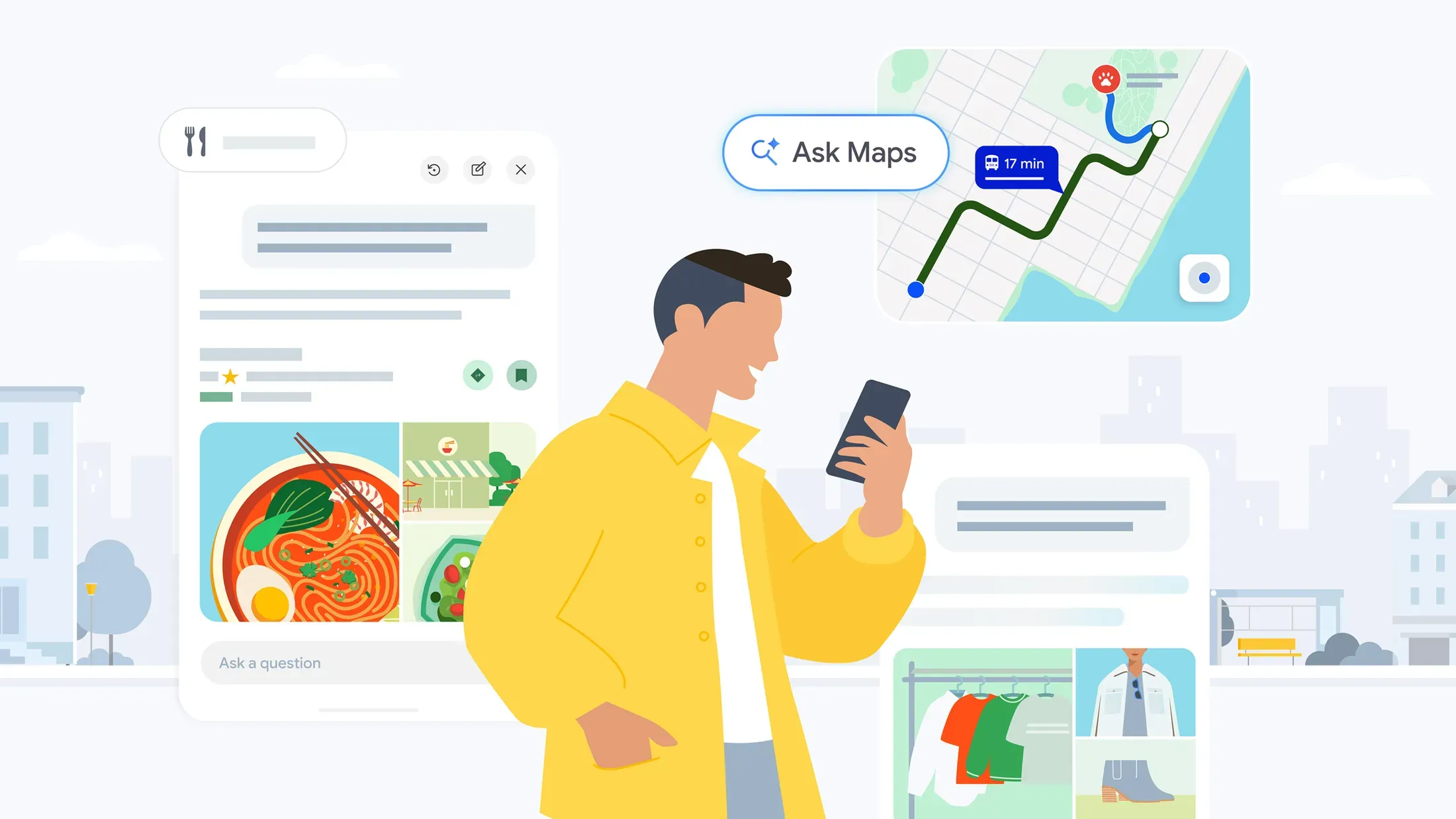
On August 6, 2026, Google announced that Ask Maps — the conversational, Gemini-powered layer inside Google Maps — can now do more than answer questions about a place. It can act on a user's behalf: ordering food for pickup, comparing hotels by price and vibe, finding event tickets, and pulling context from a user's own Gmail to skip the small talk. For a small business that depends on being found, chosen, and visited, this is not a minor app update. It is the next stage of a shift that has already been reshaping how people decide where to eat, stay, and spend money — and it moves the decision even further away from a business's own website or profile page.
🗺️ What Google Actually Announced
In a post published on Google's official blog, Google Maps VP & GM Miriam Daniel described the update as "Google Maps' biggest transformation in over a decade." The rollout adds four capabilities to Ask Maps, the natural-language assistant Google Maps introduced in March 2026:
- Agentic food ordering. A user can type or say something like "order spicy pad kee mao with seafood for me to pick up on my way home," and Ask Maps finds open restaurants along the user's route that serve it, adds the dish to a cart, and hands off checkout to a partner platform. Food ordering is rolling out now with Square and Toast, with Uber Eats coming soon.
- Hotel and event discovery. Ask Maps compares real-time prices and availability for a described hotel ("a decently priced, top-rated hotel with an artsy vibe near a gym") and surfaces nearby events with ticket links.
- Personal Intelligence. With explicit user permission, Ask Maps can read flight confirmations and dinner reservations from Gmail (and soon Calendar) to build suggestions without the user re-explaining their plans. It is off by default.
- Live transit and conversational contributions. A new widget tracks real-time bus, train, and ferry delays, and users can now update a business's hours or leave a tip just by describing it in conversation — including by uploading a photo of a storefront sign for Ask Maps to read.
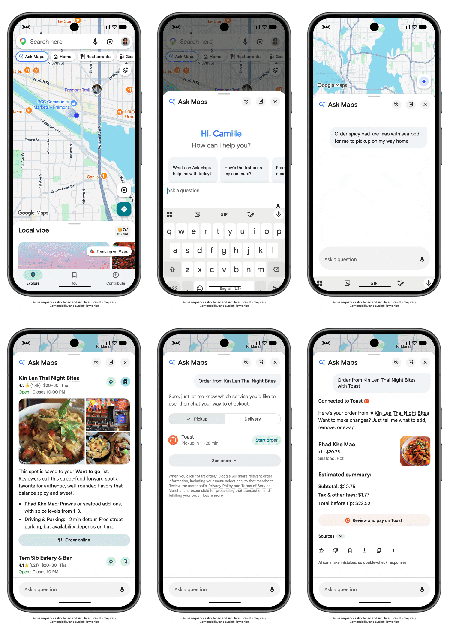
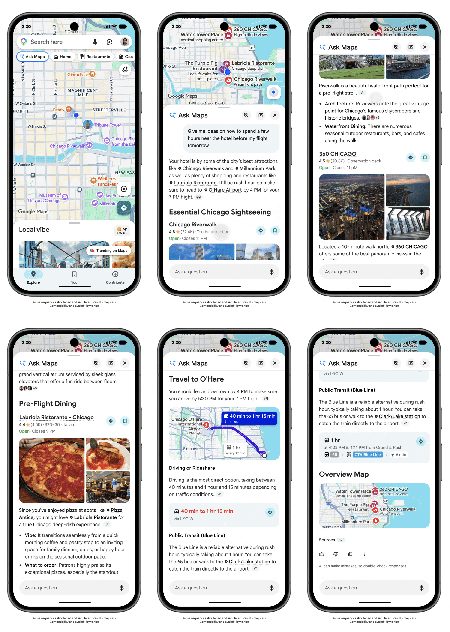
Food ordering, hotel and event discovery, and conversational contributions are rolling out first in the United States, according to Google's post. The live transit widget and Personal Intelligence are rolling out to every market where Ask Maps is available. Ask Maps itself, as TechCrunch and other outlets reported the same day, is also expanding to more than 150 additional countries and territories in English — Google's post specifically names Australia, Brazil, Canada, Indonesia, Japan, and Mexico among the markets gaining access.
🤖 Why This Is Bigger Than a Feature List
"Ask Maps is Google Maps' biggest transformation in over a decade. By bringing Gemini model capabilities together with the world's freshest map, we've made it easier than ever to get answers to real-world questions." — Miriam Daniel, VP & GM, Google Maps
The technology press covering the announcement converged on the same underlying point, even while describing different details. TechCrunch's Aisha Malik noted that Ask Maps will "pull information from a user's emails and calendar to provide tailored responses," while The Next Web's analysis went further: "The update is the clearest example yet of Google turning its products into agents that complete tasks rather than just answer questions... Ask Maps is now doing the same thing inside a navigation app used by over a billion people monthly."
That is the real story here. Google Search has spent the past two years shifting from a list of links toward an AI-generated answer that a user rarely has to click through — the zero-click search trend this newsroom has covered before. Ask Maps applies the same logic to physical-world decisions: where to eat, where to stay, what to do tonight. The assistant does not just recommend a business anymore. It can complete the transaction with a partner platform before the user ever opens that business's own page.

🍜 What Changes for a Restaurant, Café, or Shop

For a food business, the practical shift is immediate: an order can now be generated entirely from a description of a dish and a route, without the customer ever searching a restaurant's name, opening its website, or comparing it against a competitor's menu by eye. Google's own post is explicit that this depends on partner integrations — Square, Toast, and soon Uber Eats — meaning a restaurant's presence on those ordering platforms, not just its Google Business Profile, now determines whether it can be found by an AI agent placing an order automatically.
For hotels, guesthouses, and event venues, the same logic applies to Ask Maps' price-and-availability comparison: a business's listed pricing, photos, and up-to-date availability need to be accurate and structured enough for an AI system to compare them fairly against competitors, because a human is no longer scrolling through the results manually.
🔑 Key Takeaway
An AI agent that can complete an order does not need a business's website to make the sale — but it still needs a business's data to be accurate, current, and connected to the platforms that agent actually uses. Ranking well in classic search is no longer the only game; being integrated with the ordering, booking, and information systems an AI agent reaches into is becoming just as important.
📉 The Part Small Businesses in Indonesia Should Watch Closely
Indonesia is named directly among the first markets receiving the expanded Ask Maps experience, alongside Australia, Brazil, Canada, Japan, and Mexico. That timing matters for any Indonesian UMKM that depends on foot traffic driven by Google Maps — warungs, cafés, salons, bengkel, and local retail. Even before agentic ordering reaches a given country's local partners, the underlying shift in how Ask Maps surfaces and describes a business is already live: a business's Google Business Profile listing — its category, hours, photos, reviews, and the specific words used in its description — becomes the raw material an AI system reads and paraphrases when a customer asks a conversational question instead of typing a keyword search.
Search Engine Land, tracking Ask Maps' local search behavior since April 2026, has already reported that "new tests show Ask Maps is guiding users with recommendations, shifting how businesses get surfaced and how local rankings are influenced" — a trend this announcement accelerates rather than introduces.
🛠️ Three Moves a Small Business Can Make Now
1. Treat the Google Business Profile as a primary data feed, not a formality
Complete, specific, and current information — accurate hours, a real menu or price list, categories that match how customers actually describe the business — is what an AI agent reads and repeats. A profile filled with generic descriptions gives Ask Maps nothing distinctive to surface.
2. Check exposure on the partner platforms Google named
A restaurant not listed on Square, Toast, or (soon) Uber Eats is invisible to Ask Maps' new ordering flow entirely, regardless of how good its Google listing looks. The partner platform, not just Google Maps, is now part of a business's discoverability stack.
3. Keep the website's role clear: proof, not just presence
If an AI agent can complete simple transactions on its own, a business website's remaining job is to do what the agent cannot: show real photos of the actual space, host reviews and testimonials in full, explain a process or policy in detail, and give a human reason to choose one option over another once the agent has narrowed the field. A thin, outdated website is now competing against an assistant that already did the easy part of the decision for the customer.
🧭 What Still Isn't Clear
Google's post does not specify a timeline for expanding food ordering beyond the United States, nor has it confirmed which additional booking and ordering partners will be added as the program grows in markets like Indonesia. The company describes the effort to standardize this experience as the joint development of a "Universal Commerce Protocol for Food" with its partners — language that signals more integrations are coming, without committing to a date.
Sources: Google (blog.google, official announcement, August 6, 2026), TechCrunch (August 6, 2026), The Next Web (August 6, 2026), Engadget (August 6, 2026), Search Engine Land (April 2026, local search impact analysis).