Google Search Console had one job for eighteen years: show you how your own website performs on Google. Nothing else counted. If your business posted three Reels a week and never touched them again, that activity was invisible to the tool—no clicks, no impressions, no queries, nothing. On July 7, 2026, Google broke that rule. Moshe Samet, Product Manager Lead for Search Console, announced platform properties in a post on the Search Central blog: a new property type that connects an Instagram, TikTok, X, or YouTube account directly to Search Console and reports how that account's content performs in Google Search, Discover, and Google News. The rollout started gradually. By July 29, Google confirmed it was globally available. By the second week of August, Search Engine Roundtable's daily forum recap was treating it as fully live for everyone who wanted it.
For a small business, this closes a genuinely old blind spot. A shop that runs its storefront half on a website and half on Instagram has never had a single number that says: does Google actually surface any of this? Platform properties answer that question directly, for the first time, inside the same tool many small businesses already half-ignore.
⚡ Key Facts at a Glance
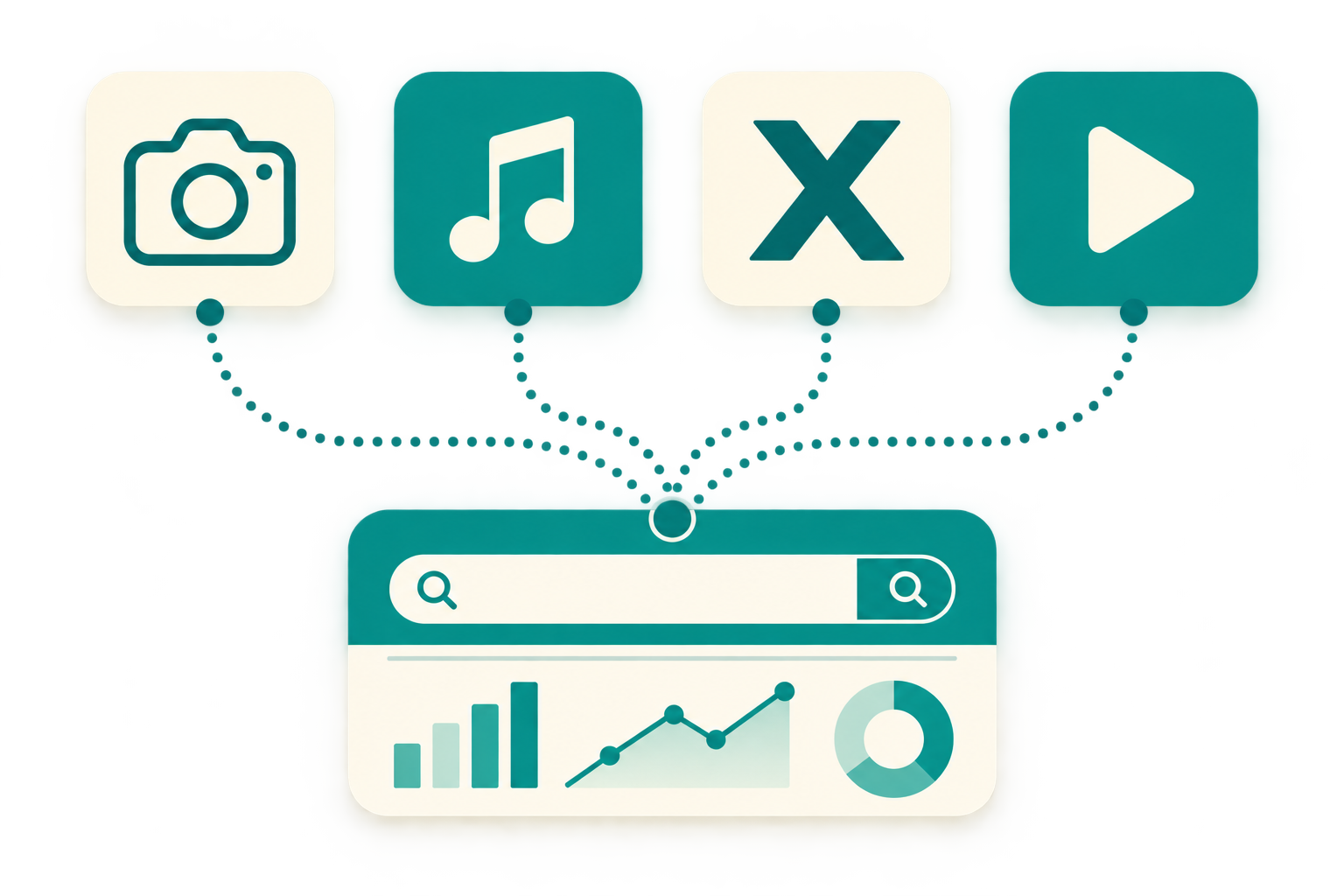
- What launched: A new Search Console property type called platform properties, covering four accounts—Instagram, TikTok, X, and YouTube—announced by Google on July 7, 2026.
- Rollout status: Gradual from July 7, confirmed globally available by July 29, treated as fully live by independent trackers by mid-August.
- What it reports: Clicks, impressions, click-through rate, and average position for a connected account's content inside Google Search, Discover, and Google News—plus a trends-focused Insights report and a milestone-tracking Achievements panel.
- What it does not report: In-app engagement on the platform itself (likes, shares, watch time, follower growth); that remains the job of each platform's own analytics.
- The catch most guides skip: Independent crawler testing found Instagram and X block essentially all general-purpose crawler tokens in their public robots.txt files, TikTok blocks nearly all of them, and YouTube blocks none—meaning the four platforms are not equally visible to Google's index to begin with.
📊 What Platform Properties Actually Measure
Start with the mechanics, because the feature is easy to describe wrong. A platform property is not a dashboard that pulls in TikTok's internal analytics or Instagram's in-app Insights. It measures one narrow thing: how content from a connected account performs specifically inside Google's own surfaces—Search, Discover, and Google News. Google's own support documentation is explicit about the boundary: "Platform properties only show how your content performs on Google Search. They don't track when people see your content on the platform itself (for example, they won't show how many times your video appeared on TikTok)."
That distinction matters more than it sounds. A business owner who connects a TikTok account and sees low numbers in Search Console has not learned that the TikTok account is failing—they've learned that Google, specifically, is not surfacing that content in search results. The account could be thriving inside TikTok's own algorithm and still show close to nothing in Search Console, because those are two separate discovery systems being measured by two separate tools.
Once connected, a platform property gives three reports, according to both Google's official documentation and independent coverage from Search Engine Land contributors and SEO agencies who tested it in the first weeks:
- Performance report — total clicks, impressions, average click-through rate, and average search position for the connected account's content, filterable by search type (web, image, video, news) and breakable down by individual post and by the query that triggered the impression.
- Insights report — a higher-level view of traffic trends, top-performing posts, and how people are discovering the account through Google, useful for a fast read rather than granular analysis.
- Achievements — milestone tracking, essentially a gamification layer marking things like a new 28-day click threshold, which several early reviewers, including the marketing agency Mintec in its August 9 write-up, suggested can be safely ignored by anyone using the data operationally.
🔌 How the Connection Actually Works
Setting up a platform property is closer to authorizing an app than verifying a website, and that is deliberate. Google's blog post lays out four steps: open Search Console, go to the property selector or verification page, choose one of the four supported platforms (Instagram, TikTok, X, or YouTube), then complete an on-screen authorization flow tied to your account on that platform. There is no DNS record to add, no HTML file to upload, no meta tag to paste into a theme file—the entire process one blog reviewer clocked at under five minutes per account.
That ease is also the catch for any business running more than one profile. Google's guidance recommends connecting accounts one at a time, and each profile needs its own separate property—there is no single "connect everything" toggle. A business running an Instagram shop account, a TikTok account for behind-the-scenes content, and a YouTube channel for tutorials will end up managing three distinct platform properties inside the same Search Console account, each with its own performance history, its own Insights report, and its own achievement track.
Access, once granted, is not permanent by default. Independent guides reviewing the rollout note that if the connected account's authorization lapses—an expired token, a changed password, a revoked app permission—the platform property pauses until re-verified, though re-verification does not force you to wait for data to re-accumulate; the historical record picks back up where it left off.
🗓️ The Timeline: From Quiet Announcement to Full Rollout
The rollout itself is a useful case study in how Google tends to ship Search Console features now—quietly, then confirmed, then treated as old news within weeks. The sequence, cross-checked across Google's own blog archive and third-party coverage:
- July 7, 2026 — Google announces platform properties on the Search Central blog, describing the feature as becoming available "gradually over the coming weeks."
- July 29, 2026 — Independent trackers, including the SEO analysis site Lantad, report the rollout reaching global availability.
- August 9, 2026 — Mintec's blog post frames the update as something "the news barely registered" when it first went out, only becoming a talking point once agencies started noticing account-level data appearing for clients.
- August 11, 2026 — Search Engine Roundtable's daily forum recap lists the related Search Console generative AI performance report as "fully live for everyone," a parallel Search Console expansion that reinforces the same pattern: Google is steadily widening what Search Console reports on beyond the traditional domain-only view.
That gap between the quiet July announcement and the August recognition is itself informative. Several SEO commentators, including the writer behind the dev.to analysis republished from Scalevise, made the same point independently: most agencies had not yet connected platform properties to the bigger measurement picture even a month after launch. For a small business owner without an in-house SEO team, that lag is normal, not a sign of being behind.
It is also worth noting this was not Google's first attempt at something like it. Google's own blog post references "an earlier experiment" that preceded the full platform properties launch, and Search Console's December 2025 changelog separately lists the introduction of "social channels in Search Console" as a distinct, earlier step. Read together, the timeline shows Google testing a narrower version of cross-platform reporting for months before committing to the four-platform, globally available version that shipped in July 2026. That history matters for one practical reason: features that follow a slow, tested rollout pattern like this one tend to be more stable once they reach general availability than features shipped all at once, which is a mild but real signal in favor of treating this data as durable rather than a beta that might disappear.

🧩 Why This Exists Now: The AI Search Backdrop
Platform properties did not appear in isolation. They landed roughly six weeks after Google's Search Console began rolling out generative AI performance reports—a separate feature showing how a site's content appears inside AI Overviews and AI Mode—and that report reached full availability around the same week platform properties did, according to the August 11 Search Engine Roundtable recap. Put those two rollouts side by side and a pattern shows: Google is expanding Search Console's definition of "your presence on Google" in two directions simultaneously—outward, to content you did not publish on your own domain, and inward, to how AI-generated answers use your content at all.
The practical reason this matters to a small business is that AI-driven discovery increasingly draws from a wider pool of content than a single company website. A shopper asking an AI assistant about a local product recommendation may surface an Instagram post, a YouTube review, or an X thread as readily as a brand's own page. Search Console previously had no way to tell a business owner whether that was happening to their own accounts. Platform properties do not solve the AI-answer visibility question directly, but they give the first concrete measurement of the underlying layer: is Google's search index even seeing your social content well enough to consider it a source in the first place?
🏪 What This Means for a Small Business Specifically
Translate the feature into a concrete scenario. A café that posts daily to Instagram and occasionally uploads a TikTok video, but has a static, rarely updated website, has historically had zero visibility into whether Google search traffic ever reaches those posts. Website analytics measure the site; Instagram Insights measure engagement inside the app; neither answers "does someone searching Google for 'best coffee near [neighborhood]' ever see our Instagram post in the results?" Platform properties answer exactly that question, for the first time, without requiring the business to have a strong website at all.
That has a specific implication worth stating plainly: platform properties reward businesses that never fully invested in their own site, but publish consistently on connected platforms. A shop with a thin website and an active Instagram account can now measure and potentially grow search-driven traffic through Instagram alone, using data that previously existed nowhere accessible to them.

It also creates a new kind of accountability. Once you connect an account and see the query data, "we post a lot" and "our content shows up when people search for us" become two different, separately measurable claims. A business that assumed heavy posting equaled search visibility might discover the opposite—strong TikTok engagement, near-zero Google Search impressions—which is a genuinely different problem to solve than more content volume.
⚠️ What the Data Does Not Tell You
Three limitations are worth stating clearly before recommending anyone act on this data, because none of the sources reviewed for this article oversell the feature.
First, as covered above, platform properties measure Google's surfaces only. They are not a replacement for a platform's native analytics, and any comparison between the two data sets should account for the fact that they are answering different questions.
Second, coverage of the feature—including the August 16 Lantad analysis of the four supported platforms—notes that three of the four platform types, TikTok, X, and Instagram, restrict automated crawler access to varying degrees on their own sites, which shapes how completely Google's index can actually see that content in the first place. In practical terms: connecting a platform property does not create more visibility, it only measures the visibility that already exists under each platform's own indexing arrangement with Google, which differs by platform and can change without notice.
Third, and most simply, data does not appear instantly. Google's own documentation states that a newly connected property may show empty charts for the first few days while metrics are collected and processed, and that a property connected mid-period will only show partial data for the days since setup—not a full historical picture reconstructed after the fact.

🚧 The Crawler Problem Nobody Mentions in the Setup Guide
Here is the limitation that matters most and gets the least attention in the how-to writeups: a platform property cannot show data for content Google's crawler never sees in the first place, and the four supported platforms are not equally crawlable. Lantad, an SEO analysis outfit that studies how AI and search crawlers are treated by major sites, pulled the public robots.txt files for all four platforms on July 31, 2026—two days after global rollout—and ran them through its own crawler-permission parser. The result: Instagram and X blocked all fifteen of the crawler tokens Lantad tested, TikTok blocked fourteen of fifteen, and YouTube blocked none.
That finding does not mean platform properties are broken for Instagram or X. Google's own primary crawler, Googlebot, operates under separate arrangements that are not necessarily identical to the general-purpose crawler tokens Lantad tested, and Google's index of major platforms like Instagram has existed independently of platform properties for years. But it is a useful reality check against assuming every connected account gets equally rich data. A YouTube channel, sitting on the one platform with an open robots.txt, is structurally positioned to show more complete Search Console data than an X account sitting behind the most restrictive gate of the four. None of the setup guides reviewed for this article mention that asymmetry, and a business deciding where to invest posting effort for search visibility should know it exists before assuming connecting a property guarantees comparable results across platforms.
🔍 How This Fits Next to the Website Property You Already Have
Nothing about platform properties replaces or absorbs a business's existing website property in Search Console. They sit side by side, entirely separate entries in the property selector, each with its own performance history and no automatic way to combine the two into a single report. A business that wants a genuinely unified view—search traffic from the website plus search traffic from Instagram plus search traffic from YouTube—still has to open each property individually and compare manually, or export the data and build that view themselves, since Google's own export tooling operates per-property.
That separation is a reasonable design choice given how differently the two property types behave. A website property tracks pages you control end to end: you can change a title tag, fix a broken link, or rewrite a paragraph and watch the effect over following weeks. A platform property tracks content you only partly control: the underlying post lives on infrastructure owned by Meta, TikTok's parent company ByteDance, X Corp, or Google itself (for YouTube), and the account owner's ability to change how that content is structured for search is limited to whatever each platform's own publishing tools allow. Search Console can measure the outcome on both, but the levers available to improve that outcome are different in kind, not just degree.
For a small business with genuinely limited time, this argues for a specific order of operations: check the website property first, since it remains the property with the most editorial control, then treat the new platform properties as a diagnostic layer that tells you whether time spent on social content is translating into any Google-driven discovery at all, before deciding whether to invest more there.
📅 What to Actually Do With This in the Next 30 Days
Translating this into a short, realistic plan for a business with one person handling marketing:
- Connect one account first, not all of them. Pick whichever platform already carries the most consistent posting history—for most small retail and service businesses in Indonesia, that tends to be Instagram or, for businesses producing tutorial or demonstration content, YouTube. Confirm the connection completes the on-screen authorization step; a property that shows as unverified in the selector will not collect meaningful data.
- Wait the full 28 days before drawing any conclusion. Google's own documentation is explicit that new properties may show empty or partial charts for the first several days, and the default reporting window for both the Performance and Insights reports is 28 days. Checking after three days and concluding the feature "isn't working" is the single most common early mistake reported in first-week reviews of the rollout.
- Compare, don't panic, if the numbers are low. A near-zero Performance report does not necessarily mean the content is bad—it can mean the platform's crawler access is restrictive (see the Lantad findings above), that the account is genuinely new to Google's index, or that the audience finding this content is arriving through the platform's own in-app discovery rather than Google Search at all, which is a perfectly normal and often even preferable outcome for certain platforms.
- Use the query data, when it appears, to inform captions and video titles going forward, not to rewrite the whole content strategy overnight. The Performance report's query breakdown shows the actual search terms triggering impressions, which is closer to real customer language than most small businesses have had reliable access to before.
- Revisit quarterly, not weekly. Because the underlying crawler access, platform indexing arrangements, and rollout maturity are all still evolving as of this writing, the data in month one is a baseline, not a verdict.
🌏 The Indonesia Angle
Indonesia's small business landscape leans unusually hard on social commerce compared to markets where this feature launched first. A large share of Indonesian UMKM sell primarily through Instagram and WhatsApp, with a formal website—if one exists at all—serving as a secondary, occasionally-updated brochure rather than the primary storefront. That structural difference makes platform properties more, not less, relevant here than in markets where the small business website remains the default sales channel.
It also raises the stakes of the crawler-access finding discussed above. If Instagram, the single most-used platform for Indonesian small business storefronts, is one of the two platforms Lantad found blocking nearly all tested crawler tokens, then a business owner relying entirely on Instagram for online presence should not expect Search Console data as rich as what a YouTube-first business will see, even after connecting the property correctly. That is not a reason to avoid connecting an Instagram platform property—the data that does surface is still new and useful—but it is a reason to calibrate expectations rather than assume parity across platforms simply because Google now measures all four the same way on paper.
✅ A Practical First Step, Stated Plainly
None of this requires urgency or a new budget line. The realistic first move for a small business is to connect whichever platform accounts already carry meaningful posting activity—typically Instagram or YouTube for most small retailers and service businesses—and let the data accumulate for the default 28-day window Search Console uses before drawing conclusions. Comparing that report against the business's own website performance report, which most owners already have access to if a site exists, gives a first honest answer to a question that used to be unanswerable: across every channel this business actually publishes on, where does Google search traffic come from, and where is it clearly not coming from at all?
That answer will not be flattering for every business on day one. For a small business trying to decide where to invest limited time between running a website, posting to Instagram, and producing video, that is exactly the kind of unglamorous, verifiable number worth having before making the next decision.
Sources: Google Search Central Blog (July 7, 2026); Google Search Console Help documentation; Search Engine Roundtable Daily Recap (August 11, 2026); Mintec Blog (August 9, 2026); Lantad SEO Analysis (July 31, 2026); DigiQuack Guide; dev.to / Scalevise analysis (August 13, 2026).