
WhatsApp has run on one identifier since 2009: your phone number. Not your name, not a handle you pick — the actual digits printed on your SIM card. That rule is now coming apart in stages, and by the second week of August 2026 the pieces were landing fast enough to notice. On August 12, 9to5Mac reported that WhatsApp had started showing a username field when users create a new contact, sitting between the name and phone number boxes. A few weeks earlier, on July 17, the company had begun activating full username support for a limited group of iPhone users. Reservations for the underlying handles opened back in late June. None of this is a single announcement — it is a rollout unfolding in visible steps, and each step has drawn its own reaction, including a formal information demand from India's government and a cluster of scam websites registered before the feature was even fully live.
For a small business that treats a WhatsApp number as its storefront door — the number on the Instagram bio, the number printed on a flyer, the number a regular customer has saved for two years — this is not a cosmetic update. It changes how a stranger finds you for the first time, and it changes what a support agent or order-taking script can assume about who is texting them.
📱 What Actually Changed by Mid-August
Start with the plain mechanics, because a lot of chatter around this feature has outrun the facts. WhatsApp announced usernames publicly on June 29, 2026, in a post from the company titled "It's Time to Reserve Your WhatsApp Username." The announcement explained the motivation in ordinary terms: someone you meet at an event, a parent in a group chat for a kids' sports team, a stranger on a marketplace — all situations where handing over a personal phone number feels like a bigger step than the interaction calls for. Usernames let a person share a chosen handle instead.
Meta opened reservations immediately, before the feature could actually be used, specifically because it has more than three billion users and expected heavy overlap in desired names. That reservation phase ran through the summer. On July 17, 9to5Mac reported WhatsApp had started activating usernames for a limited number of iPhone users — meaning some accounts could genuinely use their reserved handle to be found, not just hold it in reserve. By August 12, the rollout reached a smaller but telling milestone: the "New contact" screen in WhatsApp began showing a username field alongside name and phone number, as spotted by WABetaInfo and confirmed by 9to5Mac. Existing users with a reserved username could tell people to save it the same way they'd share a phone number, and WhatsApp said it would auto-populate the field from chat info once usernames become widely available.
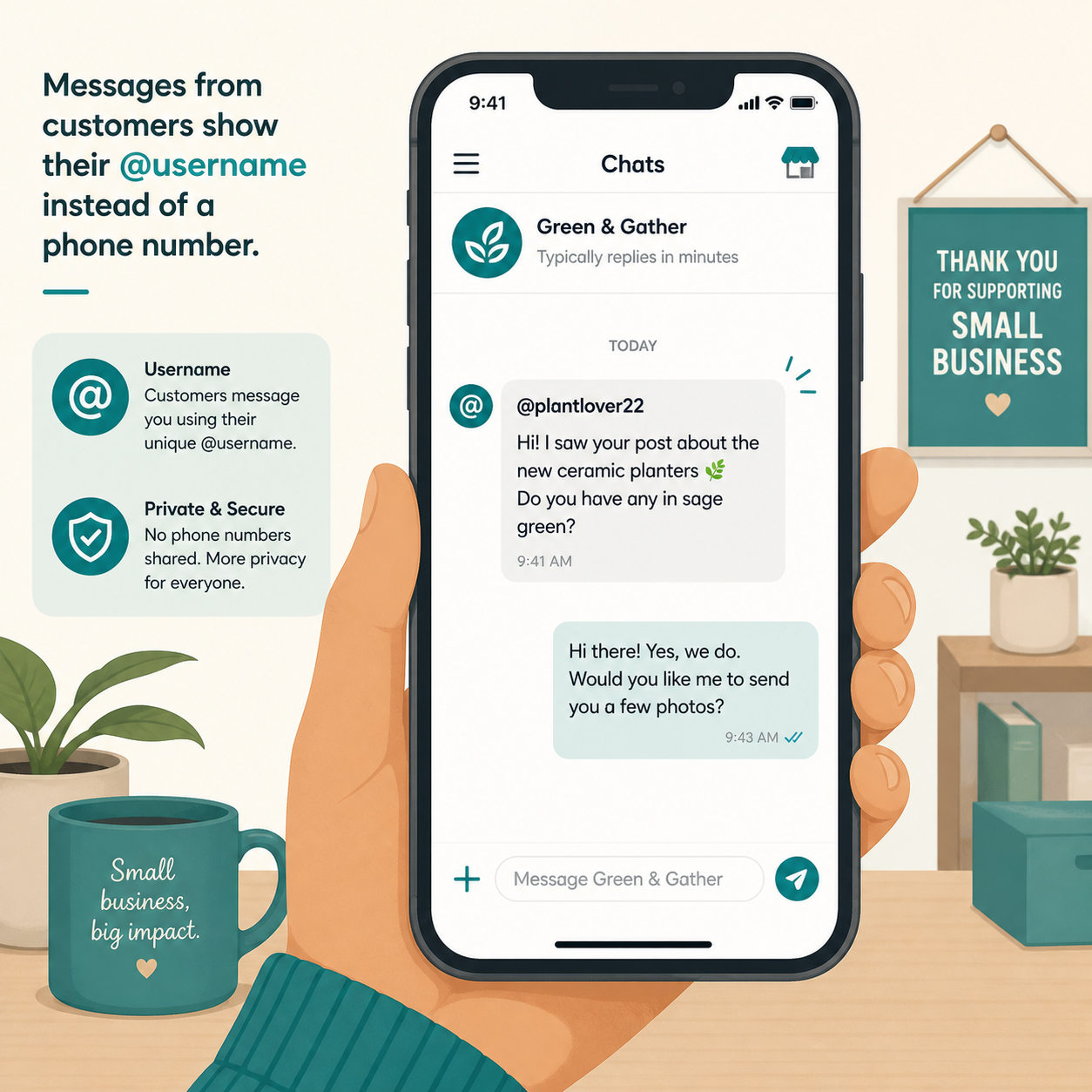
Two details matter more than the visual change. First, a phone number remains mandatory to register and operate a WhatsApp account — the username sits alongside it, not instead of it. Second, the feature has not launched everywhere at once. It is a staged rollout by platform and region, which is why the same week produced both "usernames are live for some users" headlines and "usernames aren't live yet" clarifications from WhatsApp's own spokesperson.
🌏 Why the Rollout Kept Stalling and Restarting
Reading the timeline closely shows a company moving carefully rather than flipping a single switch. Reservations opened worldwide on June 29. Activation for a subset of iPhone users followed on July 17 — not Android, not everyone, a narrow test group. The contact-creation field spotted in August is a UI change that can ship ahead of full activation, meaning a user can see a username field before they can actually be found by one. WhatsApp has not published a master schedule for when each remaining country or platform gets full access, and neither Indonesia nor most of Southeast Asia appeared in any of the confirmed batches as of mid-August.
That pacing is deliberate. With more than three billion accounts, the practical problem is not writing the code — it is resolving name collisions, filtering an enormous set of lookalike and offensive strings, and building fraud detection before letting a stranger message another stranger by handle instead of number. Meta's own framing in its June announcement leaned on that scale explicitly, which is part of why the company opened reservations months before the feature that uses them.
🔐 The Scam Warning Arrived Before the Feature Did
Any system that lets a name substitute for a hard-to-fake identifier attracts fraud attempts, and this one drew them early. Cybersecurity firm BforeAI's PreCrime Labs published a report in July 2026 documenting an eleven-domain cluster registered specifically to impersonate WhatsApp's username feature — fake reservation pages, fake marketplaces for trading usernames, and sites built to harvest login credentials from people trying to claim a handle before it was officially available. The domains were registered in a tight window immediately after Meta's June 29 announcement, which is the pattern security researchers look for when a name-squatting or phishing wave is timed to ride a company's own news cycle rather than wait for organic traffic.

That report landed alongside a separate, higher-profile flashpoint: India's government pushed WhatsApp for details on how the company would prevent fraud and impersonation once usernames went live, according to reporting from Forbes and the Times of India in early July. The concern officials raised was specific — that letting strangers connect without exchanging phone numbers removes a friction point scammers currently have to work around, and that a wave of fake customer-support or fake-seller accounts using recognizable usernames could follow. Reporting noted the scrutiny arrived while WhatsApp still had roughly 500 million users in India alone, making it one of the company's largest single markets and a natural first place for regulators to ask hard questions before a feature reaches everyone.
WhatsApp's public response, given to Android Authority, is worth quoting directly because it is the company's own account of its safeguards rather than a third-party summary:
"We've announced the option for people to reserve their preferred username on WhatsApp. The ability to use a username is not yet live and will roll out slowly later this year. To protect against impersonation, we've held the highest-profile names — think public figures, government entities, celebrities, verified Meta accounts — so they can only ever be claimed by their legitimate owners and lookalike derivatives of known names are held as well."
That statement covers a narrow category: famous names and near-matches of famous names. It does not claim that a small business's brand name is automatically protected, and it does not claim that ordinary customer-support impersonation is impossible. For a business without a Meta-verified badge, the practical read is that Meta is not going to reserve your shop's name for you — you need to claim it yourself during the reservation window, the same way businesses used to rush to register their name on Instagram or Twitter before someone else did.
🧾 What a Business Number Actually Loses and Keeps
If a business runs its WhatsApp presence through the standard consumer app, the phone number stays visible in the profile exactly as before — a username is an option a business can add, not a number it is forced to hide. The bigger shift sits on the WhatsApp Business Platform, the API layer that powers most automated storefronts, chatbots, and CRM-connected customer service. Meta's developer documentation for "business-scoped user IDs," known as BSUIDs, describes a new identifier that shows up when a customer who has adopted a username messages a business through the API. According to a technical breakdown published by contact-center vendor Hubtype in August 2026, two message flows specifically depend on knowing a customer's phone number to function correctly: messages that originate from Click-to-WhatsApp ads, and inbound service messages. If a business's backend or its middleware provider has not been updated to recognize a BSUID as a valid identifier alongside a phone number, those flows can break the moment a customer they're talking to has switched to a username-based identity.
This is a backend problem more than a storefront problem — most small businesses will not notice it directly unless they built custom automation, a chatbot, or a CRM integration that assumes every WhatsApp contact arrives with a phone number attached. But it is exactly the kind of detail that quietly breaks an order confirmation flow or a delivery-tracking bot three months from now, with no error message pointing at the real cause. If a business in Indonesia uses a third-party WhatsApp Business API provider — a common setup for stores running automated catalogs or broadcast promotions — this is worth a direct question to that provider: has their integration been updated to handle BSUIDs, and what happens today if a customer's phone number field arrives empty.

🏪 Why This Matters More for a Business Than a Personal Account
A personal WhatsApp user who never claims a username loses nothing; their number keeps working exactly as it always has. A business is in a different position for three reasons.
First, discovery. Right now, a customer finds a business's WhatsApp mainly through a saved number, a QR code, or a link. A username turns that into something closer to a social handle — shareable, memorizable, brandable, and also squattable by someone else if the business does not claim it early. The businesses that moved fastest to register a matching handle on Instagram, TikTok, and Twitter in earlier platform shifts generally avoided the awkward position of buying their own name back from an opportunist later. Usernames on WhatsApp are shaping up to follow the same pattern, just with a shorter runway because reservations already opened in June.
Second, trust signaling. A customer messaging a business for the first time currently has one weak trust signal — a saved contact name that anyone could type into their phone regardless of who actually owns that number. A username does not fix that on its own, but it changes the shape of the problem: a business that secures a clean, on-brand username and prints it consistently across its storefront, packaging, and social bios gives customers a second thing to check against impersonators, the same way a verified checkmark or a consistent logo does elsewhere.
Third, operational risk. Any business running promotions, order confirmations, or payment reminders through automated WhatsApp tooling is exposed to the BSUID transition described above whether or not the business owner has ever heard the term. An interrupted delivery notification or a broadcast that silently fails to reach customers who switched to usernames is a customer-service problem that looks, from the customer's side, exactly like the business simply going quiet.

🆚 How This Compares to What Telegram Already Does
WhatsApp is not inventing the concept. Telegram has used public @usernames as its primary discovery mechanism for years, and commentary around WhatsApp's rollout has repeatedly framed the update as WhatsApp catching up to a model Telegram users already take for granted. The comparison matters for one practical reason: Telegram's username system has also attracted years of squatting, resale, and impersonation attempts around recognizable brand and celebrity names, which is precisely the failure mode BforeAI's report flagged as already forming around WhatsApp before the feature even fully launched. A platform adopting a known pattern does not automatically inherit the older platform's defenses against its known abuses — those defenses have to be rebuilt, tested, and, in WhatsApp's case, are still being described in general terms rather than published as a detailed public policy.
There is one structural difference worth keeping in mind. Telegram was built username-first from early on, so most of its user base and its ecosystem of bots, channels, and businesses grew up already expecting a handle-based identity. WhatsApp is retrofitting that model onto three billion accounts and a huge installed base of automated business tooling that was written around the assumption of a phone number as the one stable identifier. That is the direct reason WhatsApp's rollout looks slower and more cautious than Telegram's original launch, and it is also why the backend compatibility question — whether a given business's chatbot or CRM has been updated for BSUIDs — carries more real operational weight on WhatsApp than the equivalent question ever did on Telegram.
✅ A Short Checklist Before the Rollout Reaches Indonesia
WhatsApp has not published a fixed date for full global availability, and Indonesia was not named in any of the batches confirmed live as of mid-August. That gap is useful — it is preparation time, not a reason to ignore the change.
- Check whether a username has already been reserved that matches the business name, and if not, reserve one the moment the option appears in Settings on the business's WhatsApp account. Waiting invites exactly the kind of squatting the reservation window exists to prevent.
- Ask any third-party WhatsApp Business API or CRM vendor directly whether their integration supports BSUIDs, and what currently happens to an order or ticket if a customer's phone number field is empty.
- Print the business's phone number and its future username together on official materials — website, Instagram bio, printed receipts — so customers have two consistent identifiers to check against a scam account claiming to be the business.
- Do not assume a Meta anti-impersonation policy automatically protects a small brand name the way it protects celebrities and government entities; the company's own statement names only "highest-profile" accounts as protected by default.
- Treat any message claiming a customer "needs to verify their username" through an unfamiliar link as a phishing attempt consistent with the domain cluster BforeAI documented, and report it rather than clicking through.
- Brief any staff who handle the business's WhatsApp chat that a customer's profile may soon show a username instead of a recognizable number, so a legitimate returning customer is not mistaken for a stranger or, worse, a stranger is not mistaken for someone the business already trusts.
❓ Questions a Business Owner Will Actually Ask
Does this mean customers can no longer save my business by phone number? No. A phone number still works exactly as it does today. A username is additive, not a replacement, and nothing in WhatsApp's June or August communications suggests numbers will stop functioning as a valid way to reach a contact.
Can someone impersonate my shop by grabbing a similar username first? That risk is real for ordinary brand names, based on WhatsApp's own statement that automatic protection currently extends only to "highest-profile" names, government entities, celebrities, and verified Meta accounts. A local bakery or clothing brand does not fall into that protected tier by default, which is exactly why reserving the matching handle early — during the window that has already been open since June 29 — is the practical defense rather than relying on Meta to hold the name back on the business's behalf.
Will my WhatsApp Business API integration just keep working? Possibly not without a check. The BSUID mechanism documented in Meta's developer materials and explained in Hubtype's technical breakdown specifically calls out two flows — Click-to-WhatsApp ad messages and inbound service messages — as dependent on phone number presence. A business running a chatbot, order bot, or CRM sync built before this year should confirm with its provider that BSUID handling has been added, rather than assuming it has.
Is this only a problem for big platforms, or does it affect a single-person online shop running WhatsApp manually? Manual operators are largely insulated from the BSUID backend issue since there's no automation reading the phone number field programmatically. The exposure for a manual operator is almost entirely on the discovery and impersonation side — making sure the shop's own username is claimed and consistently shared, and training whoever answers the chat to recognize that a customer's display identity might soon read as a handle rather than a number they recognize.
🔭 What Comes Next
WhatsApp has been explicit that the rollout is staged and slow by design, given the scale of resolving three billion overlapping name preferences without breaking existing contact relationships. The company has not given a date for full India availability following the government's inquiry, and it has not confirmed when Indonesian accounts will see the feature move from reservation to active use. What is already confirmed is the direction: identity on WhatsApp is moving from "a phone number, full stop" to "a phone number plus an optional public handle," and the businesses that treat that handle as brand real estate to claim early will be in a stronger position than the ones that find out about it from a customer asking why the shop's old number stopped working.
Sumber: about.fb.com (Meta Newsroom), 9to5Mac, Android Authority, Forbes, BforeAI PreCrime Labs, Hubtype, Meta for Developers — diakses Agustus 2026.