For most of the past decade, buying a smart lock, a thermostat, or a security camera meant signing up for one more cloud account. You installed a manufacturer app, created a password, accepted a privacy policy you never read, and hoped the vendor's servers stayed online long enough for you to unlock your own front door. That ritual was so common that people stopped noticing it. On October 13, 2026, Apple's Welcome Home event made the ritual the story.
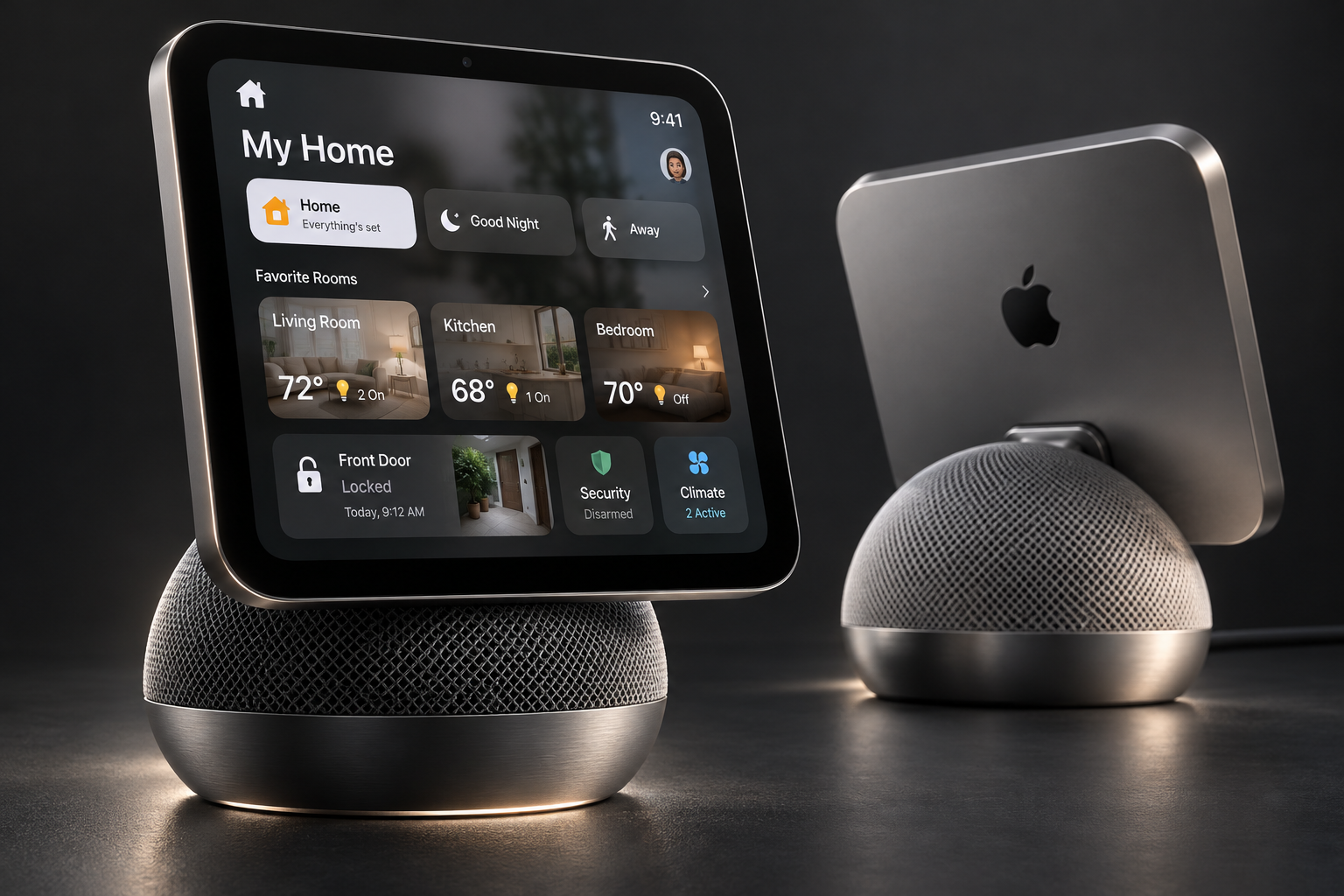
The headline product was HomeView, a $299 tabletop smart display with a 7-inch Liquid Retina screen, an A18 processor, and a 12-megapixel Center Stage camera. Apple also refreshed the HomePod mini and introduced a fourth-generation Apple TV 4K. Those devices matter. The more consequential announcement sat one layer below the hardware: Apple Home Collection, a lineup of cameras, thermostats, sensors, a video doorbell, and a deadbolt lock developed with LG Electronics and Schneider Electric. Setup starts with a tap on an iPhone. Management stays inside the Home app. Apple, LG, and Schneider all state that no separate vendor account is required.
That sentence is the architectural break. The smart home industry spent years teaching customers that "works with Matter" still meant "also create an LG account, a Nest account, a Yale account, and a cloud login that becomes a permanent liability." Apple Home Collection is trying to make the opposite claim: the platform account is enough, the radio mesh stays local, and the door still unlocks when the ISP drops.
🏠 The Product Line That Makes the Architecture Visible
Apple Home Collection is not a vague concept deck. It is a priced, dated catalog of physical products. According to coverage from 9to5Mac and other outlets that attended the October 13 briefing, the first wave includes:
- LG Floodlight Cam, $399.95
- LG Outdoor Cam Plug-in, $299.95
- LG Video Doorbell Wired, $249.95
- LG Indoor Cam Plug-in, $199.95
- LG Smart Deadbolt Lock, $349.95
- LG Smart Thermostat, $199.95
- LG Temperature Sensor, $39.95
- Schneider Home Smart Thermostat, $199.95
- Schneider Home Smart Thermostat Room Sensor, $39.95
Availability begins in December 2026 in the United States and Canada, with some accessories sliding into early 2027. The UK is listed for cameras and the doorbell. HomeView itself is priced at $299, with pre-orders open and a reported ship date of November 13 for the tabletop model. A new HomePod mini at $149 and a new Apple TV 4K at $299 round out the hub layer.
None of those prices is radical. Nest, Ring, Ecobee, and Yale already occupy the same bands. What is radical is the onboarding path. Apple says customers set the devices up from an iPhone, manage them in the Home app, and never create an LG or Schneider account. For cameras, a compatible Apple home hub is still required for monitoring features such as HomeKit Secure Video style workflows. For climate and access, Matter and Thread are the connective tissue. For the deadbolt, Matter and Aliro are named together, and Apple says core access functions continue to work locally without an internet connection.
That combination is the editorial center of the launch. HomeView is the visible face. Thread, Matter, and Aliro are the invisible stack that decides whether the house still behaves like a house when the wide-area network fails.
🔐 Why the Missing Vendor Account Is the Real Feature
Smart home friction rarely begins with radio standards. It begins with identity. Every additional manufacturer account is another password to rotate, another inbox for breach notices, another privacy policy that claims the right to process occupancy patterns, and another cloud endpoint that can silently change behavior after a firmware update. Industry surveys and consumer complaint archives have repeated the same pattern for years: people abandon devices not because the hardware failed, but because the software relationship became hostile.
Apple is not inventing local control from scratch. HomeKit always preferred a local-first posture when a home hub was present. Matter was designed as a multi-admin, IP-based application layer so a single accessory could be shared across Apple Home, Google Home, Amazon Alexa, and SmartThings without proprietary lock-in. Thread was designed as a low-power IPv6 mesh so sensors and locks did not have to burn Wi-Fi radios all day. Aliro, stewarded by the Connectivity Standards Alliance, is the credential and access-control standard for digital keys, readers, and locks.
What Apple Home Collection changes is the commercial packaging of those standards. Instead of saying "this lock supports Matter, and also download the LG app for firmware and advanced settings," the pitch is that Apple Home is the primary platform. Firmware updates, access sharing, climate schedules, and camera views are supposed to live inside one encrypted home graph. Apple states that Home app data and camera footage are protected with end-to-end encryption and cannot be accessed by Apple, LG Electronics, or Schneider Electric. Compatible iCloud+ subscribers can store encrypted camera footage for 10 days. Those are product claims, not independent audits, but they are unusually explicit about excluding the hardware partners from the data path.
The practical test is not whether the marketing copy is elegant. The practical test is whether a guest PIN, a temporary home key, a thermostat schedule, and a live doorbell feed can all be created without leaving the Home app and without creating a second identity system that outlives the house. If that holds after the December shipping wave, the industry default of "Matter plus mandatory vendor cloud" starts to look like a transitional compromise rather than a permanent architecture.
📡 Thread Mesh Is the Network That Keeps Working When Wi-Fi Does Not
Most consumers still model the smart home as a star topology: every bulb, lock, and sensor talks to the Wi-Fi router, and the router talks to the internet. That model fails in three common ways. First, low-power devices hate Wi-Fi. Keeping a door sensor associated to a 5 GHz access point burns battery and collapses when the access point reboots. Second, dense apartments and multi-story houses create dead zones. Third, when the ISP link drops, cloud-first devices freeze even if the local radio path is healthy.
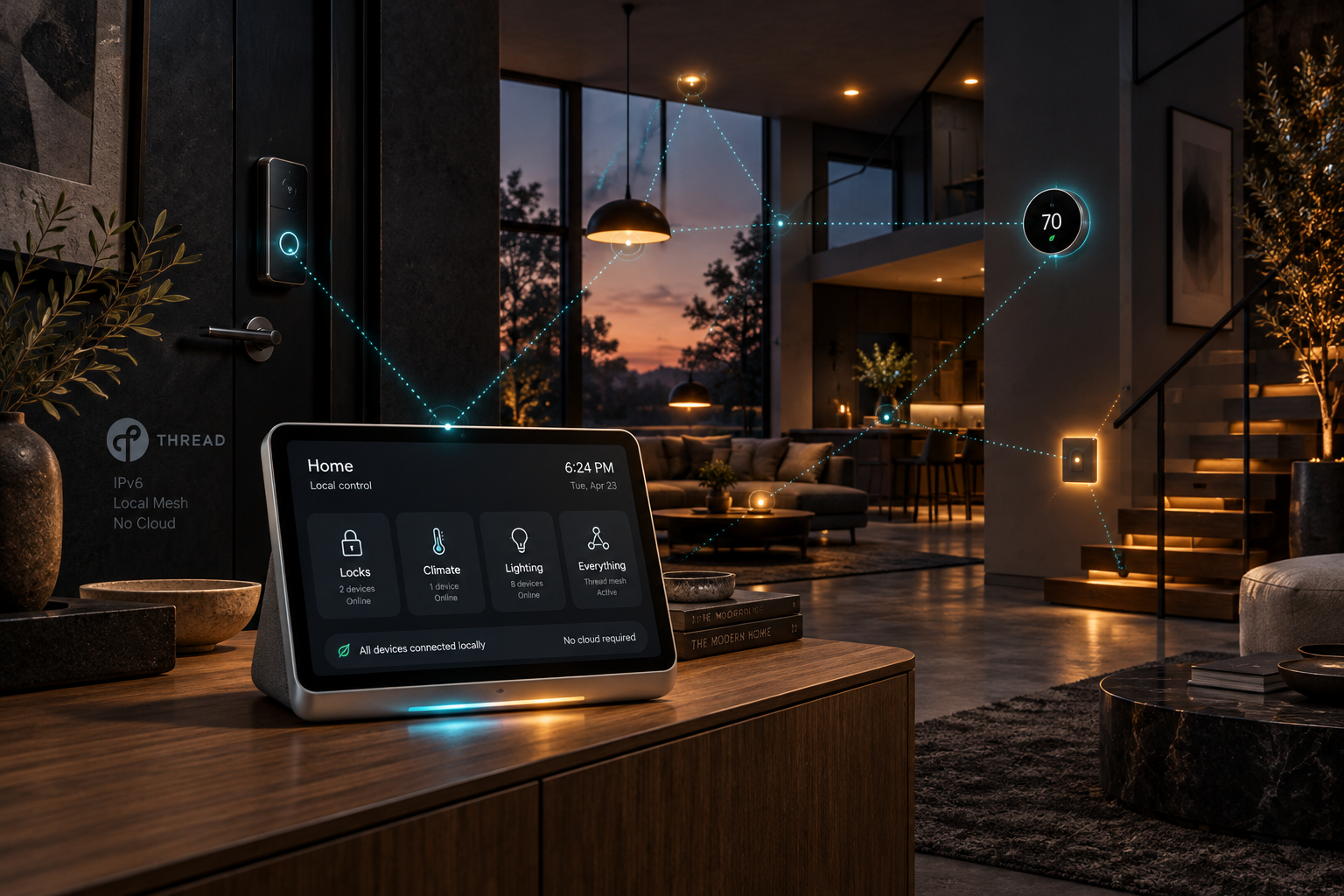
Thread answers those failures with a different topology. Devices form a self-healing IPv6 mesh. Router-eligible nodes forward traffic for sleepy end devices. A Thread border router bridges the mesh to the home's wider IP network. Apple already ships border-router capability in HomePod mini, HomePod (2nd generation), and selected Apple TV 4K models. HomeView is expected to join that hub class. Apple says every product in the Home Collection supports Thread, and that accessories can update network credentials automatically when a user changes home Wi-Fi settings.
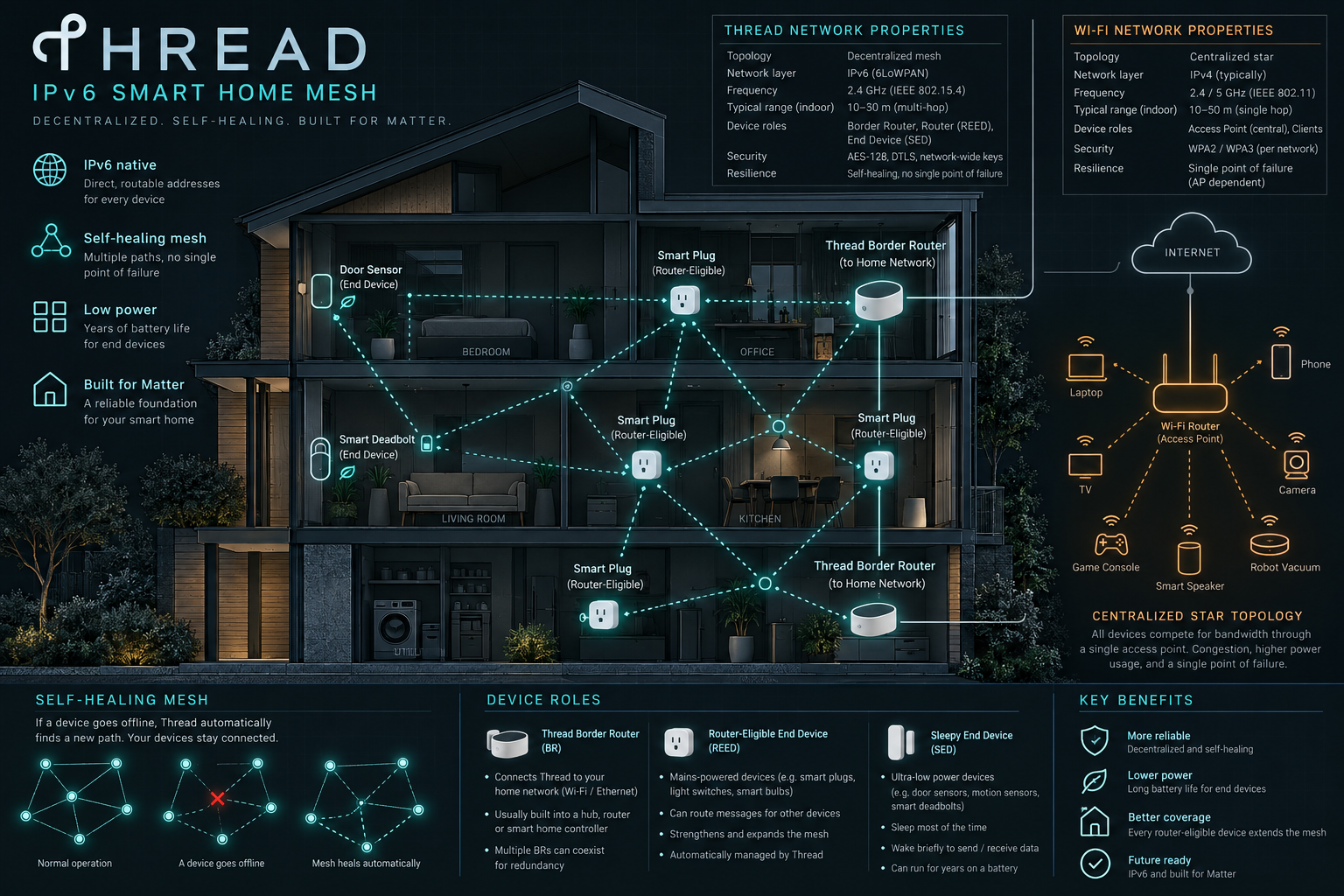
That last detail sounds minor until you have lived through a router replacement. In a cloud-bound ecosystem, changing the SSID often means walking the house with a phone, putting every device into pairing mode, and re-authenticating manufacturer accounts. In a Thread-centered design, the mesh can retain local routing while border routers refresh upstream credentials. Apple also says Thread helps accessories maintain connectivity if Wi-Fi becomes unavailable. That is the offline claim that matters for locks and climate control: a deadbolt should not become a paperweight because the cable modem lost DHCP.
Matter sits above the radio. Matter defines the application semantics: what a lock is, what a thermostat is, how multi-admin commissioning works, how certificates identify accessories. Matter over Thread is therefore not a slogan. It is a concrete stack: Thread carries IPv6 packets; Matter defines the object model; the Apple Home hub acts as controller and, when needed, border router. Wi-Fi remains necessary for high-bandwidth cameras. Cameras in the Collection still use Wi-Fi for 2.5K video. The architectural point is separation of concerns. High-bandwidth media stays on Wi-Fi. Low-power control planes move onto Thread so the house can keep deciding who may enter and what temperature the hallway should hold without waiting for a distant data center.
🔑 Aliro Turns the Deadbolt into a Standards Credential, Not a Brand App
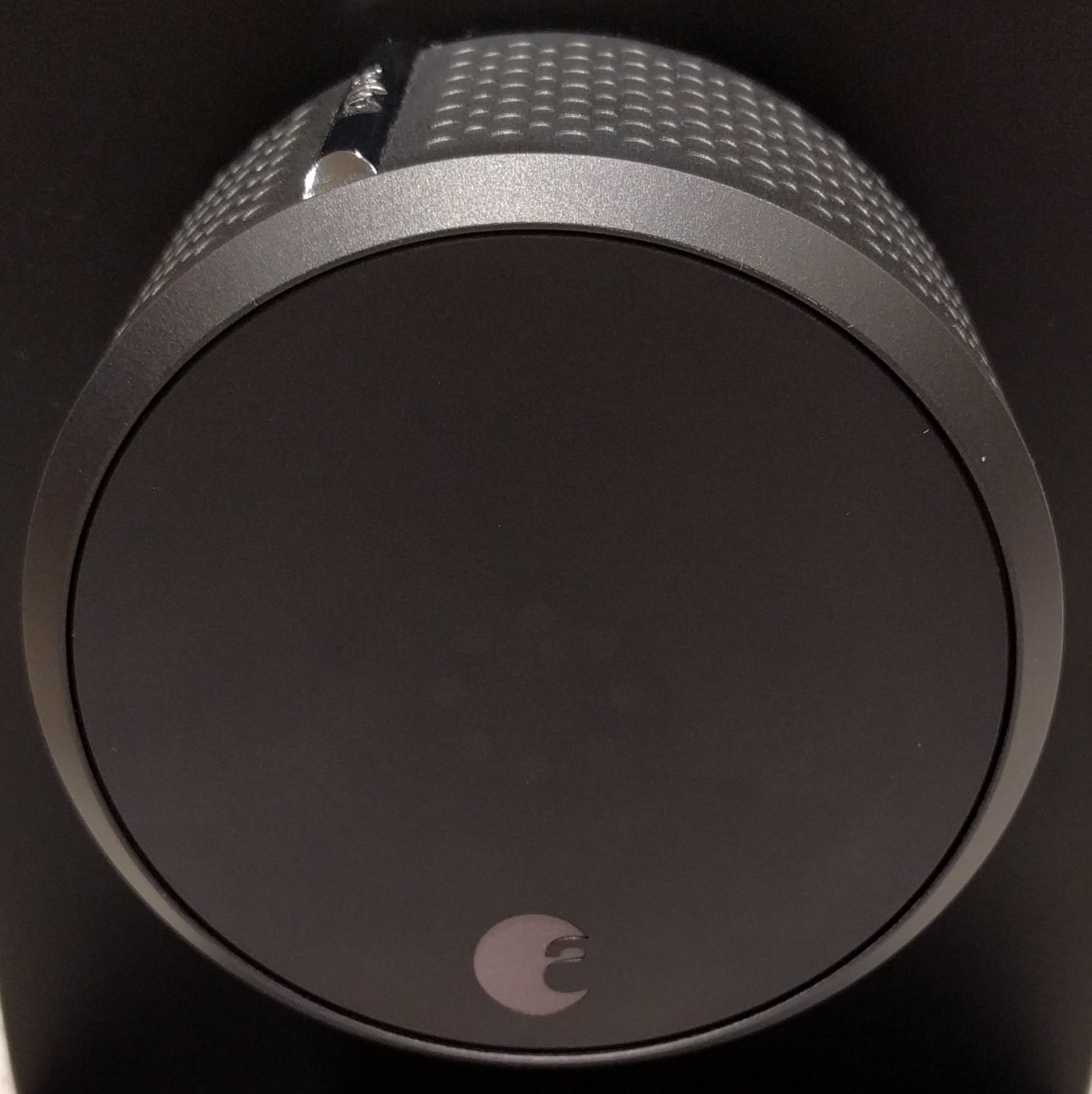
The LG Smart Deadbolt Lock is the accessory that makes the standards stack tangible. Apple confirms Ultra Wideband support, which means a configured iPhone or Apple Watch can unlock the door automatically as the owner approaches without tapping the device. The lock also accepts a tap with a home key, a PIN pad entry, and a concealed physical backup key. It can detect open, closed, and tamper states, and can alert if the door remains open while locked. Apple says the lock supports Matter and Aliro, and that core access functions operate locally without internet.
Aliro is easy to miss in a product keynote because it is not a consumer brand. It is a CSA standard for secure credential exchange between phones, wearables, readers, and locks. The point of Aliro is to stop every lock manufacturer from inventing a private digital-key protocol that only works inside one app. If a credential model is standardized, a home key on an iPhone can mean something coherent across properties, hotels, offices, and multi-dwelling units over time. Apple's decision to name Aliro next to Matter for the deadbolt is a signal that access control is being treated as infrastructure, not as a loyalty program.
Local operation is the safety requirement. A lock that needs a round trip to a vendor cloud before it can accept a valid home key is a lock that fails during ISP outages, DNS failures, and certificate expiry incidents on the manufacturer's side. Local Matter/Aliro control does not magically eliminate all failure modes. Batteries still die. Hubs still need power. Misconfigured access lists still lock people out. But it removes the absurd category of failure in which the correct cryptographic credential is present in the owner's pocket and the door still refuses because a remote API is unreachable.
The lock also pairs with the LG Video Doorbell Wired. The doorbell uses two cameras: a 2.5K outward-facing sensor and a full HD downward-facing sensor for packages. When someone rings, the chime can play through HomeView, HomePod, or HomePod mini while an iPhone or iPad receives a notification. The owner can view the visitor, speak, and unlock through the Home app or Siri. That sequence is the consumer version of a physical access control system: identify, communicate, authorize, actuate. The difference is that the identity plane is supposed to remain inside Apple's end-to-end encrypted home graph rather than a third-party camera cloud with a separate login.
🌡️ Climate Control without a Second Thermostat App
Thermostats are the other place where account sprawl becomes daily friction. A household that already uses Apple Home for lights and locks often still ends up with a separate climate app because the thermostat vendor insists on cloud schedules, energy reports, and firmware channels. Apple Home Collection counters that with two Matter-over-Thread thermostats: one from LG and one from Schneider Electric, both priced at $199.95, plus room sensors at $39.95.
Apple says the thermostats can automatically adjust temperatures based on whether users are home, getting ready for bed, or away, without requiring manual scheduling. They can also use temperature and humidity readings from sensors placed in different rooms. Sensors built into HomeView, HomePod, and HomePod mini can contribute to that picture. Apple identifies the lock, thermostats, and environmental sensors as Matter compatible, while stating that every Collection device supports Thread.
The climate story is less cinematic than UWB unlocking, but it is where local control proves its value. HVAC decisions are continuous, not event-driven. If a thermostat becomes a thin client for a remote optimization service, every schedule change and occupancy inference becomes a network dependency. If the thermostat is a Matter device on a Thread mesh with local automation in the home hub, the house can still hold setpoints when the wide-area network is dark. Energy guidance features may still benefit from cloud analytics when connectivity is available. The baseline comfort loop should not.
Regional limits matter here. Reporting on the launch notes that the thermostats are built for North American HVAC wiring and that European availability for HomeView itself is constrained while Apple and the European Commission remain in disagreement over Siri AI features. That is a reminder that a "global" smart home announcement is often a North American shipping plan with a standards story attached. Readers outside the first shipping regions should treat the architecture as real and the purchase path as delayed.
🧭 What HomeView Actually Changes in Daily Use
HomeView is easy to dismiss as another smart display in a market already filled with Echo Show and Nest Hub devices. That reading undersells the integration bet. Apple is not primarily selling a speaker with a screen. It is selling a persistent, always-visible controller for a home graph that used to live mostly inside a phone. A 7-inch touchscreen that can show live feeds from up to nine cameras, room temperatures, lock status, and media controls changes the social interface of the house. Guests do not need to unlock your phone. Residents do not need to fish a handset out of a bag to see who is at the door.
Hardware details reported across coverage include an A18 processor, a 12MP Center Stage camera, four beamforming microphones, and a tabletop acoustic package with full-range drivers, a down-firing woofer, and force-cancelling passive radiators. The industrial design deliberately echoes the old iMac G4 "desk lamp" silhouette while using contemporary aluminum finishes in silver, starlight, pink, and space gray. Wall mounts from Schneider are separately priced, including USB-C, AC wired, and later Power over Ethernet options.
The more important capability is identity of people in the home. Apple says HomeView can recognize up to six people and personalize on-screen content. That feature only works if the device is trusted as a household fixture rather than a transient phone session. It also raises the stakes on local processing and encryption claims. A display that knows who is standing in the kitchen is useful for climate presets and camera privacy modes. It is dangerous if recognition embeddings or camera buffers leak into partner clouds. Apple's explicit statement that neither Apple nor the hardware partners can access protected Home app data is therefore not a side note. It is the trust boundary the product depends on.
Professional installation through ADT, offered for an additional fee in the United States starting in the fall, is another signal. Apple is treating the Collection as infrastructure that sometimes needs a truck roll, not as a purely self-serve gadget unboxing. That is closer to how locks and thermostats have always been sold than to how Wi-Fi bulbs were sold.
⚖️ Limits, Open Questions, and the Industry Test Ahead
No launch of this size arrives without gaps. Several deserve plain language.
First, cameras still need Wi-Fi and a home hub. Thread does not replace high-bandwidth video transport. Households with weak mesh Wi-Fi will still fight dropouts on doorbells and outdoor cams. Built-in storage during Wi-Fi outages helps with recording continuity, but live viewing and notifications still depend on a healthy local network and hub availability.
Second, "no separate account" is a product claim that must survive firmware update channels, warranty support, and regional compliance. If LG or Schneider later requires a manufacturer login for a subset of advanced settings, the architectural promise frays. The December and early-2027 shipping windows are the real review period.
Third, multi-platform households remain a stress test. Matter is designed for multi-admin use, but Apple is clearly optimizing the Collection for Apple Home as the primary surface. Users who want equal-class experiences in Google Home or Alexa will need to verify commissioning behavior device by device. Interoperability on paper is not the same as parity in daily UI.
Fourth, geographic availability is uneven. HomeView's missing European launch date, driven by regulatory conflict around Siri AI, means the hub experience and the accessory catalog will not land together for every market. Standards can travel faster than finished retail SKUs.
Fifth, local mesh control does not remove physical security basics. A UWB unlock is still a proximity system. PIN pads can be shoulder-surfed. Backup keys can be copied. A standards-based lock is still a lock and needs the same mechanical discipline as any other access control device.
Those limits do not cancel the shift. For years, the smart home sold connectivity while quietly importing cloud dependency. Apple Home Collection is selling the reverse hierarchy: local Thread mesh and Matter object models first, optional cloud services second, manufacturer identity systems removed from the critical path. If that hierarchy holds after real households install the lock, the thermostats, and the cameras, competitors will be forced to explain why their Matter accessories still demand a second password.
🛠️ A Practical Checklist Before You Buy into the Stack
Readers who already live inside Apple Home can treat the Collection as an upgrade path rather than a science project. A useful pre-purchase checklist looks like this:
- Confirm you already have, or will buy, a Thread-capable home hub. HomePod mini, HomePod, selected Apple TV 4K models, and HomeView are the Apple options.
- Map which rooms need low-power sensors and locks versus high-bandwidth cameras. Put control devices on Thread expectations and camera devices on strong Wi-Fi expectations.
- Decide whether UWB unlock is worth the lock price in your entry pattern. If multiple people share access, test how guest home keys and PIN expiry will be managed in the Home app before removing mechanical keys entirely.
- For climate, verify HVAC compatibility and wiring. North American 24V systems are the first target. Do not assume universal boiler or heat-pump support from a launch-day keynote.
- Keep one offline recovery path. That can be a physical key, a documented PIN held offline, or a secondary mechanical deadbolt policy for multi-resident homes.
- Read the encryption and retention settings for camera history before enabling continuous recording. Ten days of encrypted iCloud storage is a product default, not a legal retention policy for every household.
- If you are outside the first shipping countries, track local availability instead of importing hardware that cannot receive regional support or Matter certification updates.
None of those steps requires waiting for a cryptographically relevant quantum computer or a new IEEE radio. They require treating the house as a small network with clear trust boundaries. That is the quiet maturity signal in Apple's October launch. The smart home stops being a pile of apps and starts looking like an IP system with a mesh control plane, a standards-based access layer, and a single household identity graph.
🌐 What This Launch Means for the Broader Smart Home Market
Amazon and Google already sell hubs, cameras, and thermostats at scale. Samsung's SmartThings has long mixed local and cloud execution. Matter was supposed to end the platform wars by making accessories portable. In practice, Matter reduced discovery friction while leaving manufacturer clouds in place for updates, analytics, and "advanced" features. Apple Home Collection is the first major commercial attempt to make the manufacturer cloud optional at the point of sale for a full accessory family spanning cameras, climate, and access.
If the model works, expect three industry reactions. Accessory makers will compete on industrial design and reliability while advertising "Home app only" setup as a feature. Platform vendors will face pressure to match end-to-end encryption claims and to stop treating manufacturer accounts as mandatory. Standards bodies will gain a live deployment that exercises Aliro and Matter multi-admin flows at consumer volume, which is how specifications harden.
If the model fails, it will likely fail on logistics rather than radio physics: incomplete firmware channels, delayed regional SKUs, uneven Matter certification quality, or a support process that quietly pushes users back into partner apps. Those are operational failures, and they are measurable. The next six months of owner forums, Matter certification listings, and reverse-engineered traffic captures will show whether "no separate account" is architecture or advertising.
For now, the verified facts are concrete. On October 13, 2026, Apple introduced HomeView and Apple Home Collection with LG Electronics and Schneider Electric. The accessories are priced from roughly $40 sensors to a $400 floodlight camera. Thread is universal across the Collection. Matter covers locks, thermostats, and sensors. Aliro is named for the deadbolt. Local operation without internet is claimed for core lock functions. End-to-end encryption is claimed for Home app data and camera footage, with partners excluded from access. Shipping begins late 2026 in North America, with staggered 2027 arrivals for parts of the climate line.
That is enough to write a clear consumer conclusion. The smart home problem was never only about adding more radios. It was about who owns the identity graph that those radios serve. Apple just bet that households prefer one encrypted home graph over a drawer full of vendor passwords. The mesh, the lock standard, and the missing signup forms are how that bet is supposed to clear.
Sources: Apple Welcome Home event coverage and product briefings via 9to5Mac (13 Oct 2026); HomeKit News analysis of Matter, Thread, and Aliro support (14 Oct 2026); Matter-SmartHome launch report on HomeView and regional limits (13 Oct 2026); Connectivity Standards Alliance materials on Matter and Aliro; Thread Group documentation on mesh networking and border routers.