
When your flight touches down at Tokyo Haneda or Frankfurt Airport, the modern traveler ritual is almost instantaneous. As the cabin chime rings and the seatbelt sign turns off, you swipe open your smartphone settings, toggle on your newly installed travel eSIM, and wait a handful of seconds. The carrier status indicator in the top corner shifts from searching to full signal bars. An icon for 5G lights up alongside the brand of a premier domestic mobile network, such as NTT Docomo or Deutsche Telekom. On the surface, the physical connection is flawless. The radio link between the cellular antenna embedded in your phone frame and the massive base station transceiver mounted on the terminal roof is operating at the absolute cutting edge of millimeter-wave or mid-band wireless physics.
Yet the moment you actually attempt to use the connection, a peculiar friction emerges. Launching a transit navigation app to locate the airport train platform takes four or five seconds just to render the route tiles. Tapping on a local restaurant menu presents a noticeable pause before the web page layout begins to paint. If you open a search engine, the homepage automatically defaults to traditional Chinese or Thai script and displays sponsored advertisements denominated in Hong Kong dollars. Even more alarming, launching your primary mobile banking application or digital wallet triggers an immediate security warning, demanding two-factor authentication or locking your session entirely due to suspicious account activity.
To the consumer holding the smartphone, this behavior feels baffling. You purchased a data package advertised specifically for Japan or Germany. Your screen displays maximum signal strength. You are connected to the most reputable telecommunications infrastructure in the destination country. Why does the internet feel sluggish, unresponsive, and geographically displaced?
The answer lies buried deep beneath the consumer marketing of digital SIM cards. You are experiencing one of the telecommunications industry's most widespread architectural realities: Home-Routed Roaming. Although your radio signals travel only a few hundred meters through the airport air, your data packets do not exit to the public internet in Tokyo or Frankfurt. Instead, every single byte your phone transmits is encapsulated inside an encrypted telecommunications tunnel, carried out of the country across thousands of kilometers of transoceanic subsea fiber-optic cables, and dropped onto the public internet at a core packet gateway situated in Hong Kong, Singapore, Warsaw, or Vienna.
Your travel eSIM has taken you on an 8,000-kilometer digital detour. Understanding why this detour exists, how it warps network latency, why it breaks financial security systems, and how the mobile industry is finally attempting to fix it reveals the hidden plumbing that powers our increasingly borderless digital lives.
✈️ The Mirage of the Local Connection
The fundamental misunderstanding of the travel eSIM stems from a confusion between radio access and packet routing. When you purchase an eSIM from a popular digital marketplace such as Airalo, Nomad, Holafly, or Ubigi, the application presents you with a simple consumer transaction: you select a destination country, choose a data allowance, and scan a QR code to install a carrier profile into your device's embedded secure element.
Because the smartphone seamlessly connects to the domestic cell towers of Tier-1 national operators, consumers naturally assume that they have purchased local internet access. In reality, the company that sold you the eSIM rarely possesses a direct operational relationship with the local cell tower owner. Instead, travel eSIM retailers are mobile virtual network operators (MVNOs) or retail brokers that purchase wholesale roaming capacity from global telecommunications clearinghouses and international carrier consortia.
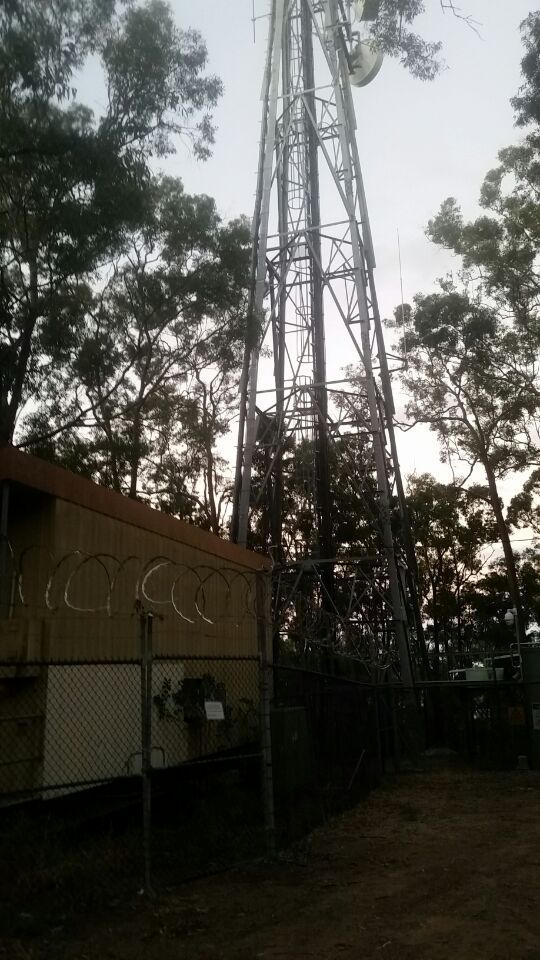
When your phone associates with a cellular tower at your travel destination, the radio link is established through what 3GPP cellular standards define as the Visited Public Land Mobile Network (VPLMN). The local base station, or gNodeB in 5G terminology, verifies that your device has permission to transmit over its licensed spectrum. The tower negotiates radio frequencies, applies beamforming matrices, and establishes an encrypted over-the-air channel.
However, the local tower is merely an access conduit. It does not decide how your internet traffic reaches its destination. That decision is dictated by the International Mobile Subscriber Identity (IMSI) stored inside your eSIM profile. The IMSI contains a three-digit Mobile Country Code (MCC) and a two- or three-digit Mobile Network Code (MNC). These numbers tell the cellular network which telecommunications operator in the world actually issued your credential.
If your travel eSIM profile was provisioned through a wholesale agreement with an operator based in Hong Kong, your IMSI identifies you as a roaming customer of that Hong Kong carrier, regardless of the fact that your feet are planted firmly on the pavement in central Tokyo. Under the standard architectural rules that have governed international mobile roaming for three decades, the visited network is forbidden from releasing your data onto the local internet. It must pack your data into a carrier trunk and ship it straight back to the mother ship.
🔄 Inside the Home-Routed Roaming Architecture
To grasp the mechanics of this transatlantic detour, one must examine the core architecture defined by the 3rd Generation Partnership Project (3GPP). In standard cellular specifications (such as 3GPP TS 23.401 for 4G LTE and TS 23.501 for 5G System), international roaming is bifurcated into two mutually exclusive operational models: Local Breakout (LBO) and Home-Routed Roaming (HRR).
In a Local Breakout configuration, the visited network authenticates your device against your home operator's database, but all subsequent user-plane data traffic exits directly onto the internet via a local gateway located within the visited country. If you request a web page hosted in Tokyo while standing in Tokyo, your packets travel from your phone to the local tower, pass through a local gateway in Japan, reach the Japanese web server, and return. The total physical journey of the data is measured in tens of kilometers.
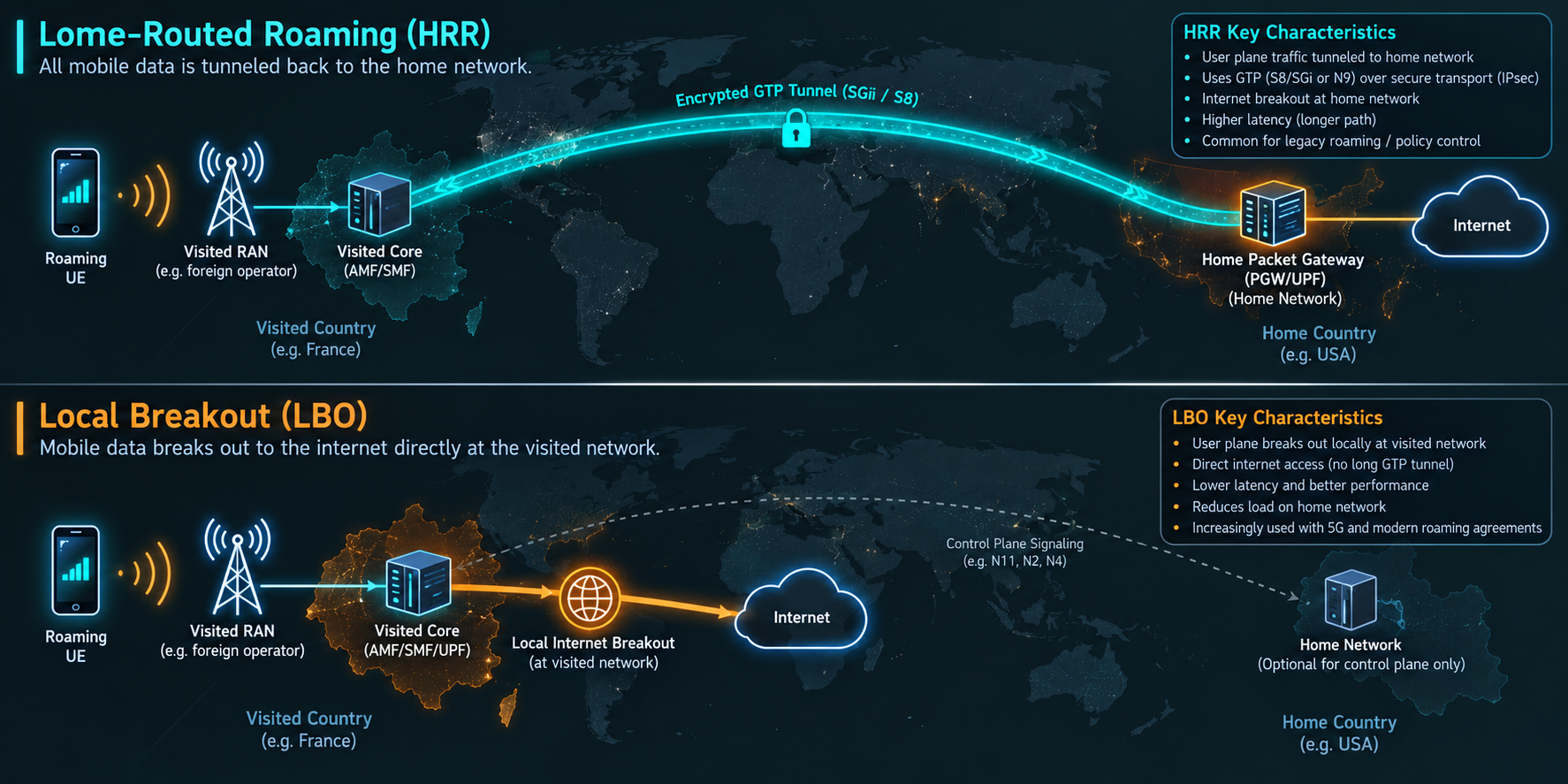
In Home-Routed Roaming, which represents the overwhelming default for budget travel eSIMs and international carrier roaming today, user data is subjected to a completely different routing paradigm. The process unfolds across several distinct architectural steps:
- Radio Bearer Establishment: Your smartphone communicates over the air with the local base station (eNodeB or gNodeB) belonging to the visited operator.
- Control Plane Authentication: The visited network's Mobility Management Entity (MME) or Access and Mobility Management Function (AMF) queries your home operator's Home Subscriber Server (HSS) or Unified Data Management (UDM) over international signaling links (Diameter or HTTP/2) to confirm your subscription status and available data allowance.
- Session Encapsulation: Once authenticated, your device establishes a Packet Data Network (PDN) connection. Instead of assigning you an IP address from a local Japanese or European pool, the visited network's Serving Gateway (S-GW) or User Plane Function (UPF) encapsulates all your IP packets inside a protocol known as the GPRS Tunnelling Protocol User Plane (GTP-U).
- International Transit: This GTP-U tunnel traverses international IPX (IP Exchange) transit networks, passing through undersea fiber cables and cross-border routing hubs.
- Home Gateway Egress: The tunnel terminates thousands of kilometers away at your home carrier's Packet Data Network Gateway (P-GW) or home UPF. It is this distant gateway that actually assigns your smartphone its public IP address.
- Public Internet Release: Your data packet finally emerges onto the public internet from the home gateway's physical location.
Consider the practical geometry of this route. If a traveler in Tokyo opens a browser to read a Japanese news site or hail a cab via a local Japanese ride app, their data packet travels from Tokyo to Hong Kong inside a GTP tunnel, exits onto the public internet in Hong Kong, travels back across the ocean to the web server in Tokyo, receives a response, flies back to Hong Kong, enters the GTP tunnel, and finally returns to the phone in Tokyo. A transaction between two computers located three miles apart in the same city has just completed a 10,000-kilometer intercontinental odyssey.
⏱️ The Physical Speed of Light in Fiber Glass
The immediate casualty of this intercontinental routing loop is network latency. In consumer technology discussions, bandwidth (measured in megabits per second) frequently dominates marketing materials. Providers boast of 5G speeds reaching 300 Mbps or 500 Mbps. But in daily smartphone use, perceived responsiveness is governed almost entirely by latency: the round-trip time (RTT) required for a single network packet to travel from your device to a destination server and back.
Latency is subject to the unyielding laws of optical physics. Light travels through a vacuum at approximately 300,000 kilometers per second. However, telecommunications data travels through the silica glass cores of fiber-optic cables. The refractive index of standard single-mode optical fiber (roughly 1.468) slows the speed of light down to approximately 204,000 kilometers per second. That equates to roughly 4.9 microseconds of propagation delay per kilometer of fiber traversed.
Fiber Optic Propagation Delay ≈ 4.9 ms per 1,000 km (one-way)
Physical Round-Trip Delay ≈ 9.8 ms per 1,000 km (round-trip)
When you add the physical geometry of transoceanic cables (which do not run in straight geometric lines), intermediate optical amplifiers, re-timing equipment, and router queueing delays across multiple Autonomous Systems, the minimum theoretical latency between East Asia and Europe or North America is between 150 ms and 240 ms.
The measured performance differences across common routing topologies demonstrate the scale of this penalty:
- Local Breakout (Domestic): Physical distance of 10 to 80 km yields an observed real-world RTT of 12 to 28 ms, providing instantaneous, interactive web responsiveness.
- Regional Roaming Breakout: Physical distance of 800 to 2,500 km yields an observed real-world RTT of 45 to 85 ms, delivering smooth navigation with minimal perceptible lag.
- Trans-Pacific Home-Routing: Physical distance of 8,000 to 14,000 km yields an observed real-world RTT of 180 to 320 ms, creating sluggish responsiveness and noticeable touch pauses.
- Intercontinental Europe-Asia Routing: Physical distance of 18,000 to 24,000 km yields an observed real-world RTT of 380 to 520 ms, causing severe delays and streaming buffer stalls.
This latency penalty does not merely add a flat fraction of a second to your browsing. Modern internet protocols amplify latency exponentially. When your smartphone loads a modern webpage, it rarely sends a single monolithic request. It must perform a DNS lookup, establish a TCP connection, execute a cryptographic TLS 1.3 handshake, and parse an HTML document that references dozens of external JavaScript bundles, stylesheets, fonts, and API endpoints.
Under HTTP/2 and HTTP/3 protocols, multiple requests can be multiplexed over a single connection, but the initial handshake requires multiple sequential round trips. If your baseline round-trip time is 20 milliseconds (as it is on a true local connection), completing a three-way TCP handshake and a TLS cryptographic negotiation takes approximately 60 to 80 milliseconds: completely imperceptible to human reaction time.
However, if your travel eSIM is home-routed to a server in Poland or Hong Kong, your baseline RTT is 350 milliseconds. That identical handshake sequence now requires over a full second of wall-clock time before a single byte of actual application content can even begin downloading. If packet loss occurs over mobile radio frequencies, TCP congestion control algorithms (such as Cubic or BBR) interpret the delay as network congestion, aggressively slashing transmission window sizes and causing high-bandwidth downloads to crawl.
🛡️ When Anti-Fraud Systems Spot the Geolocation Mismatch
While sluggish web browsing is an annoying inconvenience, the geographical displacement created by Home-Routed Roaming poses a far more severe operational hazard: it systematically triggers automated cybersecurity defenses and anti-fraud tripwires.
Every time a mobile application communicates with an enterprise backend server, the server inspects incoming network telemetry to evaluate the security risk of the transaction. Modern risk engines, such as those deployed by major commercial banks, payment processors, credit card networks, and identity providers, run continuous behavioral anomaly detection.
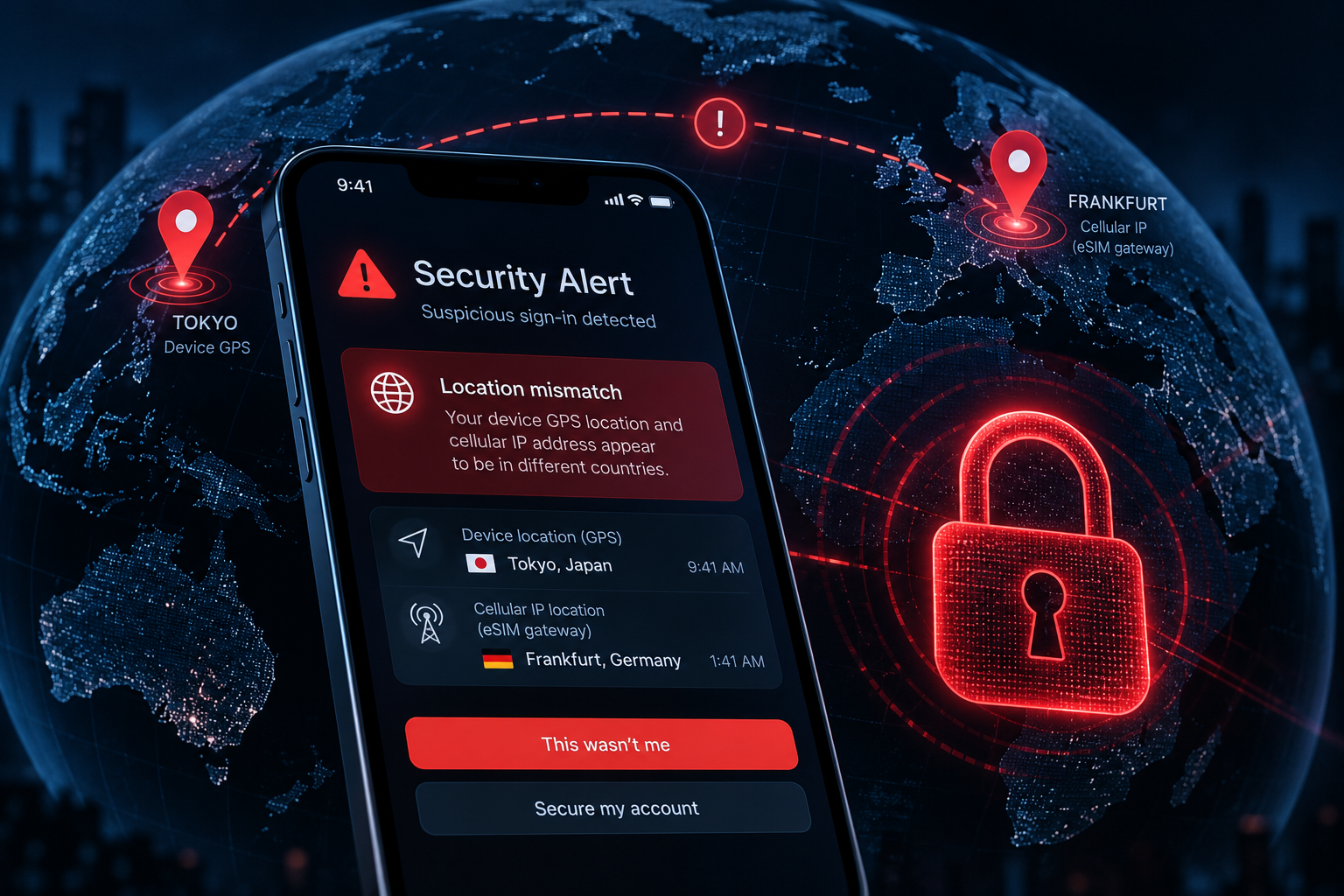
These fraud engines evaluate a critical correlation known as geographic consistency. The system compares two distinct location data streams:
- Hardware Telemetry: The physical coordinates reported by your smartphone's onboard GPS receiver, Wi-Fi BSSID environmental scans, and cell tower triangulation.
- Network Egress Telemetry: The public IP address of the incoming TCP/IP connection, which is mapped against commercial MaxMind or IP2Location geolocation databases to determine city, country, and Autonomous System Number (ASN).
Under normal operating conditions, these two vectors align. If you are sitting in a coffee shop in London, your GPS reports London and your cellular carrier's IP address resolves to a data center in London or Slough.
When you operate over a home-routed travel eSIM, however, these vectors violently diverge. Your smartphone's GPS accurately reports that you are standing inside an Apple Store in Ginza, Tokyo. But when your mobile banking app attempts to authenticate your session, the HTTP request arrives from a public IP address owned by a telecommunications provider in Kowloon, Hong Kong, or Katowice, Poland.
To an automated banking risk engine, this discrepancy does not look like an innocent tourist checking their account balance. It exhibits the exact technical signature of a credential-stuffing attack or an unauthorized account takeover executed via an overseas residential proxy network. The security engine concludes that a malicious actor in another country is attempting to hijack an account using stolen session tokens.
The defensive response is immediate and automated:
- The banking application terminates the active session without warning.
- The user's online profile is placed into a temporary security hold.
- The system demands out-of-band identity verification via SMS one-time passwords (OTP).
- If the traveler has turned off their primary home SIM to avoid exorbitant international roaming fees, the SMS OTP cannot be delivered, leaving the traveler stranded in a foreign country without access to their funds.
Furthermore, IP geolocation mismatch breaks everyday consumer utilities. Ride-hailing applications like Grab or Gojek in Southeast Asia rely on local carrier IP reputations to prevent driver location spoofing. When an incoming order originates from a European or Hong Kong IP address, ride apps frequently reject credit card transactions or require additional verification steps. Local streaming video catalogs disappear, replaced by the regional library of your eSIM's gateway country. Government portals, airport transit ticketing platforms, and tax-free shopping verification systems routinely block foreign IP subnets to mitigate distributed denial-of-service (DDoS) attacks, rendering essential travel services completely inaccessible until the user finds a public Wi-Fi network.
🌐 Why the Roaming Industry Built Home-Routing First
If Home-Routed Roaming introduces punishing latency, degrades application performance, and triggers banking lockouts, why did the global telecommunications industry adopt it as the universal standard in the first place?
The answer is rooted in the financial architecture of mobile telecommunications and the historical evolution of billing systems. When international mobile roaming was originally standardized in the 1990s under the GSM Association (GSMA), mobile operators faced a fundamental dilemma: how to allow subscribers to use foreign networks while ensuring that every minute of voice and every kilobyte of data was accurately billed, accounted for, and audited without the risk of runaway fraud.
In the early days of mobile technology, operators settled roaming accounts through a complex clearinghouse mechanism using Call Detail Records (CDRs) transferred via Transferred Account Procedures (TAP). This process was asynchronous; days or weeks could elapse before a visited operator reported usage data back to the home carrier. If a subscriber exhausted their prepaid balance or engaged in fraudulent usage while traveling, the home carrier remained liable to pay the visited network for the consumed airtime, suffering massive financial losses.
Home-Routed Roaming solved this billing exposure cleanly and decisively through architectural centralization:
- Real-Time Charging and Policy Control: By forcing all data packets through the home network's Packet Data Network Gateway (P-GW) and Policy and Charging Rules Function (PCRF), the home carrier can meter data consumption in real time down to the exact byte. If a prepaid user's allowance hits zero, the home gateway immediately terminates the session, eliminating financial risk for the wholesale provider.
- Lawful Interception Compliance: Telecommunications carriers are legally bound by national security mandates, such as the Communications Assistance for Law Enforcement Act (CALEA) in the United States and equivalent European Telecommunications Standards Institute (ETSI) regulations globally. These statutes require operators to maintain technical capabilities to wiretap and record communication traffic under court order. In a home-routed model, the home carrier retains physical access to the subscriber's raw unencrypted packet stream at its domestic gateway, satisfying domestic regulatory compliance regardless of where the subscriber travels.
- Service Parity and Firewall Filtering: The home carrier can enforce domestic parental controls, URL filtering, zero-rated application rules, and corporate APN policies uniformly, ensuring that a user's corporate data security policy remains intact across borders.
- Simplified Wholesale Interconnects: Setting up a Local Breakout peering relationship requires complex bilateral contracts between every visited carrier and every home provider, including distributed firewall policies and local regulatory compliance in hundreds of distinct jurisdictions. In contrast, Home-Routing requires only a generic IPX transit pipe between the visited carrier and an international roaming exchange.
For wholesale eSIM aggregators that sell low-cost global data packages, Home-Routing remains economically irresistible. A digital eSIM reseller does not need to deploy network infrastructure, negotiate interconnect agreements, or establish legal entities in 150 separate countries. It simply partners with a single regional Tier-1 mobile operator in Hong Kong, Singapore, or Eastern Europe, rents wholesale data trunks in bulk, and tunnels the entire planet's traffic back to a centralized server cluster.
🧭 The Rise of Local Breakout and Regional Edge Egress
While Home-Routing served the telecommunications industry well during the voice and text-messaging eras, the explosive growth of modern cloud applications, video conferencing, real-time gaming, and zero-trust corporate security has made high-latency routing unacceptable. A structural shift is underway across the travel eSIM ecosystem, driven by the emergence of Local Breakout (LBO) architecture and distributed regional edge routing.
In a genuine Local Breakout topology, the architectural paradigm is inverted. When an eSIM associates with a foreign tower, the signaling and authentication control plane still communicates with the home operator's database to verify user credentials. However, the user data plane (the actual payload of web pages, video streams, and app interactions) is severed from the home tunnel at the visited network's local User Plane Function (UPF) or local Packet Gateway.
The local UPF assigns the device a native domestic IP address belonging to the visited operator or a local internet exchange point (IXP). When the user opens a browser in London, their packets exit onto the London internet exchange (LINX) in Canary Wharf. When they check a map in Tokyo, their traffic breaks out directly at the Japan Internet Exchange (JPIX).
The performance differential between pure Home-Routing and Local Breakout is staggering:
- Latency Reduction: Round-trip time drops from an intercontinental 300–450 ms down to a localized 15–35 ms.
- Throughput Stability: TCP congestion algorithms achieve maximum window scale within milliseconds, allowing 5G download streams to saturate physical radio capacity without artificial protocol throttling.
- Battery Conservation: The cellular baseband processor on modern smartphones consumes significantly less power when network transactions complete quickly. High-latency connections force the cellular modem to remain in a high-power active state (RRC_CONNECTED) for prolonged intervals, accelerating battery drain during international travel.
- Geographic Authenticity: Because the device receives an authentic local IP address, banking applications observe consistent geolocation telemetry between hardware GPS and network egress. Streaming services serve the correct local catalog, and transit booking systems function without proxy blocks.
To bridge the financial gap between costly local breakout contracts and cheap centralized tunneling, forward-thinking eSIM providers are deploying a hybrid architecture known as Regional Edge Breakout. Instead of routing all global traffic back to a single centralized carrier in Hong Kong, the provider operates distributed core network nodes deployed across major geopolitical hubs: Frankfurt for Europe, Ashburn and San Jose for the Americas, Singapore and Tokyo for the Asia-Pacific region, and Dubai for the Middle East.
Under Regional Edge Breakout, a traveler in Rome using an Asian eSIM does not have their packets routed 9,000 kilometers back to Taipei or Hong Kong. Instead, the local cellular carrier tunnels the session only as far as a regional gateway in Frankfurt. The round-trip time is capped at a manageable 30 to 50 milliseconds, eliminating the worst penalties of intercontinental transit while preserving the operator's centralized billing control.
🛰️ GSMA SGP.32 and the New Era of Remote SIM Provisioning
The ultimate solution to the routing detour, however, is not merely optimizing international tunnels; it is eliminating the roaming middleman altogether. This transformation is being enabled by the latest standard in embedded telecommunications: GSMA SGP.32.
To understand why SGP.32 is revolutionary, one must look at how consumer eSIM profiles have been delivered historically. Under the initial consumer specification, known as GSMA SGP.22, the process of loading an eSIM profile requires a user-driven push model. The consumer scans a QR code containing an activation code string, which points your smartphone to a remote server known as a Subscription Manager Data Preparation (SM-DP+). The SM-DP+ encrypts a complete virtual SIM profile and downloads it into your phone's Embedded Universal Integrated Circuit Card (eUICC) security chip.
While SGP.22 made digital SIM delivery possible, it was architecturally rigid. The profile downloaded to your phone was static. It belonged permanently to whichever carrier issued it, locking the user into that carrier's predefined roaming agreements and routing topologies.
In late 2024 and throughout 2025 and 2026, the telecommunications industry began wide deployment of GSMA SGP.32, originally architected for the Internet of Things (IoT) but rapidly transforming consumer mobile devices. SGP.32 introduces a decentralized management architecture featuring an on-device component called the IoT Profile Assistant (IPA) and an external management entity called the eSIM IoT Manager (eIM).
The breakthrough of SGP.32 is its ability to orchestrate dynamic, over-the-air profile swapping and remote provisioning without requiring manual user intervention or QR code scanning. An SGP.32-compliant device can hold a root bootstrap connectivity profile that automatically discovers geographic boundaries. The moment your device detects foreign cellular towers, the management platform can dynamically trigger the download of an authentic, native local carrier profile directly from a domestic Tier-1 operator in the destination country.
Instead of your phone pretending to be a Hong Kong tourist roaming on a Japanese network, SGP.32 enables your phone to become a genuine, native subscriber of NTT Docomo or SoftBank for the duration of your trip, complete with local billing, local emergency service routing, and native Local Breakout. The wholesale clearinghouse layers that created the 8,000-kilometer detour are entirely bypassed.
🔮 A Practical Traveler's Playbook for International Data
Until SGP.32 and native Local Breakout become the universal baseline for every budget data package, international travelers must navigate the realities of modern mobile routing with technical intentionality. Understanding how your travel eSIM behaves allows you to prevent unexpected banking locks, minimize latency, and protect your digital workflow across international borders.
Here is an actionable technical checklist to deploy before and during international travel:
Audit Your eSIM Provider's Routing Architecture Before Purchase
Never purchase a travel eSIM based solely on price per gigabyte. Before committing, inspect the technical specifications or search technical community databases (such as r/eSIMs or telecom provider documentation) to determine two vital parameters:
- The Underlying Carrier / IMSI Issuer: Does the provider use a local carrier profile, a regional hub, or a global roaming clearinghouse (such as 3 HK, Singtel, or Play Poland)?
- Routing Topology: Does the plan explicitly state "Local Breakout" (LBO), or does it rely on Home-Routed Roaming? If you require low latency for voice calls, video meetings, or online gaming, choose providers that guarantee local breakout in your specific destination region.
Verify Your Public IP and Egress Point Upon Arrival
The moment you arrive in your destination country and establish cellular connectivity, take thirty seconds to audit your network path:
- Open a browser and visit an IP verification utility such as
ipinfo.ioorwhois.arin.net. - Check the reported country, city, and Autonomous System Organization. If you are sitting in London and the tool reports an IP address in Kowloon or Singapore, your connection is home-routed.
- Run a simple ping test to a reliable domestic server (such as
1.1.1.1or a major local website). A response time under 30 ms confirms Local Breakout; a ping between 200 ms and 450 ms confirms an intercontinental detour.
Fortify Your Financial and Security Applications
To prevent automated anti-fraud tripwires from freezing your bank accounts while traveling:
- Set Up Out-of-Band Hardware Authentication: Transition your critical financial, corporate, and email accounts away from SMS-based verification and onto hardware security keys (FIDO2 / WebAuthn) or time-based one-time password (TOTP) authenticator applications. These protocols operate entirely independent of cellular carrier routing or foreign IP reputations.
- Maintain Dual-SIM Discipline: Modern smartphones allow simultaneous dual-SIM operation. Keep your primary physical SIM or domestic eSIM active for incoming voice and SMS, but explicitly disable "Data Roaming" on that primary line. Assign "Cellular Data" exclusively to your travel eSIM. This configuration ensures that critical bank verification SMS codes still reach your phone via your home carrier's cellular signaling channel, even while data is routed through the travel package.
- Pre-Notify Financial Institutions: Use your bank's mobile application to log your international travel dates. When an automated fraud engine flags an IP geolocation mismatch, an active travel notice on file often acts as an override filter, preventing immediate account suspension.
Understand When to Use a Local Physical SIM or Native Prepaid Profile
If your travel involves professional remote work, conducting critical financial transactions, or staying in a country with strict regulatory firewalls (such as mainland China, where foreign roaming eSIMs actually bypass the Great Firewall via home-routing to Hong Kong, whereas local SIMs do not), evaluate the strategic trade-offs:
- Choose Local Breakout / Local Prepaid when raw latency, local app compatibility (taxi, food delivery, banking), and connection speed are paramount.
- Choose Home-Routed Roaming Strategically when traveling to regions with heavy domestic internet censorship, as home-routing tunnels your traffic safely outside the host nation's national firewall, preserving unhindered access to global web services.
The travel eSIM has fundamentally democratized global connectivity, rescuing millions of consumers from the predatory $10-per-day roaming fees historically levied by legacy mobile carriers. It transformed international data from an expensive luxury into an instant digital commodity. But true mobile freedom requires recognizing that wireless technology does not operate in an abstract cloud. Every digital packet is anchored to physical fiber, national jurisdictions, and architectural routing choices. When you understand the hidden 8,000-kilometer detour inside your phone, you transform from a passive consumer into an informed navigator of the global internet.
Sources: GSMA SGP.32 and SGP.22 Technical Specifications, 3GPP TS 23.401 and TS 23.501 Roaming Architecture Standards, International Telecommunication Union (ITU) Latency Benchmarks, APN Routing Telemetry and Independent Packet Analysis.