A satellite connection on a smartphone now means more than an emergency text. T-Mobile announced support for satellite-ready apps on 1 October 2025, including mapping, weather and WhatsApp communication. Starlink's current Mobile page advertises data on selected apps and voice through apps, while describing native calling and much broader broadband capability as future service. Those distinctions matter when a familiar phone icon makes an unfamiliar network look ordinary.
The useful question behind “satellite direct to cell phone explained” is not whether a phone can reach space. That has already happened. It is what kind of connection reaches back, who is allowed to use it, and what happens when many people need it together. The next stage of the story is taking shape in a US spectrum proposal circulated on 8 October 2026. It could widen the resources available to these services, but it is not an adopted rule. Neither a proposed allocation nor a successful demonstration makes an ordinary phone a limitless broadband terminal.
🛰️ A coverage map needs a second legend
The expression direct-to-cell sounds admirably straightforward: replace the tower that is missing on the ground with one in space. In one important approach, that is broadly what happens. Starlink describes a satellite antenna acting as a cellphone tower, working with existing LTE phones and integrating with operators much like a roaming partner. The burden of adapting the radio link falls heavily on the infrastructure rather than requiring everyone to buy a dedicated satellite handset.
That description still leaves several questions unanswered. A compatible phone needs a compatible service arrangement. An operator needs rights to the spectrum and permission to operate in the relevant territory. A user needs to be in coverage, with conditions that allow a workable radio link. An app might need specific optimisation. A map of the satellite's physical reach therefore cannot be read as a map of every consumer's usable subscription.
This is especially important for Indonesian readers. An international announcement about satellite connectivity does not establish availability in Indonesia. A handset sold locally can share a model name with one used in a foreign demonstration while the network partnership, firmware eligibility or service approval differs. We found no basis in the sources examined here to promise Indonesian direct-to-cell service. Check the local operator's actual offer rather than translating a foreign coverage claim into a local entitlement.
There is also an architectural distinction hidden under the satellite label. A broadband terminal serving a house can have a much larger antenna and more power than a handheld device. A phone connected to Wi-Fi from such a terminal is using satellite internet indirectly. A phone communicating directly with a spacecraft is undertaking a different radio task. Both are useful; their capacities should not be compared as if the equipment were interchangeable.
The 3GPP overview of non-terrestrial networks explicitly distinguishes these arrangements. Satellites can serve handheld terminals, relay nodes or larger VSAT terminals, and can connect back to ground gateways or through inter-satellite links. The same word “satellite” covers several places in a network diagram. Before interpreting a speed promise, identify which link and which terminal it concerns.
📡 The harder conversation travels upward
A phone receives a signal and sends one back. The second half is easy to forget because consumer interfaces mostly display reception. In a satellite link, the uplink from the handset is a central constraint: the device has limited transmit power, a compact antenna and a battery expected to do other jobs. 3GPP identifies the much greater distance, and especially the limited uplink power of user equipment, as a link-budget issue.
A link budget is an accounting exercise for radio energy. Engineers start with transmitted power, include antenna gains, subtract propagation and other losses, and ask whether the receiver can distinguish the intended signal from noise and interference. It is not a single magic number explaining all coverage. Phone orientation, obstructions, operating frequency and the receiver's processing all affect the result.
Consider a deliberately simplified comparison. At the same frequency in free space, increasing distance from five kilometres to 500 kilometres increases path loss by 40 decibels. That follows from the distance term in the free-space loss relationship, not from a measurement of either operator's service. It represents a ten-thousand-fold change in received power if the other factors stay fixed. Real terrestrial and satellite paths do not hold every other factor fixed, so this example illustrates the engineering burden rather than forecasting reception at a particular location.
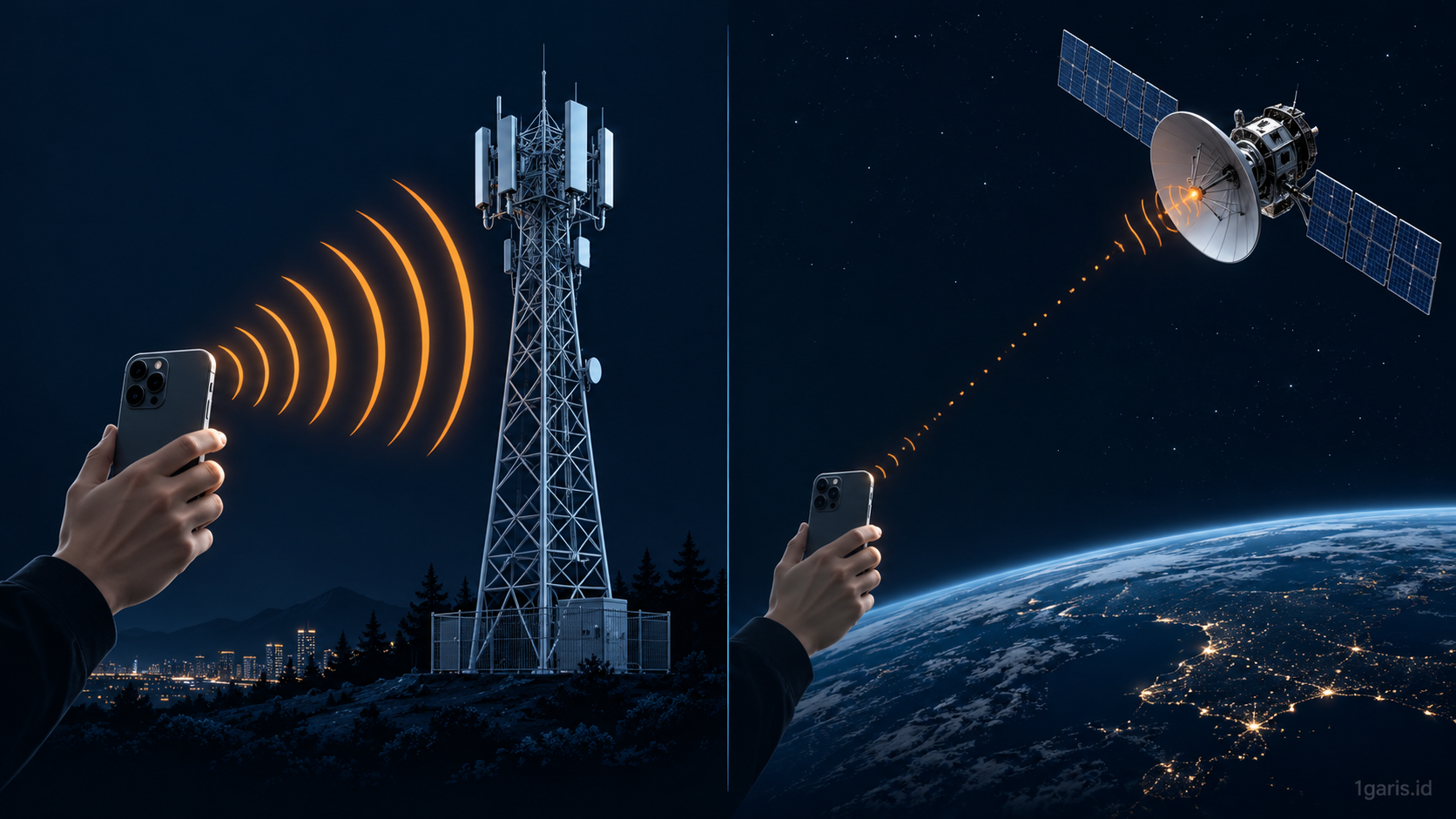
Large, sensitive satellite antennas and beamforming help meet that burden. A phased array coordinates many antenna elements to direct reception and transmission toward selected areas. The infrastructure can do sophisticated work that the phone cannot do alone. The study by Jorge Garcia-Cabeza and colleagues describes advanced arrays, sensitive receivers, high-power transmitters and compensation for delay and Doppler as enabling technologies for direct satellite-to-device communication.
None of that removes obstruction. A building, terrain or heavy foliage can make a weak link harder or impossible to establish. Apple's documentation is unusually concrete about its separate satellite messaging service: ideal conditions can allow a message to send in about 30 seconds; light or medium foliage can make it take over a minute; heavy foliage or other obstructions can prevent connection. Those figures belong to Apple's service, not every satellite phone connection, but they explain why “outside with a clear sky” is a functional requirement rather than lifestyle advertising.
🌍 The tower moves while the customer stands still
A terrestrial cell tower generally stays in place. A low Earth orbit satellite does not. Relative motion changes the frequency a receiver observes, the distance the signal travels and the area served by a beam. 3GPP lists higher Doppler shifts, moving cell patterns and rapidly changing propagation delays among the differences that require adaptations from terrestrial networks.
The familiar Doppler analogy is a passing siren, but radio engineers have to solve the effect numerically, not just notice it. Transmitter and receiver must agree closely enough about frequency and timing for the signal to be interpreted. A moving satellite is predictable in a way that a passing vehicle often is not: its orbital information can help the network anticipate geometry. The phone's location can also be useful, depending on the architecture.
A beam footprint is not necessarily dragged rigidly across the ground. The 3GPP overview distinguishes moving beams from steerable, earth-fixed beams that can remain aimed at a location during a satellite's visibility period. This distinction prevents a tempting but incorrect story in which every ground user necessarily changes cell each time an imaginary hexagon slides past them. Beam steering and handover design determine the actual service behaviour.
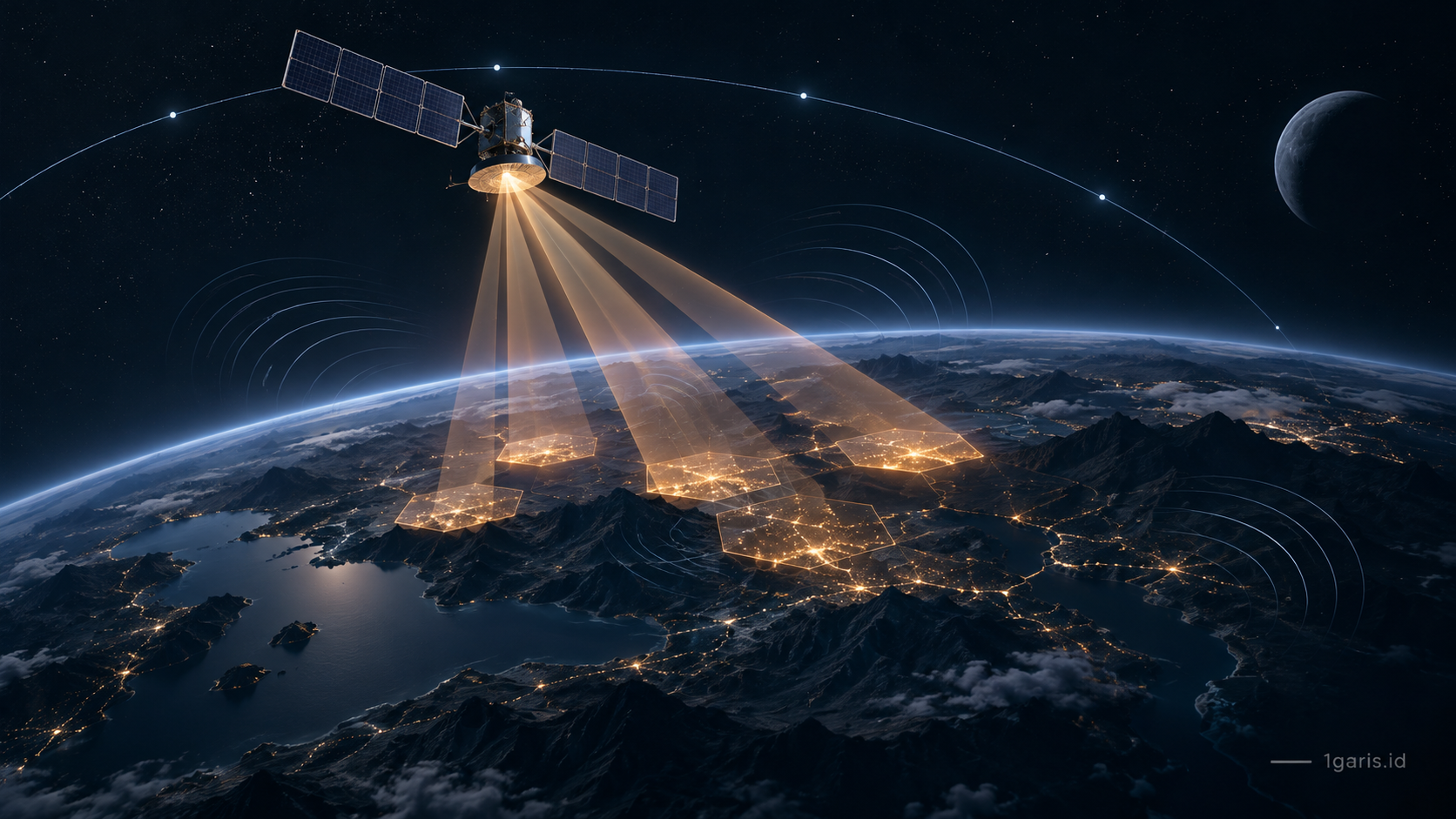
Eventually, a non-geostationary satellite moves out of the useful geometry. Another satellite or gateway may need to take over. A successful short message during one pass does not prove continuous connectivity across every subsequent transition. Satellite count, orbital distribution, beam scheduling and ground-network integration all influence whether a service remains available.
These complications also explain why signal bars are incomplete evidence. A receiver can detect a network while access attempts, scheduling or handover still cause delays. To assess a service, measure the task a person needs to complete: did the message reach the intended recipient, how long did that take, and did the connection persist? A radio-strength reading and an end-to-end communication result answer different questions.
For a traveller waiting for a reply, this distinction has practical value. Repeatedly reopening an app may not change the geometry overhead. Moving to a safe, more open position can sometimes address obstruction, while waiting may allow a better satellite opportunity. Always follow the service's own instructions. An explanation of orbital mechanics is not a substitute for the operating procedure on the phone in your hand.
🔬 Three megabits was an estimate, not a universal ceiling
The most useful counterweight to marketing is a clearly bounded measurement. Garcia-Cabeza and colleagues examined US crowdsourced mobile-network data collected between October 2024 and July 2025. Their paper characterises the SMS-only phase of Starlink's direct satellite-to-device network. It reports a median reference-signal power 24 decibels below terrestrial networks and estimates roughly three megabits per second per beam for the then-announced data service under outdoor conditions.
The qualifications are part of the finding. The authors did not establish a permanent three-megabit ceiling for all satellites, all countries or every phone. Their throughput figure was an estimate derived from signal-to-interference-plus-noise observations, rather than a promise that each subscriber would receive that rate. The paper also discusses possible capacity expansion under changes to regulatory, business, spectrum and orbital conditions.
“Per beam” is the crucial unit. A beam serves an area and its available capacity is shared. A capacity estimate for that area cannot be copied into an individual speed claim without knowing the active users, resource allocation and radio conditions. An almost empty beam and a crowded beam can present different experiences even when their hardware is the same.
The study's historical window matters just as much. T-Mobile subsequently announced satellite-ready app data in October 2025. Its release includes voice notes, photographs and calls through WhatsApp, and explicitly says these are critical or core app experiences rather than the full data-heavy experience of a terrestrial network. A 2026 article that calls the service SMS-only would be using older research to contradict a newer product offering.
The sensible reading holds both sources together. The measurement shows the constraints of an early deployment and a method for estimating capacity. The operator release establishes a later feature set and its stated restrictions. Neither eliminates the other. Supporting a voice app does not imply abundant capacity; constrained capacity does not mean no voice application can ever work.
It also helps to separate throughput, latency and availability. Throughput describes how much data can move over time. Latency describes waiting within communication. Availability describes whether a usable connection exists at all. A small weather update may tolerate a slow transfer but not complete without coverage. A conversation may need modest throughput yet suffer badly from interruptions. “Fast” alone is too blunt a description.
🧭 Three routes can share one satellite icon
There is no single universal smartphone-to-satellite design. One route adapts terrestrial cellular service for existing handsets, using operator spectrum agreements and extensive infrastructure-side engineering. Another builds satellite support into standardised non-terrestrial radio procedures. A third is a device-specific satellite feature with its own service, regions and interface. These categories help readers organise the market; they are not a complete taxonomy of every implementation.
The current market divides into three distinct architectures:
- Adapted terrestrial networks: Satellite operators deploy spaceborne base-station payloads that communicate directly on cellular frequencies licensed to terrestrial partners, allowing unmodified phones to connect as though roaming.
- Standardized non-terrestrial networks: The 3GPP framework integrates satellite adaptations directly into 5G NR and NB-IoT specifications, using dedicated satellite frequencies such as L-band and S-band alongside chipsets built for space propagation.
- Proprietary emergency links: Device manufacturers pair customized handset radios and protocol stacks with dedicated satellite constellations, focusing on structured emergency messaging and basic location sharing.
The 3GPP Release 17 work introduced satellite access into specifications for New Radio and for NB-IoT and eMTC. Its published overview describes adaptations to physical and access layers, architecture, radio-resource management and RF requirements. The early focus included transparent payloads and assumed GNSS capability in user equipment. Later work extends capabilities, but a standards release is not itself a retail subscription or proof that an older handset supports the relevant radio bands.
A transparent payload relays radio signals while the base-station function is on the ground. A regenerative payload includes more base-station processing aboard the platform. There are also split architectures. Those choices change where processing occurs and what links connect the satellite to the core network. Treating every satellite as a simple mirror is as misleading as treating every one as a complete autonomous cellular network.
Apple's Messages via satellite illustrates a different consumer experience. Its support page says iPhone 14 and later can exchange supported iMessage and SMS content outside cellular and Wi-Fi coverage, subject to software, region and carrier conditions. It lists the United States, Canada, Mexico and Japan for this feature, and identifies Globalstar and affiliates or third-party providers as the satellite network. It does not list Indonesia.
The same page says photographs, videos, audio messages, stickers and group messages are unsupported on that feature. T-Mobile's satellite-ready WhatsApp offering has a different feature list. There is no contradiction once the reader stops treating “satellite messaging” as one product. Compare the actual service pages, not just the satellite symbol in a launch presentation.
For purchases, this becomes a compatibility exercise. Match the exact phone model, its market variant, software version, network or subscription, region and desired feature. If the goal is emergency communication, inspect that feature separately from ordinary messaging. A successful recreational app demonstration cannot establish how the emergency workflow behaves or which local response system it reaches.
⚖️ The October proposal is about neighbours as well as coverage
The immediate news hook is the FCC fact sheet dated 8 October 2026. The circulated item proposes making an additional 482 megahertz available for Supplemental Coverage from Space and expanding the number of eligible bands from five to 13. It also discusses more flexible service areas and coexistence arrangements. As circulated, it is scheduled for tentative consideration at the Commission's 29 October meeting.
The document states that it does not constitute official Commission action and remains subject to change. That sentence belongs near any account of the proposed expansion. Reporting it as adopted spectrum access would move the story several steps beyond the evidence. Even adoption of a proposal to seek comments would not automatically amount to final implementation of every suggested rule.
Spectrum is not empty simply because an antenna is overhead. Signals can affect other users of the same or adjacent frequencies, and coverage can cross borders. The fact sheet discusses power-flux density at license boundaries, technical measures, interference and international coordination. These are the conditions under which a space network shares an already occupied radio environment.
The research paper likewise discusses US operation in T-Mobile's PCS G Block during its observation window and the role of emission limits. This is why increasing transmitter power is not an unrestricted solution to a weak link. A system can improve its intended connection while creating problems for spectral neighbours. Regulators have to evaluate both effects rather than reward coverage alone.
For consumers outside the United States, the news is a useful indicator of policy direction, not a local approval. US spectrum decisions do not license transmissions everywhere a spacecraft passes. National rules, operator arrangements and coordination remain part of availability. The satellite may ignore a political border in its orbit; the service cannot ignore it in its authorisation.
The proposed discussion of performance requirements deserves attention too. A product framed as a lifeline needs more than a large coverage illustration. Useful obligations might address actual service outcomes, but the document is seeking comment rather than supplying a settled universal benchmark. Until rules and contracts specify those outcomes, readers should avoid interpreting broad reliability language as a guaranteed delivery time.
🌌 A network in the sky still has a ground footprint
Satellite connectivity changes the location of infrastructure, not the need for infrastructure. Handset traffic must reach an operator network and the intended service. Gateways, core systems, satellite control and potentially inter-satellite routing all participate. A failure on the ground can still matter, depending on which part fails and what alternatives the architecture provides.

The licensed photograph here shows Starlink satellites passing near Carson National Forest in New Mexico soon after launch. It documents the visible constellation phenomenon, not the radio performance of the direct-to-cell payloads discussed in this article. It must not be read as proof that these particular spacecraft supplied smartphone coverage. That narrower caption preserves what the image can actually testify to.
There is a broader public-interest question about the number and visibility of spacecraft, but this article does not calculate the environmental impact of a particular fleet. The photograph alone cannot answer that question. The relevant point is that satellite service occupies a shared sky and radio environment while offering benefits to people on the ground. Coverage is one outcome to evaluate, not a complete account of the deployment.
Infrastructure scale can support redundancy and more coverage opportunities, yet satellite count by itself is not a usable reliability metric. Different payloads, orbital positions, beam capabilities and service permissions matter. Starlink's current page describes a launched mobile constellation and a future V2 system with substantially higher throughput capability. Those future claims should remain labelled as plans, not silently substituted for the performance of present service.
This distinction also protects readers from false comparisons. A future constellation announcement, an early radio-measurement paper and a retail product page can all be accurate about different things. Put a date, architecture and unit beside each number before comparing them. That habit is more useful than deciding that one source must be wrong because its headline sounds smaller.
🥾 Prepare for the message you actually need
For an outdoor trip, the decision starts with a task. A check-in to family, a weather update and an emergency request have different requirements. Identify which service can perform that task at the destination, and practise its interface while ordinary connectivity is still available. Apple's documentation recommends a connection demo and setting up relevant contacts before going off-grid.

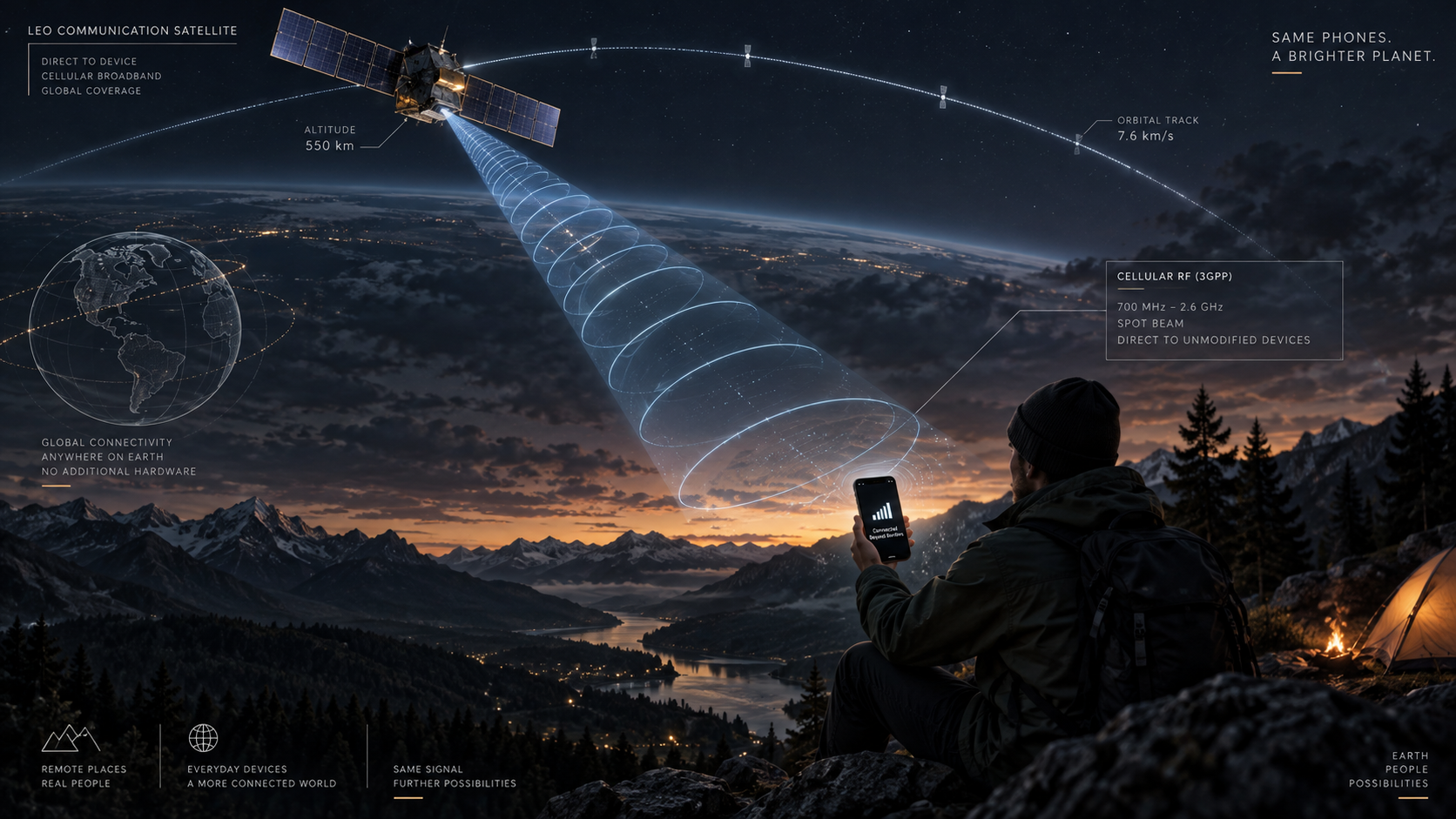
A stock photograph of a hiker with a phone is an illustration of that situation, not evidence that the photographed device has satellite service. The important preparation happens before the image-worthy moment: download maps, understand the supported messaging behaviour and tell someone your route and expected check-in arrangements. Those measures reduce dependence on a connection that the provider itself says may be delayed or unavailable.
Apple specifically says its ordinary Messages via satellite feature should not be used for emergencies; users should use Emergency SOS via satellite when applicable. T-Mobile's release directs emergency communication toward its stated text-to-911 workflow and warns that satellite service, including emergency texting, can be limited or unavailable. Those are US-specific instructions and must not be repackaged as Indonesian emergency guidance.
For travel in Indonesia or elsewhere outside an explicitly supported region, verify a local, supported emergency communication route. Do not buy a phone solely because a foreign satellite demonstration looks reassuring. For trips where consequences of disconnection are serious, assess an appropriate dedicated communicator or other backup with coverage and response arrangements relevant to the location. This is preparation advice, not a claim that one device suits every expedition.
After sending a routine check-in, distinguish the app's progress indicator from a reply or delivery indication that the service actually provides. A message queued on the phone is not the same as a person having received it. Agree in advance what missed check-ins mean so that a network delay does not force someone to invent a response plan under stress.
💬 Better coverage should come with narrower promises
The exciting part of direct-to-cell is genuine: familiar handsets can communicate in places beyond an ordinary tower's reach, and supported app experiences have already moved beyond the earliest SMS phase. The skeptical response should not deny those achievements. It should ask providers to express them in units and conditions that a customer can use.
A useful offer names compatible devices and regions, separates current features from future ones, and states when clear sky, software or a particular plan is required. It explains whether a speed figure is shared beam capacity, an individual test result or a projected improvement. It treats emergency service as its own workflow rather than borrowing reassurance from a successful photo upload.
The October FCC proposal points toward a policy debate over expanding the resources and flexibility available to these networks. The measured early network, the newer app offerings and the proposed rules describe a developing system, not a fixed two- or three-megabit destiny. Physics sets difficult constraints, but antenna engineering, spectrum, scheduling and network architecture determine how a particular service works within them.
For the reader, the practical conclusion is simple: judge the satellite connection by the message or task you need to complete, in the place you need to complete it. More sky coverage is valuable. Clearer service boundaries make that value usable without turning a fallback connection into a promise it was never designed to keep.
*Sources: Starlink Mobile, 3GPP NTN overview, 3GPP Release 17 and 18, Garcia-Cabeza et al., Apple Messages via satellite, T-Mobile app expansion, and FCC circulated October fact sheet.*