Tandem OLED is appearing on tablets, laptops and desktop monitors, but the most useful question is rarely the one printed largest on the box. A brighter screen can look spectacular for a minute. A screen that preserves its appearance through years of ordinary work has to survive a different test: the same toolbar, document background and taskbar returning every day.
The attraction of stacking light-emitting units is that a display designer gains room to choose between brightness, electrical efficiency and durability. Those choices don't automatically arrive together. Apple still warns that its tandem OLED iPad displays can develop burn-in in extreme conditions. The interesting story is therefore how manufacturers spend their new headroom, and what a buyer can establish before paying for it.
🔬 The screen is a chemical device before it is a specification
An OLED pixel makes its own light. Electrical charges enter organic semiconductor layers, meet, and form excited states that can release energy as photons. There is no separate backlight illuminating an array of shutters, as there is in an LCD. This gives OLED its familiar advantage in a dark scene: a pixel intended to show black can stop emitting light while an adjacent pixel remains bright.
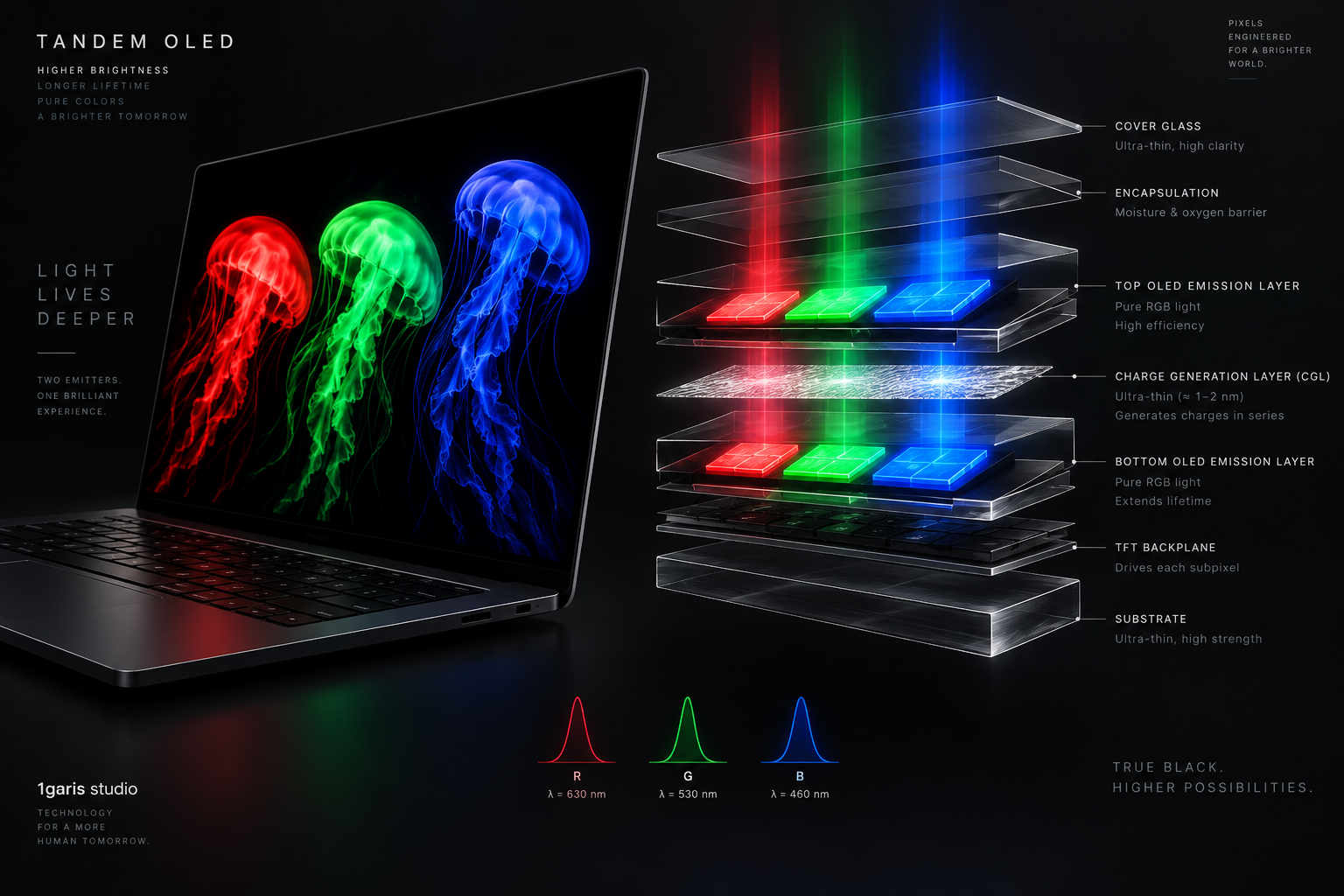
That simple description hides several jobs inside a remarkably thin structure. Electrodes inject charges, transport layers guide them, and emitting layers convert part of the available energy into light. The materials, interfaces and optical design all affect what comes out of the front of the screen. Saying that a product is OLED identifies a broad operating principle, not a complete recipe for its performance or longevity.
A conventional single electroluminescent unit can contain several functional layers. Consequently, counting layers in a diagram isn't enough to identify a tandem device. The distinction is between functional light-emitting units connected within the stack. Peng Xiao and colleagues' 2019 review in Molecules documents several tandem white OLED architectures, including structures that combine different colors and structures in which each unit already emits white light.
This distinction matters whenever a product explanation says it contains two screens. In consumer language, that is an accessible description of combined light output. It shouldn't be taken to mean two finished tablets, with two complete front glasses, simply glued together. The useful engineering picture is a layered emitting structure whose electrical and optical behavior has been designed as a system.
It also explains why an attractive photograph cannot tell us how the device was built. Deep blacks and saturated color are visible outcomes. The number of emitting units, their materials and the mechanism connecting them belong to the internal architecture. A product specification or technical source has to establish those details; an image alone cannot.
🔵 Blue exposes the limits of an easy explanation
Blue has a demanding role in OLED development. In a 2023 Nature Communications study, Jaewook Kim and colleagues described blue phosphorescent OLEDs with high triplet exciton energies of 2.6–3.0 electron volts. Those energetic states open degradation pathways that are less accessible in the red and green devices discussed by the authors. Their study concerns particular experimental materials and devices, not every blue subpixel in every commercial screen.
An exciton is an excited electronic state associated with an electron and a hole. A polaron, in the language of this research, is a charge interacting with its surrounding material. Neither term is something a buyer needs to memorize. They are useful because they identify why brightness and lifetime cannot be reduced to a mechanical wear analogy. The device is managing charged and excited molecules while it produces light.
If many excited states accumulate in a small region, interactions between them can create more energetic states. Researchers describe processes such as triplet–triplet annihilation and triplet–polaron interactions. These can contribute to chemical damage, create sites that quench light emission, and change electrical transport. A pixel can consequently lose luminance even though its external surface looks intact.
The Kim paper complicates the familiar claim that blue merely wears out because its photons have more energy. The researchers found that electron-induced degradation played a critical role in their iridium-based blue devices. Their control experiments required the presence of excitons and electrons together to explain operational lifetime. The chemistry depended on actual operating conditions, rather than a single isolated cause.
The responsible consumer translation is narrower than a dramatic headline: blue emitter stability remains an engineering challenge, and reducing stress can help. It does not establish that every tandem display uses the experimental emitter in that paper. Nor does it prove a fixed lifespan multiplier for a laptop that happens to carry an OLED badge.
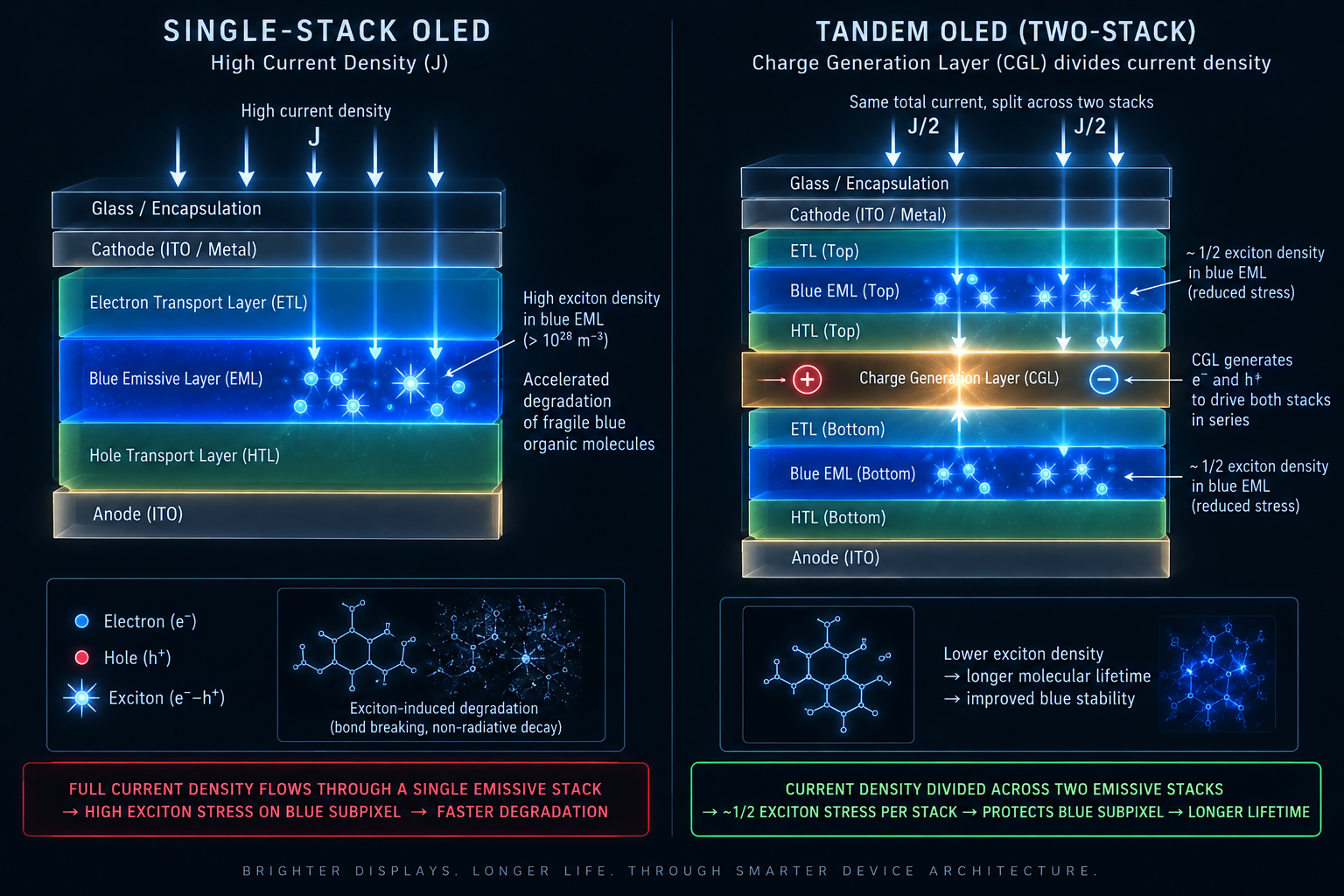
That boundary between laboratory explanation and product claim is worth preserving. Research can explain why designers care about current density, charge balance and materials. A manufacturer still needs to establish what its finished panel does, under which conditions, and with what protections. Otherwise, a scientifically plausible explanation becomes an unsupported sales promise.
🧩 What the connecting layer actually changes
A tandem OLED connects multiple electroluminescent units using a charge generation layer, usually abbreviated CGL. The 2019 Molecules review describes this layer as central to tandem device operation. It generates and supplies charges to adjacent units so that more than one emitting unit contributes to the final light output within the overall electrical structure.
The analogy of two workers sharing a load is useful, provided we don't stretch it too far. If two appropriately designed units each contribute light, a designer can target a given output with lower current density than a comparable single-unit design would require. Alternatively, the designer can use the additional emitting capacity to pursue greater brightness. What happens depends on the materials, operating point and complete panel design.
The units are not two independent batteries sharing an appliance. Their electrical connection introduces voltage requirements, and the connecting layer itself needs good charge generation, transport and optical properties. Electrical power depends on voltage as well as current. A reduction in current density therefore doesn't translate automatically into the same percentage reduction in power consumption.
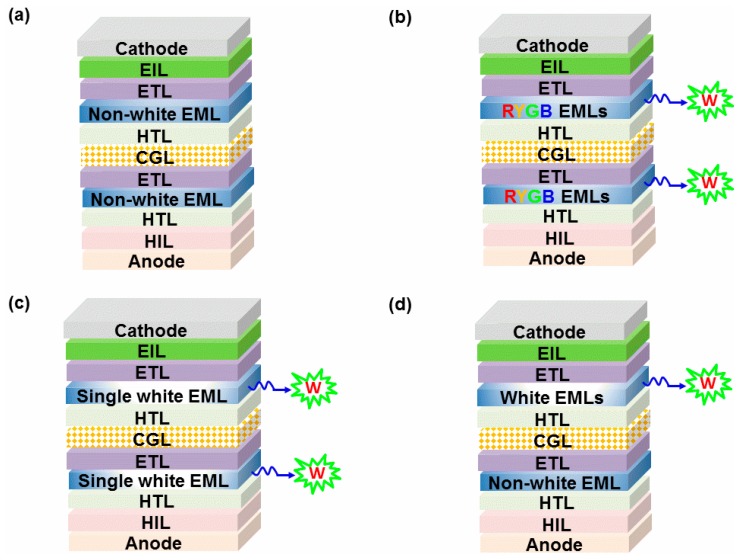
The reproduced research figure shows several possible tandem white OLED architectures. It is a record of the arrangements described in the review, not a teardown of an iPad, Dell laptop or ASUS monitor. The distinction prevents a useful teaching diagram from pretending to reveal a manufacturer's proprietary production stack.
A good connecting layer must perform several tasks at once. It has to supply charges effectively without imposing excessive additional voltage. It must remain compatible with surrounding materials. It should also avoid absorbing too much of the light that the device is trying to extract. The review discusses the importance of charge generation layers alongside the emitting units because improving one component alone cannot guarantee a good device.
This is why a tandem label is a starting point rather than a ranking. Two products can use stacked emitting structures and still make different decisions about brightness, thickness, efficiency and protection. The label explains part of their opportunity. It cannot substitute for measurements of the resulting screen or for the terms of its warranty.
🏭 The automotive origin helps explain the laptop opportunity
LG Display's June 24, 2024 announcement gives a concrete account of the move into laptop panels. The company said it had started mass production of a 13-inch tandem OLED panel. It described its technology as combining two stacks of red, green and blue organic emitting layers, and said it first commercialized tandem OLED in 2019 for automotive applications.
Automotive displays help explain the design priorities without proving a universal consumer result. LG Display explicitly linked the technology to longer operation and reliability, then identified laptops, monitors and tablets as products with substantial screen time. A dashboard and a document window have different jobs, but both make sustained operation a relevant consideration.
For the particular 13-inch laptop panel, LG Display claimed double the lifespan, triple the brightness and up to 40 percent lower power consumption compared with a conventional single-layer OLED display. Those are the manufacturer's comparative claims. Its announcement does not supply a universal lifetime in years or establish that every tandem panel delivers all those improvements simultaneously at a buyer's chosen brightness.
The same release specified a 2880 × 1800 resolution, coverage of 100 percent of the DCI-P3 color area, and VESA DisplayHDR True Black 500 certification. It also claimed a thinner and lighter panel. Each detail describes a different property. Color gamut doesn't answer the burn-in question, and a thinner panel doesn't by itself determine the weight or battery runtime of a finished laptop.
A laptop vendor integrates that panel with a processor, battery, thermal system, operating system and software settings. Workload and screen brightness matter to the final result. An efficiency improvement inside the display may be valuable, but turning it into a specific claim about extra hours of laptop use requires a system-level comparison.
The announcement is therefore best read as evidence that tandem architecture has practical manufacturing relevance beyond a laboratory sample. It is not an instruction to multiply any OLED laptop's advertised battery life or expected service life by a headline number. Buyers need the exact model, comparison conditions and finished-device behavior.
🌞 Apple's brightness choice still includes a warning
Apple's May 7, 2024 iPad Pro announcement put tandem OLED in a widely visible consumer product. The company called the display Ultra Retina XDR and described the use of combined OLED output to achieve high brightness. That launch is an example of how the available emitting capacity can support a display experience centered on contrast and HDR content.
For a photographer or video editor, the question is not simply whether a screen looks bright in a shop. It is whether the display presents the intended content accurately and predictably under the conditions in which the work will be viewed. Bright highlights, dark detail and color management are related considerations, but they are not interchangeable specifications.
Apple's support page for the Ultra Retina XDR displays on M4 and M5 iPad Pro models is particularly useful because it places product praise next to operational caveats. The page explains the tandem design, then says extended long-term OLED use can produce slight visual changes, including image persistence or burn-in. Apple distinguishes temporary persistence from more extreme cases that can leave a faint remnant.
That warning should survive any article explaining the technology. A tandem screen has not escaped the category of organic emitters. The existence of a second emitting unit does not erase the significance of sustained high brightness and repeated high-contrast content. Apple's own explanation specifically identifies continuously displaying the same high-contrast image at high brightness for prolonged periods as an extreme case.
The lesson is practical rather than alarming. Enjoy the screen's capabilities, but don't reinterpret a high-end product name as permission to disregard its operating guidance. The useful comparison between products asks which brightness behavior, protection features and support terms accompany the panel, rather than assuming the word tandem answers every durability question.
It also avoids an unfair conclusion in the other direction. A manufacturer warning about burn-in is not proof that a particular owner's device will develop it. The warning identifies a possible behavior and conditions of concern. Neither certainty of failure nor certainty of immunity is supported by that statement.
🖥️ A 2026 monitor brings a different set of decisions
The current ASUS ROG Swift OLED PG27UCWM product page shows how the discussion has moved beyond tablet and laptop panels. ASUS describes a 26.5-inch 4K tandem RGB OLED monitor with an RGB stripe subpixel arrangement and no white subpixel. It advertises a dual mode of 4K at 240 Hz or Full HD at 480 Hz.
These are separate design choices bundled in one product. Tandem describes the emitting architecture. RGB stripe describes the arrangement of subpixels. Resolution and refresh rate describe how images are addressed over space and time. A buyer interested in readable text should not assume that an improvement attributed to subpixel arrangement is caused solely by the tandem stack.
ASUS also advertises a larger color volume than a previous-generation WOLED comparison. Color volume concerns the range of colors a display can produce across luminance levels, not just a flat color gamut area. Its claimed improvement belongs to the stated product comparison. It isn't a rule that all tandem screens reproduce more colors than all other OLED screens.
More revealing for durability is that the same page includes OLED Care Pro and a proximity sensor. ASUS describes the sensor turning the display black when the user steps away and restoring content on return. The page presents these controls as protection features, even while promoting its new emitting architecture. The product's own design therefore makes the point: stacked emitters and operating safeguards belong together.
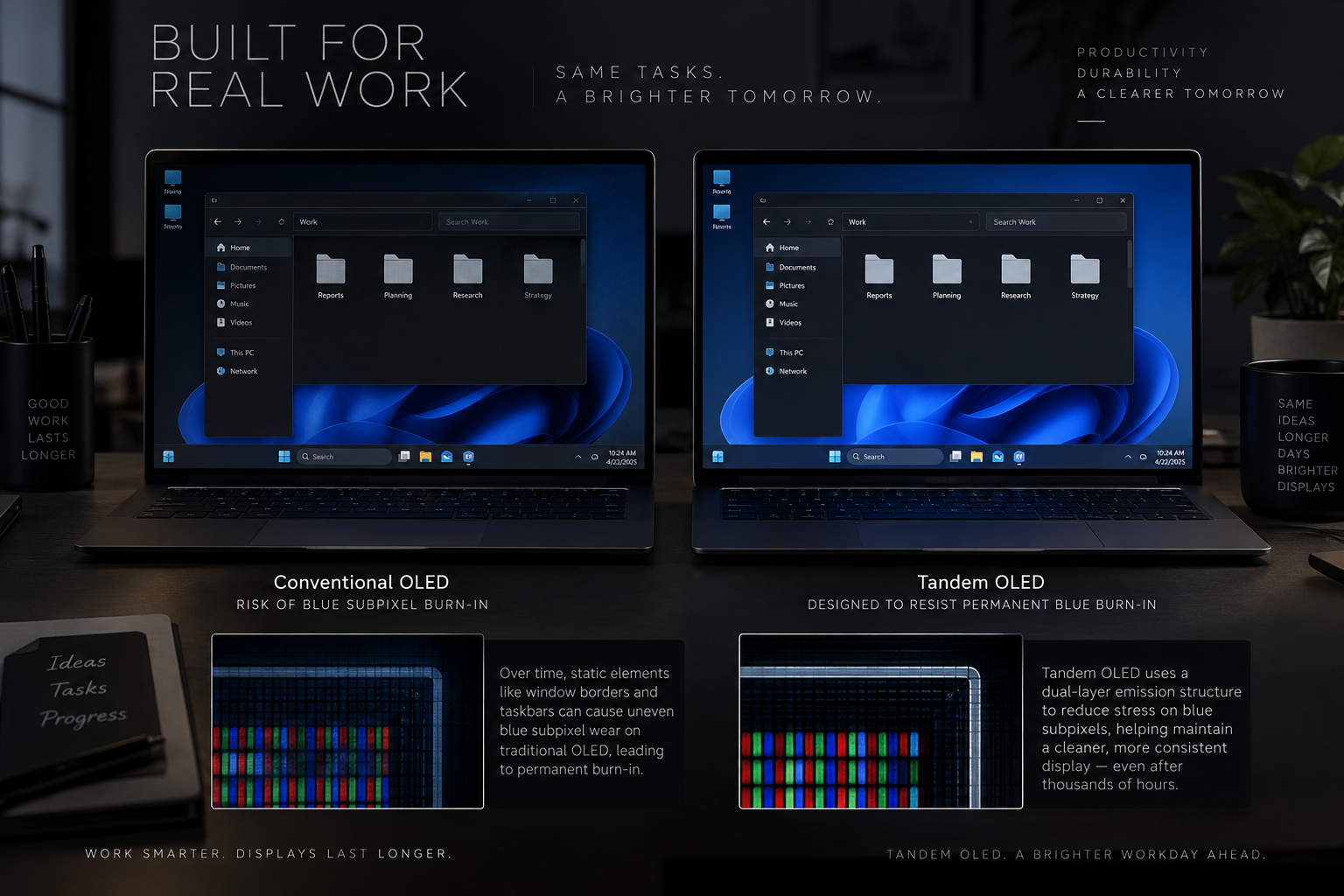
A monitor connected to a desktop computer faces a different daily pattern from a tablet used for photographs or a film. Windows, menus and taskbars may persist. A game may alternate motion with fixed interface elements. A buyer should examine the actual mixture of content rather than deciding that an entire device category has one uniform risk profile.
The availability of new specifications also makes comparisons harder. A glossy coating, a subpixel layout, refresh behavior and automatic brightness controls can all affect the experience. If a review reports better text or different reflections, read which property it tested. The stack is an important part of the story, but it shouldn't receive credit for every visible change.
🪟 A spreadsheet is a different workload from a film
Imagine two ordinary uses of the same display. One person watches varied video at moderate brightness. Another spends much of the day with a spreadsheet, a bright background and fixed window borders. This is an illustrative comparison, not a test result. It shows why total hours alone cannot describe how a screen's individual regions are driven.
An OLED screen generates light at the pixel level, so the image contributes to the electrical workload. A dark background and a bright document don't ask the emitters to do identical work. Repeating a static pattern can also create uneven use across the panel. The relevant question is what the pixels have been asked to display, at what brightness, and for how long.
That doesn't require people to reorganize their lives around a screen. Start with the manufacturer's defaults and instructions. Let the device dim or sleep when it isn't being used. Avoid leaving an unchanged high-contrast image at unnecessary brightness for long periods. On models that provide maintenance routines or pixel-care controls, follow the supplied guidance rather than copying settings from an unrelated display.
Dark mode can change the appearance and workload of an OLED interface, but it is not a universal cure for aging. It doesn't guarantee that all applications change their backgrounds or that every static element disappears. Nor does a moving wallpaper necessarily solve a fixed toolbar somewhere else on the screen. A useful habit has to match the actual content and device.
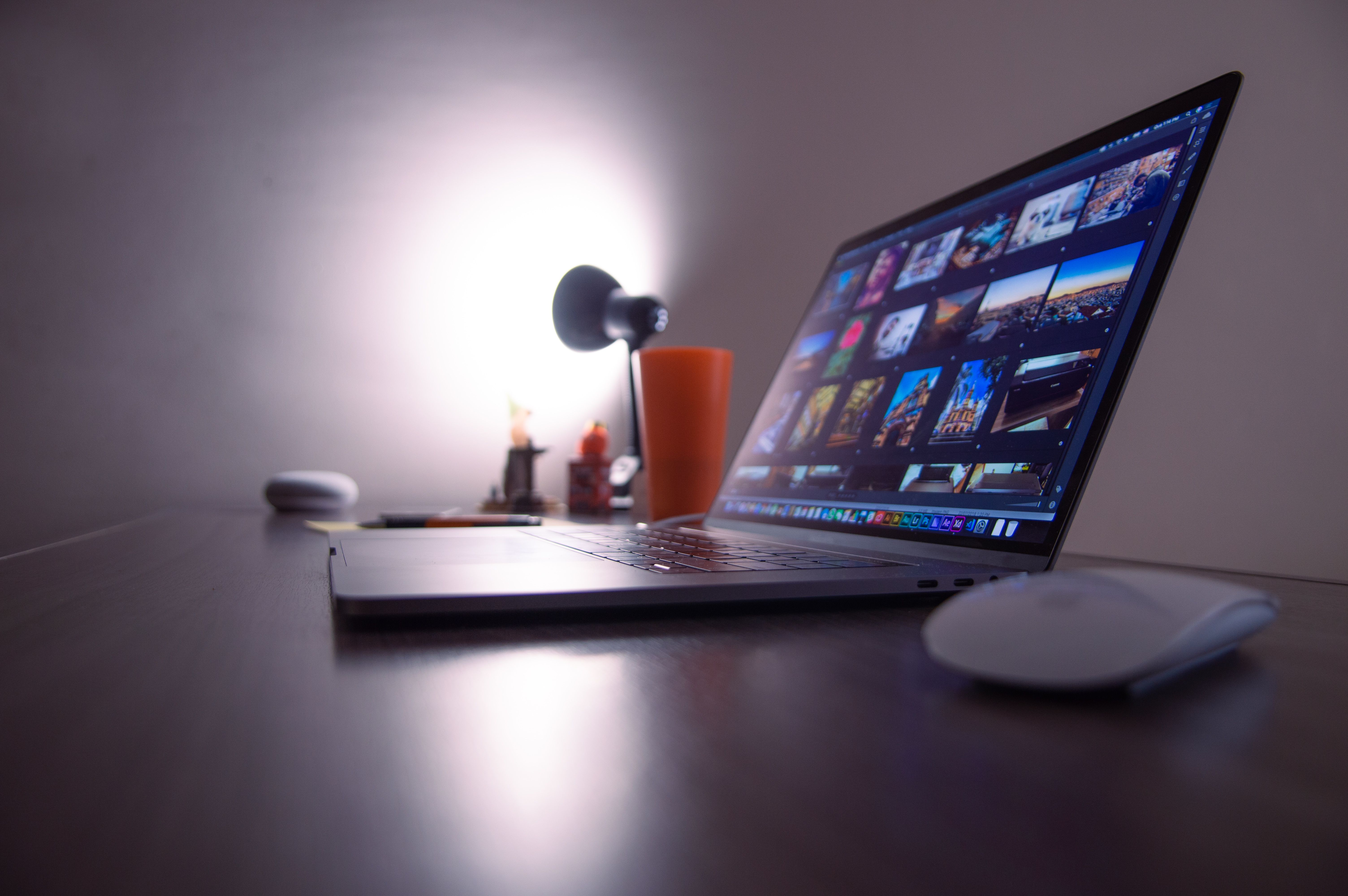
The Pexels workplace photograph is included as a generic illustration of sustained computer use. It establishes no panel technology and shows no measured burn-in. Its role is to keep the discussion anchored in real work, not to serve as evidence that a pictured laptop uses tandem OLED.
For a buyer whose day is dominated by static documents, another display technology may remain a reasonable choice. That judgment can include price, text rendering, reflections, battery runtime and warranty coverage. Choosing an LCD for a particular workload does not deny OLED's advantages. It simply refuses to treat one attractive image-quality characteristic as the whole purchase decision.
🧾 What a buyer can ask without becoming a materials scientist
Ask for the exact panel and product model first. A family name may cover configurations with different screens. Establish whether the quoted specification belongs to the version you intend to buy, and whether the seller is describing the panel supplier's claim or a measurement of the finished device. That small distinction can prevent several misleading comparisons.
Then separate peak brightness from sustained brightness and the content used for a measurement. A small highlight and a largely white document impose different demands. If a review provides measurements at different window sizes or picture levels, those results help explain behavior more usefully than a single largest number.
For durability, read the warranty language rather than relying on a headline promise. Ask whether burn-in is covered, how long coverage lasts, and which conditions apply in your market. A general warranty and an explicit burn-in policy aren't necessarily identical. Don't assume that a policy quoted for one country or model applies to another.
Useful questions include:
- Does this exact configuration use the advertised tandem panel?
- What brightness can it sustain for the content I use most?
- Which protection and maintenance features are active by default?
- Does the warranty explicitly address burn-in in my country?
- Are the battery figures measured at a comparable brightness and workload?
- How does text look in the applications and scaling settings I actually use?
None of these questions requires a consumer to judge molecular chemistry. They connect engineering possibilities to a purchase that can be checked. A credible seller should be able to point to specifications, documentation or terms instead of asking the buyer to accept a technology label as sufficient evidence.
For readers in Indonesia, import status and local support can be as consequential as panel architecture. Before buying, confirm the seller's stated warranty provider and the process for a display complaint. This is purchasing advice, not a claim that a particular brand refuses support. The value of a protection policy depends on whether it actually applies to the unit being purchased.
🎯 The gain is headroom, not immunity
Tandem OLED gives display engineers another way to manage the relationship between light output and stress. Research explains why distributing emission across connected units is useful, and LG Display's manufacturing announcement shows a concrete laptop-panel application. Apple and ASUS show that the result can support different product goals while retaining explicit protections and caveats.
The sources do not establish one lifespan number for the whole category. They don't prove that a blue laboratory emitter is the material in a particular consumer panel, or that a manufacturer's comparative efficiency claim becomes the same increase in battery runtime. Preserving those limits makes the technology easier to understand, not less impressive.
The strongest reason to care is that a display improvement can be spent on something less visible than a spectacular demo: maintaining a useful image with less stress at the chosen operating point. Whether a product makes that choice requires evidence from its specifications, measurements and support terms. The same engineering capacity can also be spent on higher brightness.
For the next purchase, keep the distinction intact. Tandem is an architecture. Brightness is a behavior under stated conditions. Burn-in coverage is a contractual promise. A good screen decision asks about all of them, then returns to the work, games and images that will actually occupy the display.
*Sources: LG Display's laptop-panel announcement, Apple's iPad Pro launch, Apple display guidance, Xiao et al.'s tandem WOLED review, Kim et al.'s blue OLED study, and ASUS PG27UCWM specifications. Analysis and purchase scenarios are editorial interpretation, not independent panel testing.*