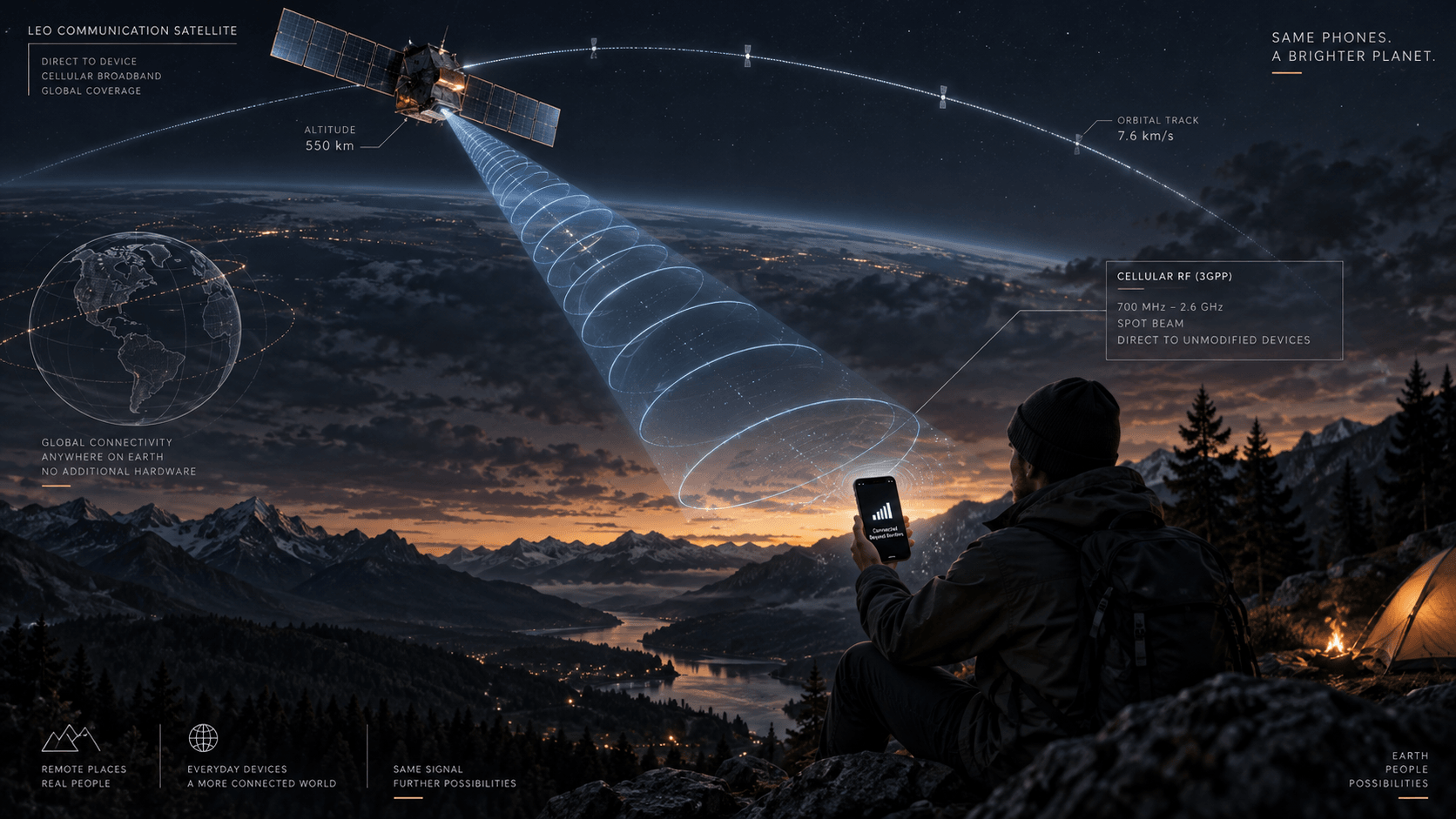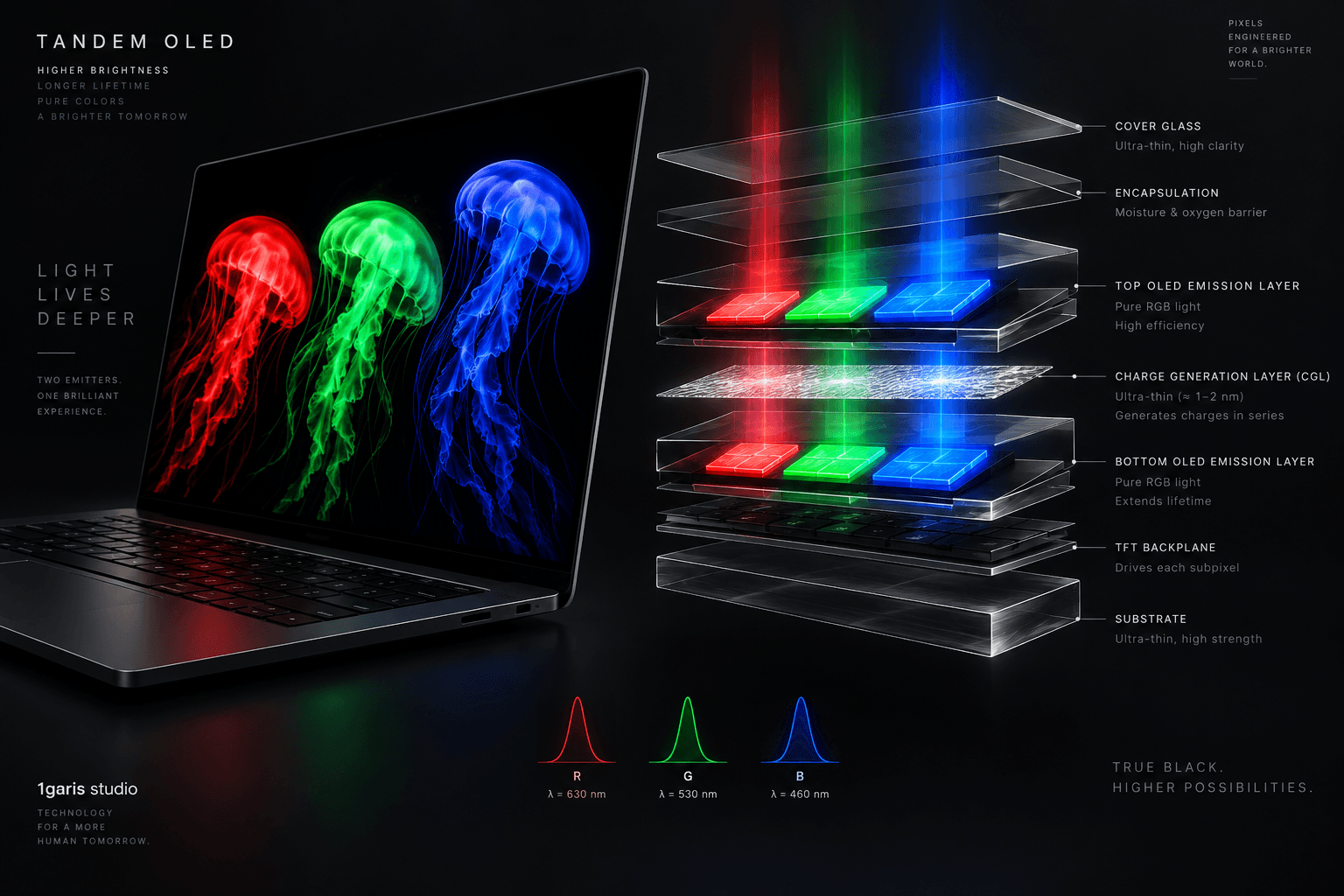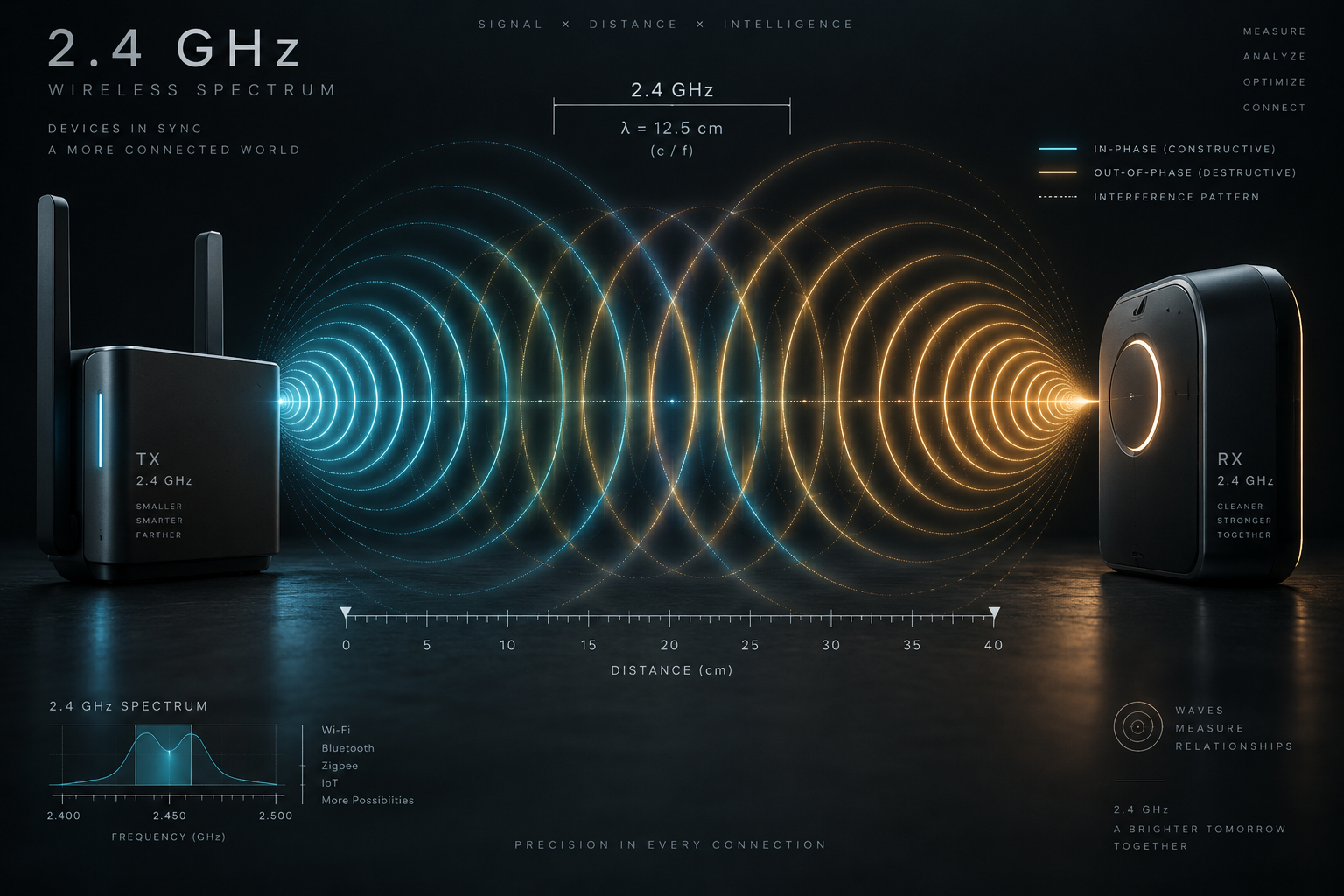
A tracker can hear your phone without knowing whether it is under the sofa or in the next room. That distinction explains why Bluetooth 6.0 Channel Sounding matters. It adds a way for compatible devices to measure their separation using radio phase and timing, rather than treating a louder signal as evidence of a shorter distance.
Bluetooth SIG announced the feature on 3 September 2024. It is not an October 2026 invention. What makes it worth examining now is the distance between a published specification and an experience people can actually use: compatible chips, smartphone support, software APIs, measurement algorithms, and products must all come together. The interesting question is how much trust a distance reading deserves, especially when it decides whether a door opens.
📡 Hearing a device is different from measuring it
Bluetooth already does several jobs that people casually group together as location. A device can advertise its presence. A phone can discover that advertisement and establish a connection. A tracker can make a noise after receiving a command. A network can report where another participating device last encountered a tag. None of those operations necessarily produces an accurate measurement of the distance between your phone and that tag.
Bluetooth SIG's technical overview separates these capabilities. It traces Bluetooth LE location services to the Find Me Profile, introduced in 2010, and describes later direction-finding features. Presence, direction, and distance answer different questions. A directional arrow needs information that a single distance reading does not contain. A map location needs a reference to the outside world that a radio exchange between two nearby devices does not automatically provide.
That distinction prevents a common buying mistake. A product described as a Bluetooth tracker is not therefore a precision-ranging product. A product that supports a recent Bluetooth core version is not therefore guaranteed to implement every optional feature within it. Consumers need the supported function, not just the largest version number on a comparison chart.
Channel Sounding is a two-device measurement procedure. One participant is called the initiator and the other the reflector. They exchange signals and obtain observations from which software can estimate their separation. It is closer to taking a measurement together than to overhearing a beacon across a room.
The experience still depends on product design. A manufacturer must decide when to measure, how to display uncertainty, whether to combine readings, and what to do when the result changes. Those decisions sit above the basic radio procedure. A standard can make an exchange interoperable without prescribing every button, arrow, or unlock threshold in the finished application.
For a reader comparing products, the first useful question is therefore specific: does this phone support Channel Sounding with this accessory and this application? Asking whether both devices have Bluetooth is too broad. Asking whether they have Bluetooth 6.0 is better, but still incomplete. A real demonstration with the exact pair tells you more than a version badge alone.
📉 Why signal strength makes a poor ruler
Before Channel Sounding, a common Bluetooth distance estimate relied on received signal strength, often abbreviated RSSI. The receiver measures the power of a signal arriving at its antenna. With assumptions about transmitted power and propagation loss, software turns that observation into an estimated distance. In a simplified environment, a weaker signal usually corresponds to a more distant transmitter.
The trouble is the word simplified. In a home, radio energy meets furniture, walls, people, metal surfaces, and other obstacles. Some energy is absorbed. Some travels along reflected paths. The receiver observes the result of that environment, not a clean label telling it how many centimeters the direct path covers. A change in signal strength can come from movement, obstruction, antenna orientation, or a combination of those factors.
That does not make RSSI useless. It can help distinguish broad proximity or support a warmer-colder interface. It is also available in an enormous installed base. The error is demanding the behavior of a precise ruler from a measurement designed to tell you how much radio power arrived.
Consider a hypothetical tag on keys. You rotate your body while holding the phone, and the display suddenly reports that you are farther away. The keys have not moved. The propagation conditions have changed. This example is an explanation of the measurement problem, not a test result from a particular tracker. It shows why a product needs to avoid presenting every fluctuation as literal movement.
Bluetooth SIG's overview describes the limitations of RSSI and path-loss calculations as the motivation for a different approach. Channel Sounding measures properties of exchanged radio signals that can be related to distance more directly. It does not simply add a smarter conversion table to the old signal-strength reading.
There is also a practical lesson for interface designers. A smooth numerical display can conceal a noisy estimate. Showing two decimal places does not establish two-decimal-place accuracy. If software reports a confident-looking distance while the underlying observation is uncertain, the visual design has supplied confidence that the measurement did not earn.
A useful product can show a range, a quality indication, or an instruction to move into a better position. Those are editorial recommendations rather than requirements quoted from the specification. They follow from a simple obligation: the display should help the reader understand what the device knows and what it is still estimating.
🌊 Reading the phase of a radio wave
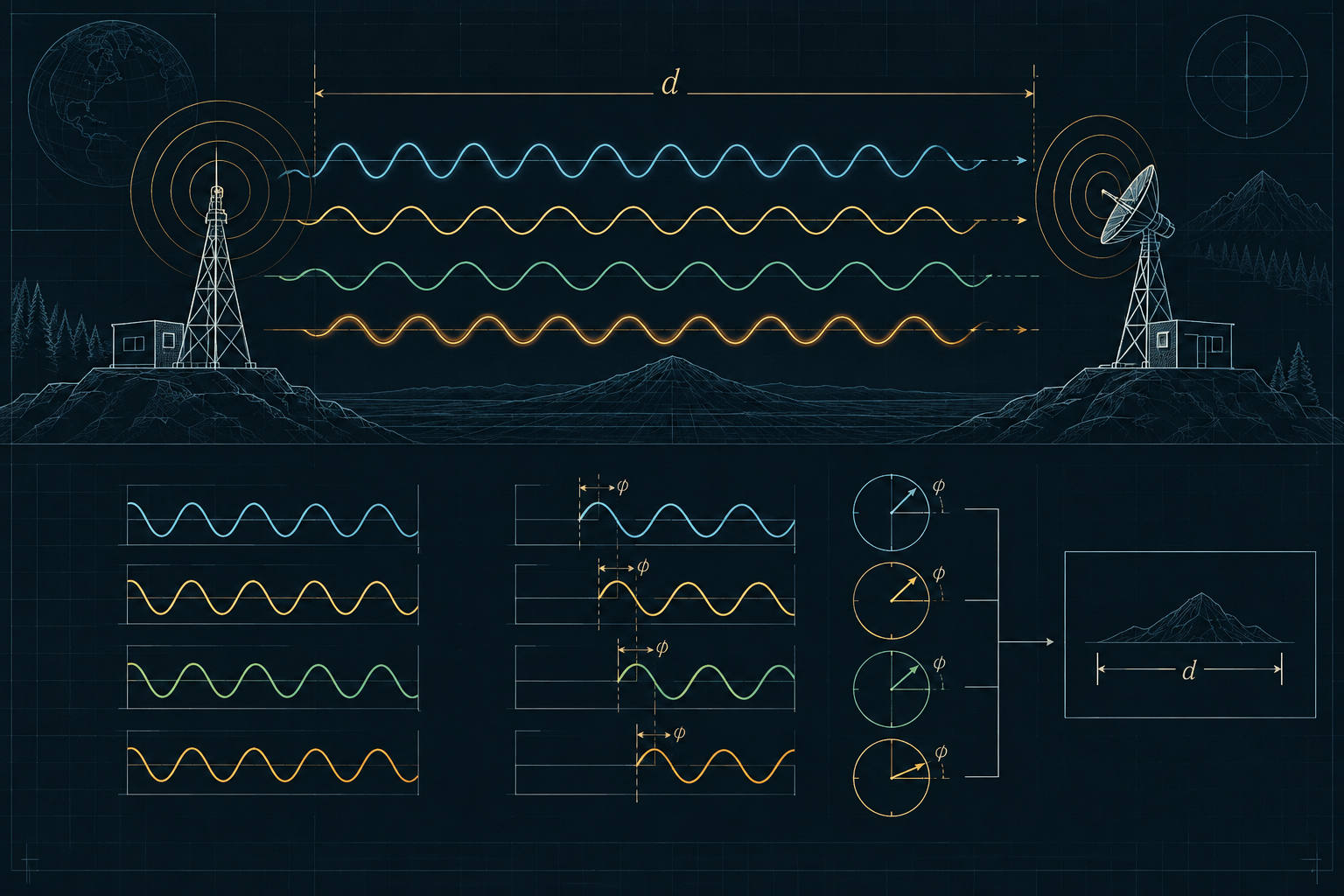
Phase describes a position within a repeating wave cycle. If two signals have the same frequency but reach corresponding points in their cycles at different moments, they have a phase difference. Radio propagation changes the phase observed at the other end of a path. That makes phase useful for ranging, provided the system can deal with the ambiguity created by repetition.
A wave repeats. One observed phase difference can be consistent with more than one possible path length. Measuring at a single frequency therefore does not magically produce a unique distance. Channel Sounding uses exchanges at multiple frequencies to obtain a richer set of observations. Software can use the relationship among those measurements to estimate the separation of the devices.
Bluetooth SIG calls this phase-based ranging, or PBR. The initiator sends a signal and the reflector participates in the return exchange. Both devices contribute measurements. Calling the second device a reflector should not make readers imagine a passive mirror: it is an active participant in the protocol, with compatible radio capabilities and scheduled behavior.
The technical overview identifies 72 allowed Channel Sounding channels, spaced at 1 MHz, within the 2.4 GHz band. The detailed specification indexes 79 possible RF channel positions and excludes some of them from Channel Sounding use. Those two numbers describe different things. Seventy-two is the count of allowed channels, not a contradiction of the indexed table.
The channel arrangement avoids the primary LE advertising channels. The overview explains that the 1 MHz separation helps defer distance ambiguity to around 150 meters. That is a property of the measurement design, not a promise that every consumer tracker works accurately across a 150-meter room, street, or building.
To select which channels to use and in what order, Bluetooth Core Specification 6.0 defines a dedicated set of channel selection algorithms known as CSA #3, divided into CSA #3a, CSA #3b, and CSA #3c. CSA #3a is designated specifically for selecting channels during mode-0 calibration steps. For the active measurement steps that follow, the devices agree on either CSA #3b or CSA #3c for that procedure instance. The protocol maintains two separate channel tables: one dedicated to calibration steps and another for the active sounding exchanges. This structured hopping across the 72 allowed channels ensures that the frequency steps are distributed in a repeatable, coordinated sequence that the algorithms can reconstruct into a coherent phase profile.
Multiple frequencies also do not abolish the environment. Reflected paths can influence phase measurements, and algorithms must interpret the observations. Antenna configuration, calibration, and the quality of the radio exchange all remain relevant. The new procedure gives developers better inputs; the finished estimate still needs engineering.
It is tempting to summarize the technology as a radio tape measure. The analogy is useful only if we remember that the tape is inferred from observations. There is no physical strip stretched between the devices. The estimated result can be excellent in one configuration and less dependable in another. Readers should look for stated test conditions whenever a vendor offers a precision claim.
🔁 A second measurement checks the first
Round-trip time, or RTT, uses another relationship between radio propagation and distance: signals take time to travel. In a ranging exchange, the devices record departure and arrival information. Software can account for the exchange and estimate distance from the time spent traveling between the participants.
The distinction from an ordinary network ping matters. A ping measured by an application includes processing, operating-system scheduling, and other delays. Channel Sounding timing is part of a defined radio procedure. The useful observation is not simply how long a phone application waits for an answer to appear on screen.
At the physical layer, Bluetooth 6.0 introduces a dedicated radio mode known as LE 2M 2BT. In traditional Bluetooth Low Energy, devices communicate using LE 1M, LE 2M, or LE Coded PHYs, which use a Gaussian frequency-shift keying filter with a bandwidth-time product (BT) of 0.5 and a minimum frequency deviation of 185 kHz or 370 kHz. LE 2M 2BT changes those physical characteristics significantly: it doubles the symbol rate to 2 megasymbols per second, raises the BT product to 2.0, and widens the minimum frequency deviation to 420 kHz. That wider deviation and steeper pulse response provide the sharper timing resolution needed to capture departure and arrival transitions accurately, but it may only be used during Channel Sounding exchanges.
Bluetooth SIG describes RTT as an independent distance-bounding technique that can cross-check phase-based ranging. Its public explanation connects that function to resistance against sophisticated relay attacks. PBR supplies fine-ranging information; timing provides another basis for assessing whether the apparent proximity is plausible.

The specification also includes cryptographically generated material in the exchange. Its Channel Sounding packet description identifies access addresses generated using a deterministic random bit generator and describes optional sounding and random sequences. The point is not to make a distance display look encrypted. Unpredictable protocol material can help make manipulation harder to arrange.
A reader does not need to memorize each packet field to understand the security logic. A system should avoid deciding that a device is nearby solely because an attacker can repeat a familiar signal with more power. It should collect observations that are harder to fake consistently, and the product should use those observations within a properly authenticated access decision.
Combining methods also requires care in how results are described. A vendor may support PBR, RTT, or a combination, depending on its implementation. Silicon Labs explicitly describes these alternatives on its product page. The strongest general explanation of the standard is not a guarantee that every shipped device enables every measurement mode in the same way.
Security and accuracy meet here, but they remain different properties. A reading can be numerically close while the surrounding authorization system is poorly designed. A securely authenticated device can produce an uncertain measurement in a difficult environment. Responsible products must handle both questions instead of treating a precise-looking number as a complete security verdict.
🔐 The door needs identity as well as distance
A relay attack attempts to make a remote authorized device appear present where an access system expects it. Instead of defeating the credential directly, an attacker forwards communication between locations. Proximity becomes the disputed claim. An access system that relies on a weak proxy for closeness can be vulnerable even when the credential itself is genuine.
Channel Sounding gives developers tools to make that claim harder to manipulate. Bluetooth SIG's launch announcement identifies digital keys as a target application, alongside finding misplaced items. It describes the goal of opening a lock only when an authorized device lies within a chosen distance. The words authorized and distance both matter.
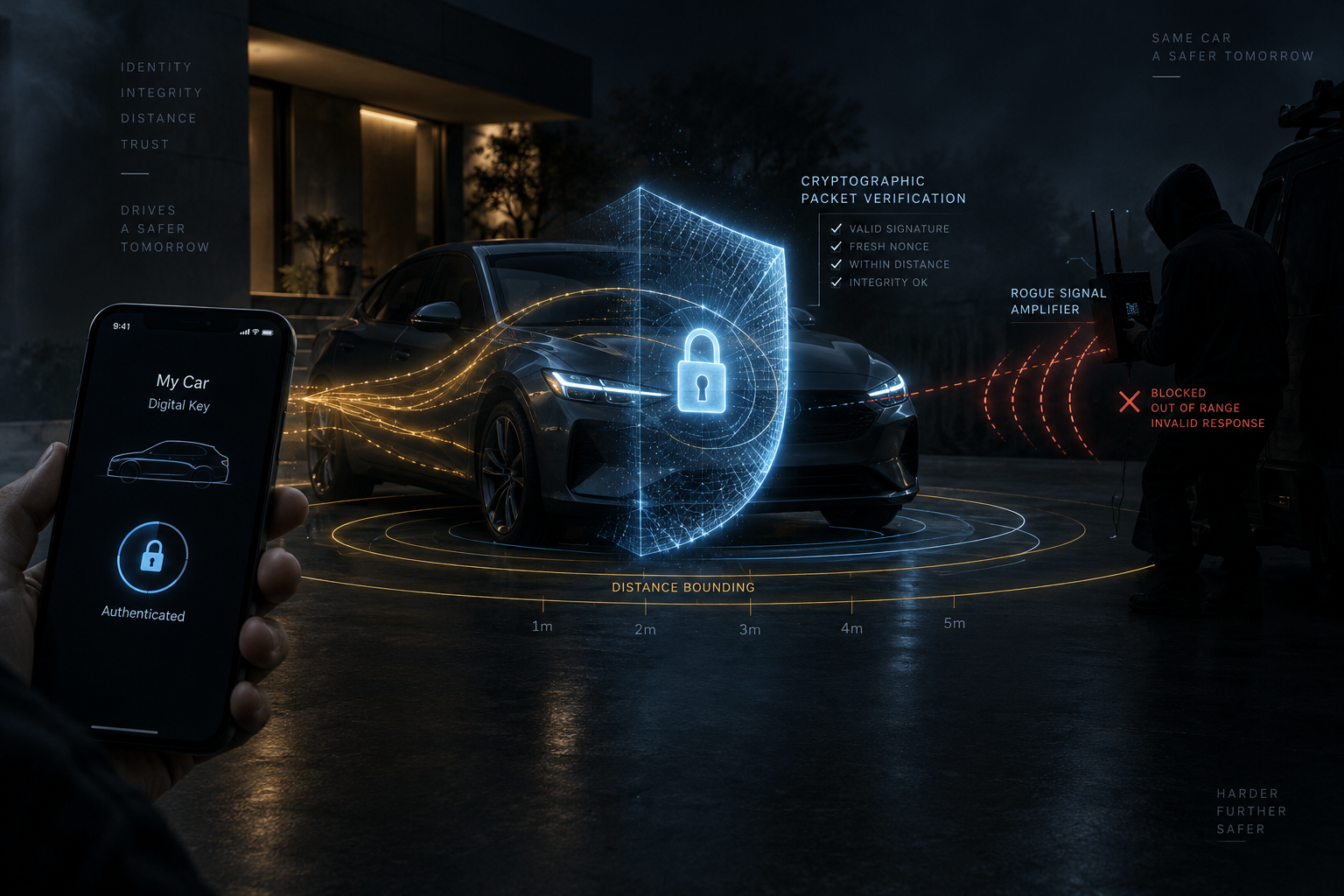
A nearby unknown phone should not unlock your door. A known phone far away should not necessarily unlock it either. The product needs authentication, permission management, and a proximity policy. It also needs rules for revocation, lost phones, battery failure, and fallback access. Radio ranging answers one part of that larger problem.
The launch announcement contains statements from vehicle-connectivity organizations about studying or adding Channel Sounding to their specifications. Those statements are evidence of interest and plans at the time of publication. They are not proof that every vehicle in those ecosystems already shipped with the feature, nor that a particular manufacturer's current digital key uses it.
It would therefore be irresponsible to describe Channel Sounding as ending vehicle theft. It is designed to mitigate relevant ranging attacks, not every route by which a vehicle or account can be compromised. A product can fail at another layer, and an owner can still need ordinary security measures unrelated to radio distance.
The useful consumer question is narrower: what technology does this access system actually use to establish proximity, and what happens if the reading is inconclusive? A manufacturer that explains those conditions is offering more useful information than one that advertises a blanket secure label.
For designers, ambiguity should be a planned state. If the system cannot establish acceptable proximity, it should follow a documented fallback rather than invent certainty. The right policy depends on the application. A tag-finding screen and a vehicle unlock decision do not have the same consequences when a measurement is wrong.
🧩 A specification needs two compatible endpoints
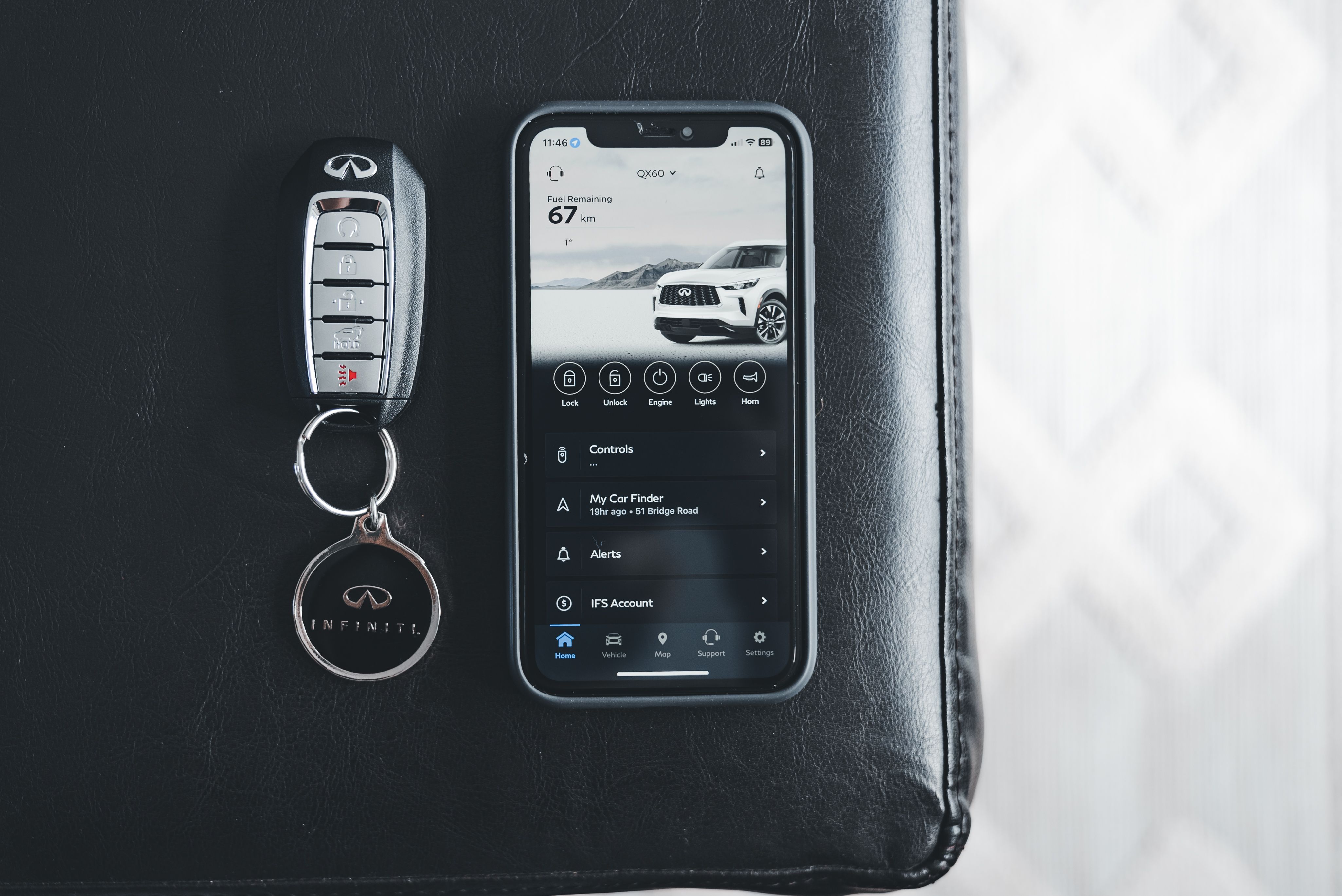
Channel Sounding cannot be judged by examining only the accessory. Both sides of the exchange need the relevant capability. Silicon Labs states this explicitly: the two devices must include Channel Sounding support. Its page describes development solutions built around EFR32BG24, EFR32BG24L, and EFR32BG2B devices, with availability and product positioning that readers should check before purchasing.
Nordic's product page describes official support in the nRF54L series, with a qualified host and controller available in nRF Connect SDK from version 3.0.1 onward. It also distinguishes Channel Sounding from Nordic Distance Toolbox, a proprietary ranging solution supported by older nRF52 and nRF53 families. Older hardware offering a ranging function is not automatically implementing the new standardized procedure.
That distinction prevents an overly broad claim about upgrades. Some capabilities can be enabled through software on hardware already designed for them. Software cannot universally manufacture a missing radio feature. Whether an existing device can support Channel Sounding depends on its hardware and stack, not on whether its owner installs the newest application.
Nordic also explains where distance estimation happens. The initiator contains an application-level algorithm that turns raw observations from the radio and stack into a distance measurement. Its sample provides an open, free-to-use IFFT algorithm for simple ranging cases, while more advanced applications may require other algorithms. Interoperability at the exchange layer does not make every estimate identical.
A Bluetooth SIG article dated 1 June 2026 discusses smartphone support and identifies the Google Pixel 10 series as providing Channel Sounding distance estimation. This is a dated ecosystem signal, not a claim that all Android phones now support the feature. The same article emphasizes endpoint support and qualification as adoption gates.
Developers therefore have several separate checks to make: controller capability, host support, application API availability, accessory interoperability, and measurement behavior under real conditions. Consumers can ask for the equivalent in plain language: which phone models, which operating-system versions, and which accessories work together?
🚗 The everyday experience should reveal its limits
Imagine looking for keys behind a cabinet. A precise distance reading could narrow the search more effectively than a signal-strength bar. But a number alone still leaves a circle of possible positions around the phone. Direction information or movement can add context. Channel Sounding does not automatically turn one reading into a complete three-dimensional location.
This is why product demonstrations deserve careful reading. A clean test bench can show that the radio procedure works. A furnished home tests whether the product can interpret reflected paths, communicate uncertainty, and guide a person sensibly. A parking area adds another environment. None of those scenes should be silently substituted for the others in a precision claim.
Silicon Labs reports that its testing achieved sub-meter accuracy, including non-line-of-sight conditions at distances greater than 30 meters. That is a vendor test claim with its own setup, not an independent guarantee for a future tag in your apartment. Bluetooth SIG's launch material discusses centimeter-level potential, including an attributed Samsung statement. Those descriptions should remain attached to their sources and conditions.
A useful review would describe the devices, firmware, distances, obstacles, antenna orientation, and how repeated readings behaved. It would report failures as well as successful measurements. Without those details, a single precision number is hard to compare across products, even when every vendor uses the same standard name.
There is a privacy question too. Distance awareness can serve convenient automation, but designers should explain who can initiate measurements and what data the application retains. A local radio procedure does not by itself establish the privacy policy of the service around it. Permission controls and data practices remain product responsibilities.
For users, a practical evaluation is possible without becoming a radio engineer. Ask to see the feature operate with your phone. Try the actual environment in which you need it. Check whether the display admits uncertainty. Read the supported-device list and fallback instructions before relying on the system for access.
The strongest product experience will probably be quiet. It will provide useful guidance or an appropriate access decision without making the user study waveform plots. But the manufacturer still owes the reader an honest explanation of where that confidence comes from.
🧭 Buy the function, not the version badge
Bluetooth 6.0 introduced Channel Sounding, but it did not erase every older Bluetooth capability or turn every connected device into a precision locator. The standard adds a specific measurement procedure to an established ecosystem. Its value depends on whether a product implements it and whether the whole device pair makes useful decisions from the observations.
Comparisons with ultra-wideband should be equally careful. UWB and Bluetooth ranging have different technical designs and product ecosystems. The sources examined here do not establish a universal price or power advantage for every Channel Sounding implementation. A claim that one always replaces the other would need evidence from comparable devices and workloads.
The better comparison is application-specific. What accuracy does the task need? Does it also need direction? Which devices must participate? How often will they measure? What happens when an obstacle reduces confidence? What security property is required before a door opens? Those questions are more useful than declaring one radio the winner in every setting.
The same discipline applies to upgrades. A supported chipset is a starting point, not a finished feature. A working application is more persuasive, and a documented compatibility matrix is essential. If the seller cannot name the supported phone-accessory combination, the buyer should not fill that gap with assumptions about a version number.
A short purchasing checklist can keep the decision grounded:
- Confirm explicit Channel Sounding support at both endpoints.
- Check the supported phone, operating-system, and accessory versions.
- Look for accuracy claims with stated test conditions.
- Separate distance measurement from direction and map location.
- For digital keys, read authentication and fallback instructions as well as ranging claims.
- Treat a demonstration as evidence of that setup, not of every possible environment.
The most important change is conceptual. Radio connection and physical proximity no longer need to be treated as the same fact. Channel Sounding gives compatible products a better way to investigate the second question. That can make finding and access experiences more useful, provided the product does not claim more certainty than its measurement supports.
A distance reading earns trust when its implementation, conditions, and limits are visible. The Bluetooth badge opens the conversation. The behavior of the exact devices should settle the purchase.
Sources: Bluetooth SIG's 3 September 2024 launch announcement, Core 6.0 feature overview, Channel Sounding technical overview, Core 6.0 Part H, and 1 June 2026 distance-awareness article; Nordic Semiconductor's Channel Sounding product documentation; Silicon Labs' Channel Sounding documentation. Vendor performance statements are attributed claims, not independent tests by 1garis.