A photograph of a flooded street arrives in a family chat. Someone asks whether the water is really that high; someone else asks when it was taken. A plausible image alone cannot settle either question. On September 15, 2026, Apple described Reference Image, an optional way for the iPhone 18 Pro and Pro Max to preserve and authenticate what their main camera sensor captured. The interesting question is narrower than “can we trust pictures again?” It is: what exactly could a signed camera capture prove, and what would still require a person to investigate?
Apple's answer begins unusually close to the sensor. It promises evidence about pixels and a bounded time of capture, followed by controlled processing into a viewable reference. That is useful evidence. It does not certify the story attached to a picture, the identity of its photographer, or the reason a scene looked the way it did. The distinction matters to anyone who has received a photograph as an argument, not merely as a keepsake.
📷 A camera claim with a precise boundary
Apple announced the iPhone 18 Pro and Pro Max on September 9. Its September 15 security explanation presents Reference Image as an opt-in camera mode debuting on the main sensor of those phones. Apple Support, updated September 17, says the mode is off by default. These dates describe a product announcement and Apple's account of its design, not an independent audit of every claim in that account. The ordinary photo still exists alongside reference data. The distinction is essential: the normal picture may be styled or edited; the developed reference is meant to show a minimally processed comparison of what the sensor recorded. Apple newsroom; Apple Security Research; Apple Support.
Apple's unusually specific promise is worth quoting without making it bigger than it is:
“a real photograph, captured by a real sensor in an iPhone camera, at a specific time.” — Apple Security Research, “Apple Reference Image: A New Approach for Verified Photography”
The sentence concerns a particular reference image and Apple's verification chain. It does not say a viewer knows the photographer's name, where the photographer stood, or whether the caption is accurate. “Real” here has a technical object: sensor capture. Consider a photograph of a demonstration projected onto a wall. A camera can faithfully photograph the projection. Its pixels attest to light reaching the sensor, not to the projected demonstration occurring outside the room. A printout, another screen, or a carefully arranged tableau creates the same logical gap. This is an inference about what photography can establish, not a reported exploit against Apple's system.
An official screenshot of the Reference Image camera setting belongs here because the first hurdle is mundane: the mode has to be enabled and used. Under Settings, Camera, Reference Image, the user adds Reference Mode, then selects Reference in Camera. It is tempting to treat a device capability as something that automatically accompanies every photograph. Apple Support says otherwise. An ordinary picture from an eligible phone should not be described as having reference evidence unless that evidence was actually captured, developed, and available for inspection. The setting is an evidentiary choice at the moment of capture, not a universal label retrospectively stamped onto a camera roll. Apple Support.
This also shifts what a reader should ask of an image. “Was it made with AI?” can be important, but it is not the whole inquiry. A sensor can record a scene that was staged for the camera; a digitally created image can accurately illustrate a real event if plainly labeled. Rather than sorting everything into true and fake pictures, ask which claims the image is being recruited to support. Does it document the existence of an object in front of a lens? Is it offered as proof of a location, a date, a person's conduct, or a public emergency? Apple's mechanism is strongest on the first kind of question and on its claimed capture-time bounds. It leaves the surrounding propositions to journalism, witnesses, records, and context.
🔐 What the sensor and signatures actually bind
Apple explains why signing a finished JPEG is not the same thing as protecting capture. A modern phone transforms sensor readings into a usable image. If a system only signs the output after software processing, software or the path from sensor to processor could potentially introduce substituted pixels before the signature. Apple says its custom sensor enters a secure Reference capture mode and cryptographically signs pixel data immediately after capture, with sensor firmware prevented from modifying those data in that mode. Sensor-produced metadata is signed with the pixels; certain metadata originating elsewhere, such as digital zoom boundaries and focal length, is signed by the Secure Enclave Processor. These are Apple's architecture and security assertions, not test results established in this article. Apple Security Research.
The device makes what Apple calls a secure digital negative. It contains the captured data and information needed to produce the reference picture. Apple then describes a separate development stage in Private Cloud Compute, its remote processing environment. This split matters because raw sensor values are not themselves a photograph most people can inspect. They need operations such as demosaicing and lens-shading correction. The task is to get from signed capture to a visible picture without silently swapping the scene. Apple's published design says the processing code is publicly verifiable and its cloud environment keeps image contents private from Apple. A design claim is substantial information about the intended trust boundary, but it should still be attributed to its maker. Apple Security Research.
The time claim is also more careful than a clock reading in an image caption. Apple says the phone receives a cryptographic timestamp token periodically, with a global average interval of about fifteen minutes that varies with network conditions. The most recent token supplies a lower time bound; a second token requested after capture supplies an upper bound. Apple says capture occurred between them. That interval is not necessarily a single exact minute printed on the screen, and it does not by itself establish the location of a scene. Time-zone interpretation, a nearby event's timeline, and what the photograph depicts remain different questions. The virtue of bounded time is that the guarantee states its own limits instead of pretending the phone's ordinary clock is sufficient proof. Apple Security Research.
After development, Apple says its signing service embeds a signature in the reference JPEG; compatible clients check that signature and consult a current revocation list when displaying the picture. Apple describes checks tied to sensor identity and anomalous capture patterns as part of its resilience strategy. Revocation matters because a credential is not necessarily a forever-valid badge: if a sensor or device is later judged compromised, affected images can be flagged retroactively, Apple says, without publicly linking all images to the same sensor. The reader need not memorize the signing algorithm to understand the social consequence. Verification is a process with an issuer and a changing status, not merely a decorative checkmark frozen into a file. Apple Security Research.
No one outside the system should collapse this chain into “the phone proves the event happened.” It aims to authenticate a capture and the viewable reference produced from it. The question of whether a caption correctly interprets the capture belongs to a different chain, with different kinds of evidence. Keeping those chains separate makes the technical advance easier to appreciate, not less impressive.
🖼️ The reference picture beside the shareable one
Reference Mode saves a regular photo and signed data from the main sensor. To view the reference, Apple Support says the user opens the photo in Photos and taps its Reference badge. Development sends the reference data, associated metadata, sensor signature, and secure timestamps to Private Cloud Compute. It needs an internet connection. Once developed, the user can switch between the reference and the regular photo to spot a crop, color adjustment, or adjustment made with generative AI. Apple says the minimally processed reference may have less contrast and saturation. A difference is evidence of processing, not automatically evidence of deception: cropping can clarify a subject, and color adjustments can be ordinary editorial work. Apple Support.
The opposite reading is risky too. A close visual match between two versions is useful but cannot make the scene's caption true. Suppose a seller photographs a product sample on a table and attaches a caption saying every delivered unit will look identical. The reference may faithfully record that sample. It says nothing about the rest of the inventory. Suppose a photograph shows a street without visible traffic, and the post says a city has banned cars there. The captured view can be genuine while the explanation is unsupported. These examples illustrate limits of inference, not claims that a particular photographed seller or street exists.
A generic photograph of someone taking or sharing pictures can illustrate the moment evidence becomes a message. It should not be captioned as showing Reference Mode or presented as documentation of Apple's interface. A shared photo often arrives separated from the conversation around its capture. The sender may have seen the location in person; the next recipient sees only an attachment and a sentence. When the attachment travels farther, the sentence can change. A verification feature can give that next person a stronger account of the image's origin, provided the associated reference accompanies it and can be inspected. It cannot carry all the eyewitness knowledge that stayed with the original sender.
There are practical costs to preserving this extra evidence. Apple Support estimates additional storage of roughly 8 to 10 MB for undeveloped reference data at 12 or 24 MP, and about 3 MB after development. At 48 MP, the corresponding estimates are roughly 35 to 40 MB undeveloped and 7 to 8 MB developed. The figures are for additional reference data, not an estimate of the complete size of every regular photo. Apple says the secure digital negative moves to Recently Deleted after successful development and is otherwise purged after 30 days unless recovered. A person planning long-term documentation should distinguish keeping a developed reference from relying on the undeveloped negative to remain there indefinitely. Apple Support; Apple Security Research.
The capability is also narrower than the word “iPhone” in a casual headline. Apple lists iPhone 18 Pro and 18 Pro Max as the capture devices at launch. Some Camera features, including Night Mode, are unavailable in Reference Mode; Live Photos, Portraits, and Photographic Styles can be used, according to Apple Support. Viewing and development require compatible software, and development requires a network. That constraint matters in a rapidly moving situation: the person with the strongest potential capture evidence may not be able to make the viewable reference available immediately. An absence of a developed reference at one moment should not be converted into a verdict about whether the underlying event occurred. Apple Support.
🧭 A signed scene still needs a map
Imagine a photo of a full supermarket shelf posted during a shortage. The sensor could truly have seen a full shelf. The photo might be from a different branch, a different day within the claimed story, or a restocking interval; a tight crop might omit an empty aisle beside it. Apple's bounded capture time could help test one possibility if a reference is present, but there is no automatic sensor proof of branch name, neighborhood, supply conditions, or the broad claim “there is no shortage.” The interesting evidentiary work begins when someone asks what the image is a sample of. A single frame is a slice of a place and time, not a survey.
That distinction is especially valuable when an image is asked to settle a dispute in a chat group. People often respond to apparent precision with more confidence than the evidence deserves. A cryptographic signature sounds precise because it is precise about integrity. But precision in one dimension does not transfer to another. A signed capture time cannot establish why a crowd gathered. Sensor-origin pixels cannot reveal whether a sign was placed moments before the shutter. A reference image may help reject the allegation that an object was pasted into a particular shared edit while leaving open whether the object itself was staged. The claim has to be decomposed before the proof is assessed.
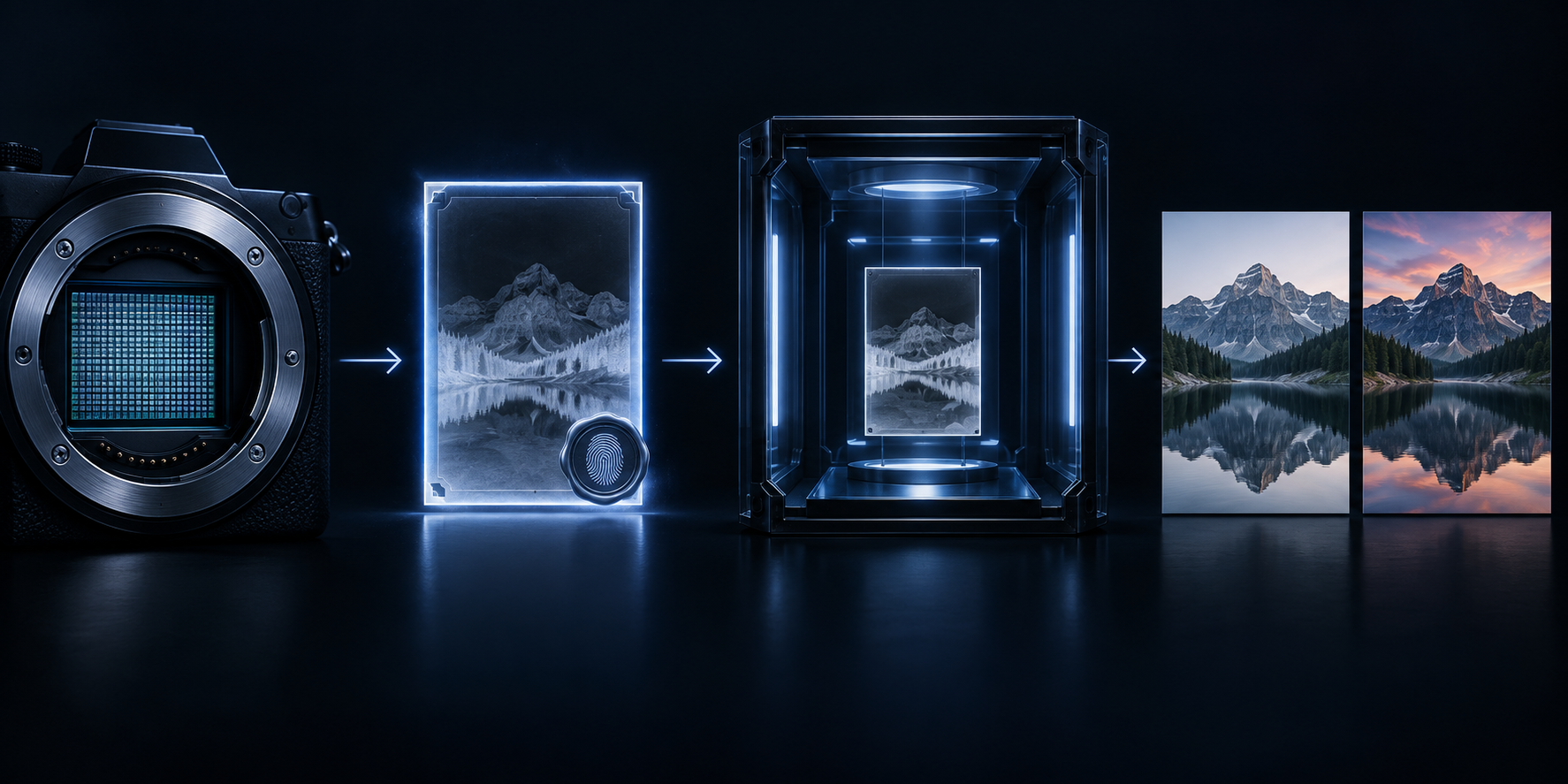
A conceptual diagram could draw two tracks from the same photograph. One track follows Apple's claimed camera path: signed sensor data, bounded time, controlled development, signature and revocation check. The other follows the human path: identify the place, ask who supplied the caption, compare independent accounts, and seek corroborating records. The second track is not an undocumented feature of Apple's software. It is the work an editor or an attentive reader must still do. The diagram's value is to keep these tracks visible rather than merging them into a green “verified” icon.
C2PA's own explainer makes a related distinction. Its Content Credentials standard records provenance assertions about digital assets, including creation and modifications, and cryptographically binds that history to the asset. The explainer says a valid credential does not make a value judgment that the information asserted is true. It is designed to show whether provenance information is well formed, untampered with, and associated with an accepted signer and asset. The standard explicitly says it is not a cure-all for misinformation and complements fact-checking, media literacy, and digital forensics. Apple's system and C2PA are different technical approaches, but both discussions expose the gap between document integrity and the truth of every statement made with a document. C2PA explainer.
A useful habit follows: restate a photo's claim in ordinary language before looking for the badge. “This was photographed by a compatible sensor within a bounded interval” is one proposition. “This shows our town's bridge today” adds geography and identification. “The bridge is unsafe” adds an assessment that may require engineering evidence. Each sentence raises a new burden. Reference Image can be an unusually strong answer to part of the first proposition, on Apple's account. It does not make the later sentences fall into place simply because they appear underneath the same picture.
🔎 Provenance is not one universal badge
Apple criticizes approaches that attach provenance only after capture because, in its account, altered pixels could enter earlier in the pipeline. Its answer is to bind sensor data at capture and develop it in Private Cloud Compute. C2PA's published explainer describes a more general, interoperable framework for assertions about an asset's origin and edits across tools and organizations. These statements should not be flattened into “Apple replaces C2PA” or “C2PA already does exactly the same thing.” The scope of the guarantees and the point at which each system begins making them differ. Apple's criticism of earlier signing points is Apple's security analysis, not an independently demonstrated failure of every C2PA-enabled camera. Apple Security Research; C2PA explainer.
Think of a chain of custody for an object. One record might establish where a particular chain begins; another might document transfers and alterations afterward. Neither automatically proves the label on the object is accurate. A sensor-bound reference and a provenance history could answer different questions in a publishing workflow, but this is a conceptual comparison, not a claim of a released interoperability feature between Apple Reference Image and Content Credentials. A newsroom might care about both the camera capture and the edits that made a photograph ready for publication. A reader might care whether a transparent crop was used to focus attention or whether an element was introduced later. Specific evidence matters more than the presence of a fashionable badge.
The public Content Credentials Verify site cautions that credentials are still rolling out and that some inspected content may contain no information to view. An empty result there is not proof that an image was fabricated. Conversely, a credentialed image deserves a reading of the actual assertions and signer, not unthinking acceptance. The project's introduction to its official icon also explains that identity information can be optional. Do not assume a provenance mark inherently discloses a person's legal identity, or that the absence of such disclosure is proof of an anonymous hoax. These details matter when people start using “verified” as shorthand for several separate ideas. Content Credentials Verify; Content Credentials icon; C2PA explainer.
Before sharing a striking picture, consider what the evidence actually accompanies. Is there a developed reference available to compare with the regular photo? Has a crop excluded something important? Does the claimed place have independent support? Can a sender explain when and why they took the picture? These questions do not require every family chat to become a forensic laboratory. They prevent a signed record of pixels from being mistaken for a signed interpretation of history.
🛡️ Privacy has a practical edge
Apple's design states a privacy goal: outside observers should not be able to tell whether two reference pictures came from the same device, and Apple should not see the image contents while Private Cloud Compute processes them. It also describes a way to revoke fraudulent images without publicly exposing the photographer's identity. These are material design assertions, especially for someone photographing in a sensitive setting. They are not a promise that an image can never reveal its maker through the scene itself, ordinary file metadata, accompanying messages, or the choices of the person sharing it. Privacy in the verification architecture and privacy in a social encounter are different problems. Apple Security Research.
One warning in Apple's own support page makes the distinction concrete. Sharing or exporting a Reference Mode photo before its reference has been developed may expose sensitive device information, including a serial number, and the full frame regardless of the zoom setting at capture. That full frame could matter if the crop or zoom was intended to keep someone outside the shared picture. Apple allows users to choose whether to include the reference when sharing a photo and provides sharing and transfer settings. The safe question before forwarding is not merely “is this authentic?” but “what additional information am I sending?” Apple Support.
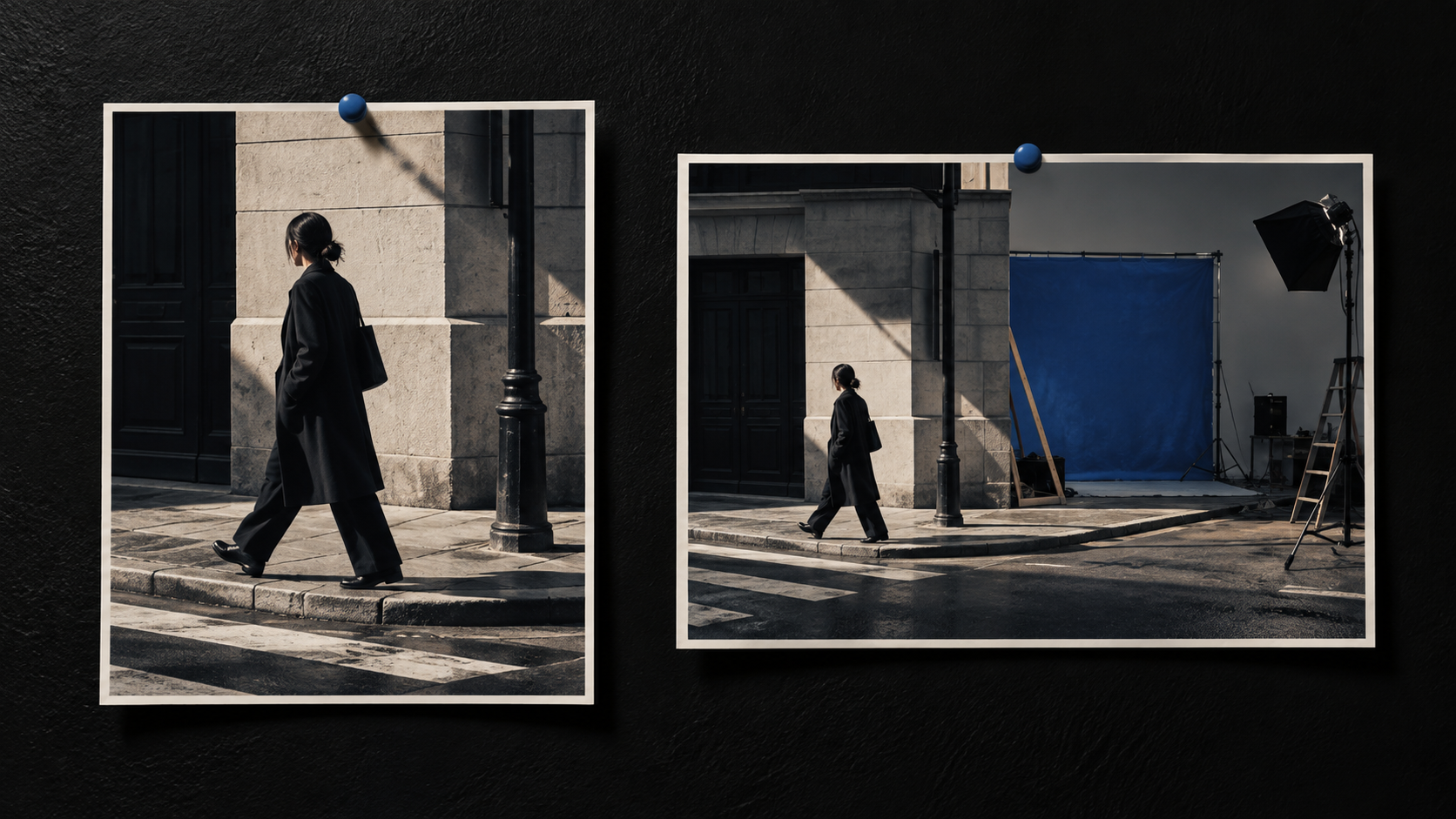
A symbolic image of a framed scene with visible space outside the frame could carry this idea without posing as forensic evidence. The invisible surroundings are the problem of context; the potentially exposed full frame is a separate, concrete sharing risk described by Apple. The same picture can matter deeply to two people for opposite reasons. A witness may want to prove that a sign or person appeared in front of the camera. Another person in the wider frame may not want identifying details circulated. A verification feature therefore asks for an ethics of disclosure as well as an ethics of belief.
Geography sets further limits. Apple Support says capture in Reference Mode is unavailable in the EU, although supported devices there can develop and view reference images under the listed operating systems. In China mainland, users cannot capture or develop references but can view ones shared with them. Apple lists iOS 27, iPadOS 27, and macOS 27 or later for viewing on the respective devices. These are availability statements from Apple, not a universal map of access for all people and software. They also mean that a reader cannot treat the absence of a reference from a photograph taken in one of those settings as suspicious by itself. Apple Support.
The privacy question will not be resolved by a single switch. Sometimes supplying a reference may strengthen a public claim. Sometimes the person sharing should first develop it, inspect what will travel, and decide whether the stronger proof justifies the extra exposure. The capacity to decline is part of responsible use, not an admission that the picture is false.
📰 What a careful reader and editor can ask
Take the hypothetical flooded-street picture again. A reader might first save the caption's exact claim, rather than mentally replacing it with a vaguer one. “The underpass by the hospital was flooded this morning” contains a place, an event, and a time. If a developed Apple reference accompanies the regular photo, inspect the two versions and the information Apple makes available. The reference can help answer whether a visible object or waterline was added in an edit and whether the capture fits the claimed time interval. Check whether the relevant reference can actually be viewed on a compatible device. If there is no reference, do not treat its absence as a verdict; the sender may lack a compatible device, may not have enabled the mode, or may have omitted it from a share. These are possibilities, not facts about any particular sender. Apple Support.
Next, investigate the propositions the sensor cannot sign. Compare the visible buildings with an independently identified location; ask a local source; look for other views, public notices, or a timestamped report. Even if the image really comes from that underpass, the waterline might have changed by the time the message arrives. A photo records a moment, whereas advice about whether to travel requires current conditions. When verification is unavailable, express that uncertainty plainly: “The image shows water, but I have not confirmed where or when it was photographed.” It is a more useful sentence than either immediate belief or immediate dismissal.
A practical reading sequence keeps the distinct claims visible:
- Identify the exact caption claim, including place, time, and alleged event.
- Compare a developed signed reference with the edited photo when one is available, without treating an absent reference as evidence of fabrication.
- Confirm the place and timing with independent evidence, and state what remains unknown.
For an editor, there is another layer. The original image, the reference if supplied, the caption, and the later publication edit are distinct objects. Labeling an illustration as an illustration avoids asking it to stand as documentary proof. Describing a crop honestly gives readers a chance to interpret what is outside it. Publishing the source and its limitations can carry more trust than displaying an icon without an explanation. C2PA's explainer situates provenance alongside fact-checking rather than replacing it, and Apple's account situates Reference Image at sensor capture rather than at every subsequent statement a publisher may make. C2PA explainer; Apple Security Research.
A holiday photo offered as a memory rarely needs the evidence required to establish a safety hazard or wrongdoing. The burden should rise with the consequence of being wrong. A certificate should answer a question someone actually asked.
🌱 A better question than “is it real?”
Apple Reference Image is a serious attempt, by Apple's published account, to narrow an uncertainty that ordinary pixels cannot resolve alone: whether a viewable reference corresponds to an iPhone camera sensor's capture during a bounded period. The chain reaches from signed sensor data through cloud development to later signature and revocation checks. Its meaningful limitation is equally specific. A real capture can depict a staged scene, a screen, a misleadingly selected moment, or an ordinary subject paired with a false caption. None of those observations is an allegation of a defect in Apple's system. They describe the difference between evidence of capture and evidence of an event's interpretation. Apple Security Research.
For everyday readers, that difference is a modest change in habit. Ask what was actually authenticated. Ask what the picture was used to claim. Ask which part requires a second source, a location check, a conversation with a witness, or a fuller frame. If sharing the reference, check its development and privacy implications first. If a credential is absent, remember that neither Apple's opt-in mode nor the wider Content Credentials ecosystem covers every image. The Content Credentials Verify site says explicitly that some content will have no credential information. A missing mark cannot carry the weight of a verdict. Apple Support; Content Credentials Verify.
The flooded-street picture might eventually prove useful: the sensor record could anchor part of its history, and other evidence could establish the underpass and current risk. Or it might remain a warning with an unresolved origin. Either outcome is better than treating a photograph as an oracle. The most honest account of a picture may be a sentence with a boundary: this is what the camera recorded; this is what we have independently confirmed; this is what we still do not know.
*Sources: Apple Security Research; Apple Support; Apple Newsroom; C2PA explainer; Content Credentials Verify; Content Credentials icon.*