
Google Ads is about to stop letting budget-limited campaigns quietly beat their own targets. Starting August 17, 2026, campaigns with a "Limited by budget" status that run Target CPA or Target ROAS bidding will deliver performance that tracks closer to the number an advertiser actually typed into the target field, instead of the cheaper number the algorithm had been finding on its own. If a campaign's stated Target CPA is $10 but its real-world CPA has quietly been running at $5, Google's own documentation says that campaign will "deliver more closely to a $10 actual CPA starting August 17, 2026." For a small business owner who has never opened a Bid Target Adjustment Tool in their life, that sentence is easy to skim past. It is also the reason marketing agencies and PPC specialists have spent the past two months telling clients to check one setting before the middle of August.
The change traces to a June 15, 2026 announcement from Ginny Marvin, Google's Ads Product Liaison, published on the Accelerate with Google blog and repeated across LinkedIn threads that PPC trade press has been dissecting ever since. It is not a rumor or a leaked roadmap slide. It is a documented, dated change with a support page, an in-account tool, and a hard rollout date that has now arrived on the calendar this week.
🎯 What Actually Changes on August 17
Google Ads Help describes the update plainly: "Today, when your campaign has a 'Limited by budget' status, if you use a Target-based bid strategy (for example, Target CPA or Target ROAS), some campaigns may be overperforming on bidding targets and see performance fluctuations when budgets are adjusted. After August 17, 2026, campaigns that are limited by budget that use a target-based bid strategy will more consistently perform toward your bid target, including when you make budget adjustments so you can grow your campaigns with more predictable performance."
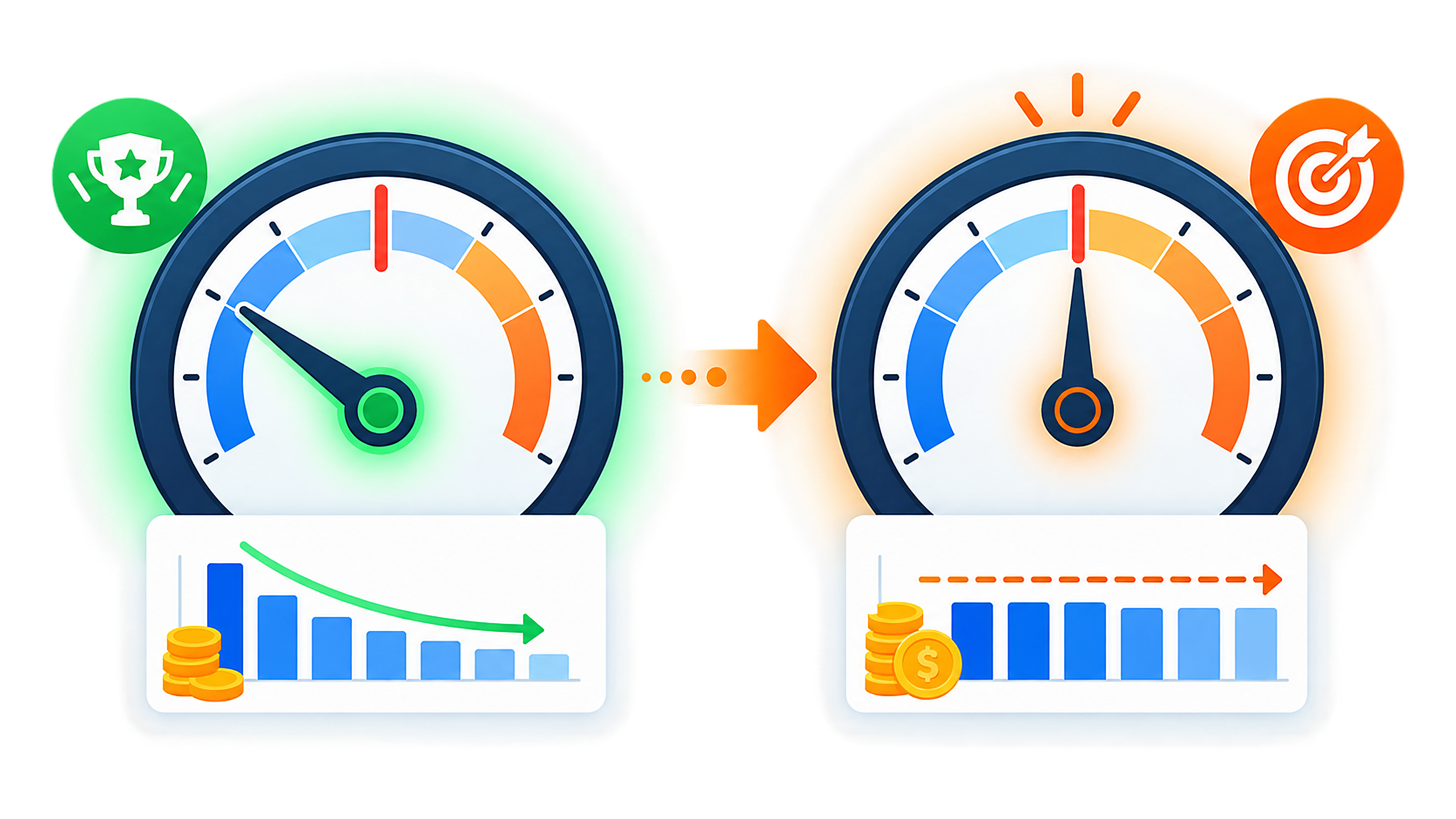
Translated out of Google's own phrasing: for years, a budget-capped campaign running Target CPA or Target ROAS has been allowed to cherry-pick only its cheapest, most efficient auctions within that fixed daily spend. A campaign told to hit a $10 cost per action might have been quietly landing conversions at $5 the whole time, because the algorithm optimized for the best result the budget could buy rather than for the number the advertiser actually set. That gap looked like a gift. After August 17, the system stops treating it as one. The algorithm will bid more aggressively toward the stated target, using the same fixed budget to chase volume at up to that ceiling instead of stopping early once the cheap conversions ran out.
📐 Why an "Efficiency Gift" Was Actually a Blind Spot
The practical effect is that campaigns which have been overperforming their stated targets for months are the ones most exposed. Google's own worked example in its help documentation is direct: a Target CPA of $10 with recent actual performance of $5 will move toward $10 after the rollout, and the advertiser is told to "update your target to $5 to maintain your recent performance or to a target CPA of your choosing based on your business goals." In other words, Google is not fixing a bug. It is closing a gap between what an advertiser told the system to optimize for and what the system was actually delivering, and it is telling advertisers plainly that the fix will change their numbers unless they act first.
Marketing analysts who reviewed the update in the weeks after the June announcement summarized the mechanism the same way. One detailed breakdown of the change, published by digital marketing analytics firm SearchAtlas, put it bluntly: "When a campaign was capped by its daily budget, Smart Bidding would cherry-pick only the highest-efficiency auctions it could afford... BTO changes the objective: the algorithm will now bid toward your stated target... instead of using that budget at maximum efficiency, it uses it at your stated efficiency ceiling." The firm's shorthand for the update, Bidding Target Optimization, is not Google's own official name for the change, but the mechanism it describes matches Google's help documentation closely.
🧭 Who Is Actually Exposed
Not every advertiser needs to worry. The change only touches campaigns that meet two conditions at once: the campaign carries a "Limited by budget" status inside Google Ads, and it uses an explicit target-based bid strategy, Target CPA or Target ROAS. A campaign with a healthy, unconstrained budget is not affected, because it was never being throttled by spend in the first place. A campaign running Maximize Conversions or Maximize Conversion Value without an explicit target is also unaffected, since there is no stated number for the system to converge toward.
Google's own eligibility table, published alongside the change, confirms Search, Shopping, Performance Max, Demand Gen, Display, Hotel, and Travel campaigns are all affected, while App campaigns, Video reach campaigns, and Video view campaigns keep their previous bidding behavior. The update reaches beyond the standard Google Ads interface too: Search Ads 360, Display and Video 360, Google Ads Editor, and the Google Ads API all carry the same change, so an agency managing accounts through a third-party platform is not exempt just because it never opens ads.google.com directly.
For Performance Max and Demand Gen campaigns specifically, Google's documentation adds a further wrinkle: because these formats spread a single budget across multiple channels and inventory types, the shift toward stated targets "may also see shifts in how traffic is distributed across different channels," not just changes in overall cost per result.
🔧 The Tool Google Built to Soften the Landing
Google did not simply flip a switch without warning. On July 6, 2026, it opened the Bid Target Adjustment Tool inside Google Ads, giving advertisers roughly six weeks to review exposure before the August 17 change took effect. The tool surfaces inside two places: a notification banner reading "Review your campaign targets" at the top of the account dashboard, and a "Review campaigns" option inside a campaign's Bidding settings. Once opened, it shows historical performance for every eligible campaign and offers three choices: keep the existing target unchanged and accept the shift toward it, update the target to match recent real performance, or pause the campaign entirely if neither option fits current goals.
Google Ads Help is explicit that none of this happens automatically on the advertiser's behalf: "Google will not automatically adjust your bidding targets or budgets." The review step, and the decision about what a business is actually willing to pay per conversion, is left entirely to the account holder. For a small business running its own campaigns without an agency, that means the notification banner is the only nudge that exists, and skipping it silently is the default outcome if nobody reads it before the fix arrives.

💬 How Advertisers Reacted When the Change Was Announced
The June 15 announcement traveled first through a LinkedIn post from Jordan Fry, CEO of the agency RevAmp and a former Google employee, who summarized the coming changes for his network. Marketing outlet PPC Land, which has tracked the update closely since the announcement, reported that the discussion thread beneath Fry's post became one of the most detailed public records of how practitioners were actually processing the news in real time. Roger Cooney, a PPC specialist focused on lead generation quoted in that thread, described the budget-limited campaign change as likely to be "very bad for those applicable campaigns," predicting it would "almost definitely drive CPAs up."
That reaction captures the anxiety running through the paid search community heading into this week: campaigns that had been quietly beating their targets are the campaigns whose reported numbers are about to look worse on paper, even though nothing about their real-world conversion quality has changed. The metric moves; the value delivered to the business does not necessarily move with it.
🌏 What This Looks Like for an Indonesian Advertiser
The change does not distinguish between an account billing in US dollars and one billing in Indonesian rupiah, and it does not distinguish between an in-house marketing team and a business owner running Google Ads alone from a phone. Indonesian small businesses that run Search or Shopping campaigns through Google Ads, whether managed directly, through a local digital agency, or through a freelancer hired on a per-campaign basis, sit inside the same eligibility rules as any account anywhere else. A UMKM selling through its own website, using Target CPA to control cost per lead or Target ROAS to control return on ad spend, is exactly the profile this change is built around, especially if that business has a modest daily budget that regularly gets exhausted before the day ends. A modest, tightly capped daily budget is precisely what produces a "Limited by budget" status, and a tightly capped budget paired with a target-based strategy is precisely the combination this update touches.
Indonesian digital marketing agencies that manage multiple small-business accounts on tight budgets have a specific reason to move quickly here: the Bid Target Adjustment Tool review happens per account, not in bulk across a portfolio through a single click, so an agency running dozens of small client accounts faces a genuinely larger review workload than a business checking one account of its own. A business owner working with an outside agency should ask a direct question this week: has our account been reviewed against Google's Bid Target Adjustment Tool, and if a cost per lead rises next month, was that expected. An agency that cannot answer that question plainly has not done the review yet.
For a business that has never touched Target CPA or Target ROAS and instead uses Maximize Clicks, Manual CPC, or Maximize Conversions without an explicit target, none of this changes anything. That is worth stating clearly, because trade coverage of platform changes like this one tends to travel faster and louder than the fine print about who is actually affected, and a business owner reading a headline about Google Ads costs rising should check their own account's bid strategy before assuming the story applies to them.

🔁 Part of a Longer Pattern, Not an Isolated Event
The August 17 bidding change did not arrive alone. Google bundled it into the same June 15, 2026 announcement as two other updates: an expansion of Smart Bidding Exploration to Performance Max and Shopping campaigns, and a beta launch of promotion mode, a scheduling tool that lets advertisers widen ROAS tolerance and add temporary daily budget for a defined window of three to fourteen days, such as a seasonal sale. According to Google's own reporting, campaigns already using Smart Bidding Exploration on Search saw an average 18 percent increase in unique converting search query categories and a 19 percent increase in conversions, based on internal data Google gathered between March 11 and April 11, 2025. Google has also said accounts using campaign total budgets, a related feature that launched in open beta on January 15, 2026, saw a 66 percent average reduction in manual budget adjustments.
Taken together, this string of updates across 2026 forms a pattern rather than a single event: Google has been steadily narrowing the gap between what an advertiser deliberately sets and what its automated systems are permitted to do independently of that setting. A budget pacing change tied to ad scheduling rolled out on March 1, 2026. Campaign total budgets expanded in January. Smart Bidding Exploration graduated out of beta for most Performance Max campaigns in June. Each change on its own looks like routine platform maintenance. Read as a sequence, they describe a Google Ads product team pushing advertisers toward more explicit, more frequently reviewed settings, and away from the older assumption that a target, once set, could be safely ignored for months or years while the algorithm quietly did something more favorable behind the scenes. The August 17 change is the most consequential of that sequence specifically because it is the one that can move a number on an invoice.
📅 A Deadline That Already Passed for Some, Arrives Now for Others
The rollout is not an instant, single-day flip for every account. Google's own language describes changes "starting August 17, 2026" and "rolling out over a few weeks," which means some advertisers will see the shift immediately this week while others notice it gradually through September. That staggered timeline is one reason a business owner searching for the story right now may find conflicting accounts of whether "it already happened" or "it is about to happen." Functionally, both are true depending on which account and campaign type is being discussed. What is consistent across every account is Google's own recommendation: review campaigns that were "Limited by budget" and used target-based bidding "by August 17, 2026," a deadline that, as of this week, is either arriving or has just passed.

🏪 What This Means for a Small Business Running Its Own Ads
Most small businesses running Google Ads do not have a dedicated PPC specialist checking dashboard notifications daily. That makes this exactly the kind of platform change that quietly erodes a marketing budget's predictability if nobody looks. A handful of concrete checks cover most of the exposure.
- Find out whether any active campaign is "Limited by budget." Inside Google Ads, this status is visible on the Campaigns page next to each campaign name. A campaign that has never shown this status is not exposed to the August 17 change at all, regardless of which bid strategy it uses.
- Check whether that campaign uses Target CPA or Target ROAS. Maximize Conversions and Maximize Conversion Value without an explicit target are unaffected. If a campaign uses one of the exempt strategies, this update changes nothing about how it bids.
- Compare the stated target against actual recent performance. If a campaign's real CPA has been running noticeably below its Target CPA, or its real ROAS has been running noticeably above its Target ROAS, that gap is exactly what the August 17 change closes. A business that has been quietly getting a lower cost per lead than the number in its own settings should expect that number to rise toward what was actually typed in.
- Decide deliberately, rather than by default. The Bid Target Adjustment Tool offers three real choices: keep the target and accept a probable cost increase, lower the target to match recent reality and keep costs roughly where they have been, or pause the campaign if neither option supports current business goals. Doing nothing is itself a choice, and it defaults to the first option.
For a business owner working with an outside agency, the useful question is simpler: has anyone reviewed our accounts against the Bid Target Adjustment Tool this month, and if a campaign's numbers move in September, was that reviewed and expected, or is it a surprise that needs an explanation.
🧮 Reading the Bid Simulator After the Change
Beyond the Bid Target Adjustment Tool, Google Ads has long offered a built-in bid simulator that advertisers use to estimate the outcome of a target or budget change before committing to it. After August 17, the numbers that simulator produces for a budget-limited campaign will reflect the new bidding behavior, not the older, cheaper pattern many accounts got used to. An advertiser comparing today's simulator projection against last month's actual results needs to recognize that the baseline itself has shifted. The simulator is no longer modeling a campaign free to cherry-pick the cheapest available auctions; it is modeling a campaign steered toward the stated target.
That distinction matters for anyone building next quarter's budget plan. A business that has been estimating how many leads a given spend will produce, based on recent actual CPA, needs to rerun that estimate using a CPA closer to the stated target rather than the historical average, since that average may no longer hold once the rollout has fully worked through an account over the coming weeks.
🗂️ Building a Review Record Before the Numbers Move
The simplest way to handle this transition is to write down a short record before the numbers shift, not after. That record does not need to be elaborate. A list of active campaigns, their budget status, their bid strategy, the stated target, and actual performance over the last 30 days is enough. With that record in hand, a business owner has a clear point of comparison when next month's report shows CPA rising or ROAS falling, making it possible to tell the difference between a shift this update already explained and a separate problem, such as a seasonal demand swing or increased auction competition, that deserves its own investigation.
That same record is useful when talking to an agency or freelancer managing the account. Instead of asking generally whether ad performance still looks fine, a business owner can point to a specific number and ask directly whether this month's CPA increase traces to the target-based bidding change Google announced, or to something else that needs separate attention.
📊 Reading the Change Without Overreacting
It is worth separating what actually changed from what is being read into it online. Google is not raising prices, changing auction dynamics for anyone else's ads, or penalizing well-run campaigns. It is closing a specific gap between a number an advertiser set and a number the system was actually delivering, for accounts where that gap existed. A campaign that has genuinely been performing in line with its stated target sees nothing different at all. A campaign whose target was set carelessly, copied from a template, or left over from a previous strategy years ago is the one most likely to see its metrics shift, and in most of those cases the shift reflects the advertiser's own stated preference finally being honored, not a platform malfunction.
The more durable lesson for a small business is less about this one date and more about a pattern: automated bidding systems reward the advertiser who checks in periodically and sets numbers deliberately, and they quietly compound the cost of numbers nobody has revisited in a year. August 17, 2026 is simply the date that pattern became visible all at once, across a huge number of accounts, at the same time.
A short review this week costs less than an unexplained cost increase in September. Open the Campaigns page, look for "Limited by budget" next to any campaign using Target CPA or Target ROAS, and open the Bid Target Adjustment Tool if the notification banner is showing. Ten minutes now is the difference between choosing a target on purpose and discovering it was chosen for you two years ago and never revisited since.
Sources: Google Ads Help, "About Target ROAS bidding" (support.google.com/google-ads/answer/6268637); Google Ads Help, "Changes to target based bid strategies" (support.google.com/google-ads/answer/17061251); Google Ads Help, "Estimate your results with bid, budget, and target simulators" (support.google.com/google-ads/answer/2470105); PPC Land, "Promotion mode is here – Google's Ginny Marvin explains what actually changed," June 2026; SearchAtlas, "Google Ads Bidding Target Optimization (BTO) August 2026," June 22, 2026; Accelerate with Google blog, "Bidding and budgeting updates to scale your growth," June 15, 2026.