
On August 20, 2026, Google's General Manager of Search Ecosystem, Mrinalini Loew, published a post confirming that more than 600,000 unique publisher sources have already been selected by readers through a tool most small business owners have never heard of: the "Preferred Sources" button. Alongside that number, Google announced two more changes that arrived the same day: a natural-language way to retune the Discover feed, and a customizable Google News audio briefing on Android. None of the three headlines by themselves sound like something a UMKM owner running a coffee shop's Instagram and a two-page website needs to read. Put together, they say something sharper: Google is now actively building tools whose entire purpose is to send readers back to specific websites, on purpose, by name. It is a small but real countersignal to two years of "zero-click" search headlines.
🔎 What Google Actually Announced on August 20
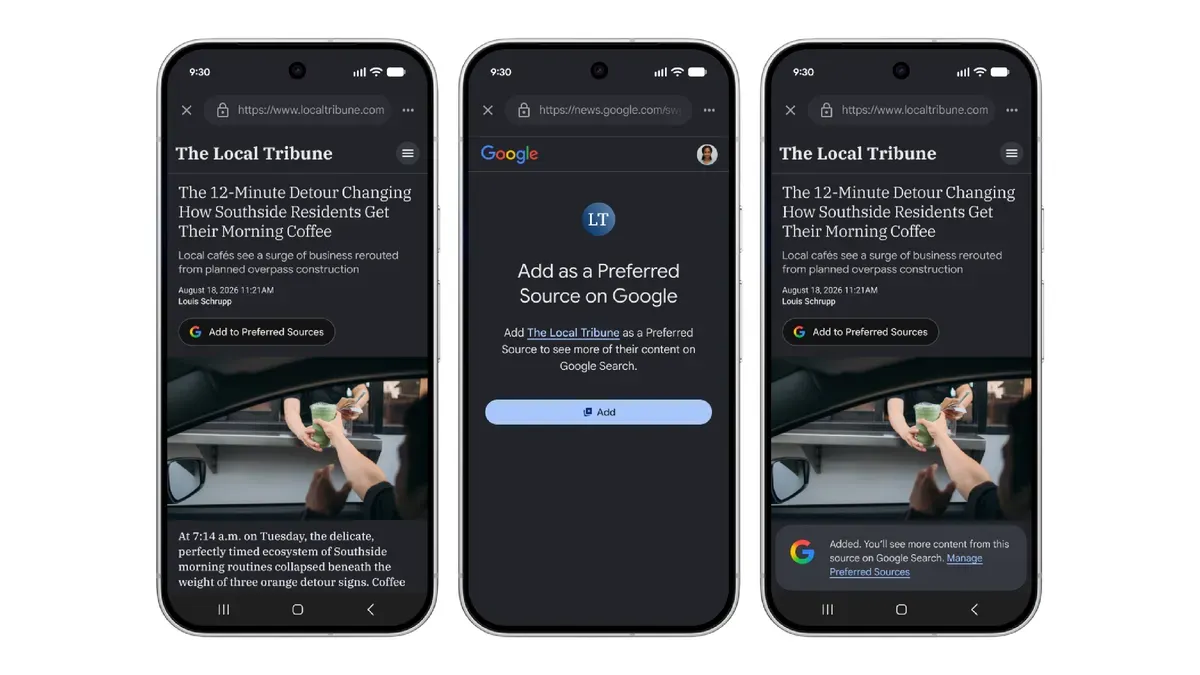
The centerpiece of Google's blog post, titled "Personalize the content you see on Search, Discover, and News," is a two-line embeddable JavaScript button that any website owner can now add to their pages. According to Google's own developer documentation at developers.google.com/search/docs/appearance/preferred-sources, publishers add a script tag that loads news.google.com/swg/js/v1/publisher.js, then place a marked container element anywhere on the page where the button should appear. Google renders an automatically localized button in that spot. When a reader clicks it, Google marks that site as a "preferred source" tied to the reader's Google account and immediately returns them to the exact spot on the page where they clicked, without a page reload or a lost scroll position.
Once marked as preferred, a publisher's content becomes more likely to appear with a visible "preferred" badge inside three surfaces: the Top Stories carousel in regular Search, AI Overviews, and AI Mode.
Google's documentation notes a real technical limit worth knowing before getting excited: only domain-level and subdomain-level sites qualify. A homepage like www.example.com or a subdomain like code.example.com can appear in the source preferences tool, but a subdirectory such as www.example.com/blog cannot register on its own. For a small business, that generally means the tool works at the level of the whole website, not a single blog category page.
📅 This Is a Rollout, Not a Launch
The Preferred Sources concept did not appear out of nowhere on August 20. TechCrunch reporter Sarah Perez, writing the same day, traced the feature back to an earlier May 2026 rollout that limited Preferred Sources to Google's AI Mode and AI Overviews experiences, itself building on Top Stories integration that goes back further. Perez reported that Google's May figure was 345,000 unique sources selected by readers; by the August 20 announcement, that number had grown to over 600,000 in roughly three months. Google had already expanded a related version of Preferred Sources globally to English-language users in December, according to PYMNTS' summary of Google's own blog history on the topic.
That trajectory matters for how a small business should read this news. It is not a brand-new experiment with an uncertain future. It is Google steadily expanding a feature it has already tested in three markets and three surfaces, and the reader-adoption number nearly doubled in one quarter. A feature Google keeps investing engineering time in expanding is one worth a small website taking fifteen minutes to add.
🧭 The Discover Feed Now Talks Back
The second announcement, and the one likely to reach far more ordinary readers first, changes how people experience Google Discover, the feed of article and video cards shown in the Google app and inside Chrome's mobile new tab page. 9to5Google's Abner Li, who has covered Google Discover changes closely for years, reported that "in the coming days," users will be able to tap the three-dot overflow menu on any Discover card and type a request in plain language: more of this, less of that, described however they like. Google's blog post uses the example "kitchen reno ideas (eco-friendly only)" versus "videos about weekend road trips (but no camping)": genuinely specific requests that today's toggle-based Discover settings cannot express.
Google says the chatbot can ask follow-up questions to refine a vague request, and that stated preferences persist across future sessions rather than resetting. iTechPost's coverage on August 21 added a detail from Google's own support materials: the new natural-language layer sits on top of the existing system, not in place of it. Google Discover has always used a mix of search history, app activity, followed topics, and explicit "not interested" taps to decide what to show; the chatbot is a new input channel layered onto those same underlying signals, not a replacement mechanism.
For a website owner, the practical question is not "should I optimize for this," because there is no keyword trick for a feature driven by open-ended user requests. The practical question is whether the content on a business's own site is specific and well-labeled enough that if a reader typed a request matching that niche, the site's actual pages would satisfy it. A bakery's blog post titled "5 Tips" tells a personalization system nothing; a post titled "Eco-friendly cake packaging ideas for small Jakarta bakeries" gives a specific-request-matching system something to work with.
🎧 A Smaller, Android-Only Third Change
The least consequential of the three announcements for most businesses is the Google News audio briefing customization, currently limited to Android. Google's blog post describes letting users pick from categories (Headlines, Business, Entertainment & lifestyle, Sports, Science & technology) and then drill into subcategories, so the Entertainment briefing can be narrowed to just Movies or just Music. Google tied this update to what it calls its "news AI pilot program," a group of participating publishers whose stories get deeper coverage inside the generated briefing.
This change has almost no direct action item for a small business without an existing partnership with Google's publisher programs. It is included in the same announcement mainly because it shares the same underlying theme: Google building more channels through which a reader's stated preference, rather than a blanket algorithm, decides what surfaces. The pattern across all three updates is consistent even though the audience size for each differs enormously.
📊 Why Google Is Doing This Now
None of the three coverage outlets that reported on August 20 and 21 treated this as an isolated product update. TechCrunch's Perez opened her piece by referencing "AI continues to kill traffic to websites," linking directly to her own June 2025 reporting on how AI Overviews reduced publisher click-through. AI Insider's James Dargan made the connection explicit: "The move follows criticism that AI-powered search features have reduced website traffic for publishers." Analytics Insight and iTechPost both framed the Preferred Sources button as one half of a two-sided response: publishers get a tool to fight for direct traffic, while readers get an AI layer that makes Discover and News feel more personally useful, which keeps them inside Google's own surfaces rather than searching elsewhere.
Google's own blog post states a concrete data point behind the push: people are reportedly twice as likely to click through to a source they have already marked as preferred, when that source is available in a given result set. That statistic is Google's own claim, not an independently audited figure, but it is the stated business logic for why Google built the button at all, not goodwill toward small publishers, but a belief that habitual return traffic converts better than one-off discovery. For a website owner, the honest way to read the tool is as Google addressing a problem partly of its own making, with a mechanism whose benefit still depends entirely on getting a critical mass of returning readers to click one small button.
✅ Four Things a Small Business Should Check This Week
- Add the Preferred Sources button if the site qualifies. Confirm domain eligibility first at google.com/preferences/source by searching the business's own site name. If it appears, the two-line script from Google's developer documentation is a low-effort addition for any site using a CMS that allows custom head scripts or embeds.
- Audit whether the site is registered as a domain, not buried in a subdirectory. Because only domain-level and subdomain-level pages qualify, a business publishing its newsroom or blog under a path like
/blogon the main domain is fine; a business running a separate blog platform under a totally different unrelated domain should check that domain is the one showing up in search results, not a fragmented, unlisted one. - Write content around specific, describable use cases, not generic listicle titles. Discover's new prompt-based tuning rewards content whose topic is nameable in a sentence. A page titled with a precise local or niche angle is more likely to satisfy an actual typed request than one with a vague, catch-all headline.
- Track referral traffic from Discover and Top Stories separately over the next month. Google Search Console already segments Discover performance under its own report. A business that sees any Discover traffic today has a baseline worth comparing once the natural-language tuning rolls out broadly, since Google has not published a fixed date for full availability beyond "in the coming days."
🌐 Part of a Wider Pattern, Not a Google-Only Move
AI Insider's coverage placed the Discover change inside a broader trend: "a broader trend of social media platforms introducing user-controlled algorithms in recent months." That framing is worth taking seriously. Over the past year, several major platforms have shipped their own version of a reader-controlled feed dial. Meta has expanded "Show more / Show less" controls across Facebook and Instagram. X has iterated repeatedly on toggles between a chronological timeline and its algorithmic "For You" feed. What sets Google's version apart is the interface: instead of a settings menu with fixed categories, Discover's new tool accepts an open-ended sentence and lets an AI model interpret intent, then asks a follow-up question if the request is ambiguous.
That distinction matters for how a small business thinks about visibility. A settings-menu system rewards fitting into a predefined category. A natural-language system rewards content whose subject a person could plausibly describe out loud, unprompted, in their own words. A general blog post trying to cover ten adjacent topics fits neither system well; a page with one clear, nameable subject fits both.
Independent context helps explain why Google is investing in reader-return mechanisms at all. A widely cited earlier study, separate from this week's announcements, found that a majority of Google searches now end without any click to an outside website, as AI Overviews and AI Mode answer the query directly on the results page. That backdrop is the reason TechCrunch's framing lands the way it does: a company whose own product changes are documented to reduce outbound clicks is now building a second product whose explicit job is to increase outbound clicks for sites a reader has actively chosen. Google's self-reported "twice as likely to click through" statistic for preferred sources should be read in that context: as a partial offset Google is offering for a larger structural shift it triggered, not as a return to pre-AI-Overview traffic levels.
Neither Google nor the outlets covering the announcement have published data comparing preferred-source click-through rates against a baseline before AI Overviews existed, so it is not yet possible to say whether the tool restores lost traffic or simply softens the decline for the small subset of publishers whose readers bother to click a button. That is a real limitation of the current reporting, and it is worth naming plainly rather than assuming the button solves a problem of the scale AI Overviews created.

🛠️ Implementation Detail Worth Knowing Before Adding the Button
Google's developer documentation lists three implementation paths, not just one. The "Standard JavaScript implementation," the two-line script and div described above, is what Google recommends for most sites, because it auto-localizes button text into the visitor's language and matches Google's own visual styling without any design work. A second option, the "Advanced JavaScript implementation," lets a site swap in its own custom button design while keeping the same underlying click behavior, useful for a business with a strict brand style guide that does not want an unstyled default button breaking a page's visual consistency. A third option, a plain deeplink, exists for sites on a CMS or page builder that cannot embed a script tag at all. The deeplink can be dropped into an email newsletter, a social bio link, or a simple text link on a page, and it walks the reader through the same "add as preferred source" flow inside Google's own interface instead of an embedded widget.
For most small businesses running a modern website builder or CMS with a custom-code or embed block, the standard script option is the fastest and lowest-maintenance path, and it is the one Google itself recommends first in its documentation.

💬 What the Reporting Agrees On
"As AI continues to kill traffic to websites, Google on Thursday threw a bone to those publishers negatively impacted by the change."
That line from TechCrunch's Sarah Perez, published August 20, 2026, captures the skeptical read shared across multiple outlets that covered the announcement: this is Google responding to a traffic problem it created, not a purely generous new feature. The number Google chose to lead with, over 600,000 unique sources selected by readers already and up from 345,000 in May, is the company's own evidence that the tool is gaining real usage, even if it addresses a small fraction of the traffic AI-driven search changes have taken away industry-wide.
🔮 What to Watch Over the Next Month
Google has not committed to a fixed global availability date for the Discover natural-language tuning beyond "in the coming days," and it has not said whether the Preferred Sources button will eventually expand beyond domain and subdomain-level eligibility to cover individual subdirectories or blog sections. Both details matter for a small business deciding how much time to invest now versus later. A website owner whose site already qualifies for Preferred Sources loses little by adding the button today, since implementation takes minutes and the button simply sits idle until a reader clicks it. A website owner whose blog lives on a subdirectory of a larger platform, and therefore does not currently qualify, has a reason to watch for an eligibility expansion rather than restructure a whole site around a feature that might broaden its own rules within months.
The audio briefing customization, limited today to Android, is the piece most likely to expand to iOS given Google's history of eventually bringing Android-first Discover and News features to its iOS apps after an initial testing window. None of the three outlets that reported the announcement gave a timeline for that expansion, and Google's own blog post does not mention iOS at all, so any assumption about a same-year rollout would be speculation rather than reporting.
📈 A Modest Fix, Not a Reversal
It is worth restating plainly what this announcement is not. It is not a reversal of AI Overviews, AI Mode, or the broader shift toward answers that satisfy a search query without a click. Google has made no public statement suggesting those features will pull back. The Preferred Sources button and the Discover prompt tool exist alongside AI-driven search summaries, not instead of them. A small business should treat this week's changes as a way to make the traffic it does still receive slightly stickier and slightly more repeatable, not as a return to the traffic patterns of several years ago. That distinction shapes expectations correctly: the tools are worth using, and they cost very little to try, but they solve a narrower problem than the one most publishers are actually facing.
🏁 What This Means for a 1garis-Built Website
None of the three features announced on August 20 require rebuilding a website. The Preferred Sources button is a two-line script tag. The Discover changes require no code at all; they depend entirely on whether a site's existing content answers specific reader requests clearly. What they do require is a website structured so Google can tell what a business actually does, on a domain the business actually controls, with pages specific enough to be worth a reader's one click of "prefer this source." That is a smaller, cheaper task than most owners assume, and one worth doing in the same week Google made the tool available rather than months later.
Sources: Google, "Personalize the content you see on Search, Discover, and News" (blog.google, August 20, 2026); Sarah Perez, "Google gives publishers a new way to fight AI-driven traffic losses" (TechCrunch, August 20, 2026); Abner Li, "Google now lets you chat to customize Discover, tune News audio briefings" (9to5Google, August 20, 2026); Google Search Central, "Help your readers find your site through preferred sources in Google Search" (developers.google.com, accessed August 22, 2026); iTechPost, "Google Discover Gets an AI Chatbot-Tuned Feed With New AI Personalization" (August 21, 2026); James Dargan, "Google Rolls Out Embeddable 'Preferred Sources' Button To Help Publishers Facing AI Traffic Declines" (AI Insider, August 21, 2026); PYMNTS, "Google Launches Preferred Source Button for Publisher Websites" (August 20, 2026).