Google started rolling out its August 2026 spam update on August 18 at 09:27 Pacific time. The Search Status Dashboard says the update applies globally, in every language, and may take a few days to complete. That puts Indonesian websites in scope, whether they target local customers, overseas buyers, or both.
The announcement is short. It does not identify a new policy category, publish an impact percentage, or name a class of business that should expect a change. Yet a short announcement can trigger a very long day for someone who watches organic leads closely. A café owner sees fewer discovery calls. A contractor notices a ranking dip for one service page. An online shop sees impressions move after months of stability. The temptation is to rewrite, delete, disavow, or commission twenty new articles immediately. That is usually the wrong first move.
For a small business website, the better response is disciplined and modest: confirm that the site is technically reachable, read the data without forcing a story onto it, check the tactics that carry genuine policy risk, and keep serving people who arrive today. This article separates what Google has actually said from the checks that 1garis recommends as sensible website stewardship.
🔎 What Google confirmed on August 18
Google’s own dashboard records the incident as an August 2026 spam update. Its release note says the update applies globally and to all languages, and that rollout may take a few days. Search Engine Land and Search Engine Roundtable each reported the same notice on August 18. Google did not attach a companion announcement that changes the spam-policy rulebook.
That distinction matters. The launch is confirmed. A claim that Google is targeting one specific niche, language, AI tool, or CMS is not confirmed by the dashboard notice. A business should not turn an industry rumor into a diagnosis of its own site.
Google’s documentation describes a spam update as a notable improvement to automated spam detection. The company identifies SpamBrain as its AI-based spam-prevention system. Its systems run continuously, while named spam updates mark significant improvements. A site that violates spam policies can rank lower or disappear from results. Google also says that improvements can take months after a site changes because automated systems need time to learn that the site complies.
The current update is the third confirmed spam update reported in 2026, following updates in March and June. That frequency is another reason to treat compliance as an operating habit instead of a last-minute repair project.
🧭 Spam update versus core update
Website owners often use “Google update” as one catch-all label. It is useful shorthand, but it hides an important difference. A core update broadly changes how Google assesses and ranks content. A spam update improves the detection of behavior that violates Google’s spam policies.
A ranking movement during a spam update does not prove a site is spam. Search results are relative. If Google suppresses pages that were gaining an unfair advantage, other pages can rise. Competitors can improve. Search demand can shift. Tracking tools can also show noise. A site owner still needs to investigate their own evidence.
Google’s published policies give practical examples of the behavior its systems seek to address: scaled content abuse, cloaking, doorway pages, scraped content, keyword stuffing, hacked content, misleading functionality, link spam, and site reputation abuse. The categories are not a checklist for creating “safe enough” pages. They describe practices designed to manipulate Search or mislead people.
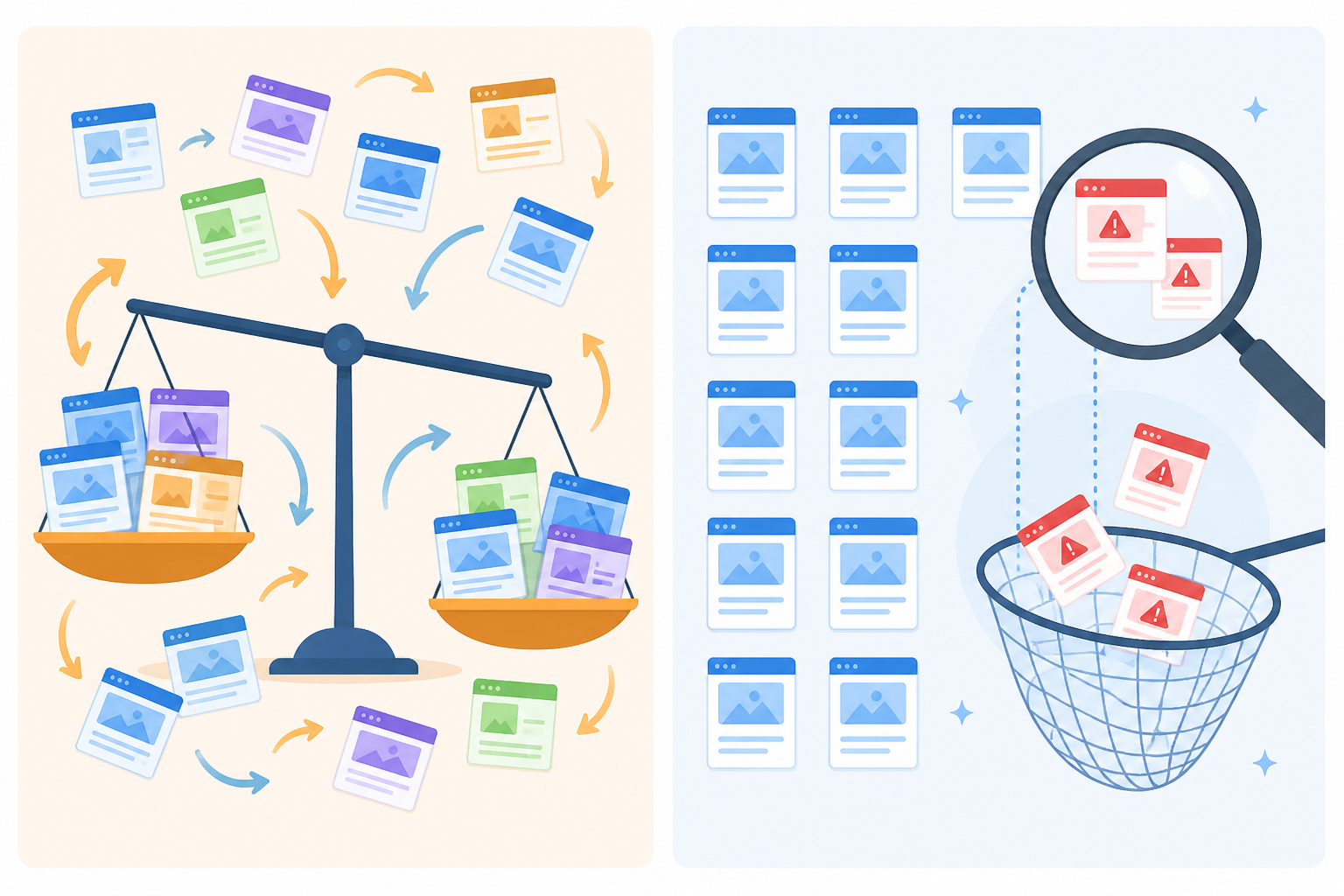
For a local service business, the distinction can be concrete. A plumber who maintains distinct pages for different services, prices, coverage areas, qualifications, and booking options is describing a real business. A site that generates hundreds of near-identical suburb pages with no local staff, address, job examples, or distinct service information is taking a much riskier path. The number of pages is not the point. The purpose and evidence behind each page are.
📊 Read the first few days without inventing a cause
The August rollout may take several days. During that window, take notes before making large edits. Start in Google Search Console, then compare with your web analytics and business records. If calls, orders, or inquiries stayed steady while a single dashboard line moves, that context matters.
Use a short observation log:
- Record the date and time you first noticed a movement.
- Compare the same weekday and a 28-day range, not only yesterday.
- Split the data by query, page, country, and device.
- Check whether the change is in impressions, average position, clicks, conversion actions, or all of them.
- Note any changes your team made to redirects, templates, robots rules, hosting, analytics, product availability, or paid campaigns.
A decline that affects only one old article asks for a different investigation than a decline across every indexed page. A drop in impressions but not conversions can mean a page lost low-intent visibility rather than customers. A sudden fall to nearly zero across the site may point to indexing, crawling, server, or tracking trouble before it points to an algorithmic response.

Do not use a third-party volatility chart as proof that Google punished your site. Those charts can be useful context, but they cannot see your server configuration, pages, customers, or Search Console property. Your own verified property remains the first source for your diagnosis.
🧰 The four checks worth doing this week
A small business does not need an emergency war room. It needs a short, accountable inspection. Give each check an owner and a written outcome.
🟢 Confirm that Google can reach the site
Open the homepage, key service pages, contact form, product pages, and a recent article from a normal browser. Then check Search Console for manual actions, security issues, crawl problems, page indexing changes, and URL Inspection results for pages that matter. Review robots.txt, noindex directives, canonical tags, redirects, and recent deployment notes.
This check prevents a common waste of effort. A developer can accidentally block a directory, change a canonical tag, or break an internal link pattern on the same day Google announces an update. Timing alone does not establish causation.
🟠 Review pages built for a keyword pattern rather than a customer need
Look for repeated templates that differ only by town, product adjective, question wording, or keyword order. Ask a plain question for each page: what can a buyer learn or do here that they cannot learn or do on the other page?
Keep pages that answer a real, distinct need. Consolidate or improve pages that merely echo one another. Do not manufacture details. A business that does not serve a district should not claim a service presence there to capture a search phrase. A product page without stock, delivery, specifications, or a way to buy gives a person very little reason to trust it.
🔵 Inspect copied, automated, and thin material
Automation itself is not a verdict. Google’s concern is the purpose and result of content, especially material produced at scale to manipulate rankings without adding value. Review pages that were published rapidly, copied from supplier feeds, translated without human review, or assembled from generic prompts.
Add first-hand information wherever the business can honestly provide it: a current price range, a service process, availability, photos of completed work with permission, returns information, named credentials, an address, an appointment route, or answers from actual customer conversations. Remove claims you cannot support. A human editor should be able to explain why every important page exists.
🟣 Check link acquisition and third-party publishing
Ask whoever handles marketing where recent links came from. Paid link packages, automated directory submissions, guest-post networks, and articles placed mainly to borrow another domain’s authority deserve scrutiny. Google’s policies cover link spam and site reputation abuse. A good partnership, trade association listing, or local media mention serves a human audience as well as search. A scheme built only to push ranking signals creates avoidable exposure.
Document the answer rather than guessing. A small business can ask its agency for a list of link-building work, sponsored placements, content partners, and domains used in the past year. Clear records help a business decide what needs to stop.
🧾 A useful page test for owners and editors
Every page that attracts search traffic should survive a five-question review:
- Does the page answer a specific visitor question or help them complete a real task?
- Does it contain information, experience, evidence, or service detail that is not copied from a competing page?
- Can the business stand behind its claims, images, prices, availability, and contact information today?
- Does the page make it easy for a person to identify the business and take the next legitimate step?
- Would the page still deserve to exist if it received no search traffic tomorrow?
The fifth question is particularly revealing. A location doorway page created only for rankings may fail it. A clear booking page, a detailed service explanation, a portfolio case study, or a delivery guide usually will not.
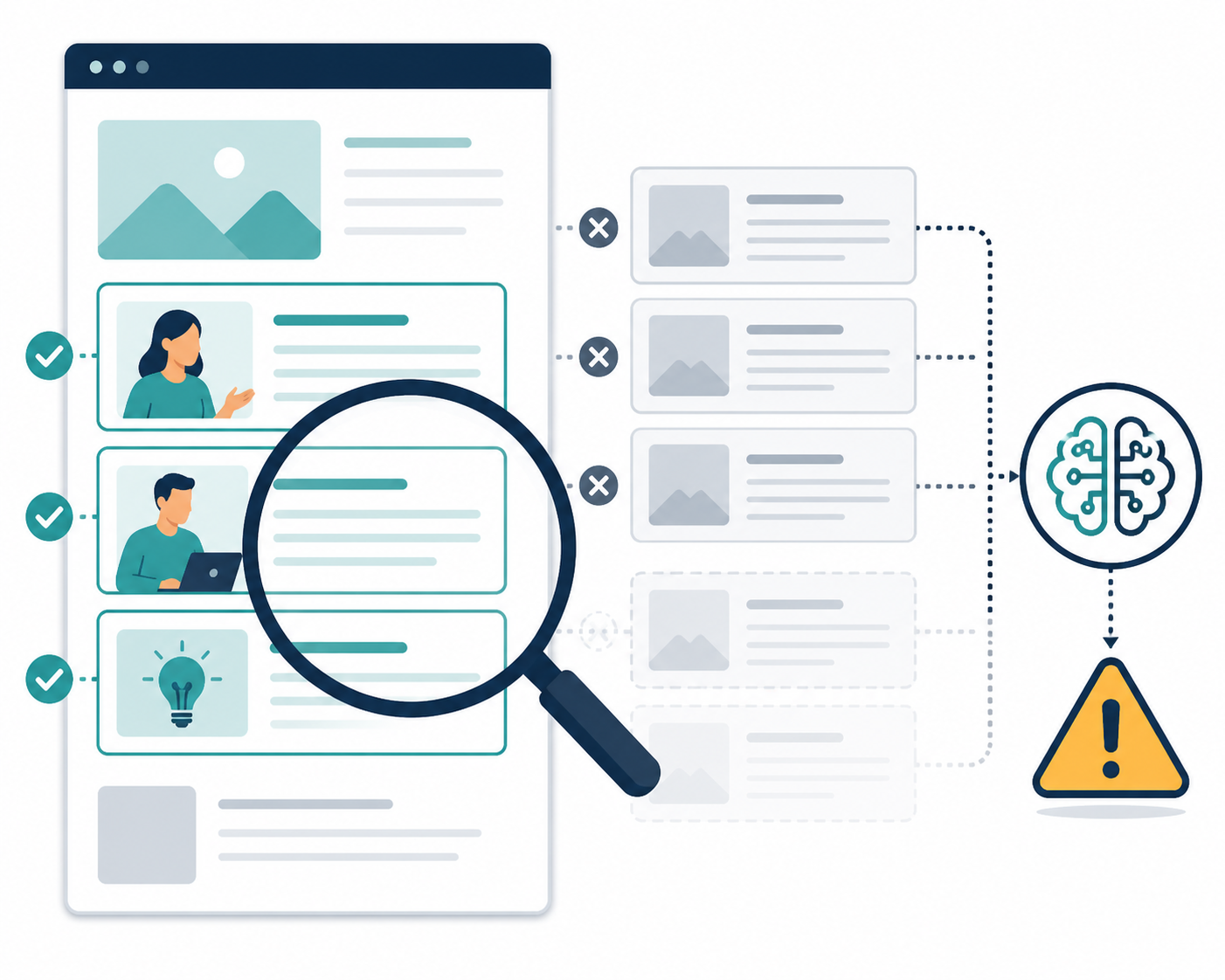
This is not a request for every business to publish more words. A concise page with a real price, a clear service boundary, a verified address, and a working contact route can be more useful than 2,000 words of generic advice.
🧑💻 What an agency or freelancer should be able to explain
An owner who outsources SEO does not need to become a ranking engineer. They do need enough visibility to ask direct questions. A reliable partner should be able to show what changed, why it changed, and how the work helps a customer.
Ask for a plain-language answer to these questions:
- Which pages were created, changed, redirected, or removed in the last 90 days?
- Which sources, staff knowledge, or customer evidence support new content?
- Did anyone buy links, place advertorials, run automated submissions, or use a private network?
- Are location pages tied to actual service areas and distinct customer information?
- What Search Console data supports the proposed next action?
- What will the team measure besides a ranking screenshot?
A credible answer can include uncertainty. No agency can promise that a named update will improve every website. A promise of guaranteed number-one placement or instant recovery is a reason to slow down, not sign faster.
🛍️ Why this matters even if your leads come from social media
Many Indonesian small businesses gain attention through Instagram, TikTok, WhatsApp, marketplaces, or word of mouth. Their website may still be the place where a buyer checks legitimacy before paying, finds operating hours, compares services, or sends a high-value inquiry. Search visibility and site trust reinforce one another, but they are not identical.
A business can use this week’s update as a practical reason to fix basics that benefit every channel: keep the phone number current, make the WhatsApp button work, state delivery areas accurately, publish a real privacy policy where needed, compress slow images, and remove old promotions that no longer apply. These improvements help a person who arrives from a social link just as much as someone who arrives from Google.

Photo illustration credit: Kampus Production via Pexels. The photo is not evidence of Google’s update or of a specific business’s traffic.
⏳ When to change something and when to wait
Fix a confirmed technical problem immediately. Restore a broken contact form, remove an accidental noindex tag, repair a redirect loop, correct a false claim, or take down hacked spam as soon as you verify it. Those are direct defects, not speculative reactions.
For content and SEO strategy, avoid a site-wide purge during the rollout. First identify the affected page group, the queries involved, the date pattern, and the real quality issue. Then make a documented improvement. Examples include merging duplicate service pages, adding missing original information, removing pages that make unsupported claims, or ending a questionable link-building arrangement.
Wait when you only have a single-day fluctuation and no confirmed defect. Google says the rollout itself may take days. A business that changes titles, URLs, internal links, copy, and templates simultaneously loses the ability to learn what happened.
📅 How this compares to the March and June 2026 spam updates
Reading a single update in isolation can make it look bigger or smaller than it is. Google confirmed three spam updates in 2026 before this one landed: March, and June. Coalition Technologies, which tracks these rollouts closely, notes that the March 2026 update was the fastest confirmed rollout on record for the dashboard, finishing in roughly 19 hours and 30 minutes. The June 2026 update took about two days and one hour. Neither came with a companion blog post explaining new spam categories, and neither named an industry or region as a specific target.
That pattern is useful context for the August rollout. Google again gave no fixed completion time beyond “a few days,” did not publish a new spam-policy document alongside the announcement, and did not confirm which categories of violation this specific update improves detection for. Third-party rank-tracking tools such as AccuRanker, Mozcast, and SEMrush recorded visible volatility during the June rollout, and some site owners reported real ranking losses, even though Google published no official percentage of affected queries. Expect a similar shape this time: noisy tracking charts, some ranking movement across the web, and no official confirmation of exactly who was targeted.
The June update carried one additional wrinkle worth remembering. It landed only a few weeks after the May 2026 core update, which made it harder for site owners to tell which system was responsible for a given ranking change. Google had also clarified in May that its spam policies extend to attempts to manipulate generative AI responses in Search, including AI Overviews and AI Mode. Google has not confirmed whether the August update specifically targets that kind of manipulation, but the policy scope itself has not narrowed since May, so tactics built purely to force citation inside an AI-generated answer carry the same risk as tactics built to force a classic ranking position.
For an Indonesian small business, the practical lesson from March and June repeats itself in August: a spam update is not a single event with a clean before-and-after line. It is closer to a maintenance window during which detection systems get sharper, and a business that has nothing to hide should expect only ordinary week-to-week variation once the rollout finishes.
🇮🇩 What this looks like for an Indonesian website specifically
Google’s announcement makes a point of saying the update applies globally and to every language, which puts Bahasa Indonesia content on the same footing as English, Japanese, or Portuguese content. TechCorner Indonesia’s coverage of the June 2026 spam update made the same point directly to a local audience: “Artinya, website berbahasa Indonesia juga termasuk dalam cakupan pembaruan tersebut” — meaning Indonesian-language websites are included in the update’s scope, not a separate or lesser priority for Google’s systems.
That matters because a common assumption among smaller Indonesian businesses is that global algorithm news is mainly relevant to large English-language publishers. It is not. A UMKM selling batik, running a laundry service, offering photography packages, or operating a small guesthouse in a tourist area competes for the same finite set of ranking positions as every other Indonesian-language page targeting the same queries. If a competitor's thin, auto-translated, or link-purchased pages get suppressed by this update, positions can open up for a page that is honestly written and properly maintained. The reverse is also true: a site that has been leaning on the same shortcuts can lose ground when those shortcuts stop working.
TechCorner's explainer also makes a point that applies directly to how 1garis advises clients: a traffic drop after a spam update is not proof of a penalty. Traffic can move because of seasonal demand, a stronger competitor, an outdated article, a technical issue unrelated to spam, or a shift in how people search. The responsible response is the same whether the business operates in Jakarta, Denpasar, or a small town outside a provincial capital: check the data first, then act on what the data actually shows.
🚫 What a spam update is not
It helps to be precise about what this update does not do, because vague fear tends to fill the space left by an ambiguous announcement.
- It is not a manual review of your specific website. Google's systems operate at the scale of the entire indexed web; no one at Google is opening your site and deciding your fate individually during this rollout.
- It is not a penalty for using AI tools to draft content. Google's own guidance says the company cares about whether content is helpful and created for people, not about which tool typed the first draft. A human-reviewed, accurate, well-sourced article assisted by AI tools is treated differently from a mass-produced page with no human judgment behind it.
- It is not a confirmed attack on any single platform, CMS, or hosting provider. No official Google source named a specific software stack, page builder, or website platform as a target.
- It is not permanent in the sense that a single bad week defines the business forever. Google's documentation notes that sites can recover once automated systems learn, over a period of months, that a site now complies with its spam policies.
- It is not a reason to abandon SEO altogether. Businesses that already publish honest, specific, well-maintained pages have historically weathered spam updates with little disruption, because the update targets manipulation, not ordinary competition.
Because Google says the rollout itself may take a few days, and because algorithmic effects can continue to settle after a named rollout technically finishes, a sensible expectation is a period of two to four weeks of watching before drawing firm conclusions. During that window, keep the observation log described earlier updated at least twice a week rather than checking obsessively every few hours. Compare week-over-week figures, not hour-over-hour ones.
If a genuine, sustained drop appears on pages that legitimately deserve to rank, escalate calmly: verify indexing status again, check for any external report of a manual action in Search Console, review whether outside parties (a hosting provider, a plugin update, an old contractor) changed something without your knowledge, and only then consider that the update itself affected the page. Google's own advice is that improvements can take months to reflect in rankings, so an overnight rewrite followed by an overnight recovery is not a realistic expectation even for a page that genuinely needed fixing.
- Confirm the homepage, top service or product pages, and contact/order paths load correctly and are indexable.
- Pull a 28-day Search Console comparison before making any content decision.
- List every page created mainly to capture a keyword variant rather than serve a distinct customer need.
- Ask whoever manages marketing for a plain accounting of how backlinks were acquired in the last year.
- Fix confirmed technical defects immediately; hold content and link strategy changes until you have real evidence, not a single day of noisy data.
📌 What this update asks of a small business
Google’s August 2026 spam update is fresh news because the company began it on August 18 and says it is still rolling out globally. It is not a signal to rebuild a healthy website overnight. It is a prompt to make sure the business is not relying on pages, links, or shortcuts that it cannot defend in front of a customer.
The practical goal is simple. Keep your site accessible. Keep your business information true. Publish pages that have a reason to exist for people. Keep a record of how marketing work is done. Then let verified data, not panic, determine the next change.
Sources: Google Search Status Dashboard, August 18, 2026; Google Search Central documentation on spam updates and spam policies; Search Engine Land and Search Engine Roundtable reporting, August 18, 2026; Coalition Technologies analysis, August 18, 2026; TechCorner Indonesia’s June 2026 spam-update explainer.