
Walk outside at midday, point a modern smartphone at a sunlit cityscape, and tap the shutter. When you open the camera roll, the result is startling: the deep shadows beneath the concrete awning remain crisp and legible, while the sun reflecting off an office window glows with physical, squint-inducing intensity. The image does not merely look like a photograph of sunlight; it radiates light. You can feel the heat in the highlights because your phone's organic light-emitting diode (OLED) display is actively pushing past one thousand nits of localized luminance, driving individual subpixels with enough electric current to mimic the dynamic range of real life.
Now send that exact photograph to a friend browsing the web on an older office monitor, or open it in a messaging app on a budget laptop. Suddenly, the magic evaporates. The sunlight that previously dazzled your eyes either turns into a chalky, blown-out patch of dead white, or the entire scene collapses into a muddy, dim gray wash. On some screens, scrolling past the image makes the rest of the web page flicker violently, as if the monitor is struggling to decide whether software or hardware owns the backlight.
This visual breakdown exposes the most contentious engineering dilemma in modern computing: how to drag a thirty-year-old digital imaging ecosystem into the era of high dynamic range (HDR) without breaking the billions of screens, browsers, and operating systems that still live entirely in standard dynamic range (SDR). For decades, digital photography operated under an unspoken truce. Cameras captured the world, converted photons into eight-bit integers per color channel, and mapped those values onto the standard sRGB color space. That space assumed a maximum display brightness of roughly one hundred to four hundred candelas per square meter (nits).
Over the past five years, that truce collapsed. Smartphone manufacturers pushed mobile screens into a realm where peak brightness routinely breaches two thousand nits, with contrast ratios exceeding one million to one. Digital cameras on those phones capture twelve-bit and fourteen-bit sensor data with extraordinary latitude. Yet the bridge connecting capture and display remained stuck in 1992, anchored to the venerable Joint Photographic Experts Group (JPEG) format. If engineers forced pure, raw HDR files onto everyday users, legacy screens broke. If they crushed everything down to conventional SDR, the breathtaking vibrancy of modern displays was wasted.
The salvation of modern mobile photography did not come from an entirely new image format or a disruptive file extension. It arrived via a remarkably clever, almost invisible piece of applied mathematics buried inside the standard JPEG file you already use: the gain map. Standardized internationally under ISO 21496-1 through a rare consensus between Apple, Google, and Adobe, this architecture embeds a hidden secondary image inside standard photo files. Understanding how this secondary image functions, why naive HDR ruined digital publishing, and how mathematical headroom scaling solves the problem is the definitive story of visual computing in our decade.
🌅 The High Dynamic Range Dilemma in Your Pocket
To understand why HDR photography is so difficult to share, one must first appreciate the physical chasm separating human vision from electronic displays. The human eye operates across an astonishing dynamic range. Sitting under the shade of a tree on a brilliant summer afternoon, your visual cortex effortlessly perceives details in deep foliage while simultaneously tracking clouds passing across the sun, encompassing a contrast span exceeding twenty photographic stops.
Traditional photography could never replicate this span directly. Instead, film emulsions and digital image sensors relied on tone reproduction curves to compress that immense real-world range into a narrow container. When the sRGB standard was formalized by HP and Microsoft in 1996, computer monitors were bulky cathode-ray tubes (CRTs) whose peak output rarely exceeded one hundred nits. An eight-bit digital file, providing 256 discrete tonal steps per channel (values from 0 to 255), was deemed sufficient because the physical phosphors simply could not produce greater nuance without visible banding.
Within those narrow 8-bit boundaries, a value of 255 represented pure white: the maximum luminance the display could emit. If you painted a pixel with RGB values (255, 255, 255), white paper, a wedding gown, and the midday sun were assigned the exact same physical luminance. Photographers compensated through careful exposure and local dodging and burning, evoking the feeling of light where physical luminosity was absent.
In the late 2010s, consumer hardware severed this link. Maturing OLED panels and quantum-dot mini-LED backlights enabled individual pixels to emit immense localized energy. Modern flagship smartphones boast sustained full-screen brightness of 1,000 to 1,600 nits, with specular highlights reaching 2,500 nits. Simultaneously, video standards advanced into high dynamic range through HDR10, Dolby Vision, and Hybrid Log-Gamma (HLG), utilizing the Perceptual Quantizer (PQ) curve defined in SMPTE ST 2084.
These video standards proved displaying real luminosity was possible, but revealed a harsh truth: video is a closed, controlled medium, whereas web and desktop still photography is radically open. A television playing an HDR movie switches its entire panel into HDR mode in a dim room according to a fixed metadata profile.
Still photography operates under completely different constraints. A photo lives inside a mobile feed, framed by white browser chrome, bordered by text, surrounded by application menus, and viewed while walking under the noon sun or lying in pitch darkness. If an operating system displays a photo using raw video-style HDR, the consequences are severe: the photo blows out surrounding UI elements, blinds the user at night, drains the battery, and overheats the chassis. The industry needed an image format that adapts to the specific glass on which it lands.
📺 Why Traditional Tone Mapping Failed Modern Displays
Before the emergence of gain maps, software architects attempted two crude approaches to bridge the SDR and HDR divide, and both produced catastrophic visual failures.
The first approach was brute-force HDR rendering, often implemented through unconstrained 10-bit AVIF or PQ-encoded HEIC files. When an image is encoded using the PQ transfer function, pixel values are mapped directly to absolute luminance targets, scaling up to an astonishing 10,000 nits. On a mastering monitor calibrated to 1,000 nits in a Hollywood post-production suite, such an image looks breathtaking. But when that same file is downloaded onto an ordinary office monitor with a 250-nit SDR panel, the rendering engine must perform tone mapping on the fly.
Tone mapping is the mathematical process of squeezing a wide dynamic range into a narrower one. Because the SDR monitor cannot reach 1,000 nits, the display driver must decide where to compress the tonal scale. If it clips highlights, every subtle gradient in clouds, reflections, and skin highlights turns into flat, chalky blotches of dead white. If it compresses the entire tonal curve globally to preserve the highlights, the midtones and shadows must be dragged down proportionally. The resulting photograph appears shockingly dark, lifeless, and muddy, looking far worse than a standard, inexpensive eight-bit JPEG captured on an entry-level camera.
The second failed approach was static tone mapping during capture. Smartphones captured multiple exposures and fused them into a single tone-mapped SDR image (often labeled Smart HDR or Auto HDR). While this prevented blown highlights and preserved shadow detail, it flattened contrast. Shadows were artificially lifted, skies darkened, and the scene took on a hyper-processed painterly look. More importantly, it trapped the photograph forever in an 8-bit SDR container. Even if the user upgraded to an advanced OLED screen years later, that captured memory could never expand to exploit the new panel's dynamic range.
The structural breakdown of traditional pipelines reveals why both failed:
- Static SDR Mapping: Raw HDR Capture -> Static Tone Mapping -> 8-bit SDR JPEG (Highlights flattened forever; cannot exploit modern panels).
- Pure PQ HDR Encoding: Raw HDR Capture -> Pure PQ / ST.2084 -> 10-bit HDR File (Blinds users on OLED; collapses into muddy gray on SDR).
The underlying flaw of both methods was the assumption of a static destination. An image file historically assumed that it was speaking to a known, predictable output device. But in modern computing, the playback target is an unpredictable variable. A single image file might be viewed on:
- An ultra-budget smartphone with a 350-nit LCD screen covering only 70% of sRGB.
- A high-end creative laptop with an 800-nit SDR display operating in a color-managed Display P3 environment.
- A professional reference monitor with 1,600 nits of sustained full-field luminance and hardware-calibrated Rec. 2020 primaries.
- A flagship smartphone under direct sunlight whose ambient light sensor has kicked the OLED panel into high-brightness mode at 2,400 nits.
- The same smartphone viewed at 2:00 AM under bedsheets, where the display is throttled down to a gentle two nits to prevent ocular strain.
No single, static tonal curve can survive across this spectrum of physical reality. An image that looks balanced in sunlight looks searing and violent in the dark. An image optimized for a 1,600-nit panel looks hopelessly crushed on a 300-nit office screen. To solve this dilemma, visual computing required an architecture that completely divorced the authored intent of the photograph from the physical limitations of the viewing hardware.
📐 The Architecture of a Gain Map Hidden in Plain Sight
The breakthrough that unlocked modern HDR imaging is elegant in its simplicity: instead of saving a single compromised image, the file saves an ordinary standard-range photograph accompanied by a lightweight, secondary mathematical transformation layer known as a gain map.
At its core, a gain map is an auxiliary grayscale or color image, typically stored at a fraction of the primary image's resolution (often one-half or one-quarter width and height), whose pixels do not represent light or color directly. Instead, each pixel in the gain map stores an arithmetic multiplication factor (gain) that describes how much brighter or darker the corresponding pixel in the primary image must become when rendered on an HDR display.
The internal architecture of an Ultra HDR / ISO 21496-1 file consists of two unified streams:
- Primary Image (Standard 8-bit SDR JPEG): Encoded in sRGB or Display P3; 100% readable by legacy decoders from 1995; beautiful, fully balanced tone-mapped baseline; contains XMP and MPF metadata headers.
- Concatenated Secondary Stream (Gain Map): Auxiliary grayscale or RGB JPEG image; encodes logarithmic boost values; carries ISO 21496-1 metadata specifying minimum and maximum boost, gamma, and stabilization offsets.
The foundational genius of this architecture is its absolute backward compatibility. When an ancient image viewer, a legacy web browser, or an un-updated social media crawler opens an Ultra HDR JPEG file, it encounters a perfectly ordinary, standard-compliant eight-bit JPEG baseline. The decoder reads the initial markers (Start of Image, Start of Frame, Define Huffman Table), parses the baseline SDR pixels, and displays the photograph. It does not crash, it does not throw parsing errors, and it does not display an unreadable blank canvas. To the legacy viewer, the file is simply a beautiful, expertly balanced SDR photograph.
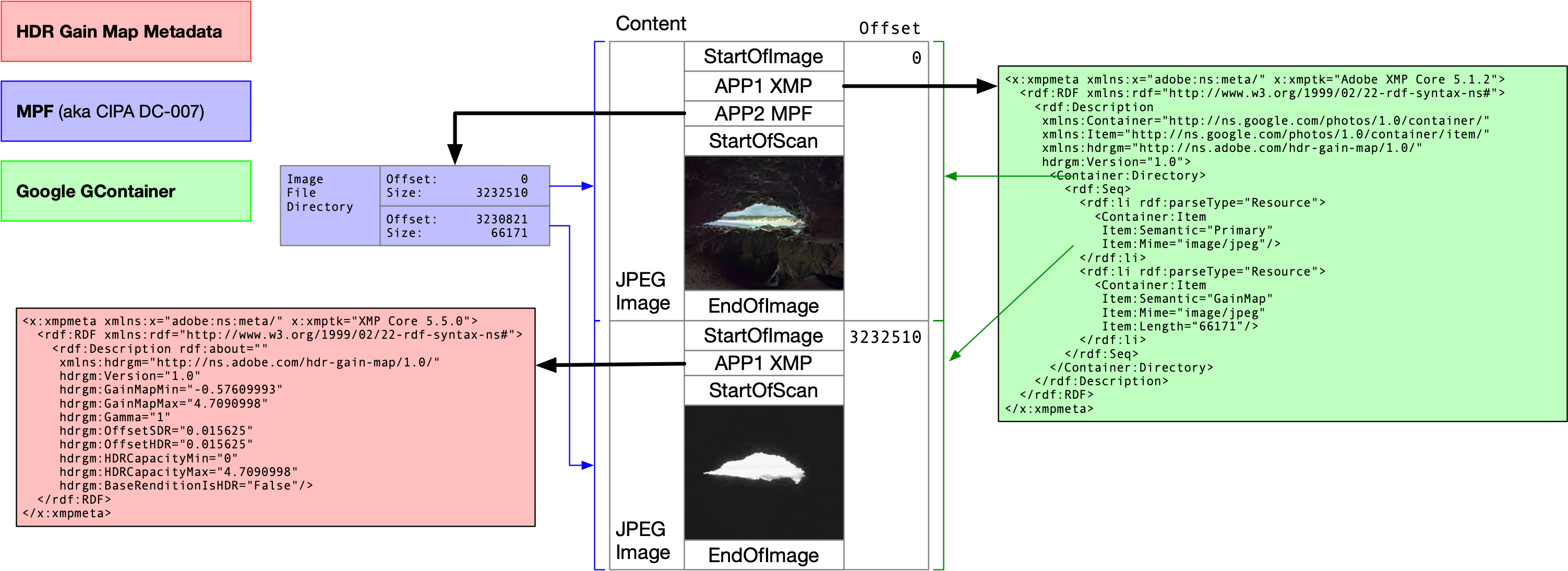
However, hidden within the file's application segments (specifically the APP2 markers utilized by the Multi-Picture Format (MPF) or Adobe's extensible metadata platform (XMP) container schema), the file announces the presence of secondary content. Modern decoders that understand the format inspect these headers, locate the exact byte offset of the secondary image appended to the file, and unpack the gain map alongside its mathematical metadata.
The metadata accompanying the gain map defines the precise rules of engagement for the display engine:
- Minimum and Maximum Gain: The logarithmic brightness boost factors, defining the floor and ceiling of highlight expansion.
- Gamma / Transfer Exponent: The mathematical curve applied to the gain map pixels to ensure smooth, banding-free interpolation across gradients.
- SDR and HDR Offsets: Mathematical stabilization offsets that prevent divide-by-zero errors in absolute shadow values, ensuring dark regions remain completely noise-free.
- Target Headroom Parameters: Metadata specifying the exact display contrast ratio under which the original author graded the HDR presentation.
Because the gain map is essentially a spatial guidance layer rather than an asset requiring high-frequency edge detail, it compresses with extraordinary efficiency. While a full-resolution 48-megapixel smartphone photo might occupy four megabytes as an eight-bit SDR JPEG, an accompanying half-resolution gain map compressed with aggressive quantization adds merely 150 to 300 kilobytes to the overall file size (an overhead of roughly five to eight percent). In exchange for this negligible bandwidth penalty, the file gains the ability to render flawlessly across every screen on planet Earth.
🤝 How Apple, Google, and Adobe Settled on ISO 21496-1
While the conceptual brilliance of the gain map was obvious, its early commercial rollout threatened to fragment the visual web into hostile, proprietary walled gardens.
Beginning around 2020 with the launch of the iPhone 12 Pro and iOS 14, Apple pioneered the practical application of gain maps in consumer devices. Apple stored proprietary HDR metadata inside Apple MakerNotes within the Exif and MPF segments of HEIC and JPEG files. When viewed within Apple's ecosystem, iPhone photographs ignited with stunning HDR highlights. But the moment an iPhone user emailed that JPEG to a Windows PC or posted it to a cross-platform web app, third-party software stripped the unrecognized MakerNotes, or third-party image decoders failed to interpret the custom color space transforms, leaving images looking washed out or corrupted.
Simultaneously, Adobe recognized the critical need for a standardized gain map pipeline for creative professionals. Working within Adobe Camera Raw and Lightroom, Adobe engineers formulated an open specification for gain map storage based on XMP metadata and auxiliary image streams. Adobe's specification provided comprehensive color science documentation, demonstrating how gain maps could operate across standard SDR baselines as well as alternative formats like AVIF, TIFF, and JPEG XL.
Then, in 2023, Google introduced Ultra HDR as a headline platform feature in Android 14. Google's implementation adopted Adobe's core mathematical principles but wrapped the architecture in its own container schema known as GContainer. Android 14 enabled smartphones like the Google Pixel 8 and Samsung Galaxy S24 to capture, edit, and render Ultra HDR photos natively. Yet compatibility frictions persisted: an Ultra HDR JPEG exported from Android did not always render its HDR highlights properly inside Apple's Safari browser, while Apple's native HDR JPEGs often failed to trigger the HDR hardware pipelines of Android smartphones.
The industry path to a unified HDR standard evolved through three distinct phases:
- Apple (2020): Proprietary MakerNote and MPF segments in HEIC and JPEG files.
- Adobe (2022): Open XMP Gain Map Specification for creative workflows.
- Google (2023): Ultra HDR v1.0 utilizing GContainer and XMP in Android 14.
- ISO Consensus (2024 to 2026): ISO 21496-1 standardizes gain map metadata directly in the codestream, unifying rendering math across iOS 18, Android 15, Adobe Camera Raw 17, Chromium, and WebKit.
The imaging industry stood on the precipice of a format war. If the dominant mobile operating systems and creative suites could not agree on metadata storage and mathematical formulas, platforms would refuse to adopt HDR photography. Social networks like Instagram, Threads, and X would continue stripping auxiliary metadata, flattening every upload into eight-bit sRGB.
Recognizing this threat, Apple, Google, Adobe, Qualcomm, and ISO committee members convened to establish ISO 21496-1 (Photography and digital imaging - Gain map metadata for high dynamic range images).
ISO 21496-1 codified:
- Exact metadata serialization: Embedding metadata parameters directly into standardized codestream segments, eliminating incompatibilities between Adobe XMP containers, Apple MakerNotes, and Google GContainers.
- Standardized colorimetric transforms: Specifying exact mathematical equations for color space conversions between sRGB, Display P3, and Rec. 2020 gamuts.
- Deterministic rendering math: Ensuring an image decoded on iOS 18, Android 15, or Adobe Lightroom Classic 14 produces identical highlight luminance under identical display headroom.
Google formalized this in Ultra HDR specification v1.1, directing Android implementations to dual-encode legacy metadata alongside ISO 21496-1, with decoders prioritizing the ISO standard. Apple followed suit across iOS 18 and macOS Sequoia, integrating native ISO 21496-1 parsing into Image I/O and ColorSync. With tech leaders aligned, the open web could safely adopt high dynamic range.
⚡ The Real-Time Mathematics of Display Headroom Scaling
To appreciate why ISO 21496-1 is considered an engineering masterwork, one must look at what happens inside the GPU shader at the exact millisecond an image is drawn to the glass.
The central concept governing gain map rendering is display headroom. Headroom represents the ratio between the maximum linear luminance of HDR content that a display can produce at a given moment (the HDR white point) and the maximum luminance allocated to standard user interface elements (the SDR white point):
$$\text{Headroom} = \frac{\text{HDR White Point}}{\text{SDR White Point}}$$
On a traditional SDR monitor, the HDR white point and SDR white point are identical, yielding a headroom ratio of 1.0 (zero stops of dynamic range expansion). On a high-end mobile OLED screen displaying a dark web page under indoor lighting, the SDR UI might be mapped to 200 nits while the display's peak hardware burst capability reaches 1,600 nits, yielding an immense headroom ratio of 8.0 (three full photographic stops of highlight expansion).
Display headroom determines the real-time boost behavior across varied hardware environments:
- Legacy SDR Monitor: 1.0 headroom ratio, weight factor 0.0, rendering standard SDR only.
- Mid-Tier Laptop (500 nits): 2.5 headroom ratio, weight factor 0.4, delivering gentle highlight pop.
- Apple Pro Display XDR (1,600 nits): 8.0 headroom ratio, weight factor 1.0, rendering full intended HDR radiance.
- Midnight Viewing (2 nits): 1.0 headroom ratio, weight factor 0.0, protecting dark-adapted vision without glare.
When an application renders an ISO 21496-1 image, the operating system's compositing pipeline queries the display hardware in real time to ascertain the currently available headroom. It then compares this physical headroom against the image's embedded metadata: specifically the minimum content boost and maximum content boost.
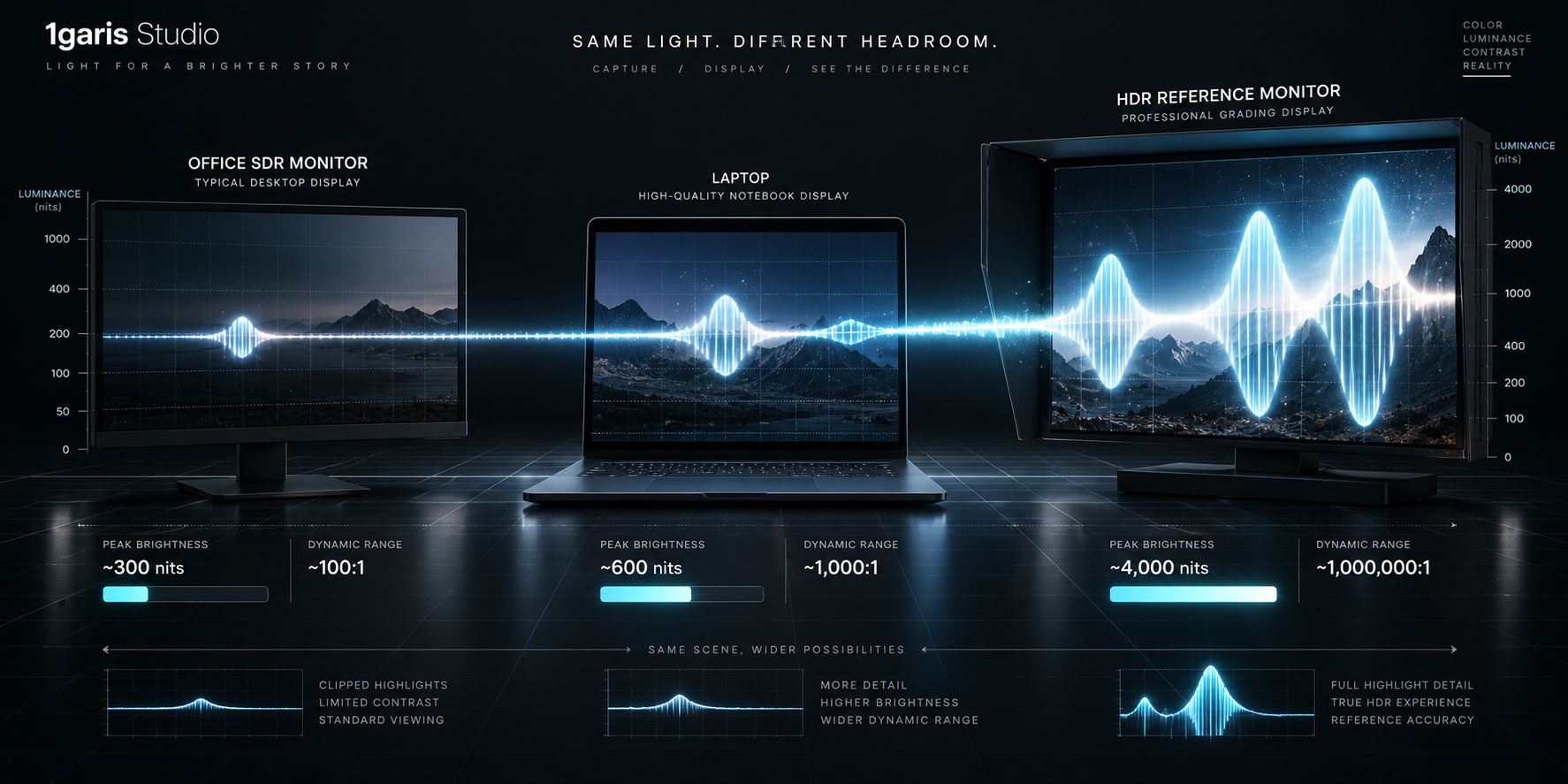
From these variables, the GPU calculates an interpolation factor known as the weight factor. If the display has zero headroom (an SDR screen), the weight factor evaluates to exactly zero. If the display possesses headroom equal to or exceeding the image's maximum boost capability, the weight factor evaluates to 1.0. If the display sits somewhere in between (such as an ultra-thin laptop panel capable of 600 nits), the weight factor cleanly interpolates between 0.0 and 1.0.
The GPU then executes the gain map reconstruction equation across every pixel in parallel within a custom fragment shader:
$$\text{Recovery}(x, y) = \left( \frac{\text{Encoded Gain}(x, y)}{255.0} \right)^{\frac{1}{\text{Gamma}}}$$
$$\text{LogBoost}(x, y) = \text{Gain}_{\min} \cdot (1 - \text{Recovery}(x, y)) + \text{Gain}_{\max} \cdot \text{Recovery}(x, y)$$
$$\text{Target Luminance}(x, y) = (\text{SDR}(x, y) + \text{Offset}_{\text{sdr}}) \cdot 2^{\text{LogBoost}(x, y) \cdot \text{Weight}} - \text{Offset}_{\text{hdr}}$$
Look carefully at the beauty of this formula. Because the exponent includes the dynamically calculated weight factor, the image scales with absolute fluid grace. If the user drags a browser window from an internal laptop screen across to an external SDR projector, the photo does not violently clip or glitch; the highlights smoothly melt back down into standard dynamic range. If the user steps from a dim hallway into bright sunshine and the phone's ambient light sensor boosts the panel's backlight, the photo gracefully blooms into HDR intensity, maintaining perfect perceptual balance with the surrounding physical environment.
Furthermore, because the transformation operates in a logarithmic domain tied to linear light, the spatial relationships between midtones and shadows remain completely unmolested. Skin tones, clothing textures, and interior shadows, which were mastered to perfection within the baseline SDR image, remain entirely stable. Only the pixels that the photographer intended to emit actual light receive the calculated energetic boost.
🌐 What Happens When HDR Photos Hit Social Media and the Web
While operating systems and cameras have perfected local capture and display, transmitting HDR photos across the internet historically created severe friction.
For over twenty years, automated image optimization has been standard on the web. Content delivery networks, content management systems, and social backends strip Exif and XMP metadata to save bytes, downscale resolutions, and recompress assets using lossy tools like MozJPEG or WebP.
In the SDR era, this was harmless hygiene. For gain maps, it was fatal. If a naive compressor strips APP2 or XMP headers, the gain map is severed from the primary JPEG. The recipient receives only the baseline SDR image, losing all HDR brilliance. Even worse, if a proxy resizes the base image without resizing the gain map proportionally, the spatial alignment desynchronizes, generating glaring halos around high-contrast edges.
The modern web transmission pipeline functions as a multi-stage chain:
- Camera Capture: Produces a clean ISO 21496-1 dual-stream JPEG.
- Social and Web Upload: Avoids naive CDNs that strip metadata, ensuring both image streams remain intact.
- Modern Processing Engine: Preserves spatial synchronization between the base image and gain map.
- Web Browsers (Chromium and WebKit): Decode SDR baseline and gain map concurrently in GPU fragment shaders.
- Display Panel: Delivers real-time adaptive illumination tailored to ambient light and panel headroom.

Major platforms have adapted. Meta rebuilt Instagram and Threads pipelines to preserve ISO 21496-1 gain map streams. An HDR photo captured on an iPhone 16 or Galaxy S25 uploaded to Instagram now retains its gain map, illuminating compatible feeds while appearing as crisp SDR on legacy hardware.
Browser engines have similarly integrated gain maps into standard HTML image elements (img tags). Chromium implemented GPU-accelerated decoding across Chrome, Edge, and Brave on Windows, Android, and macOS. Apple's WebKit team shipped crucial fixes in Safari Technology Preview (such as STP 248), patching color shift regressions where RGB gain maps were mistakenly decoded to eight bits per channel and refining headroom handling for Pro Display XDR screens.
The W3C CSS Working Group has also advanced CSS Color HDR, introducing media queries to detect HDR-capable displays:
@media (dynamic-range: high) {
  .hero-banner {
    border-color: color(display-p3 1 1 1);
  }
}
With browser engines rendering gain maps directly on the canvas and in image tags, the web is transitioning into a luminous visual canvas.
🛠️ Practical Guidelines for Designers, Photographers, and Developers
For creative professionals, visual artists, and software engineers, the arrival of standardized ISO 21496-1 gain maps demands an overhaul of established digital media workflows. You can no longer assume that the pixels you paint in design applications will be experienced identically by your audience.
Here are the concrete operational rules for navigating the gain map era:
- Author with a Rock-Solid SDR Baseline First: Never treat the standard dynamic range version as an afterthought. Because billions of users will view your work on SDR displays, your primary JPEG must look completely finished, balanced, and aesthetically compelling in standard sRGB or Display P3. The gain map should serve exclusively as an additive enhancement for highlights, specular reflections, and localized light sources, never as a crutch to rescue poorly exposed shadows.
- Verify Export Pipelines in Modern Creative Suites: If you are exporting HDR photography from Adobe Lightroom Classic (version 14 or later) or Adobe Camera Raw (version 17 or later), ensure that HDR Output is enabled and Maximize Compatibility (Gain Map) is checked in your export presets. This ensures Lightroom writes the standardized ISO 21496-1 codestream metadata alongside the JPEG file, guaranteeing seamless playback across both Android and iOS devices.
- Audit Image Ingestion Pipelines and CDNs: If you operate an e-commerce website, a digital newsroom, or a web platform that processes user uploads, immediately audit your image ingestion workers. Ensure that your image processing libraries (such as libvips or Sharp) are upgraded to versions that support dual-stream image preservation. Verify that your asset minifiers do not strip XMP and MPF application segments (
APP2,APP1) from JPEG headers. - Beware of Extreme Headroom Glare in Web Typography: When designing web interfaces that feature HDR photography, be acutely aware of visual contrast balance. If an article features a brilliant HDR photo whose highlights blaze at 1,500 nits, placing pure black text on a blinding white background immediately adjacent to that photo will create severe visual exhaustion. Designers should utilize soft off-white backgrounds (such as
#F4F4F5or#ECECEC) so that UI chrome does not compete with photographic light sources. - Test Across Asymmetric Hardware Targets: Never finalize a creative campaign or digital product launch by reviewing assets exclusively on an Apple MacBook Pro or a high-end OLED phone. Always cross-test your assets on a standard office monitor capped at 250 nits, an Android device with Ultra HDR enabled, an iOS device running iOS 18, and a Windows desktop running Chrome with Windows HDR display calibration active.
🔮 The Future of Digital Imaging Beyond the 8-Bit Ceiling
The standardization of ISO 21496-1 gain maps represents far more than an incremental patch for smartphone photography; it marks the definitive psychological transition away from the static, print-centric heritage of computer graphics toward a dynamic, light-centric computational medium.
For over a century, photography was defined by the chemistry of paper and film. An image was an immutable record: once silver halide crystals or ink droplets were fixed to a physical surface, the reflectance of that surface was permanent. When digital imaging emerged in the late twentieth century, it dutifully inherited that print mental model. A pixel was treated as a digital speck of ink, with an eight-bit number representing the percentage of light that speck should reflect.
Gain maps shattered that mental model forever. In the modern visual stack, a photograph is no longer a static picture; it is a portable, adaptive light field. It carries both the human artistic interpretation of the scene and the physical instructions required to synthesize that scene across whatever silicon, glass, and photon emitters happen to be available at the moment of viewing.
As display hardware continues its relentless march toward five-thousand-nit micro-LED panels, transparent augmented reality visors, and holographic light-field arrays, the principle of decoupled, headroom-adaptive visual computing will become universal. The thirty-year-old JPEG format, written when computers connected over 14.4k dial-up modems and CRT monitors filled entire desks, has once again proven its uncanny, stubborn immortality. By hiding a secondary universe of mathematical light inside its humble headers, JPEG did not just survive the arrival of high dynamic range; it quietly ensured that the digital memories of humanity will continue to shine, without ever blinding the world that watches them.
Sources: International Organization for Standardization (ISO 21496-1:2025/2026 Photography and digital imaging - Gain map metadata for high dynamic range images); Google Android Developers (Ultra HDR Image Format Specification v1.1, October 2024); Apple Developer Documentation (ColorSync Headroom Adaptive Gain Curve & Image I/O Framework, 2025/2026); Adobe Help Center (Gain Map in Adobe Camera Raw & Lightroom, October 2024); WebKit Engineering Blog (Safari Technology Preview 248 Release Notes & HDR Gain Map Decoding, 2026); Greg Benz Photography (ISO 21496-1 Gain Maps Technical Analysis).