
For nearly a decade, the modern React ecosystem operated under an unspoken infrastructure tax: if your engineering organization chose Next.js for its developer ergonomics, routing paradigms, and server rendering primitives, your production deployment was effectively funneled toward Vercel. While the framework technically remained open source under the MIT license, deploying it outside Vercel's proprietary edge network routinely felt like swimming upstream against an intentionally complex runtime architecture. Teams attempting to host production Next.js applications on Amazon Web Services, Google Cloud Platform, or Cloudflare had to rely on fragile community shims like OpenNext, reverse-engineer undocumented build outputs, or accept stripped-down Node.js container images that forfeited global edge performance.
On September 28, 2026, Cloudflare shattered that architectural lock-in by announcing the general availability of Vinext 1.0. What began seven months earlier as an audacious AI-driven research probe to see whether one engineer and eleven hundred dollars in language model tokens could replicate the Next.js API surface has matured into a production-hardened framework. Running entirely on top of Vite, Vinext 1.0 delivers more than 99 percent feature compatibility across both the contemporary App Router and the legacy Pages Router. Crucially, independent and reproducible benchmarks demonstrate that Vinext compiles production applications up to 4.4 times faster while producing client JavaScript bundles that are 57 percent smaller than Next.js 16 running on Turbopack.
This release represents far more than another alternative bundler wrapper. It signals a fundamental shift in how web development frameworks interact with cloud hosting providers. By rebuilding the entire Next.js runtime surface on top of Vite, the toolchain powering more than 130 million weekly npm downloads, Cloudflare has decoupled React Server Components, Server Actions, and incremental rendering from proprietary deployment platforms. The web development stack is moving toward a universal, vendor-agnostic build substrate, and the economics of full-stack engineering will never be the same.
⚡ The Architectural Breakaway from Proprietary Hosting Rails
When Next.js introduced the App Router in version 13 and doubled down on React Server Components, it promised a unified model for full-stack web applications. Developers could write async server components that fetched database records directly without client-side API waterfalls, stream HTML chunks progressively to the browser, and co-locate server mutations alongside user interface code. In practice, however, the implementation details increasingly reflected the architectural assumptions of Vercel's proprietary serverless platform.
Deploying an advanced Next.js application required a labyrinth of proprietary abstractions: image optimization pipelines bound to platform-specific edge workers, Incremental Static Regeneration (ISR) mechanisms dependent on managed caching infrastructure, and dynamic server routing split across dozens of ephemeral lambdas. For organizations operating their own infrastructure or standardizing on alternative cloud platforms, this created a painful dilemma. They could either surrender to Vercel's pricing tiers, which escalate rapidly once team seats, bandwidth egress, and edge middleware invocations scale, or accept the operational overhead of running monolithic Docker containers running next start on virtual machines.
The operational friction reached a boiling point with the introduction of Turbopack. Positioned as the Rust-based successor to Webpack, Turbopack was tightly integrated into the Next.js core repository. While Turbopack delivered noticeable improvements in local hot module replacement, it reinforced framework insularity. Other modern frameworks across the JavaScript ecosystem, such as Astro, SvelteKit, Nuxt, SolidStart, and Remix, had converged on Vite as their shared, community-governed foundation. Next.js stood alone, maintaining a bespoke bundler that only its own parent company had the engineering resources to maintain and optimize.
Cloudflare recognized that fighting Next.js on framework adoption was a losing battle; millions of production codebases and developer resumes were already written in Next.js idioms. The strategic maneuver was not to convince developers to rewrite their applications in a new framework, but to make the Next.js API surface completely portable. Vinext achieves this by treating Next.js not as an indivisible binary monolith, but as a public application programming interface that can be executed natively inside standard Vite environments.
🏗️ Rebuilding Full-Stack React on a Universal Build Substrate
To understand why Vinext represents an engineering breakthrough, one must examine how traditional bundlers handle full-stack React. Next.js historically utilized Webpack, and later Turbopack, to perform complex multi-pass compilations. A single project required compiling a server bundle, a client hydration bundle, an edge middleware bundle, and specialized manifests mapping client reference IDs to their respective script chunks. This multi-pass architecture introduced significant memory consumption and prolonged build times during continuous integration cycles.
Vinext replaces this entire bespoke compilation pipeline with a clean Vite plugin architecture. Rather than wrapping existing Next.js build artifacts, Vinext implements the next/* module namespace from scratch. When an application imports next/navigation, next/headers, next/image, or next/cache, Vinext provides Vite-native implementations that compile directly through standard Rollup and Rolldown pipelines.
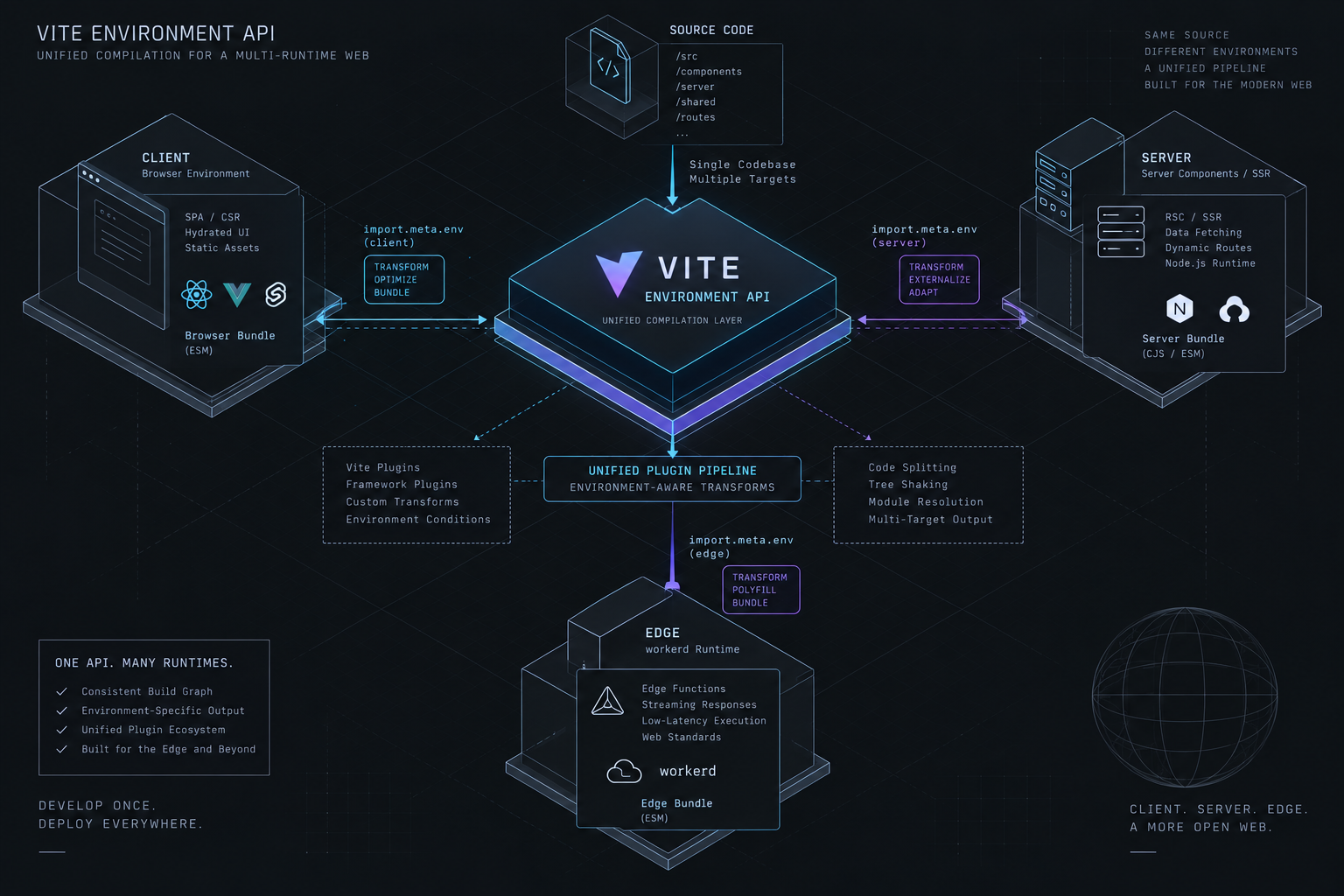
The architectural cornerstone enabling this clean separation is the Vite Environment API, stabilized in Vite 6 and expanded throughout Vite 7 and 8. The Environment API allows a single Vite instance to manage distinct runtime contexts simultaneously: client-side browser bundles, standard Node.js server execution, and lightweight JavaScript virtual machine runtimes such as Cloudflare's workerd. Under this model, Vinext does not need to execute separate build commands or marshal intermediate file manifests across disparate processes. It orchestrates server component rendering and client bundle generation inside a unified compilation graph.
Furthermore, Vinext embraces the native Web Standards that have become standard across modern edge runtimes. Standard Request, Response, Headers, and ReadableStream primitives are used directly throughout the request lifecycle, eliminating the translation layers that previously converted Node.js IncomingMessage and ServerResponse streams into edge-compatible formats. The result is an execution pipeline that is structurally cleaner, significantly easier to inspect, and devoid of proprietary closed-source glue code.
⏱️ Benchmark Reality Checks on Compilation Speed and Bundle Footprint
Marketing claims regarding framework speed are common across developer tooling, but the performance figures documented in Vinext 1.0 reflect genuine structural differences between bundler architectures. Cloudflare established an automated benchmarking suite running on public GitHub CI runners that compares Next.js 16.1.6 against Vinext across identical application fixtures containing 33 distinct dynamic and static routes.
To ensure strict fairness, the benchmark isolates bundler and compilation speed from secondary tasks. TypeScript type checking and ESLint linting were disabled in the Next.js configuration, as Vite relies on external checkers for these tasks during production builds. Furthermore, routes were configured with force-dynamic to prevent Next.js from spending extra time prerendering static HTML, which would have artificially inflated its build duration. Both frameworks were evaluated purely on their ability to ingest source files, resolve module graphs, transform React Server Components, and output production assets.
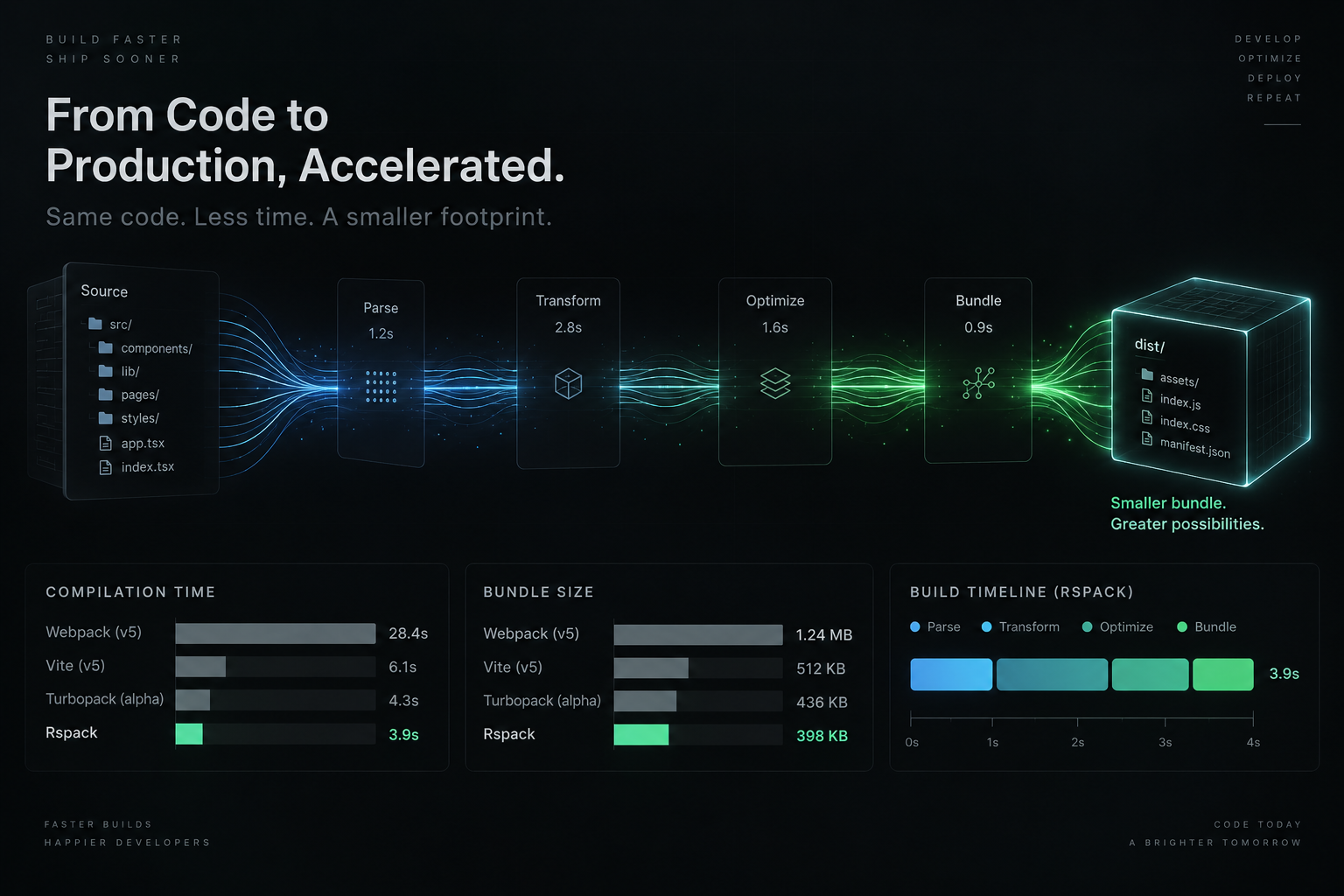
The empirical results reveal a dramatic performance delta:
- Production Build Duration: Next.js 16.1.6 utilizing Turbopack recorded an average build time of 7.38 seconds on the benchmark fixture. Vinext running on Vite 7 with standard Rollup completed the same build in 4.64 seconds, representing a 1.6x speedup. When Vinext was configured with Vite 8 powered by Rolldown, the Rust-based bundler developed by the VoidZero team, build duration plummeted to just 1.67 seconds. That marks a 4.4x acceleration over the official Turbopack pipeline.
- Client Bundle Footprint (Gzipped): The size of JavaScript delivered to end users is critical for mobile performance and Core Web Vitals. The shared 33-route test application compiled under Next.js 16.1.6 produced a cumulative gzipped client bundle of 168.9 kilobytes. The identical application compiled under Vinext with Rollup generated a client bundle of only 74.0 kilobytes, achieving a 56 percent reduction. Under Rolldown, the bundle shrank further to 72.9 kilobytes, representing a 57 percent decrease in client payload.
This substantial reduction in client bundle size stems from Vite's superior dead-code elimination and tree-shaking algorithms, combined with the elimination of runtime polyfills that Next.js embeds to support legacy environments. For large enterprise web properties comprising hundreds of routes and complex component hierarchies, a 57 percent reduction in baseline JavaScript payload translates directly into faster Largest Contentful Paint (LCP) and reduced Interaction to Next Paint (INP) latency on low-powered mobile devices.
🔄 Moving Past Fragile Output Adapters and Build-Time Reverse Engineering
The emergence of Vinext addresses a long-standing grievance within the web engineering community: the fragility of post-build adapters. Before Vinext, organizations committed to running Next.js outside Vercel relied heavily on OpenNext, an ambitious open-source initiative supported by cloud providers and independent developers.
OpenNext functioned by reverse-engineering the compiled output generated by next build. Because Next.js did not provide a stable, formal intermediate representation for external hosting providers, OpenNext had to inspect compiled JavaScript chunks, decipher internal routing manifests, extract serverless functions, and stitch them back together into formats acceptable to AWS Lambda or Cloudflare Workers.
Every minor release of Next.js threatened to disrupt this delicate reverse-engineering pipeline. A subtle change in how Next.js serialized flight data, a restructuring of internal directory layouts, or an unannounced modification to caching headers could break production deployments without warning. Engineers maintaining alternative cloud pipelines found themselves playing an exhausting, perpetual game of whack-a-mole, patching adapter libraries days after each upstream framework update.
Moreover, post-build adapters suffered from an unavoidable local development disconnect. During local development, developers executed next dev, which ran in a standard Node.js process. When the application was deployed to an edge environment powered by V8 isolates, such as Cloudflare Workers, platform-specific behaviors emerged that were never detected locally. Developers attempting to use edge-native primitives like Key-Value stores, relational database bindings via Hyperdrive, or object storage via R2 were forced to construct mock interfaces or employ cumbersome proxy utilities.
Vinext eliminates this architectural impedance mismatch entirely. Because server execution is integrated directly into Vite, local development runs inside the exact same workerd runtime engine that executes production traffic in Cloudflare's global network. A binding, secret, or streaming response behaves identically on a developer's laptop as it does across hundreds of data centers worldwide, eradicating an entire category of environment-specific deployment bugs.
🌐 Shifting Page Prerendering from Exhausting CI Pipelines to Edge Cache Warming
One of the most consequential architectural innovations introduced in Vinext 1.0 is a fundamental reimagining of page prerendering and static generation. In conventional full-stack frameworks, including Next.js, static generation occurs on the continuous integration build server. Functions such as generateStaticParams and getStaticPaths instruct the build system to render dozens, thousands, or even hundreds of thousands of individual HTML files sequentially before an application can be considered ready for deployment.
For large content platforms, e-commerce storefronts, and media websites, this build-time prerendering model creates crippling operational bottlenecks. Continuous integration pipelines often stretch to 45 minutes, an hour, or longer simply rendering pages that may receive negligible organic traffic. If a critical bug fix needs to be deployed to production, engineering teams are forced to wait for thousands of static pages to compile before their urgent code patch reaches users.

Vinext 1.0 challenges the foundational assumption that static rendering must occur on build servers. Instead, it introduces edge-native cache warming. When an application is compiled with Vinext, the build process focuses strictly on assembling the core application logic and assets, finishing in seconds rather than hours. The prerendering workflow is then offloaded directly to Cloudflare's distributed edge network.
The cache warming mechanism operates through an elegant zero-traffic deployment lifecycle:
- Staged Version Upload: The newly compiled Worker version is uploaded to the global network and assigned zero percent of live production traffic. Real end users continue to interact with the previous stable version without interruption.
- Targeted Edge Ingestion: Vinext's deployment tooling issues targeted internal requests directly to the staged deployment. Prerendering directives defined in
generateStaticParamsare evaluated directly inside edge data centers nearest to the underlying origin databases, utilizing low-latency edge connections. - Automated Traffic Promotion: Once edge caches across global points of presence have been populated with fresh rendered HTML and streaming server components, the staged Worker is instantly promoted to receive 100 percent of production traffic.
This paradigm shift decouples deployment speed from content scale. A digital publication with 500,000 archived articles can ship production code changes in under two minutes, while ensuring that high-traffic routes remain warmed and responsive the instant user traffic touches the new release.
🧩 Dual-Router Parity Across Server Components and Legacy Pages
When frameworks undergo generational shifts, real-world development teams rarely migrate overnight. The transition from Next.js Pages Router to App Router has been notoriously fraught. Many large technology organizations maintain mature production applications where mission-critical checkout flows, account dashboards, or enterprise administrative portals remain firmly rooted in the Pages Router, while marketing sites and editorial sections embrace the App Router.
Initial experiments with alternative Next.js runtimes frequently made the mistake of supporting only the newest App Router features, leaving existing enterprise codebases stranded. Vinext 1.0 explicitly rejects this purist approach, achieving greater than 99 percent test compatibility across both router architectures.
Engineering teams running Vinext can seamlessly operate hybrid applications:
- Pages Router Support: Full compatibility with classic Next.js data fetching methods, including
getServerSideProps,getStaticProps, andgetStaticPaths. Client-side page navigation, custom_app.jsand_document.jswrappers, and legacy API routes function without modification. - App Router Parity: Complete implementation of React Server Components, Server Actions for handling forms and mutations, nested layout hierarchies, error boundaries, loading skeletons, and route handlers. Client-side navigation utilizes native streaming transitions without page refreshes.
- Unified Caching Layer: Caching semantics across both routers are unified under a pluggable architecture. Rather than relying on rigid proprietary cache implementations, Vinext provides standard interfaces that integrate directly with Cloudflare KV, R2 storage, or custom in-memory caching solutions via
next/cachebindings. - Enterprise Observability: Existing observability instrumentations, including OpenTelemetry tracing and Sentry error monitoring, function out of the box through standard Next.js hooks. On Cloudflare Workers, telemetry traces automatically correlate with native Workers Observability dashboards.
Interestingly, Cloudflare's telemetry and community discussions revealed a clear divergence in feature demand. While Next.js 16 heavily promoted experimental "Cache Components" driven by the "use cache" directive, the vast majority of production engineering teams surveyed viewed that specific abstraction as unstable and unnecessary for their workloads. Vinext 1.0 consequently prioritized rock-solid stability for core routing, revalidation by path and tag, and middleware execution over experimental directives, ensuring that teams migrating today experience zero regressions in critical application paths.
🤝 Why Cloudflare Absorbed VoidZero to Anchor Open Source Web Tooling
The release of Vinext 1.0 cannot be understood in isolation from Cloudflare's broader strategic investments in open-source developer tooling. On June 4, 2026, Cloudflare finalized its acquisition of VoidZero, the company founded by Vue.js creator Evan You that stewards Vite, Vitest, Rolldown, and Oxc.
Prior to the acquisition, VoidZero occupied a paradoxical position in the technology sector. The open-source tools maintained by Evan You and his engineering team had become the de facto standard for frontend development worldwide. Vite alone crossed 130 million weekly npm downloads, while Vitest became the fastest-growing unit testing framework in JavaScript history. However, sustaining a commercial business purely on open-source tooling while simultaneously attempting to build a proprietary cloud deployment platform placed immense strain on a lean engineering team.
By bringing VoidZero into Cloudflare's Emerging Technology and Incubation group, Cloudflare resolved VoidZero's revenue equation while insulating Vite from commercial enclosure. Under the terms of the agreement, Vite, Vitest, Rolldown, Oxc, and the recently launched Vite+ toolchain remain strictly MIT-licensed, vendor-agnostic, and governed by open community roadmaps. Furthermore, Cloudflare committed one million dollars to an independent ecosystem fund specifically dedicated to supporting open-source maintainers who have no formal affiliation with either company.

The strategic rationale for Cloudflare is clear: controlling the edge cloud market requires owning the developer's default build experience. For years, Vercel successfully captured frontend mindshare because its platform offered the smoothest, zero-configuration path from local git push to production URL. By acquiring the team behind the web's dominant bundler and releasing Vinext 1.0, Cloudflare has eliminated Vercel's exclusive moat.
Developers now have a direct, friction-free path from the industry's most popular framework (Next.js) through the industry's most widely adopted build tool (Vite) straight onto Cloudflare's high-performance edge compute network. The cloud wars have officially shifted from raw compute pricing to developer toolchain integration.
🛠️ The Concrete Engineering Steps for Evaluating Production Decoupling
For engineering leads, software architects, and development teams evaluating whether Vinext 1.0 is viable for their production stacks, Cloudflare has designed a pragmatic, non-destructive migration workflow. Converting an existing Next.js codebase does not require deleting legacy configurations or committing to an irreversible rewrite.
A structured evaluation follows four disciplined engineering phases:
Phase 1: Automated Compatibility Preflight
Before altering a single line of code, teams can run an automated preflight check directly against their current repository. This utility inspects project dependencies, configuration flags, routing patterns, and custom server code:
npx vinext checkThe CLI outputs an exhaustive audit highlighting any unsupported third-party packages, bespoke Webpack loaders, or deprecated configuration options. If compatibility exceeds the project's requirements, teams proceed to initialization.
Phase 2: Non-Destructive Workspace Scaffolding
Running the initialization command installs Vinext dependencies and configures Vite alongside the existing project structure:
npx vinext initThis command generates a vite.config.ts file tailored to Next.js conventions while leaving the existing next.config.js, app/, and pages/ directories untouched. Developers can continue running npm run dev with standard Next.js while simultaneously testing npm run dev:vinext to evaluate performance side by side.
Phase 3: Local Edge Verification
With the Vinext development server running, developers can verify application behavior in the local workerd environment:
npm run dev:vinextHot module replacement (HMR), server component streaming, and form actions can be validated across real browser sessions. Any Cloudflare bindings, such as KV namespaces or D1 databases, can be tested locally using native Wrangler configuration without third-party mocks.
Phase 4: Production Staging and Cache-Warmed Deployment
When the team is satisfied with local fidelity, the application can be deployed to a staging environment with cache warming enabled:
npx @vinext/cloudflare deployThe command bundles the production assets using Vite and Rolldown, deploys the Worker to a private staging route, warms the edge cache against designated paths, and provides a verified preview URL.
The web has always thrived when open standards and vendor neutrality prevail over closed software silos. For years, the React ecosystem felt uncomfortably bound to a single vendor's commercial ambitions. With Vinext 1.0, Next.js has finally escaped its proprietary rails. Full-stack React belongs to the open web once more, and developers are free to build on Vite and deploy wherever performance, cost, and reliability dictate.
Editorial sources: Cloudflare Engineering Blog, Vinext Documentation, VoidZero Ecosystem Announcements, and Vite Core Project Releases.