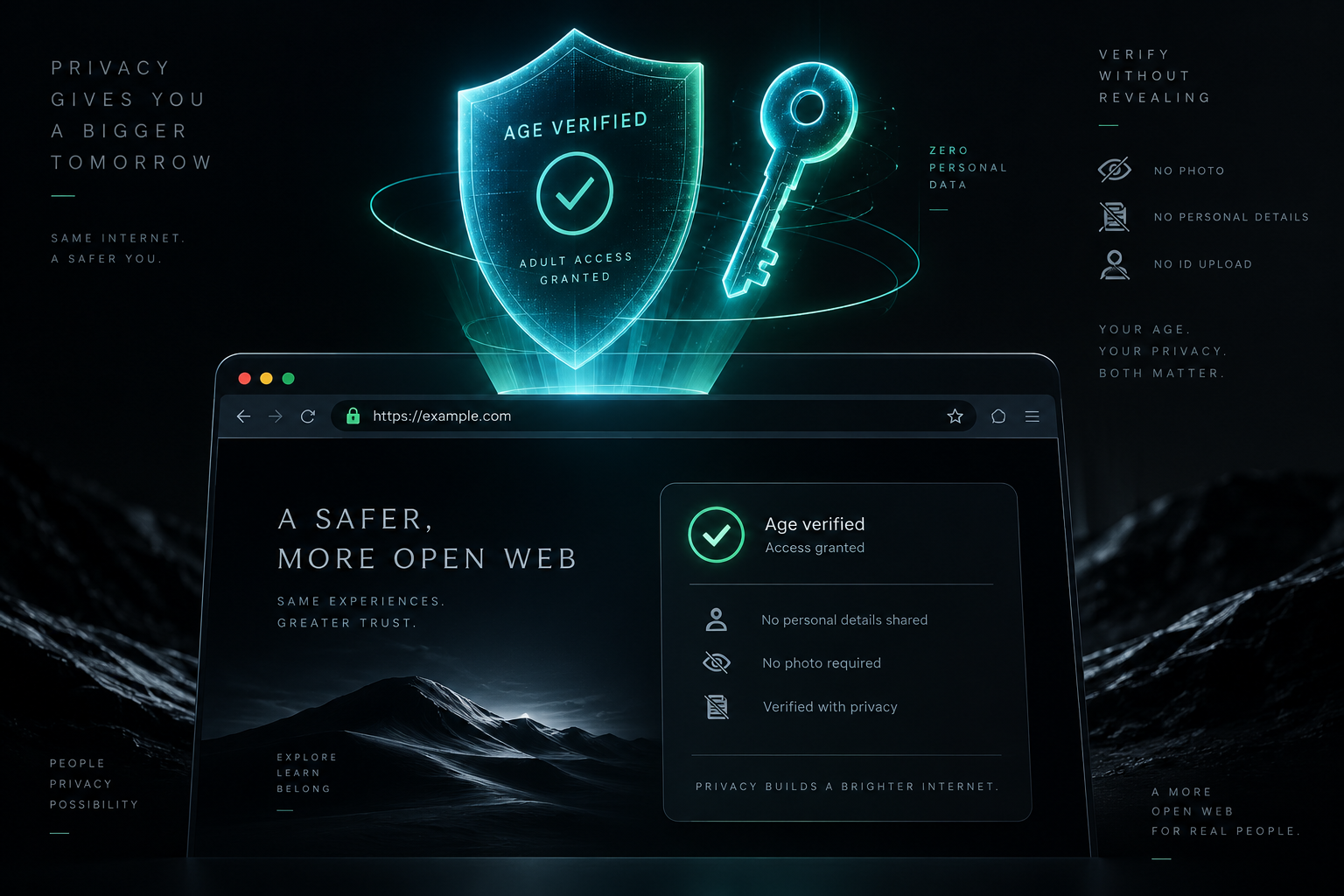
The modern web was never designed to hold an official passport. For three decades, the browser operated as an untrusted client navigating public hypertext documents, intentionally kept apart from the legal identities and state-issued credentials of the human beings sitting behind the screen. When an online service needed to verify that a visitor was legally an adult, a certified professional, or an eligible citizen, the web platform offered no native primitive. Developers were forced to improvise an ugly, invasive compromise: instructing users to hold their government-issued identity cards up to a smartphone camera, record a high-definition video selfie nodding at an arbitrary prompt, and upload those raw biometric assets to a third-party software vendor.
That workaround became a catastrophe for digital privacy. Centralized identity verification vendors assembled massive databases containing unrevokable biometric templates, high-resolution scans of driver's licenses, and complete government identifiers. These honeypots turned into prime targets for extortion, credential stuffing, and identity theft. Simultaneously, new waves of child online safety regulations, financial compliance laws, and adult content access gates across Europe, North America, and the Asia-Pacific region began imposing mandatory age verification on everyday websites. Web publishers faced an agonizing dilemma: either exclude visitors entirely or force every adult reader to surrender unencrypted personal dossiers to an opaque verification intermediary.
In the autumn of 2026, the World Wide Web Consortium and browser platform architects delivered a definitive structural answer. Through the advancement of the W3C Digital Credentials API within the Federated Identity Working Group, working in concert with the European Union's revised eIDAS 2.0 framework and Architecture and Reference Framework version 3.0, the browser has evolved into a privacy-preserving user agent capable of cryptographic mediation. Instead of transmitting identity documents across the network, websites can now ask the browser a binary mathematical question, and the user's native hardware wallet can answer it with an unforgeable cryptographic proof.
🛡️ The Structural Breakdown of the Uploaded Identity Scan
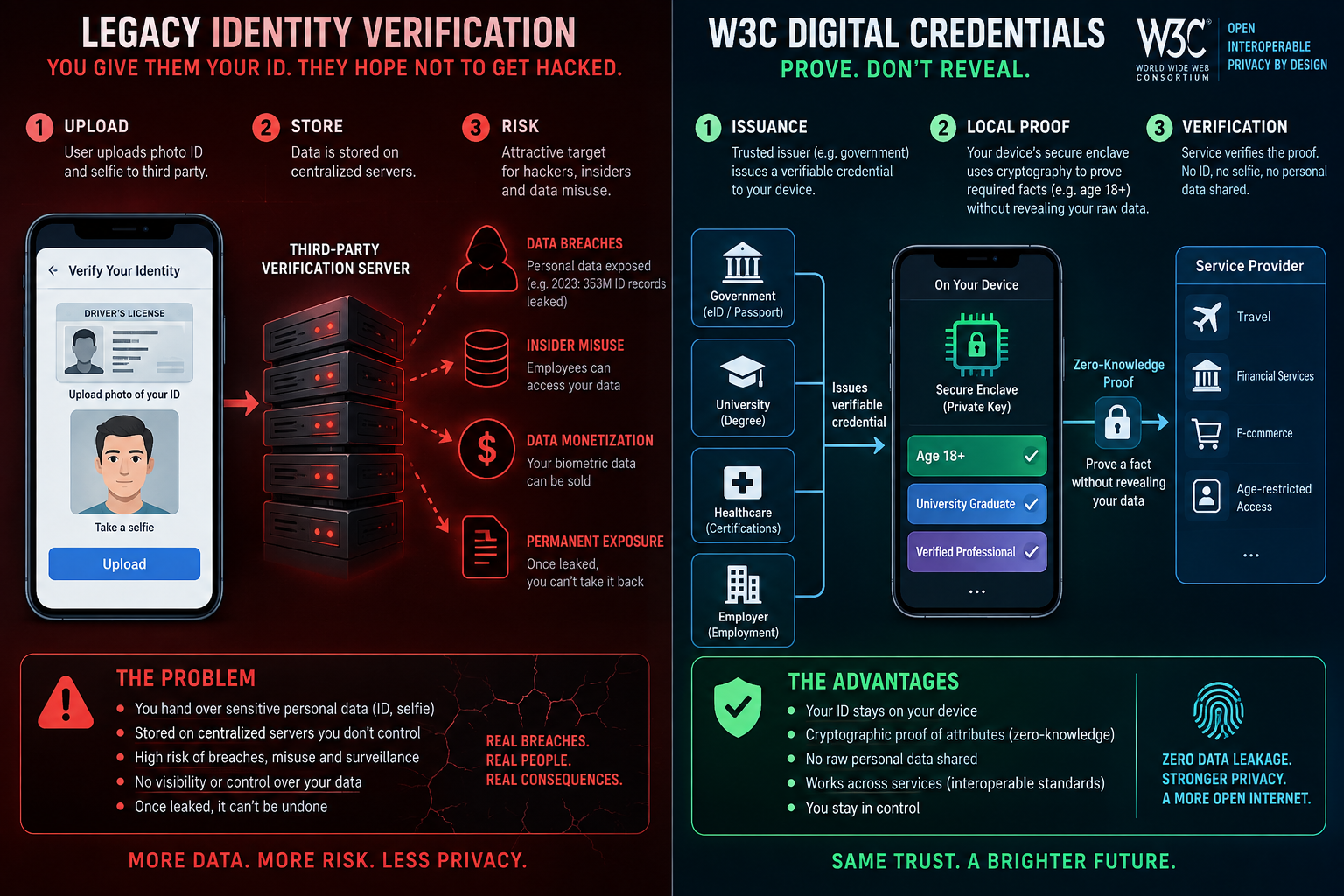
To understand why the web platform requires a native identity standard, one must examine the catastrophic failure mode of contemporary online verification. The prevailing commercial workflow for age assurance and customer identification relies on optical character recognition and biometric matching performed on remote cloud infrastructure. When a user creates an account on a regulated platform, the application initiates an iframe or redirects to a vendor that requests permission to capture the device's camera. The visitor captures both sides of a national identity card or driver's license, alongside a 3D facial mesh capture to prove liveness.
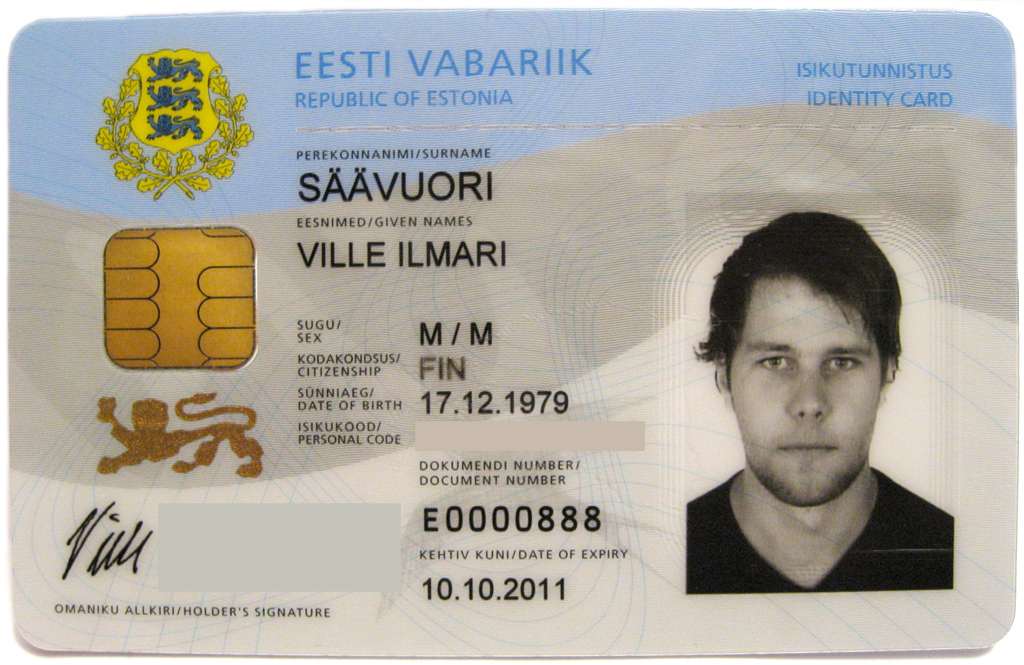
This architecture violates the foundational security principle of data minimization at every layer of the exchange. An identity card is an analog artifact engineered for physical human inspection by law enforcement officers or store clerks. It contains a high-density cluster of unredacted personal information: the citizen's full legal name, date of birth, home residential address, national registration number, physical height, organ donor status, and a stamped photograph. When an e-commerce merchant or social forum merely needs to ascertain whether a visitor is at least eighteen years of age, collecting this entire physical document is an egregious act of over-asking.
The consequences of this architectural mismatch are severe and permanent. Passwords can be rotated, session tokens can be revoked, and credit card numbers can be reissued upon compromise. Biometric geometry and government-issued national registry numbers, however, cannot be changed when a database leaks onto an underground forum. Over the past five years, breaches at identity verification providers and credit monitoring agencies have permanently compromised the foundational identity records of hundreds of millions of people. Every uploaded passport scan acts as an irrevocable vulnerability waiting to be exploited.
Furthermore, remote optical verification is inherently brittle against synthetic media. With generative adversarial models and diffusion-based rendering pipelines capable of fabricating photorealistic driver's licenses and synthetic human faces in real time, the optical verification industry has been trapped in an unwinnable arms race. Verifiers deploy increasingly intrusive behavioral monitoring, browser fingerprinting, and device telemetry to detect spoofed cameras, converting simple web interactions into invasive surveillance operations. The web needed a cryptographic mechanism that validates truth without observing the person.
🔑 Inside the Architecture of the Digital Credentials API
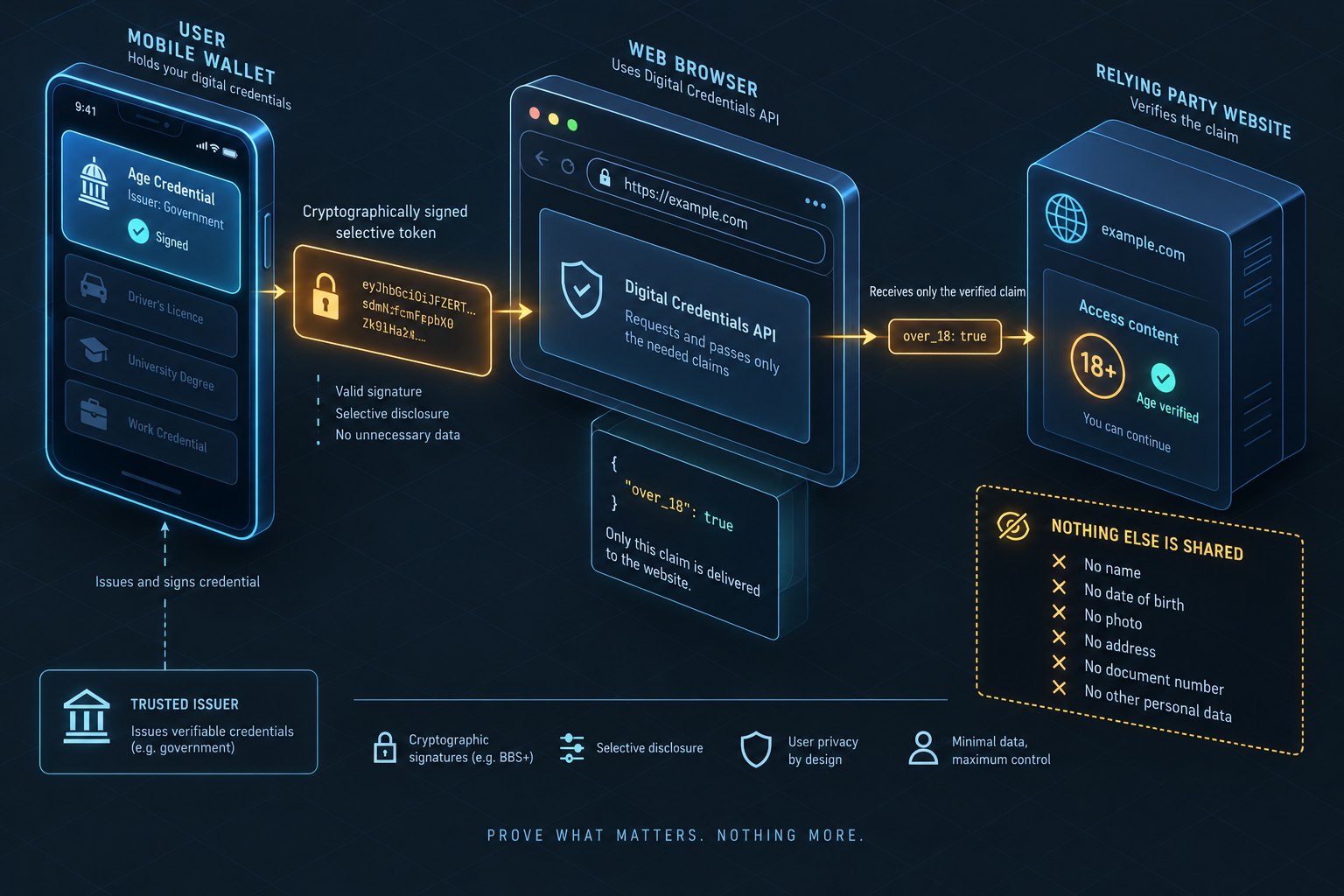
The W3C Digital Credentials specification fundamentally reframes the relationship between websites, browsers, and legal identities. Rather than allowing a website to directly inspect or interrogate a user's credentials, the standard introduces an explicit mediation boundary enforced by the browser user agent. The API extends the proven W3C Credential Management Level 1 interface, placing digital identity verification alongside passwords, federated identity tokens, and WebAuthn public keys under the native navigator.credentials container.
At the technical center of this integration is the navigator.credentials.get() method invoked with a dedicated digital dictionary. Instead of spawning a proprietary software development kit, an enterprise website or small publisher issues a standardized declarative request that specifies the requested protocol and the structured query defining the required claims:
// Requesting cryptographic age verification via the Digital Credentials API
const credential = await navigator.credentials.get({
  digital: {
    requests: [{
      protocol: "openid4vp-v1-unsigned",
      data: {
        response_type: "vp_token",
        nonce: crypto.randomUUID(),
        client_metadata: {
          client_id: "https://1garis.id",
          client_name: "1garis Digital Journal"
        },
        dcql_query: {
          credentials: [{
            id: "age_verification",
            format: "dc+sd-jwt",
            meta: { vct_values: ["urn:eu:europa:ec:eudi:pid:1"] },
            claims: [
              { path: ["age_over_18"] }
            ]
          }]
        }
      }
    }]
  }
});
When this invocation occurs, the browser does not expose the user's storage or query external servers behind the scenes. Instead, the browser suspends the executing script and evaluates its internal Permissions Policy. The specification normatively gates all credential requests behind the digital-credentials-get policy directive, which defaults exclusively to the top-level origin (self). Embedded iframes cannot silently poll for credentials or trigger the interface unless the parent document explicitly grants permission via the allow="digital-credentials-get" attribute.
If permissions are satisfied, the browser presents a native, operating-system-level credential selector. The requesting website cannot observe which digital wallets are installed on the device, nor can it discover whether the user possesses a driver's license, a national passport, or a university diploma. The browser user agent serves as an impenetrable firewall between the untrusted website and the secure enclave of the operating system, ensuring that identity selection remains strictly mediated by human consent.
⚡ The Mathematics of Selective Disclosure
The technical brilliance of modern verifiable credentials lies in their ability to provide cryptographic certainty while withholding almost all underlying data. In the legacy web model, proving that an attribute is authentic required revealing the entire signed payload issued by the authority. If a government digital agency signed a JSON Web Token containing your full identity profile, presenting that token to a website exposed every attribute enclosed within the signature envelope, because modifying or redacting any single field would invalidate the digital signature.
Modern digital credential architectures overcome this limitation through two primary standardized formats: Selective Disclosure JSON Web Tokens (SD-JWT VC, formalized in RFC 9901) and ISO/IEC 18013-5 mobile driving license (mdoc) data structures. Both formats rely on salted cryptographic hash trees that detach individual claims from the master signature.
Under the SD-JWT architecture, the issuing authority does not sign raw plaintext values directly. Instead, for every attribute in the citizen's record—such as birth date, legal name, citizenship, or residential address—the issuer generates a cryptographically secure random salt, concatenates it with the claim key and value, and calculates a SHA-256 hash digest. The issuer then compiles an array of these digests into the primary JWT payload, signs the master token with its authoritative private key, and returns the signed credential alongside the discrete salted disclosure strings to the citizen's device wallet.
Claim: "age_over_18": true
Salt: "k9F3xL2pQ8wZ1vM"
Disclosure String: ["k9F3xL2pQ8wZ1vM", "age_over_18", true]
Digest: SHA-256(Base64URL(Disclosure String)) -> "a7b3...e91c"
When a relying website queries the browser for proof of majority age, the citizen's wallet receives the request and constructs a specialized Verifiable Presentation. The wallet extracts solely the disclosure string corresponding to age_over_18: true, leaving all other disclosure strings—containing name, exact date of birth, and home address—locked inside the hardware vault. The wallet packages the issuer's signed master token containing the array of digests, appends the single requested disclosure string, and generates a dynamic ephemeral signature proving possession of the wallet's device-bound private key.
Upon receiving the response, the verifying website performs three mathematical operations:
- Issuer Signature Validation: The verifier validates the issuer's digital signature against the public key certificate of the trusted government registry.
- Selective Digest Matching: The verifier hashes the supplied disclosure string and confirms that the resulting digest matches the corresponding entry inside the signed master token.
- Holder-Binding Nonce Verification: The verifier confirms that the wallet's ephemeral signature matches the dynamic session nonce generated for this specific transaction.
The relying party obtains mathematical certainty that a sovereign government has certified that the person holding the device is over eighteen years old, without ever learning who the person is, where they reside, or what year they were born.
📱 The Division Between mdoc and SD-JWT VC
The emergence of the Digital Credentials API is accompanied by an architectural convergence between two formerly competing industrial paradigms: the telecommunications and identity card ecosystem governed by the International Organization for Standardization (ISO), and the open web standards ecosystem nurtured by the Internet Engineering Task Force and W3C.
The ISO/IEC 18013-5 standard was initially architected for mobile driving licenses (mDL) meant for offline, proximity-based physical encounters, such as police traffic stops or airport security checkpoints operating over Near Field Communication (NFC) and Bluetooth Low Energy (BLE). It utilizes concise binary object representations (CBOR) and COSE signatures, packing identity attributes into structured namespaces. Mobile operating systems, spearheaded by Apple Wallet and Google Wallet, baked ISO 18013-5 support directly into the secure hardware elements of iOS and Android.
Conversely, the web ecosystem grew up around JSON Web Signatures, REST APIs, and HTTP transport layers. Translating a binary CBOR credential designed for a roadside NFC scanner into an asynchronous web interaction proved cumbersome. For several years, browser vendors diverged: Apple implemented support exclusively for org-iso-mdoc credentials in Safari, while Google and open-source contributors championed OpenID for Verifiable Presentations (OID4VP) transporting SD-JWT VC tokens across Chromium.
🌐 The Governance Decision That Hardcoded Supported Protocols
The W3C Federated Identity Working Group resolved this fragmentation through a decisive governance decision at TPAC. Rather than maintaining an unconstrained, open protocol registry where arbitrary commercial plugins could execute arbitrary code, the working group hardcoded a bounded suite of approved protocols directly into the normative specification: openid4vp-v1-unsigned, openid4vp-v1-signed, openid4vp-v1-multisigned, org-iso-mdoc, and openid4vci-v1 for issuance.
This finite protocol boundary provides two crucial benefits. First, it ensures that every protocol mediated by the browser undergoes rigorous horizontal review for cryptographic robustness, timing attacks, and privacy leakages. Second, it creates an interoperable bridge: a relying party operating an e-commerce platform can request credentials using OpenID4VP, and the browser's underlying platform can fulfill that request from either a native ISO mdoc stored in the secure enclave or an SD-JWT VC held in an independent sovereign wallet application.
🏛️ How eIDAS 2.0 and ARF 3.0 Reshape the Continental Web
While the W3C crafted the software interface, the European Union provided the legal and regulatory engine that transforms digital credentials from an academic experiment into universal reality. Under Regulation (EU) 2024/1183, which amended the eIDAS regulation, all twenty-seven EU member states are legally mandated to provide their citizens, residents, and registered businesses with a European Digital Identity (EUDI) Wallet by the end of 2026.
The technical blueprint executing this mandate is the Architecture and Reference Framework (ARF), which reached version 3.0 in July 2026 alongside Commission Implementing Regulations (EU) 2026/1730 and 2026/1731. The European framework establishes that every national wallet must support both SD-JWT VC and ISO/IEC 18013-5 formats, and mandates that very large online platforms, public sector bodies, and regulated private industries—including banking, telecommunications, transport, and healthcare—must accept these sovereign digital credentials for authentication and service provisioning.
Critically, the European regulation addresses the structural power dynamics of digital hardware. Article 12b of the amended regulation explicitly mandates that designated operating system gatekeepers must grant digital identity wallet providers and electronic identification issuers unhindered, free-of-charge interoperability with the exact same hardware and software primitives utilized by the gatekeepers' proprietary wallets. This ensures that third-party, privacy-focused open-source wallets can access NFC antennas, biometric secure enclaves, and cryptographic co-processors on equal terms with Apple and Google.
In the regulatory implementation, the European Commission also addressed the browser surface directly. Under ARF Topic F, the EU established a conditional requirement for Digital Credentials API support across all member state wallets, ensuring that European citizens can use their sovereign national identity wallets directly inside standard web browsers without installing cumbersome proprietary browser extensions or scanning secondary QR codes from a desktop display.
🔍 The Unlinkability Frontier and the Risk of Surveillance
Despite the undeniable privacy advantages of selective disclosure over raw identity scans, the introduction of government-certified cryptographic credentials into the web platform introduces profound societal and architectural hazards. If poorly implemented, digital credentials could inadvertently create an infrastructure of total online accountability, eliminating the pseudonymous freedom that has characterized the internet since its inception.
The primary architectural hazard is known as credential linkability. When a sovereign authority signs a digital credential, the signature itself or the cryptographic public key bound to the user's hardware device could serve as a persistent, global identifier. If a user presents an age proof to an independent newspaper in the morning, a medical discussion board in the afternoon, and an e-commerce platform in the evening, and all three presentations carry the same cryptographic signature or public key thumbprint, the three unrelated services—or a state surveillance apparatus monitoring network traffic—could correlate those visits to track the individual across the web with absolute precision.
The W3C and decentralized identity community have countered this threat through rigorous architectural requirements for unlinkability. Under advanced verifiable presentation schemes, modern wallets generate ephemeral, pairwise-unique public keys for each relying origin. Furthermore, zero-knowledge proof primitives, such as BBS+ signatures, allow a wallet to prove that a valid cryptographic signature exists over an attribute without revealing the signature itself. To the verifying website, each interaction appears as a mathematically valid proof originating from a completely distinct, uncorrelatable cryptographic entity.
A secondary hazard is the phenomenon of verifier phone-home channels. In legacy single-sign-on systems like OpenID Connect or OAuth, when a user logs in, the identity provider (such as Google or an enterprise identity server) is directly contacted during the transaction to validate the token. If applied to national identity credentials, this would mean the government registry would be notified every time a citizen accessed an online service. The W3C Digital Credentials architecture strictly prohibits verifier phone-home during presentation: all cryptographic verification is performed entirely offline by the relying website using cached public trust lists, ensuring that the credential issuer has zero real-time awareness of where, when, or why an individual is presenting their credentials.

⚖️ How Product Teams Should Prepare Their Codebase
For digital product teams, engineering leaders, and web developers, the arrival of standardized digital credentials represents an immediate operational shift. Regulatory pressures demanding age verification and customer due diligence are accelerating globally, and continuing to rely on legacy document scanning vendors carries escalating legal, financial, and reputational liabilities.
Preparing a modern web application for the Digital Credentials API does not require discarding existing authentication architectures; rather, it requires establishing a clean progressive enhancement strategy. Because browser support and national wallet rollouts vary across operating systems and jurisdictions, relying parties must implement capability detection before initiating verification flows.
First, websites must utilize the synchronous DigitalCredential.userAgentAllowsProtocol() inspection method to determine whether the visitor's browser runtime supports the intended protocol:
// Progressive enhancement check for digital credential protocols
function isDigitalCredentialsSupported(protocol) {
  if (typeof window.DigitalCredential !== "undefined" &&
      typeof DigitalCredential.userAgentAllowsProtocol === "function") {
    return DigitalCredential.userAgentAllowsProtocol(protocol);
  }
  return false;
}

if (isDigitalCredentialsSupported("openid4vp-v1-unsigned")) {
  renderInstantWalletVerificationButton();
} else {
  renderStandardVerificationFallback();
}
Second, product teams must audit their data schemas and enforce strict adherence to the data minimization principle. Architects should review every form and verification pipeline to identify instances of over-asking. If a regulatory mandate only requires confirming that a customer is over eighteen, the backend should be refactored to store a verified boolean flag alongside a cryptographic verification receipt, rather than storing birth dates, full names, or scanned image files. Storing raw identity documents that your business does not legally require is an unnecessary data liability under modern data protection regimes like GDPR and CCPA.
Third, engineering teams must recognize that digital credentials are built for verification and authorization, not as a blanket replacement for local session authentication. While WebAuthn passkeys excel at authenticating an existing user to an origin-bound account across repeated visits, the Digital Credentials API specializes in presenting certified identity claims issued by external authorities during onboarding, periodic compliance audits, or high-value financial transactions. Combining both standards creates a cohesive, passwordless, and surveillance-resistant web architecture: citizens prove their eligibility through the Digital Credentials API once, and bind that verified status to a local, origin-scoped passkey for seamless daily access.
The web platform is finally outgrowing the analog artifacts of the twentieth century. By embedding cryptographic mediation into the browser core, the W3C and open web architects have demonstrated that online trust does not require the sacrifice of human privacy. The future of online verification is not a clearer photo of a plastic card, but an invisible mathematical proof that leaves the person in complete control of their identity.
Editorial sources: W3C Federated Identity Working Group Digital Credentials Specification (Working Draft, September 2026); W3C Credential Management Level 1 Recommendation; European Commission Implementing Regulation (EU) 2026/1730 on European Digital Identity Wallets; Chromium Web Standards Platform Architecture; OpenID Foundation OID4VP Specification.