On October 16, 2026, several owners of Ray-Ban Meta smart glasses noticed something unsettling while reviewing their conversation logs inside the companion Meta AI mobile application. The smart glasses resting on their faces had begun recording room audio and capturing personal conversations without any intentional activation. The wearers had not spoken the wake word "Hey Meta". Many had explicitly disabled the software setting titled "Respond without Hey Meta", a toggle designed to prevent the device from listening passively for follow-up questions. Yet inside the companion application, detailed audio recordings and clean text transcripts of their private discussions sat uploaded, timestamped, and stored on Meta's remote servers.
The discovery transformed what had long been dismissed as an alarmist hypothetical into an indisputable technical reality. For years, critics warned that putting microphones and wireless transmitters on everyday eyewear would inevitably blur the line between conscious recording and accidental surveillance. Technology vendors responded with promises of local wake-word filtering, visible LED privacy indicators, and user-controlled settings dashboards. The mid-October firmware glitch dismantled that reassurance, proving that when an always-powered microphone sits inches from a user's mouth, the barrier separating private life from cloud ingestion is nothing more than fallible software.
🎙️ When the Microphone Opens Without Permission
The incident began circulating publicly when a Reddit user operating under the handle Kindly-Audience-137 documented the unprompted recording behavior across three separate pairs of Ray-Ban Meta frames. The owner had configured every pair with strict privacy settings, disabling ambient listening features and ensuring that speech recognition should only trigger upon explicit vocal invocation. Despite those precautions, the wearer discovered that ordinary, unprompted household and office conversations were being digitized, packaged, and synced to Meta's infrastructure, creating permanent voice logs accompanied by machine-generated text transcriptions.
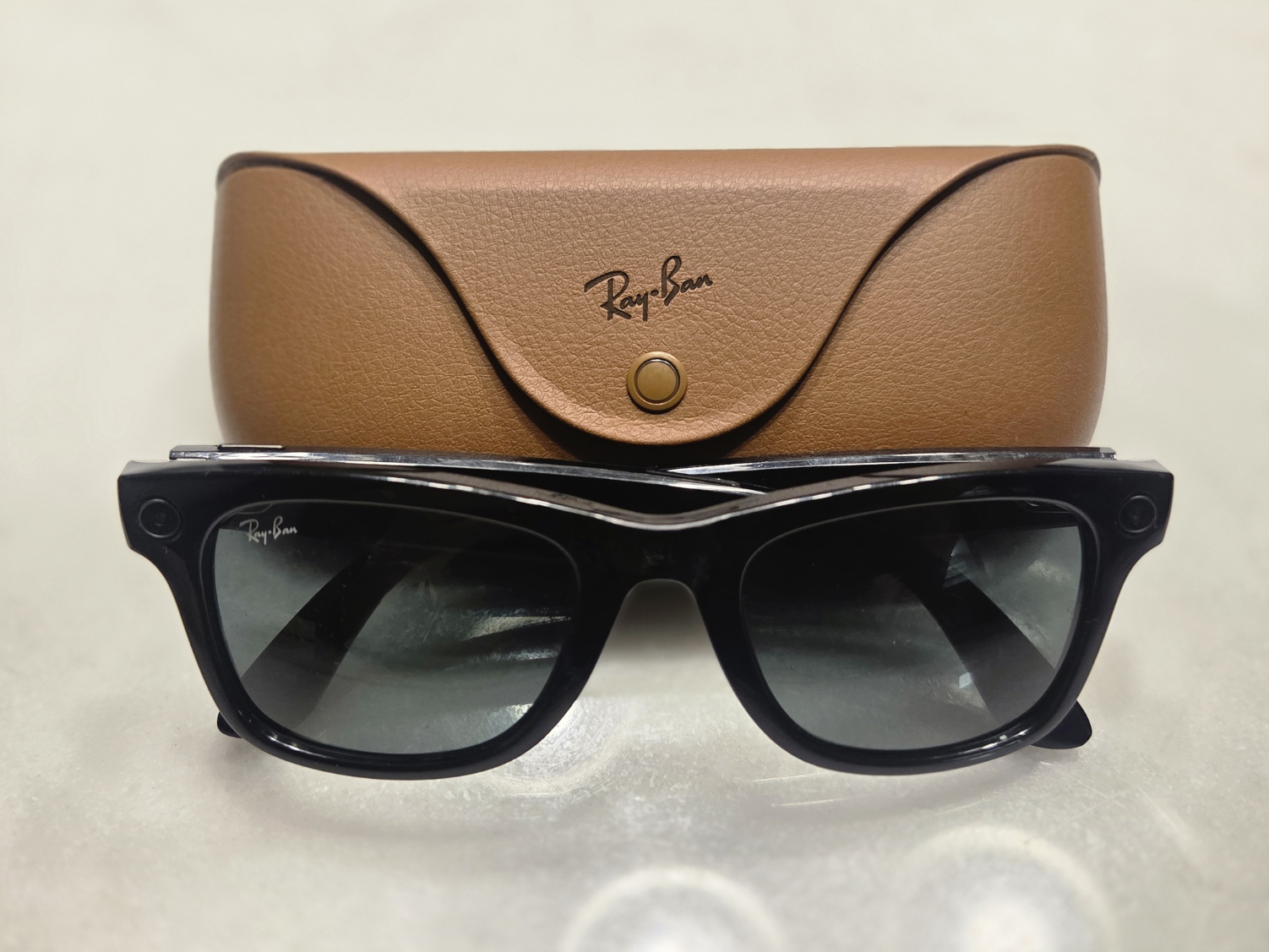
The user's public warning captured the immediate gravity of the situation: customers should never have to wonder whether their private conversations are being captured when they have not intentionally activated their glasses' artificial intelligence assistant. Within hours, other owners inspected their own accounts and reported identical discoveries. Android Authority investigated the reports and reached out directly to Meta for clarification. Later that day, Meta issued a brief statement confirming that an issue had occurred and claiming it had been resolved: "This issue has been resolved. People can manage, review, and delete voice logs of their interactions with Meta AI via settings at any time."
Meta's curt statement was notable for what it omitted. The company offered no technical post-mortem explaining what architectural defect caused the microphones to stream audio to remote servers without authorization. It did not clarify how many tens of thousands of active devices had received the faulty firmware or background configuration payload, nor did it disclose how many hours of unauthorized ambient audio had been ingested into Meta's data centers before the fix was deployed. Telling users that they can manually review and delete voice logs after the fact inverted the foundational principle of informed consent: in a privacy-conscious system, unauthorized audio should never leave the physical device in the first place.
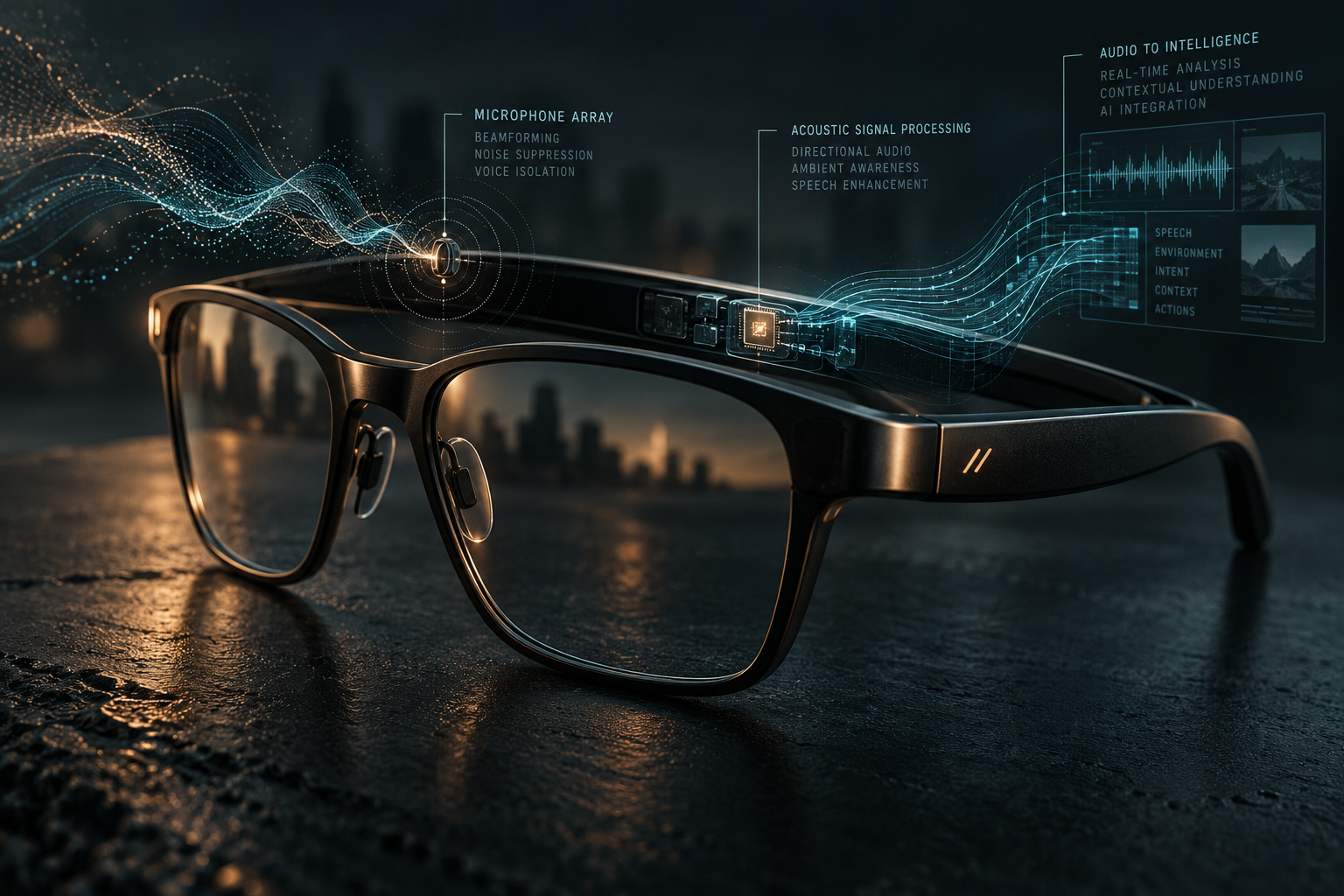
The incident highlights a fundamental asymmetry in modern consumer hardware. When a smartphone microphone is hijacked by rogue software, the phone usually sits face down on a table or deep inside a pocket, where ambient acoustics are muffled and cameras are obscured. Smart glasses, by contrast, occupy prime human sensory real estate. They sit perpetually elevated at eye level, aimed directly at conversation partners, equipped with multi-microphone beamforming arrays engineered specifically to isolate human voices from background noise. When smart glasses suffer an activation failure, they do not merely record fabric rustling; they capture intimate, face-to-face human interactions with studio-grade vocal clarity.
⚙️ The Broken Mechanics of On-Device Keyword Detection
To understand how a pair of smart glasses can record a conversation without being asked, one must examine the delicate engineering balance required for on-device voice activation. Modern voice-activated hardware cannot afford to stream continuous, uncompressed audio to cloud servers twenty-four hours a day. Doing so would exhaust battery reserves within ninety minutes, overwhelm cellular data plans, and generate untenable server costs for the platform operator.
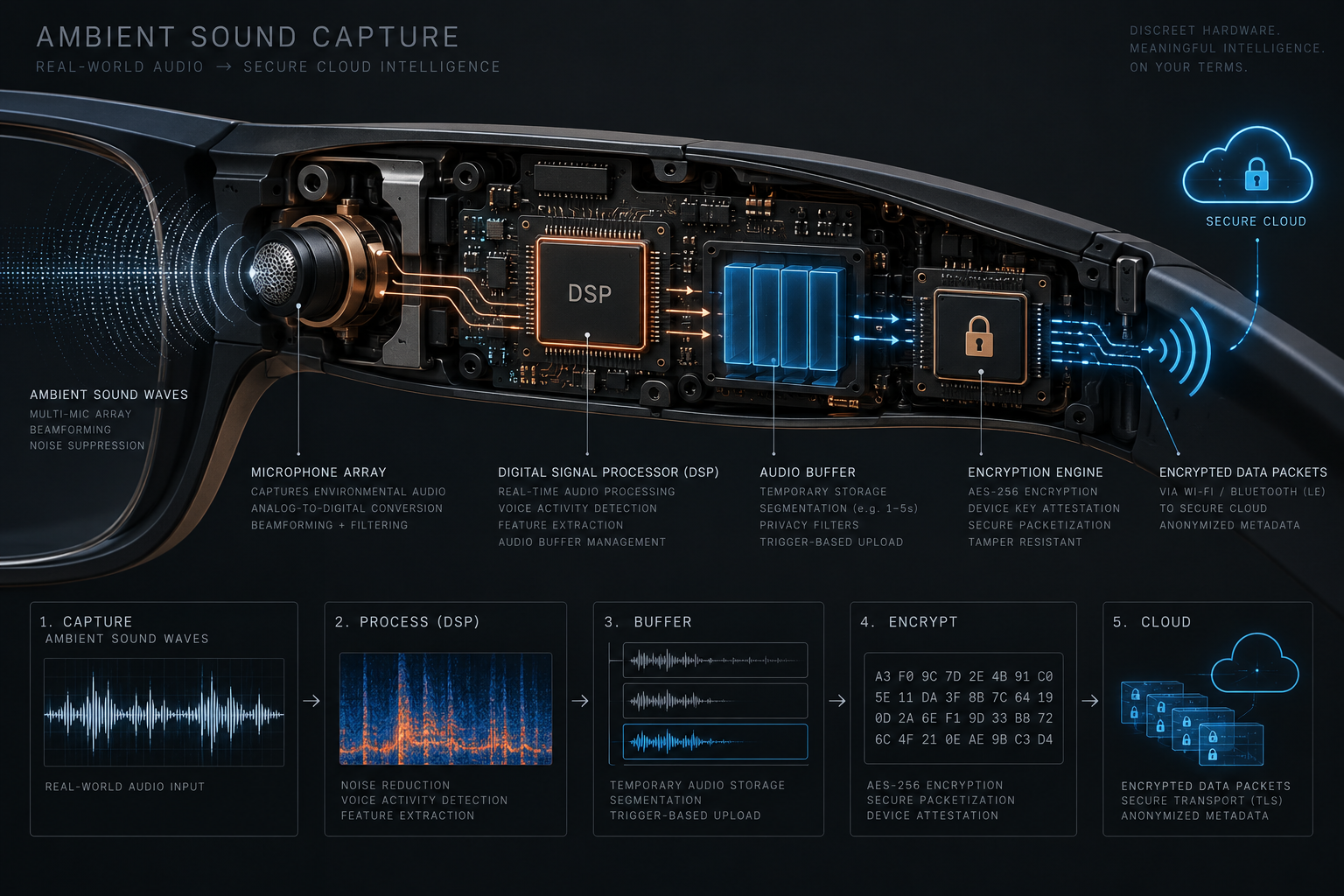
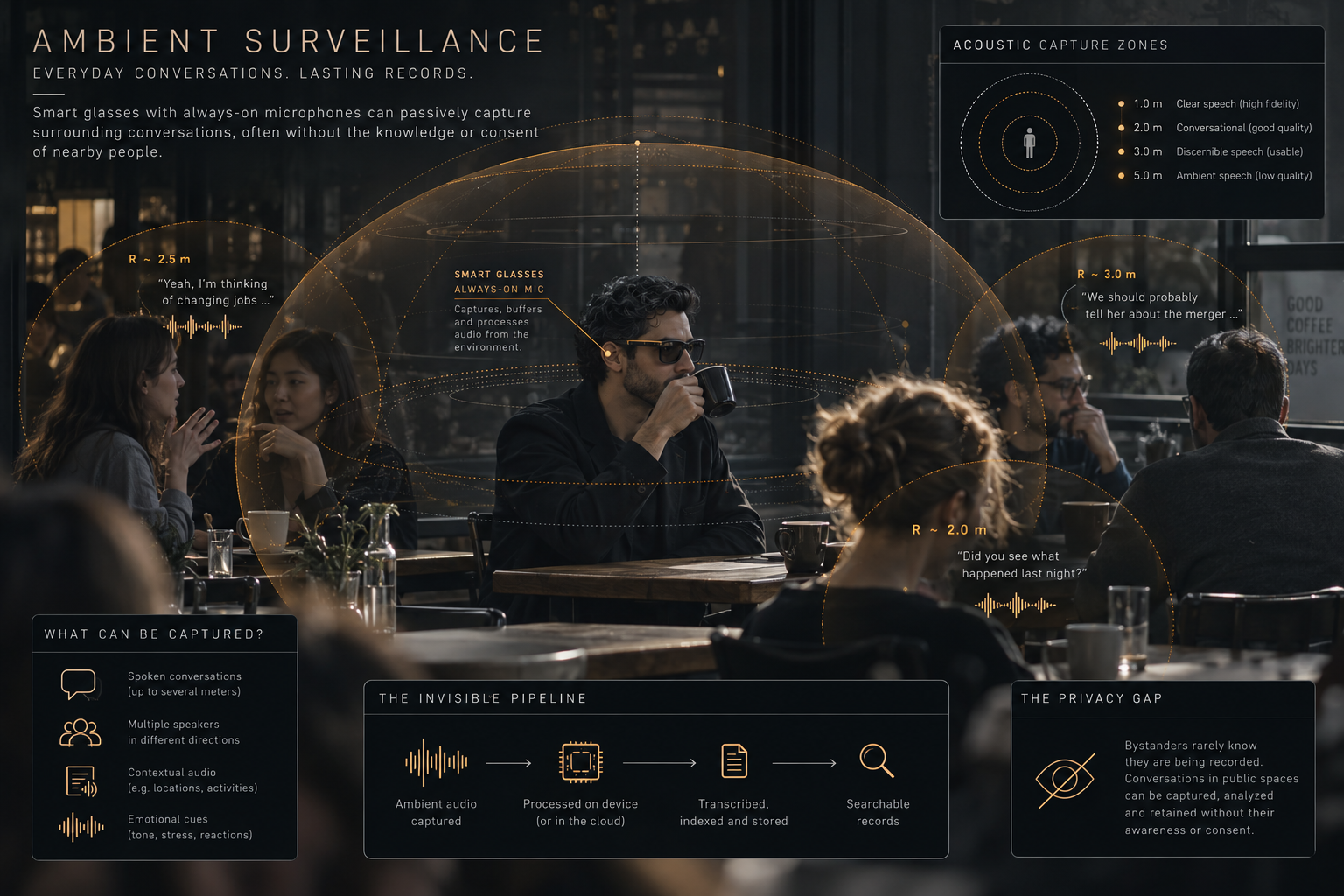
Instead, wearable devices rely on a two-tier acoustic architecture. At the hardware layer sits an ultra-low-power Digital Signal Processor (DSP), running a tiny, quantized neural network known as an acoustic trigger model or keyword spotter. This low-power processor operates in a continuous circular buffer, typically holding between five hundred milliseconds and two seconds of rolling audio in local volatile memory. The DSP continuously scores incoming sound waves against mathematical representations of the target phonetic sequence, specifically the syllables that make up the phrase "Hey Meta".
In standard operation, the audio residing in the circular buffer is instantly overwritten and discarded unless the keyword spotter calculates an activation score that exceeds a hard-coded statistical threshold. Once that threshold is breached, the low-power DSP fires an interrupt signal that wakes the main application processor. The main processor then captures the preceding audio snippet from the buffer to preserve the user's initial command, establishes an encrypted transport layer security connection, and streams the subsequent voice data to remote cloud servers for heavy natural language processing.
This architectural handoff reveals why voice activation systems are inherently prone to catastrophic failure:
- The false-acceptance dilemma: Keyword spotters face an inescapable trade-off between false rejections (failing to hear the user) and false acceptances (triggering when the user said something entirely different). To prevent user frustration, manufacturers frequently tune detection models aggressively, lowering the statistical confidence required to trigger an activation.
- Firmware regression risks: When engineers push over-the-air firmware updates to introduce new features, changes to audio driver buffers or interrupt routines can cause the main processor to misinterpret ambient noise bursts as valid wake commands.
- State-machine desynchronization: If the software state machine governing the audio pipeline fails to register that the "Respond without Hey Meta" toggle is disabled, the system can remain stuck in a continuous listening state, treating pauses in conversation as opportunities to send audio packets to the cloud.
- Silent error propagation: Because the low-power DSP operates below the operating system's main application layer, a logic error in audio routing does not trigger an obvious application crash. The device simply continues doing what its corrupted state dictates: streaming sound across the wireless link.
When software bugs occur inside a closed smartphone app, the blast radius is bounded by the screen. When a bug strikes the acoustic state machine of face-mounted eyewear, the failure mode immediately compromises the physical sanctity of the user's living room, bedroom, or workplace. The hardware did not fail because someone hacked the device with sophisticated exploit tools; it failed because modern ambient computing architectures are fundamentally engineered to listen first and verify later.
💡 The Theater of the Privacy Indicator Light
For years, hardware vendors have insisted that wearable cameras and microphones do not represent a surveillance threat because they incorporate hardware-enforced visual indicators. On the Ray-Ban Meta frames, this takes the form of an ultra-bright white light-emitting diode embedded in the corner of the right frame, positioned directly adjacent to the ultra-wide camera lens. Meta's marketing materials and safety documentation routinely cite this capture LED as proof that the glasses cannot be used for covert surveillance, assuring the public that the light illuminates brightly whenever photo, video, or audio capture is taking place.
In practice, the privacy indicator light represents an exercise in security theater rather than a robust technical barrier. While the LED may provide a degree of notification in controlled indoor environments when someone is standing directly in front of the wearer, real-world deployment reveals severe physical and social limitations.

The first limitation is optical physics and environmental ambient lighting. In direct outdoor sunlight, a tiny white micro-LED is virtually invisible against the reflective gloss of acetate frames, especially from an oblique angle or from a distance greater than two meters. Anyone sitting across a picnic table or walking past on a bright afternoon will fail to notice the light entirely. Furthermore, the LED is directional: it emits light forward along the camera's visual axis. If two people are having a quiet conversation side by side on a park bench, in a car, or at an office desk, the person speaking into the glasses' lateral microphone array has zero line-of-sight to the indicator light on the wearer's temple.
The second limitation lies in how the indicator light is integrated into the device's electrical circuitry. Privacy advocates and hardware security researchers have long demanded that privacy LEDs be hardwired in physical series with the sensor's power rail, ensuring that current cannot physically reach the camera sensor or microphone preamplifier without flowing through the LED diode. On mass-market smart glasses, however, the capture LED is frequently governed by software or firmware commands sent through an embedded microcontroller. When activation pipelines glitch or firmware routines desynchronize, there is no guarantee that the LED trigger matches the actual state of the microphone buffer.
Even when the LED functions exactly as designed, social dynamics undermine its utility:
- Ambiguity of the signal: The general public has never been educated on what a tiny white light on a pair of designer eyeglasses actually signifies. Most observers assume it indicates pairing mode, a low-battery alert, or an aesthetic design accent, rather than an active audio-visual broadcast to cloud servers.
- Social hesitation: Even when a bystander recognizes that the glasses are actively capturing, human social norms strongly discourage confronting acquaintances, colleagues, or strangers in public to demand whether their eyewear is recording.
- Physical tampering vulnerabilities: Despite Meta introducing firmware patches in August 2026 designed to halt recording if the optical sensor detects that the LED is covered by electrical tape or dark nail polish, directional light baffles and partial occlusions remain widely shared in online communities dedicated to covert recording.
- The audio blind spot: Meta designed the LED primarily around video and photo capture. When the device engages in background audio analysis, voice commands, or assistant processing, the visual signal is subtle, intermittent, or completely absent, leaving conversation partners entirely unaware that their spoken words are being transcribed.
Relying on a miniature diode to solve the profound ethical dilemma of pervasive audio surveillance is a category error. A light bulb cannot negotiate consent, cannot evaluate social context, and cannot prevent unauthorized audio buffers from leaking across a network interface.
👥 Bystanders in the Crosshairs of Ambient Recording
When a consumer purchases an electronic device, they enter into a contractual relationship with the manufacturer. By unboxing the hardware, creating an account, and ticking the mandatory terms of service, the buyer explicitly consents to data collection policies, privacy policies, and telemetry ingestion. One may question whether modern consumer consent is truly voluntary or informed, but from a formal legal perspective, a contract exists between the user and the platform.
With face-mounted computing, that contractual boundary disintegrates. The primary victims of a smart glasses recording glitch are rarely the wearers themselves; they are the unconsenting bystanders who happen to inhabit the wearer's acoustic environment.
Consider an ordinary working day. A professional wearing smart glasses enters a doctor's examination room, sits through a confidential human resources dispute, attends an attorney-client briefing, or discusses sensitive financial figures in an executive meeting. Simultaneously, they walk through coffee shops, ride crowded commuter trains, and return home to their spouses and children. In every one of those environments, third parties speak freely under the reasonable, legally protected expectation that their words are ephemeral, shared only with the individuals physically present in the room.
When smart glasses suffer an acoustic activation bug, every voice within a three- to five-meter radius is captured by the device's five-microphone spatial array. Those innocent bystanders never purchased a Meta device. They never signed Meta's terms of service. They never granted permission for their vocal cadences, emotional inflections, and spoken secrets to be digitized, transcribed, and processed by proprietary neural networks. Yet their private speech is ingested into the exact same cloud pipeline as the wearer's deliberate queries.
This creates severe friction across several distinct social spheres:
- The domestic sanctuary: The home has historically served as an environment where family members can speak without self-censorship. When one household member adopts always-listening smart glasses, the home is transformed into an ambient sensor grid. Intimate spousal conversations, children's emotional outbursts, and confidential phone calls are exposed to accidental recording.
- The professional workplace: Corporate trade secrets, proprietary source code discussions, and personnel evaluations rely heavily on confidentiality. If an employee's eyewear silently captures room audio and uploads it to external cloud infrastructure, the employer suffers a severe, unmonitored data exfiltration event that breaches non-disclosure agreements.
- Healthcare and therapeutic spaces: In medical clinics, therapy offices, and pharmacies, patients disclose personal health conditions and psychological struggles. An accidental audio recording in these environments constitutes a grave breach of professional ethics and statutory patient privacy protections.
- Public civil liberties: In democratic societies, the ability to assemble or speak in public squares without fear of permanent corporate tracking is a foundational freedom. Pervasive, inconspicuous face-mounted sensors threaten that freedom by turning every pedestrian into an unwitting corporate listening post.
The traditional privacy paradigm was built around intentionality: a person pulled out a camcorder or pointed a smartphone. The conspicuousness of the act gave bystanders a chance to object, step out of frame, or lower their voices. Smart glasses strip away that social friction, replacing intentionality with continuous, potentially accidental surveillance.
🏢 The Cloud Funnel and Human Ears in the Annotation Loop
When users discovered that their private audio had been uploaded to the Meta AI application, many consoled themselves with the thought that the files were merely processed by automated server algorithms and stored securely in an isolated database. However, an examination of the global artificial intelligence supply chain reveals a far more uncomfortable truth: where machine learning models operate, human contractors inevitably follow.
To train, fine-tune, and benchmark the speech recognition algorithms and natural language models that power Meta AI, technology companies do not rely solely on automated math. They employ vast global networks of third-party data annotation vendors. Thousands of human reviewers sit in front of computer monitors in outsourced facilities across Kenya, India, the Philippines, and Eastern Europe, listening to audio snippets, verifying machine-generated transcripts, correcting phonetic errors, and categorizing vocal tone.
The reality of this human annotation pipeline was laid bare in an investigative report published earlier this year by Swedish journalists, who conducted extensive interviews with more than thirty workers employed by Sama, a major data annotation contractor headquartered in Kenya that provides content labeling services for Silicon Valley firms. The contractors revealed that they were routinely assigned to inspect video clips and audio streams captured directly by Ray-Ban Meta smart glasses. Because users frequently recorded without realizing their devices were active, the workers were exposed to an unrelenting stream of deeply private, non-consensual material.
Contractors reported viewing footage of users engaging in sexual acts, domestic disputes, and private medical moments, including instances where an owner's partner exited a bathroom unclothed without knowing a camera was active in the room. As one anonymous Sama employee recounted to investigators, "Meta has that type of content in its databases. People can record themselves in the wrong way and not even know what they are recording." The Swedish disclosures triggered immediate legal repercussions in the United States, leading to a class-action lawsuit filed in federal court seeking certification on behalf of affected consumers, as well as an official regulatory investigation launched by Texas Attorney General Ken Paxton.
The October 2026 audio recording bug demonstrates that the vulnerability exposed by the Sama investigation has not been structurally resolved. When a pair of glasses records a private conversation without authorization and syncs the resulting file to cloud storage, that audio file enters the broader corporate telemetry ecosystem. Unless a user actively navigates through nested settings menus to opt out of model training data sharing, those recordings are flagged as candidate training samples, eligible to be listened to, analyzed, and transcribed by third-party contractors on the other side of the planet.
The promise of cloud-backed artificial intelligence is that an intelligent assistant lives in the ether, ready to answer questions at a moment's notice. The hidden cost of that architecture is an expansive data funnel that sweeps raw human life out of private rooms and distributes it across corporate servers and outsourced labeling centers, where human privacy is permanently subordinated to algorithm optimization.
⚖️ The Legal Vacuum and the European Regulatory Backlash
The emergence of wearable artificial intelligence hardware has exposed glaring inadequacies in existing legal frameworks governing privacy, wiretapping, and video surveillance. Most surveillance laws across global jurisdictions were drafted during the twentieth century to regulate two distinct paradigms: stationary closed-circuit television cameras installed on building facades, or deliberate, handheld audio recording devices operated by private investigators or law enforcement agents.
Neither legal framework maps cleanly onto a pair of prescription spectacles equipped with high-resolution cameras, directional microphone arrays, ambient listening chips, and real-time cloud uplinks.
In the United States, wiretapping and eavesdropping statutes are splintered across federal and state boundaries. Twelve states—including California, Florida, Illinois, Pennsylvania, and Massachusetts—operate under strict "two-party" or "all-party" consent laws. Under these statutes, it is an illegal misdemeanor or felony to record a private oral communication without the affirmative consent of every single individual participating in the discussion. In California, California Penal Code Section 632 explicitly prohibits recording confidential communications without mutual consent, establishing statutory civil damages of five thousand dollars per violation.
When an individual walks into a private meeting in San Francisco or Miami wearing smart glasses that silently record a discussion due to a firmware glitch, a technical malfunction has suddenly intersected with criminal and civil liability. Does the wearer bear legal culpability for illegal wiretapping even if they never intended to record? Does Meta bear direct liability for distributing defective firmware that caused an unlawful interception of oral communications? Up to this point, hardware manufacturers have attempted to shield themselves by burying indemnification clauses in end-user license agreements, claiming that the individual wearer is solely responsible for obtaining legal consent from everyone they encounter.
In Europe, the regulatory friction is escalating far more rapidly under the comprehensive framework of the General Data Protection Regulation (GDPR) and the newly enacted European Union Artificial Intelligence Act. Under GDPR, the capture of an identifiable individual's voice or face constitutes the processing of biometric personal data. While the regulation provides an exemption for data processing carried out by an individual purely in the course of a "personal or household activity", European data protection authorities and the European Court of Justice have repeatedly ruled that the household exemption ceases to apply the moment data collection spills over into public spaces or involves automated transmission to third-party corporate servers.
That legal tension reached a boiling point in Norway, where the national data protection authority, Datatilsynet, initiated formal scrutiny of smart glasses deployment in public venues. Regulators across several Scandinavian nations have begun openly debating temporary bans on smart glasses in sensitive public facilities, including schools, public transport networks, and municipal buildings, citing the total impossibility of obtaining valid GDPR-compliant consent from unnotified passersby.
The core legal problem is irreconcilable: European data protection law requires that individuals have a legal basis for data processing, receive clear notice before processing begins, and retain the right to object and demand data erasure. A person walking past a pair of smart glasses on a sidewalk in Oslo, Berlin, or Paris receives no prior notice, has no mechanism to assert an objection, and cannot possibly know which cloud server to contact to demand the deletion of their vocal signature. As regulatory bodies awaken to this reality, the wearable hardware industry is hurtling toward a massive legal confrontation that software patches and marketing campaigns will be powerless to avert.
🛡️ A Practical Defense Routine for Owners and Bystanders
While policymakers, corporate executives, and regulatory courts contest the long-term boundaries of face-mounted computing, individual consumers and workplace operators must navigate the immediate risks posed by devices currently circulating in the wild. Given the demonstrated fragility of software-based privacy controls, relying on vendor defaults is an invitation to privacy exposure.
For individuals who own and wear Ray-Ban Meta smart glasses or competing smart eyewear, establishing a disciplined operational routine is essential to protect both personal data and the privacy of colleagues and loved ones:
- Conduct immediate voice log audits: Open the Meta AI mobile companion app, navigate to Settings, select Meta AI, and inspect the Voice Interactions log. Review the historical record to see whether unexpected audio clips or transcripts exist. Delete any recordings that were captured without your explicit intent, and clear the stored interaction history.
- Revoke training data permissions: Inside the account settings dashboard, locate the privacy and model improvement toggles. Explicitly opt out of allowing your voice recordings and conversational transcripts to be used for model training or reviewed by human annotators.
- Enforce the physical privacy switch: The Ray-Ban Meta frames include a physical toggle switch located on the inside of the left temple hinge. Sliding this switch forward physically disconnects the power supply to the camera sensor and microphones, signified by an orange indicator flag. Treat this physical switch as your primary security control. Whenever you enter private residences, medical facilities, restrooms, or confidential business meetings, physically power down the device rather than relying on software stand-by modes.
- Re-evaluate continuous listening features: If you frequently use voice assistance, leave continuous conversational follow-up features permanently disabled. While speaking "Hey Meta" before every query introduces slight conversational friction, that friction is the only software gate preventing ambient speech from being ingested as a potential prompt.
- Establish transparent social etiquette: Adopt a personal policy of upfront disclosure. When sitting down with friends, clients, or business partners, take a moment to acknowledge that your glasses contain camera and microphone hardware, and explicitly offer to take them off or switch them off during the conversation. Respecting the comfort of others is the only way to counteract the growing social stigma surrounding wearable surveillance.
For businesses, small teams, and facility managers, the proliferation of camera-equipped smart glasses demands formal workplace governance:
- Implement device zoning policies: Explicitly update employee handbooks and visitor policies to restrict camera-equipped eyewear in sensitive corporate zones, including executive boardrooms, legal briefing suites, engineering laboratories, and server facilities. Require visitors and employees to remove smart glasses or switch them to physical power-off mode upon entry.
- Address client-facing confidentiality: If your enterprise handles sensitive client information, such as accounting firms, medical practices, or legal counsel, establish a binding rule that staff members may not wear active smart glasses during client consultations. The presence of unverified recording hardware creates unacceptable liability and destroys professional trust.
- Educate teams on the limits of visual indicators: Ensure that security personnel and office managers understand that the absence of a glowing LED light does not guarantee that a pair of smart glasses is inert. As the October 2026 audio bug proved, microphones can capture and exfiltrate speech while cameras and indicators remain entirely dark.
Taking these proactive measures does not require an anti-technology mindset. It represents a sensible, pragmatic defense against hardware systems that have proven incapable of policing their own acoustic boundaries.
🔮 The Structural Price of Face-Mounted Computing
The controversy surrounding the Ray-Ban Meta recording glitch is not an isolated story about a single buggy software update. It is an early skirmish in a much larger, structural transformation of the relationship between technology and human bodily space.
For the first four decades of the personal computing revolution, digital tools were external instruments. A user sat down at a desktop workstation, opened the lid of a portable laptop, or pulled a glowing glass rectangle from their pocket. The physical act of engaging with the machine was distinct, bounded, and visible. When the interaction concluded, the laptop lid closed, the smartphone slipped back into a pocket, and the user re-entered the unmediated physical world.
The ultimate ambition of ambient artificial intelligence is to dissolve that boundary entirely. Silicon Valley venture funds and technology giants are pouring billions of dollars into face-mounted displays, audio-only frames, smart contact lenses, and biometric pins because they recognize that owning the sensory layer of human perception represents the ultimate computing monopoly. An artificial intelligence assistant that can only answer when you unlock a screen is useful; an artificial intelligence assistant that sees everything you see, hears everything you hear, and whispers contextual guidance directly into your ears before you even think to ask is omnipresent.
Yet the physics and psychology of human social life are not compatible with frictionless, omnipresent capture. Human civilization functions precisely because our everyday speech is mostly forgotten. Social trust relies on the unspoken understanding that casual remarks, emotional venting, awkward pauses, and unrefined opinions vanish into the air the moment sound waves dissipate against the walls. We forgive each other, compromise, and grow because our imperfect past is not permanently indexed, searchable, and cross-referenced in an offshore corporate database.
When technology companies demand that we sacrifice that ephemerality in exchange for the convenience of asking an AI chatbot to identify a landmark or draft a text message without lifting a finger, they are asking for an astonishingly bad trade. They are asking society to accept continuous, non-consensual surveillance, normalized corporate eavesdropping, and the degradation of private spaces, all to shave two seconds off the time it takes to look something up on a smartphone screen.
The October 2026 recording incident proved what critical technologists have maintained from the beginning: face-mounted computing cannot be made safe through clever software toggles, voluntary corporate codes of conduct, or tiny blinking lights. When you strap microphones and cameras to a human head and connect them to a business model that monetizes human attention and data, surveillance is not a bug; it is the inevitable destination of the architecture. Until the technology industry is forced to build devices that privilege physical disconnects over cloud connectivity, the smart glasses sitting on the bridge of someone's nose will remain an open microphone waiting for its next mistake.
Sources: Ars Technica gadget investigation by Scharon Harding on Ray-Ban Meta audio recording vulnerabilities (published Oct 16, 2026); community bug reports and audio log disclosures across r/RaybanMeta and r/MetaGlasses (Oct 2026); Meta Platforms official statement and product documentation on Ray-Ban Meta smart glasses privacy settings and voice logs (published Oct 16, 2026); Swedish investigative reports and US Federal Class Action Amended Complaint regarding Sama data annotation contractors and non-consensual wearable capture (filed in US District Court, updated Oct 2026); Texas Attorney General Ken Paxton official inquiry into Meta smart glasses biometric privacy violations (launched May 2026); Norwegian Data Protection Authority (Datatilsynet) regulatory statements via AP News on wearable AI smart glasses in public spaces (published 2026); Wikimedia Commons Ray-Ban Meta hardware documentation by CCadio (CC BY 4.0).