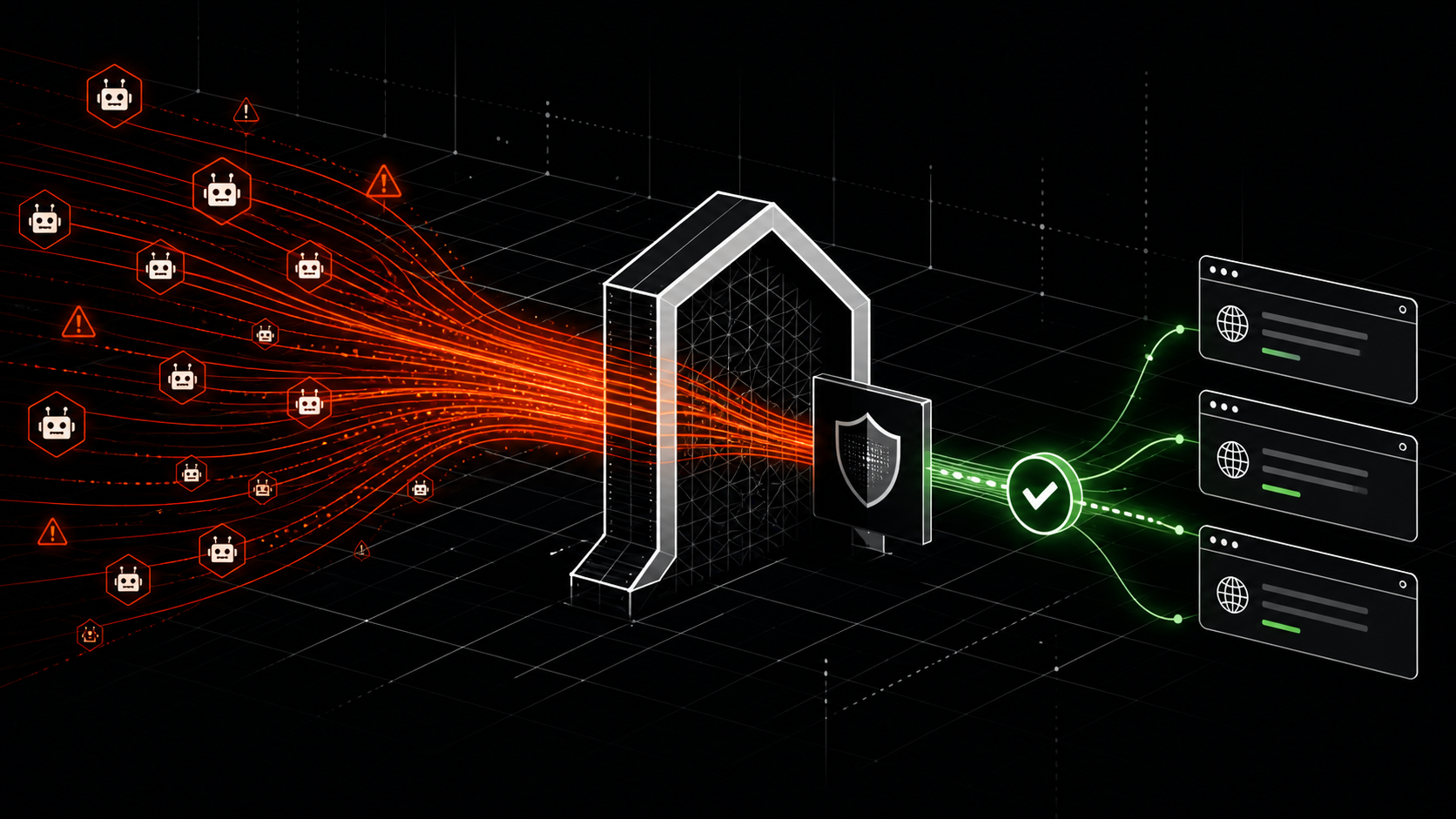
Cloudflare’s latest bot-management updates matter because a small website cannot simply block everything automated. Search crawlers, uptime monitors, link previews and customer-directed agents may be useful. Credential stuffing, scraping, spam and checkout abuse are not. The operational task is to make that distinction visible, deliberate and reversible.
This article examines Cloudflare’s Adaptive Intelligence and BotBase updates as a practical prompt for Indonesian web teams. They are Cloudflare products, not universal Internet standards, and some capabilities are plan-specific. Still, the underlying discipline applies to every site: define the automated traffic you want, measure it, protect high-risk routes, and keep a path for legitimate systems to identify themselves.
🧭 The decision hiding behind bot traffic
A bot is software that performs automated tasks over the Internet. That definition is broad enough to include Googlebot indexing a product page, an uptime service checking a health endpoint, a messaging platform generating a link preview, and a program attempting thousands of stolen-password logins. Treating “bot” as a single category produces bad policy.
For a small business website, the question is rarely whether bots exist. They already do. The question is what each automated request is allowed to do. A public catalogue page may need to remain accessible to search engines. A login endpoint should have a much narrower tolerance for repeated attempts. A checkout flow has different failure modes again: inventory hoarding, card testing, promotion abuse and automated account creation can all look like ordinary HTTPS requests until their pattern becomes visible.
Cloudflare’s Learning Center lists credential stuffing, scraping, denial-of-service activity, brute-force password cracking, inventory hoarding, spam, address harvesting and click fraud among malicious bot activity. That list is useful as a threat model, not as a reason to deploy every possible control. An Indonesian studio or shop should start with the routes where a mistaken allowance costs the most: administration, customer accounts, password resets, forms, API endpoints, search, carts and checkout.
The first useful artefact is therefore a route map. Write down which pages are public content, which accept input, which change state, and which expose valuable data. Pair every route class with an owner. If a bot rule breaks a lead form at 10 p.m., someone needs to be able to see it, turn it back, and record why. Security that cannot be operated is only a future outage.
📌 What Cloudflare actually announced
Cloudflare describes Adaptive Intelligence as a bot-detection engine behind its bot score. Its first released component continuously retrains the machine-learning component that contributes to the score. The company says it aggregates network signals and estimates the probability of automated abuse for each request. It also describes disposable rules that appear and expire, intended to deny attackers a stable signal they can repeatedly test.
That wording matters. Cloudflare is not promising a magical test that can identify every malicious request in isolation. The announcement argues that a static deterministic defense lets a determined operator learn the boundary through repeated probes. The proposed response is to change detection as evidence changes, raising the cost of adapting an attack.
Enterprise customers are instructed by Cloudflare to enable “Auto Update Machine Learning” in the Bot Management dashboard to receive Adaptive Intelligence. Availability and exact controls depend on the customer’s plan and configuration. A business on another plan should not assume it has the same feature, nor should it treat a marketing announcement as proof that its zone is protected.
The practical takeaway is less glamorous. Check the plan, inspect the current controls, and test the routes that matter. If a team uses a bot score in a WAF rule, it should document the score threshold, the action, the exception process, and the person who owns false positives. A score is evidence for a decision, not a substitute for one.
🗂️ BotBase changes the conversation with legitimate automation
Cloudflare’s BotBase update is aimed at bot operators rather than only site owners. The dashboard now offers a directory, a submission form and submission history. An operator can declare who runs a bot, what it does, how it uses content and how it proves its identity. Submissions can be tracked as waiting for review, accepted or rejected.
That is important because an allowlist based only on a familiar user-agent string is fragile. Anyone can type a well-known user-agent into a request header. Cloudflare’s Verified bots documentation instead describes honest self-identification through a cryptographic Web Bot Auth signature, a published IP list with a stable user-agent, or reverse DNS, alongside non-abusive behavior such as obeying robots.txt and reasonable request rates.
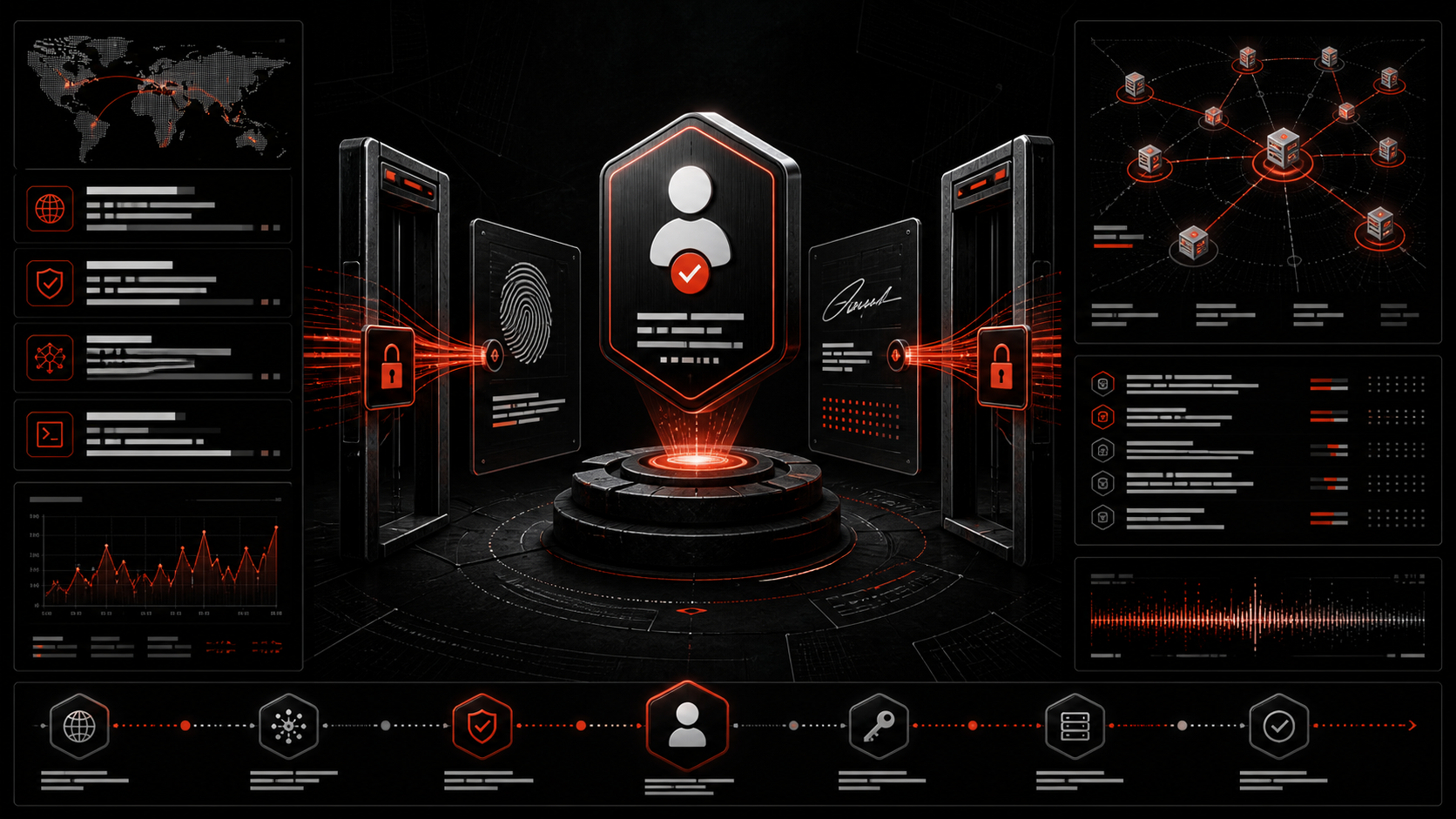
Cloudflare’s current taxonomy also separates behavior from identity. Its documented behaviors include Search, Agent, Training, Transact, Data Collection, Security Testing, SEO, Ads Verification, Social or Link Preview, Feed Fetching, and Monitoring and Operations. A single system can have more than one behavior. That is a better starting point than a blanket label such as “AI bot.”
For a website owner, the value is precision. A link-preview bot should not gain the same treatment as a system attempting checkout on behalf of users. A crawler that indexes a page for search is not automatically entitled to retain it for model training. Policy should state the permitted action and the conditions, then be enforced with controls appropriate to the route.
🔐 Identity is not permission
Verified status can make a request easier to classify, but it should not become unlimited access. Cloudflare explicitly distinguishes Direct operators, which run a narrow bot on their own infrastructure, from Intermediaries that act for many end users. The latter introduce transitive trust: a website may trust the intermediary’s technical operation without knowing every end user directing requests through it.
That distinction is especially relevant for web teams building customer portals, booking tools or commerce sites. A bot that identifies itself accurately can still trigger a costly action. A good design separates three questions:
- Is this requester presenting a verifiable identity?
- Is the declared behavior appropriate for this endpoint?
- Does this request have the authority to perform this specific action?
Authentication and authorization remain necessary for state-changing actions. Rate limits, CSRF protections, transaction controls, per-account quotas and human review may be needed even when a request comes through a recognised channel. Do not replace them with a general bot allow rule.
A simple example is an automated accessibility audit. It may deserve access to public pages at a controlled rate. It does not need permission to submit contact forms, create accounts or place orders. Put that distinction in rules rather than hoping the tool behaves as expected forever.
🧱 Start with a narrow enforcement design
Small teams often begin by challenging or blocking suspicious requests everywhere. That can harm legitimate visitors using privacy tools, corporate networks or accessibility software. A safer rollout starts in observation mode where the platform supports it, then focuses enforcement on endpoints with clear abuse patterns.
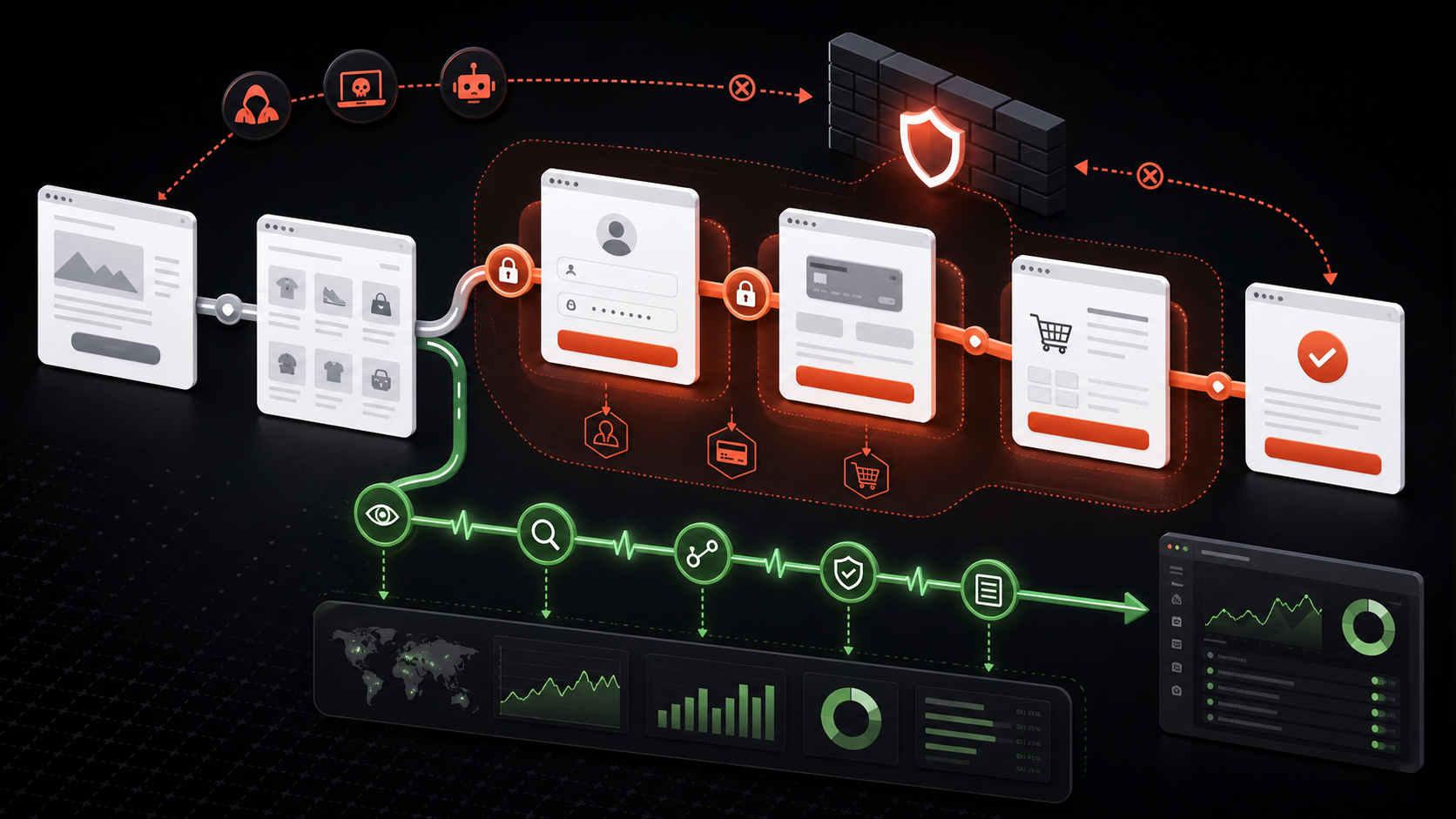
Use layers rather than one dramatic rule. At the edge, apply managed protections, basic rate limits and bot controls. In the application, validate input, limit account actions, protect sessions and return useful error states. In operations, retain logs long enough to investigate incidents and alert on unusual rates, error spikes or conversion drops. None of those layers requires a perfect global definition of a bot.
For login routes, measure failed attempts by account, IP range and device or session signals where appropriate. For forms, add friction proportional to abuse: a hidden-field check may handle simple spam; a challenge or stricter rate limit may be justified during a spike. For APIs, require keys or user authentication, scope them to the minimum capability and rotate them when exposure is suspected. For public content, avoid blocking verified search and social-preview traffic unless there is evidence it is being abused.
The operational test is concrete: can a legitimate customer still complete the task, and can the team explain why a request was blocked? Run that test after every significant rule change.
📈 Measure outcomes, not just blocked requests
A dashboard showing millions of mitigated requests can look reassuring while hiding a broken checkout or an inaccessible campaign page. Security metrics should connect to the service being protected.

Track at least these measures before and after a change:
- Successful and failed logins, broken down by route and time window.
- Form submissions, spam reports and completion rates.
- Checkout starts, payment failures and completed orders.
- Challenge rates, challenge solve rates and support tickets about access.
- Server errors, origin load and response times during automated traffic spikes.
- Search-console crawl errors and link-preview failures for important pages.
These are not targets to maximize independently. A lower challenge rate may mean an attack is passing through; a higher one may mean legitimate visitors are being interrupted. Compare with a known period, annotate deployments, and investigate abrupt movement rather than celebrating a single number.
Cloudflare’s account of continuously retrained detection reinforces this point. When detection changes over time, a team must observe its own business outcomes over time too. Static weekly screenshots will not tell you whether an automated policy has shifted from protecting a site to quietly reducing its conversion.
🧪 Test changes as if they can fail
Bot rules affect real customer journeys. Treat them like a release. Keep a short change record containing the rule name, purpose, routes, expected impact, owner, start time and rollback condition. Test from a clean browser and a mobile network, not only from the administrator’s logged-in laptop.
Test the happy path and the recovery path. Can a customer reset a password? Can an editor log in after a travel connection changes? Does a payment callback still reach the endpoint? Does a WhatsApp or Telegram link preview render? Can search crawlers retrieve the public page without being challenged? The answer should come from controlled tests and logs, not assumptions about a vendor setting.
Where a platform offers an exception, make it specific. Prefer a verified integration, a narrow route, a limited method or a documented service identity over a broad IP-based bypass. Revisit exceptions on a schedule. Vendors change infrastructure; tools change behavior; an exception that was narrow last quarter may become a hole later.
🧾 Content signals need an editorial policy
Cloudflare’s BotBase article gives an example of a robots.txt content signal that permits search and reference use while declining AI training. Whether a site uses that exact mechanism is a product and policy choice. The broader lesson is that content-use preferences should be written down rather than implied by inconsistent blocks.
A studio should decide what public pages are meant to do. Portfolio pages may invite indexing and social sharing. Paid client materials, private staging sites and customer dashboards should not be publicly crawlable in the first place. Publishing a directive does not replace access control. robots.txt is guidance for cooperating crawlers, not a lock on sensitive information.
For public editorial work, state the publication’s preference plainly and preserve the technical basics: canonical URLs, accessible HTML, sitemap hygiene, stable performance and no accidental noindex directives. That keeps search visibility separate from the question of model training or agentic transactions.
⚠️ Limits that should remain visible
Cloudflare’s announcements describe its own products and network-level observations. They do not establish that every bot defense is equally effective, that every site needs enterprise bot management, or that a particular configuration is suitable for Indonesian businesses. Pricing, availability, dashboard labels and product behavior can change.
Machine learning can also produce false positives and false negatives. A legitimate automated service can be misclassified; malicious operators can change tactics. That is why the most durable protections are not a secret score threshold. They are well-designed application flows, limited privileges, audited exceptions, monitored outcomes and an incident path that does not require guesswork.
There is a privacy boundary as well. Collecting more signals merely because a tool can score them is not a sound strategy. Teams should minimize the personal data they store, secure operational logs, define retention periods and explain relevant processing in their privacy documentation. Security telemetry should serve a defined risk, not become an unexamined archive.
🛠️ Turn policy into site configurations
A written policy becomes useful only when it maps to a configuration someone can inspect. Start by naming the route and the desired outcome, then choose the least disruptive control that can produce it. A public article needs availability and clear indexing. A login route needs resistance to repeated guessing. A webhook needs authentication that does not depend on a browser challenge. A checkout needs a combination of rate limits, business rules and payment-provider controls.
Avoid copying a rule from a tutorial without recording its scope. A rule that blocks a path might also catch a locale prefix, a preview URL or an integration callback. A rate limit that looks conservative in a staging environment may break a shared office network in production. Put the route pattern, methods, threshold, time window, action, exception and rollback owner in the change record. That record makes an urgent incident less dependent on the memory of whoever built the rule.
Where traffic must be automated, give it a designed interface. Use an authenticated API rather than asking a partner to imitate browser clicks. Provide stable webhook endpoints, verify signatures, return clear status codes and document limits. Separate human pages from machine endpoints whenever the product allows it. This reduces the temptation to create broad bypasses just to keep an integration working.
For public pages, protect the origin as well as the edge. Ensure that origin servers accept traffic only through the intended proxy where that architecture is used. Keep administrative systems on separate access controls. Remove old DNS records and unused subdomains that expose an origin accidentally. A thoughtful bot rule has limited value if an attacker can reach an unprotected alternate host.
Finally, rehearse a rollback. A team should know which control can be safely paused, what evidence to preserve, and how to confirm that customer journeys recovered. Rollback is not an admission that security failed. It is the mechanism that lets a team make careful changes without forcing customers to absorb an error for hours.
✅ A 30-minute review for a small web team
Set aside half an hour with the person responsible for the website and answer six questions. Which five routes would hurt most if automated abuse doubled today? Which legitimate bots or integrations must work? What evidence identifies them beyond a user-agent? Which current rule can block or challenge them? Where will you see a false positive? Who can roll a change back?
Then make one improvement that can be tested this week. It may be a rate limit on password resets, an inventory of third-party webhooks, a route-specific WAF rule, a documented exception for a monitoring provider, or an alert on failed checkouts. Do not begin with an all-site blockade and call it maturity.
Make the review repeatable. A monthly twenty-minute check is more useful than an annual emergency meeting, provided it compares the same routes and records the same decisions. Keep a list of essential third parties: payment providers, email delivery, analytics, search engines, social preview services, uptime monitors and deployment tools. For each one, note its published verification method, the endpoint it needs and the consequence if it fails. That inventory turns a vague “the integration stopped working” report into a concrete investigation.
The same practice helps during vendor changes. A new dashboard feature, a revised crawler policy or a threat spike does not automatically require a whole-site redesign. Read the release note, identify the affected route, make a testable hypothesis and deploy the narrowest change. If the evidence does not support action, write down that choice as well. Restraint is a security decision when it protects customers from unnecessary friction.
Keep the policy legible to people outside the security function. Customer support needs a short explanation for a legitimate visitor who encounters a challenge. Marketing needs to know before a campaign sends unusual traffic to a landing page. Developers need a safe way to test integrations without carrying a production bypass into permanent use. A concise operational note can prevent a security control from becoming an argument between teams when speed matters.
The practical standard is modest but demanding: know which automated requests you need, decide where they can act, and retain enough evidence to correct a bad decision quickly. That work is continuous because products, attackers and customer journeys change. Review it regularly.
Cloudflare’s Adaptive Intelligence and BotBase developments point in the same direction: automated traffic is no longer a side issue for websites. The useful response is not to fear every crawler or trust every identified service. It is to make each permission deliberate, narrow and observable.
Sources: Cloudflare, “Introducing Adaptive Intelligence”; Cloudflare, “BotBase for Operators”; Cloudflare Developers, “Verified bots” and “Get started with Cloudflare bot solutions”; Cloudflare Learning Center, “What is a bot?”