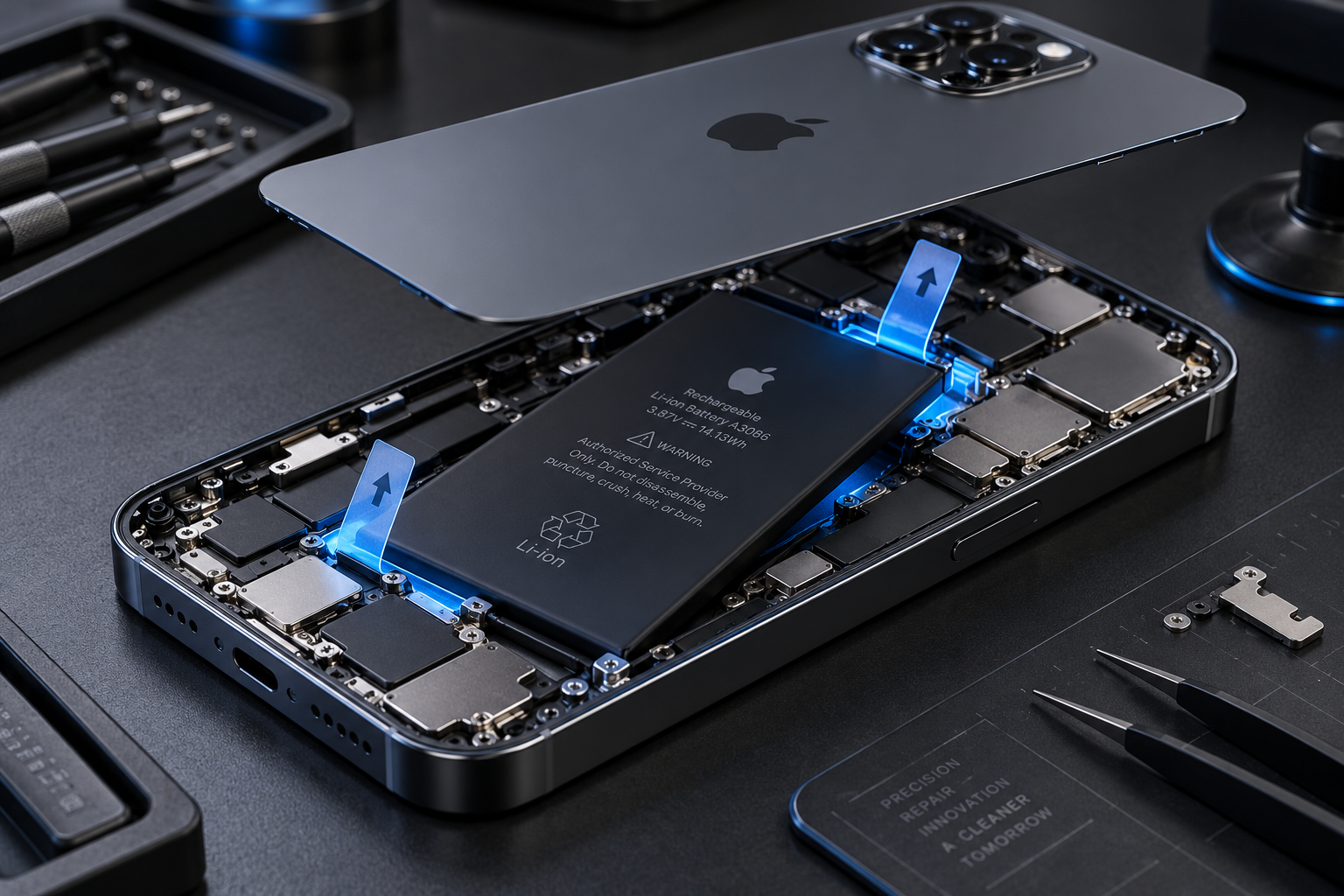
When the European Union passed Regulation (EU) 2023/1542, the internet immediately jumped to a collective conclusion. Tech forums, social media commentary, and mainstream lifestyle publications declared that the clunky, snap-off plastic phone back was returning. Commentators imagined a glorious return to the year 2004, where anyone sitting on a commuter train could pop open their sleek glass flagship with a fingernail, slide in a fresh lithium slab, and carry on without pausing for a wall outlet. It was a comforting wave of consumer nostalgia, fueled by genuine exhaustion over sealed electronics, swollen battery packs, and two-hundred-dollar depot repair bills.
That viral narrative, however, fundamentally misread European law. Your next smartphone will not feature a flimsy plastic battery door, and you will not be hot-swapping batteries while walking down the street. Flagships will continue to arrive encased in polished titanium, aerospace aluminum, and hardened glass, maintaining high ingress protection against accidental drops in water. Yet the relief felt by corporate hardware designers when consumers misunderstood the statute was remarkably short-lived. Behind the scenes, the European Union executed a far more sophisticated, technically brutal maneuver against consumer electronics manufacturers than simply demanding a snap-on shell.
By splitting its regulatory power across two distinct statutes—Regulation (EU) 2023/1542 on batteries and Regulation (EU) 2023/1670 on ecodesign for smartphones and tablets—European lawmakers built a legal pincer movement. While they granted smartphone makers an exemption from pop-off battery panels to protect water resistance, they simultaneously outlawed the industrial glue that made battery extraction dangerous. They criminalized the proprietary software locks that bricked third-party replacements, mandated five continuous years of affordable spare parts, and forced manufacturers to design devices that can be dismantled using basic workshop tools. The snap-off phone back may be dead, but the toxic industrial assembly practices that held consumers hostage for fifteen years have officially run out of runway.
📱 The Viral Nokia 3310 Nostalgia Trap
The belief that the European Union had mandated a return to modular phone chassis began with a careless reading of Article 11 of the EU Battery Regulation. The text stated plainly that by February 18, 2027, portable batteries incorporated into appliances must be readily removable and replaceable by the end user at any time during the lifetime of the product. To the casual reader, an iPhone, a Samsung Galaxy, or a Google Pixel is an appliance with a battery. Therefore, commentators reasoned, every smartphone sold in Europe would need to be re-engineered into something resembling a modern Nokia 3310 or a Fairphone.
The viral meme spread rapidly across TikTok, YouTube, and tech aggregators because it tapped into deep consumer frustration. Over the last decade and a half, consumer electronics moved relentlessly toward hermetically sealed sandwiches of glass and metal. Devices that once took thirty seconds to service became delicate, bonded puzzles. If a battery degraded after seven hundred charge cycles—roughly twenty-four months of standard daily use—the owner faced a stark choice: pay an authorized service center thirty percent of the phone's residual value, attempt an agonizing at-home repair involving volatile heat guns and toxic adhesive solvents, or surrender and purchase an entirely new device.
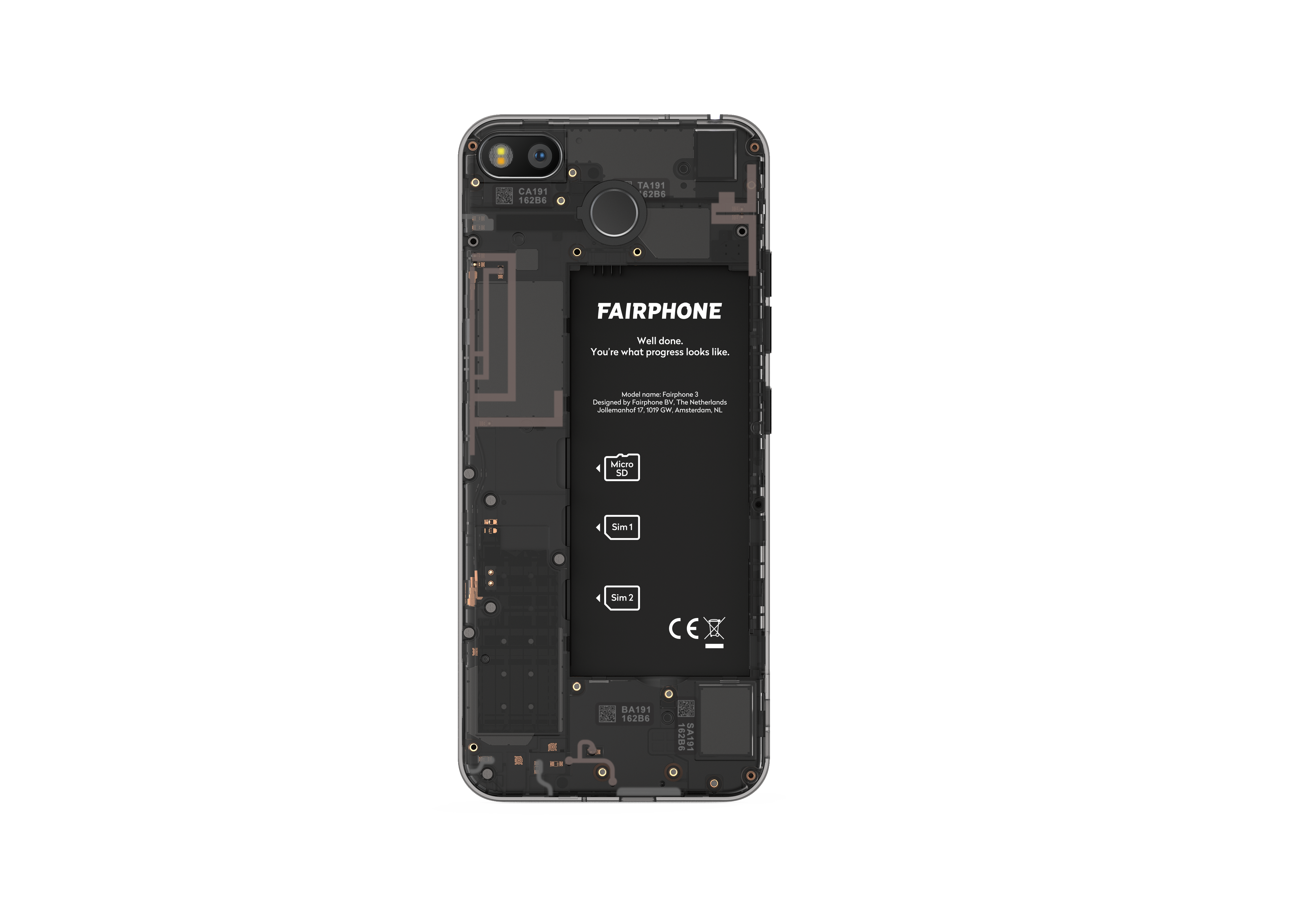
When the initial headlines broke, the public celebrated what appeared to be a decisive victory for consumer sanity. Tech enthusiasts visualized modular frames, transparent battery bays, and a secondary market of high-capacity aftermarket packs. Even hardware analysts began questioning whether Apple and Samsung would design separate European stock keeping units with chunky plastic hatches or capitulate globally to a single universal standard.
The reality, as always, lived in the dense regulatory annexes. What the consumer press missed was the fundamental legal classification established under European Union product law. While portable batteries inside common household tools, wireless vacuum cleaners, electric shavers, and children's toys fall squarely under the rigid end-user swap mandate of Article 11, personal communications hardware occupies an entirely different regulatory jurisdiction. The European Commission recognized that forcing smartphones into snap-off designs would abruptly dismantle fifteen years of consumer safety engineering, structural rigidity, and water ingress protection. But rather than granting Silicon Valley and Shenzhen a blanket pass, regulators drafted a parallel framework with teeth of its own.
⚖️ The Two Regulations Everyone Confused
To understand what will actually happen to consumer smartphones in 2027, one must trace the boundary between two separate pieces of European legislation: Regulation (EU) 2023/1542 and Commission Regulation (EU) 2023/1670. The former is a macro-level environmental directive governing the complete lifecycle of chemical energy storage, from raw lithium extraction in South America and graphite refining in Asia to end-of-life recycling standards. The latter is an explicit ecodesign regulation focused exclusively on the mechanical and digital durability of smartphones, feature phones, and slate tablets.
Article 11 of Regulation 2023/1542 establishes the general rule: portable batteries must be removable and replaceable by an ordinary adult without specialized training, using commercially available tools, without requiring thermal energy or chemical solvents. However, Article 11 contains an explicit statutory caveat. Where specific sector-specific ecodesign requirements lay down stricter or harmonized conditions for user safety, product integrity, and device longevity, those specific regulations take legal precedence.
That specific rule for mobile hardware is Regulation (EU) 2023/1670, which entered into force in the European market on June 20, 2025. It directly addresses the technical trade-offs inherent in modern telecommunications devices. A cordless electric drill or a robotic floor cleaner has substantial internal volume; allocating two millimeters of plastic wall thickness for a sliding battery latch does not compromise the device's functional integrity. A modern smartphone, by contrast, operates under unforgiving spatial physics. Every fraction of a millimeter inside a 7.8-millimeter chassis is fiercely contested between millimeter-wave 5G antenna arrays, wireless charging coils, periscope camera optical paths, and thermal vapor chambers.
Had the European Commission mandated snap-on battery doors for smartphones, manufacturers would have been forced to choose between abandoning water resistance altogether or increasing phone thickness by twenty to thirty percent while shrinking battery capacity. European regulators understood this trade-off intimately. Instead of forcing mechanical regression, they designed a compromise that preserved modern hardware ergonomics while systematically stripping manufacturers of their favorite tools for enforced obsolescence.
🛡️ The IP67 Water Resistance and 800-Cycle Exemption
The centerpiece of this compromise is the durability exemption carved out in Annex II of Regulation (EU) 2023/1670. Under this clause, smartphone manufacturers are not legally required to make the battery removable by an untrained consumer with bare hands, provided the manufacturer meets two rigorous technical thresholds.
First, the device must maintain full ingress protection against dust and liquid immersion, certified at IP67 or higher under international standard EN 60529. This means the phone must survive being submerged in at least one meter of freshwater for thirty continuous minutes without liquid breaching the internal electronics enclosure. For modern consumers, this protection is not a cosmetic luxury; liquid ingress represents one of the leading causes of premature smartphone mortality globally. Preserving water resistance directly prevents millions of water-damaged handsets from prematurely entering the municipal waste stream.
Second, if a manufacturer chooses to rely on a sealed chassis that requires professional disassembly rather than an instant consumer hand-swap, the internal battery chemistry must demonstrate exceptional cycle life. The regulation mandates that the battery must retain at least 80 percent of its original rated capacity after completing 800 full charge and discharge cycles, tested under harmonized European standards. For manufacturers who want even greater leeway, that threshold jumps to 80 percent health after 1,000 cycles.
To put those numbers into perspective, the consumer electronics industry spent a decade treating 500 cycles to 80 percent health as the accepted standard. Under the old 500-cycle regime, a heavy smartphone user who plugged in their device overnight and topped it up during afternoon commutes would see battery health plummet below 80 percent in roughly eighteen months. By codifying an 800-cycle minimum, European regulators effectively legislated a three-to-four-year lifespan into the battery cell itself before performance throttling or premature shutdowns occur.
Crucially, this exemption does not allow manufacturers to keep building phones the way they built them in 2020. Even if a smartphone qualifies under the IP67 and 800-cycle rule, the manufacturer is still prohibited from bonding the battery with permanent, irreversible industrial glues. If a certified technician or an adventurous consumer chooses to open the device using standard screwdrivers and prying picks, the battery must come free cleanly, safely, and without requiring hazardous heating pads or chemical solvents that risk puncturing the delicate pouch cell.
⚡ The Death of Industrial Glue and the Rise of Voltage Debonding
For over a decade, the standard method for securing a lithium-ion pouch cell inside an aluminum smartphone unibody was aggressive pressure-sensitive adhesive. These rubbery, petrochemically formulated glue strips held the battery flat against the chassis with immense shear strength. While this prevented the battery from vibrating loose during accidental drops, it turned disassembly into a high-stakes minefield.
Technicians attempting to remove a glued battery had to heat the exterior glass to eighty degrees Celsius using specialized hot plates or heat guns, hoping the thermal energy would soften the adhesive without causing the volatile battery chemistry to reach thermal runaway. When stretch-release pull tabs snapped—which happened with infuriating regularity—repairers were forced to pry against the fragile foil casing with plastic spudgers. One accidental puncture of the lithium cobalt oxide core could release toxic fumes, spark an intense localized fire, and destroy the device instantly.
European standard EN 45554, which defines the test methods for repairability under the new regulations, specifically excludes repair processes that require specialized thermal equipment, open flames, or industrial solvents like acetone and isopropyl alcohol. Under the new rules, battery removal must occur using commonly available tools. If a special disassembly fixture is strictly necessary, the manufacturer must supply that tool free of charge with replacement parts or publish its technical specifications openly so third-party toolmakers can manufacture it.
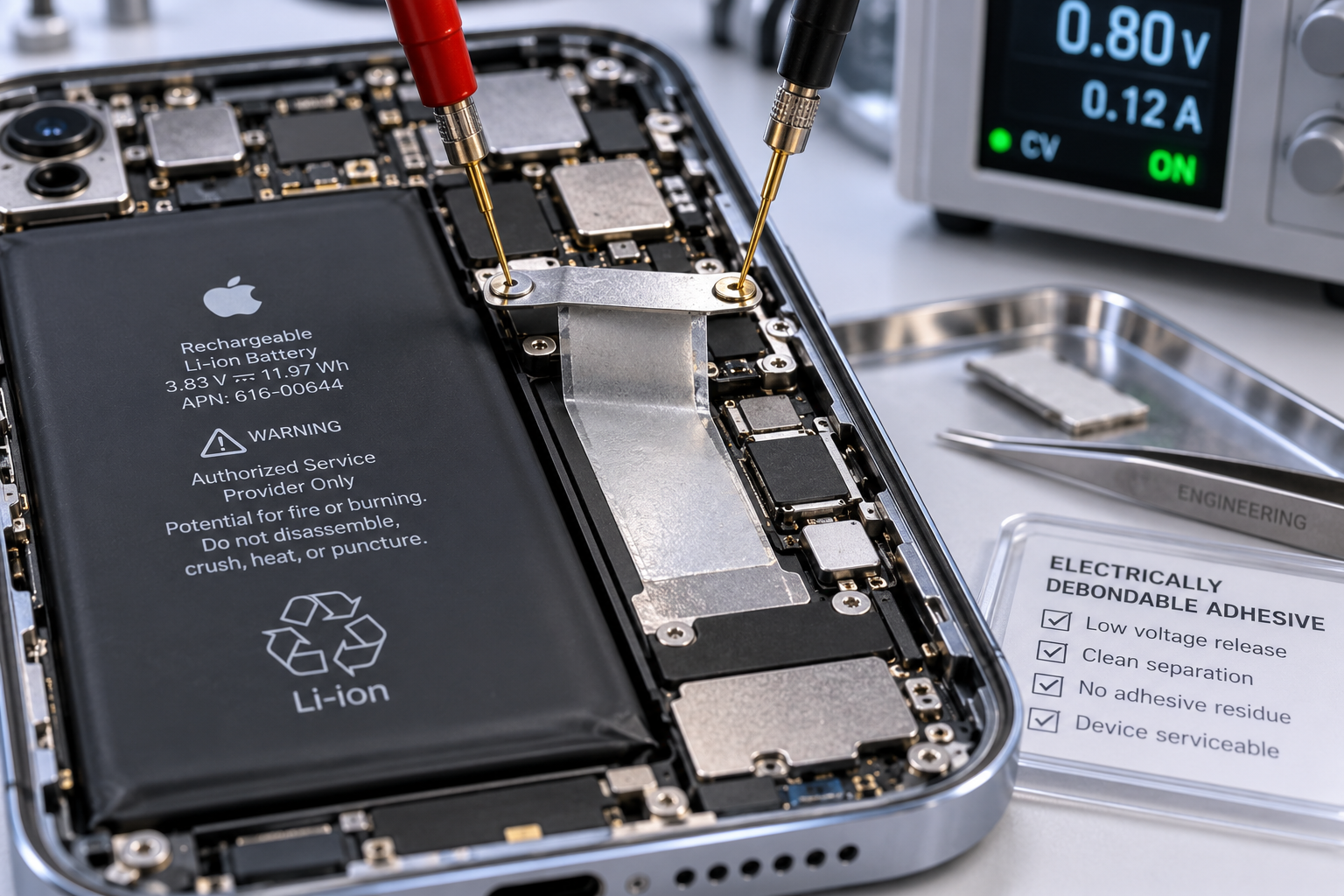
This legal constraint forced hardware engineering departments into a frenzy of material science innovation. The most elegant solution to emerge is electrically debondable adhesive, commonly known as ionic liquid bonding.
Instead of relying on permanent petrochemical tack, ionic liquid adhesives consist of conductive polymer layers that maintain rock-solid mechanical adhesion during normal device operation. When a low-voltage electrical current is applied across the bonding tabs—typically delivered by a standard nine-volt household battery or a basic bench power supply for ninety seconds—an electrochemical reaction takes place within the adhesive matrix. The applied voltage alters the ionic charge balance, breaking the polymer bonds at the interface. The adhesive instantly releases its grip, allowing the battery pouch to slide out effortlessly with zero prying force, zero heat, and zero sticky residue.
When Apple quietly introduced this exact electrically induced debonding mechanism in the base iPhone 16 and iPhone 16 Plus, many industry observers treated it as an isolated engineering curiosity. In reality, it was a direct compliance rehearsal for the looming European mandate. By engineering a battery that releases cleanly when touched by a nine-volt battery clip, hardware makers can satisfy the European requirement for cold, solvent-free disassembly while retaining the ultra-thin, highly rigid, and water-sealed physical architecture that modern consumers demand.
🚫 The Ban on Software Parts-Pairing and Serial Number Locks
Physical disassembly, however, was only half of the planned obsolescence equation. Over the past six years, the consumer electronics industry perfected an even more insidious barrier to longevity: software parts-pairing, also known as serialization.
In serialized devices, individual hardware components—including the display, camera modules, biometric sensors, and the battery pack—are programmed at the factory with unique cryptographic serial numbers. When the device powers on, the system-on-chip reads these hardware identifiers and checks them against an encrypted registry stored in the secure enclave. If a consumer replaced a degraded battery with an identical, brand-new OEM battery harvested from another legitimate phone, the device's operating system would detect the serial mismatch.
The resulting penalties were severe. The smartphone would display persistent, unremovable warning notifications on the lock screen, informing the user that the device could not verify whether the battery was a genuine part. More critically, the operating system would disable essential software features. Battery health percentage meters were greyed out, dynamic performance management algorithms were crippled, and in some aggressive implementations, fast-charging protocols were intentionally throttled to base speeds. To clear the artificial software flags, the device had to be connected to proprietary, cloud-linked diagnostic servers accessible only to authorized corporate repair depots.
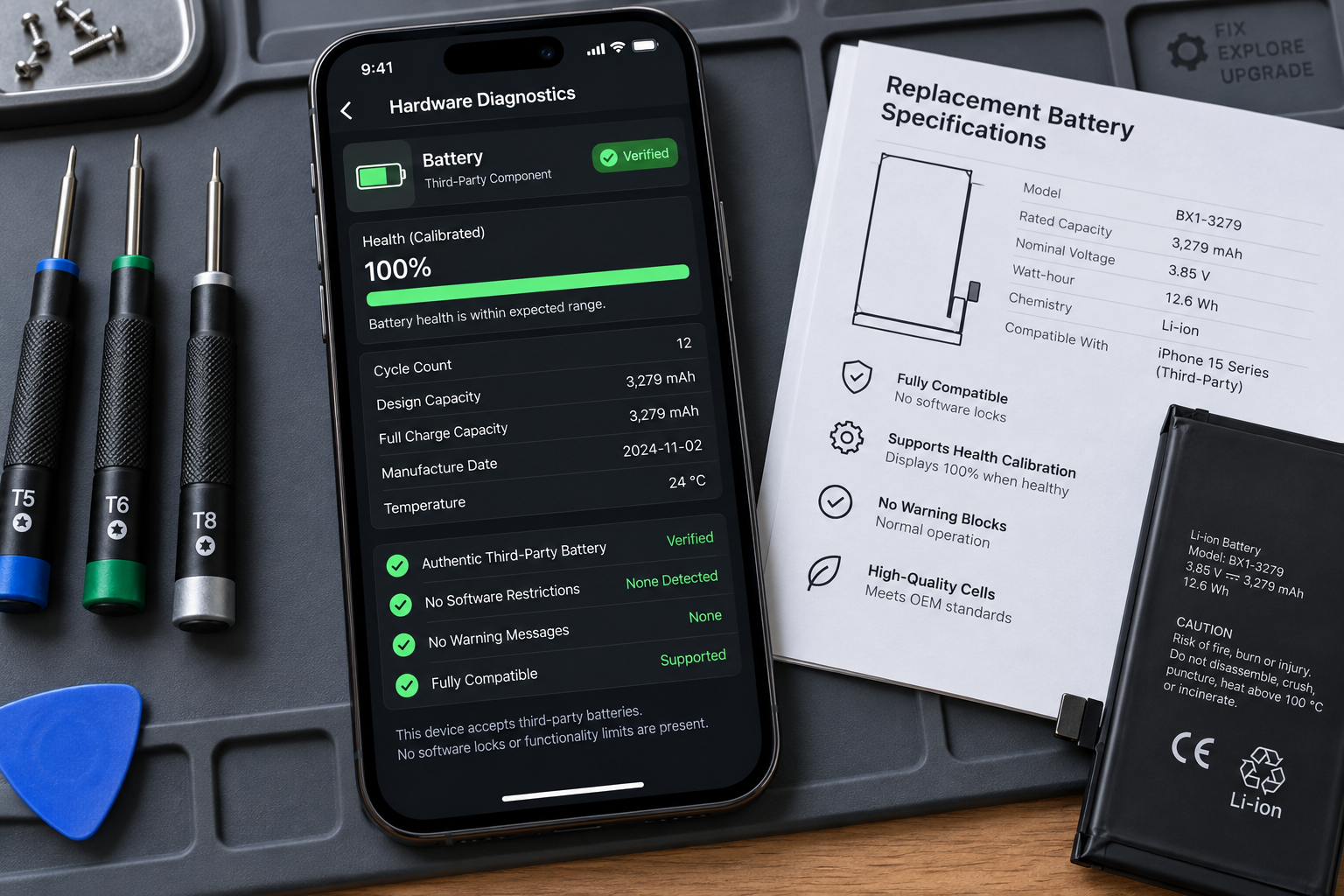
Regulation (EU) 2023/1670 systematically outlaws this practice across the European market. The statute explicitly declares that software, firmware, or hardware restrictions may not be used to prevent the replacement of a battery or any other critical spare part by an independent repairer or end user.
Manufacturers are still legally permitted to display informational notices alerting consumers if a non-original or untested battery is detected, ensuring transparency and safety awareness. However, the law strictly forbids software locks that penalize device functionality, disable health monitoring metrics, or degrade performance purely because the replacement was performed outside the manufacturer's proprietary corporate walled garden. If a replacement battery meets standard electrical, thermal, and mechanical safety certifications, the host operating system must calibrate it transparently and treat it as a first-class component.
This legal prohibition represents a seismic shift for the independent repair ecosystem. For years, neighborhood repair shops and third-party electronics technicians operated under the constant threat that an operating system update could brick their repairs or trigger algorithmic customer panic. By outlawing cryptographic parts-pairing, European regulators stripped original equipment manufacturers of their private monopoly over device maintenance, restoring an open, competitive marketplace for hardware servicing.
📦 The Mandatory Five-Year Spare Parts and Public Documentation Window
Even if a phone is physically easy to dismantle and software-unlocked, repairability remains an empty promise if replacement components are impossible to buy. In the traditional smartphone business model, hardware vendors maintained tight control over their spare parts inventories. Once a model was discontinued from the retail market, OEM battery manufacturing runs were quickly wound down. Within two to three years of a phone's release, consumers seeking official battery replacements were frequently told that parts were obsolete, leaving them with no choice but to gamble on dubious, uncertified clone batteries from grey-market import sites.
The European Union's ecodesign mandate closes this supply gap with an ironclad timeline. Under Regulation (EU) 2023/1670, manufacturers placing smartphones on the European market must guarantee the commercial availability of replacement batteries, displays, back covers, camera assemblies, and charging ports for a minimum of five years after the final unit of that specific model is sold.
Furthermore, the availability mandate is bound by strict pricing and logistical conditions:
- Reasonable and Non-Discriminatory Pricing: Manufacturers are legally prohibited from pricing spare batteries so exorbitantly that replacement becomes economically irrational compared to buying a new device. Regulators established price transparency metrics to prevent vendors from hiding the true cost behind inflated shipping fees or mandatory bundle packages.
- Rapid Delivery Windows: Replacement batteries and critical repair parts must be dispatched and delivered to professional repairers and consumers within five working days of an order being placed across all twenty-seven European Union member states.
- Open Diagnostic Documentation: Repair manuals, schematics, torque specifications, and electrical pinouts must be permanently published online, freely accessible without paywalls, non-disclosure agreements, or proprietary dealer logins.
- Repair Tool Access: Any proprietary software utility required to reset battery health counters, run diagnostic handshakes, or initiate system calibration must be made accessible to independent repair technicians on fair, reasonable, and non-discriminatory terms.
For a flagship smartphone launched in late 2026 and sold through early 2028, this statutory mandate means that certified OEM replacement batteries, official service manuals, and calibration tools must remain readily purchasable until at least 2033. This single provision fundamentally alters the economic math of smartphone ownership, creating a stable, legally protected ten-year operational horizon for modern electronics.
🔬 How Independent Repair Shops Reclaim the Electronics Bench
To appreciate the practical impact of these harmonized regulations, one must look away from corporate keynote stages and examine the daily reality of the independent repair technician.
For the past decade, entering an independent electronics repair shop was an exercise in witnessing industrial guerrilla warfare. Repair benches were cluttered with specialized curing ovens, suction clamps, hazardous chemical droppers, microscope heating plates, and specialized micro-soldering stations. Technicians spent hours carefully slicing through micro-millimeters of stubborn foam tape, praying that an errant pick would not nick a delicate display flex cable or pierce a fragile lithium pouch.
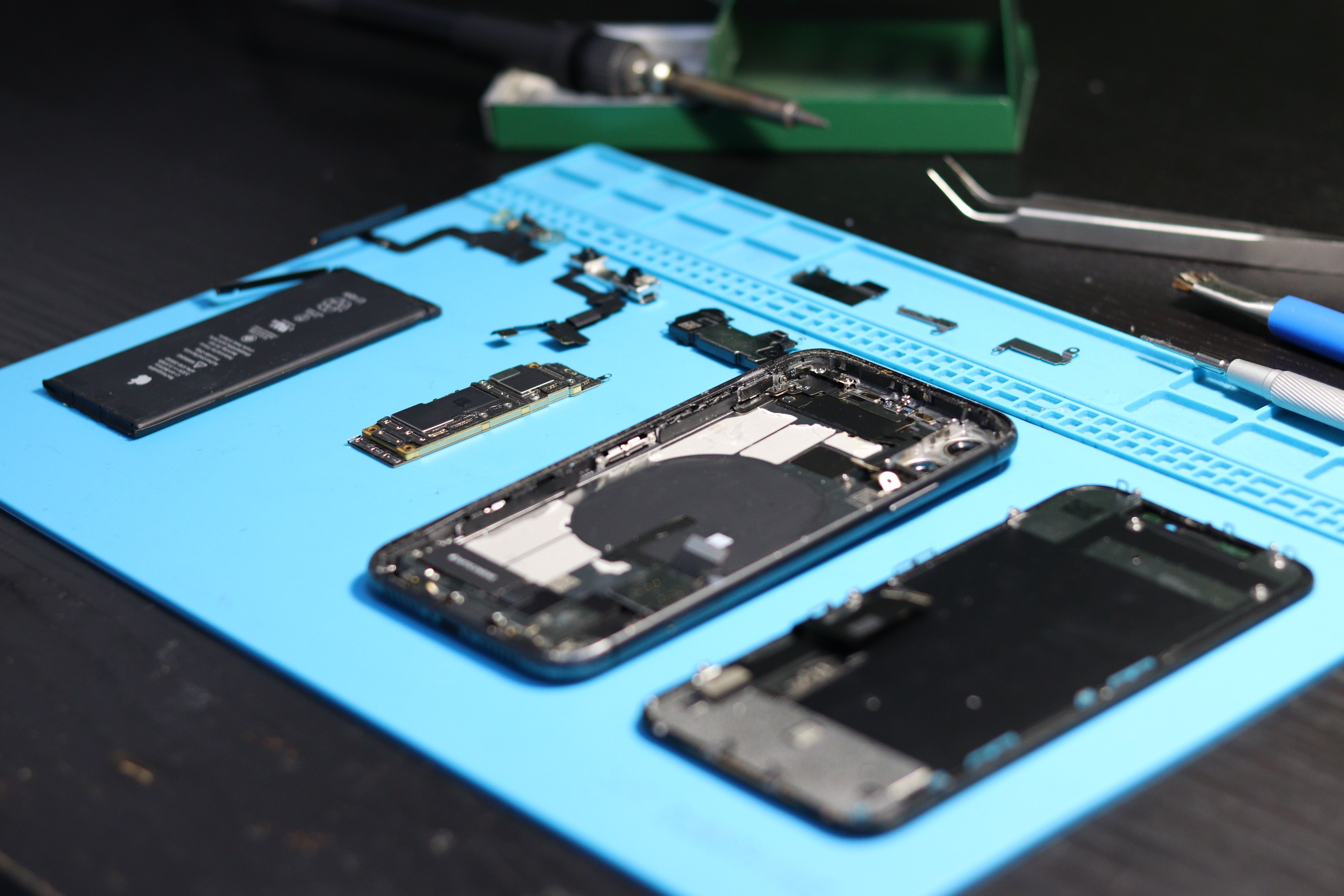
The financial burden of this complexity fell squarely on small businesses and their local customers. Independent repair shops had to invest tens of thousands of dollars in proprietary prying jigs for every distinct smartphone model that entered the market. If an independent shop repaired an iPhone display or an Android battery, they had to spend valuable shop time explaining to skeptical customers why their settings menu was flashing artificial error codes, despite the technician having installed a high-grade replacement part.
The enforcement of the EU Battery and Ecodesign Regulations dismantles these artificial operational barriers. By mandating solvent-free, non-thermal disassembly, the regulations restore the primacy of basic mechanical craftsmanship. An independent repairer in Madrid, Berlin, or Jakarta can open a compliant device using standardized Torx and Phillips drivers, pop the battery using a safe, low-voltage electrical lead or a manual mechanical pull latch, install a fresh certified cell, and run open diagnostic calibration in under fifteen minutes.
This operational efficiency directly cuts the labor cost of battery servicing in half. When battery replacement shifts from an anxiety-inducing, high-risk surgical procedure into a standardized, ten-minute bench routine, the entire consumer calculus changes. Upgrading a battery ceases to be a traumatic financial threshold that triggers a reluctant phone upgrade; it becomes routine, affordable device maintenance, akin to replacing worn tires or brake pads on a family car.
💡 What Changes When Your Battery Outlives the Upgrade Cycle
As the February 18, 2027 deadline approaches, the broader technology industry is beginning to grasp the profound second-order effects of European hardware legislation. Just as the European Union's common charger mandate single-handedly killed Apple's proprietary Lightning connector and forced universal USB-C across the globe, the EU's battery and repairability rules are establishing a universal baseline for global hardware design.
Consumer electronics manufacturers operate on global assembly lines. Designing, tooling, and certifying two completely different internal chassis architectures—one easily serviceable for Europe and one aggressively glued shut for North America and Asia—is an economic nightmare that introduces catastrophic manufacturing complexity. The engineering changes designed to appease European regulators will inevitably become the standard production blueprint for smartphones shipped to Tokyo, London, Sydney, and Jakarta.
For the ordinary consumer, the death of glued-in batteries marks the end of planned physical obsolescence. Modern smartphone silicon has matured to an extraordinary degree; a flagship mobile processor manufactured today possesses vastly more computational headroom than casual web browsing, messaging, high-resolution photography, and light gaming will ever exhaust over a five-year period. The primary bottleneck that forced consumers into involuntary two-year upgrade cycles was never an underpowered CPU or insufficient RAM. It was the physical decay of the lithium-ion battery cell, deliberately sealed behind walls of industrial glue and cryptographic software locks.
When you purchase a smartphone in late 2026 or 2027, you will not receive a phone with a creaky plastic back that splits apart on impact. You will hold a dense, precision-milled, water-resistant instrument crafted from refined metal and tempered glass. But beneath that flawless exterior, the internal architecture will reflect a hard-won victory for consumer rights and environmental stewardship. The industrial glue is gone. The cryptographic traps are outlawed. The replacement parts are guaranteed. For the first time in the modern smartphone era, the decision to retire your device will belong to you, not to the chemical decay of a battery pack you were never allowed to touch.
Sources: European Parliament and Council Regulation (EU) 2023/1542; Commission Regulation (EU) 2023/1670 on Ecodesign for Smartphones; European Commission Directorate-General for Environment Guidelines on Battery Removability and Replaceability; CEN-CENELEC Standard EN 45554; Right to Repair Europe Policy Audits.