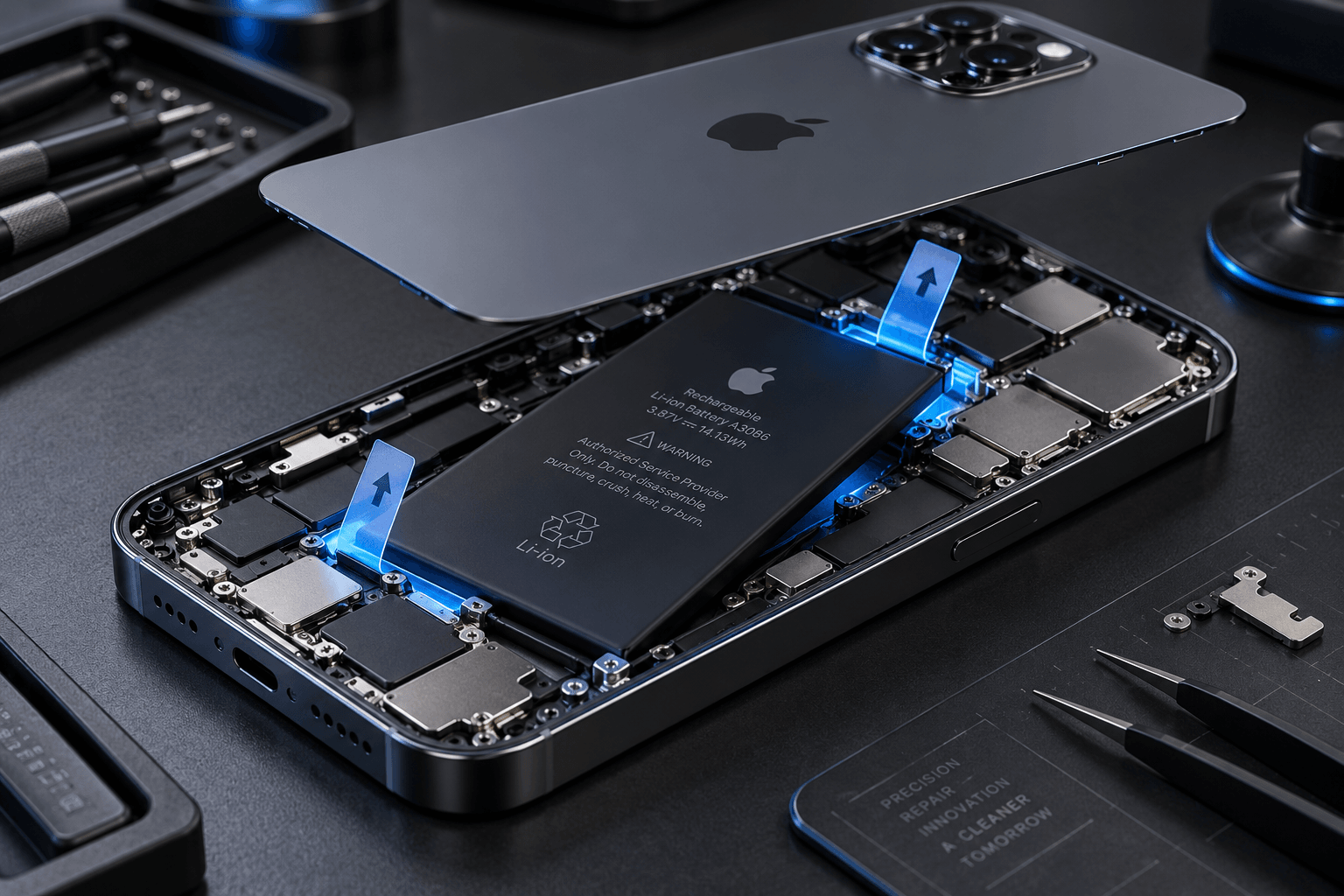
For nearly a decade, the battery capacity of flagship smartphones seemed locked in place. From 2016 through early 2024, whether you bought a phone from Cupertino, Suwon, or Shenzhen, the numbers on the spec sheet hovered stubbornly between 4,000 and 5,000 milliamp-hours. Whenever a manufacturer attempted to push beyond that threshold, the phone thickened into an awkward brick, weighed down pockets, or encroached on space reserved for periscope telephoto lenses and vapor chambers. The physics of mobile devices appeared to have struck a hard boundary: if you wanted a slim, elegant chassis measuring under eight millimeters, five thousand milliamp-hours was the price of admission.
That ceiling shattered with disorienting speed. Across 2025 and 2026, premium and upper-midrange smartphones began arriving with 6,500, 7,300, and even 8,000 milliamp-hour ratings while remaining thinner and lighter than the phones they replaced. The OnePlus 15 packed a 7,300 mAh cell into an 8.1-millimeter body. Honor launched devices exceeding 7,500 mAh, while Oppo and Vivo pushed flagship phones past 7,000 mAh without demanding compromises in industrial design. According to market trackers at Counterpoint Research, the average battery capacity of smartphones sold worldwide jumped to 5,291 mAh in early 2026, marking the largest single-year leap recorded in more than half a decade.
This sudden expansion did not occur because smartphone frames grew larger, nor because processors magically required less room. It happened because the core electrochemistry of the lithium-ion battery underwent its most radical material transformation in thirty years. By replacing conventional pure graphite with silicon-carbon composite anodes, battery engineers unlocked volumetric energy densities that previously belonged only to academic laboratories.
Yet beneath the enthusiastic marketing slogans and the seductive promise of two-day battery life lies an engineering reality that manufacturers rarely print on the retail packaging. Silicon is an astonishing energy sponge, but it is also an unruly, physically volatile material that breathes violently every time energy flows through it. Packing 7,000 milliamp-hours into an everyday pocket computer solves the immediate problem of daily endurance, but it alters the underlying physics of degradation. Understanding how silicon-carbon chemistry works reveals why this leap took decades to achieve, why Apple and Google have chosen to watch from the sidelines, and what buyers must trade in long-term longevity for freedom from the wall socket.
🔋 The Sudden Leap from Five Thousand to Seven Thousand Milliamp Hours
To understand why the recent jump in capacity feels so dramatic, one must first recognize the structural gridlock that mobile engineering faced for over ten years. Inside any modern glass-and-aluminum slab, volume is the supreme currency. Every cubic millimeter is fiercely contested. The camera system demands deeper sensor cavities and multi-element glass lenses. 5G millimeter-wave antenna arrays require clear perimeter zones. High-power system-on-chip processors dissipate twenty watts under peak loads, necessitating broad copper vapor chambers and graphite heat spreaders.
In this crowded interior, the battery traditionally occupied roughly thirty to thirty-five percent of total internal device volume. Because energy density remained largely static, the only way to deliver more run time was to physically enlarge the cell, which inevitably forced the entire phone to become thicker, wider, and heavier. When power-hungry 120Hz LTPO displays and high-brightness outdoor panels arrived, manufacturers struggled merely to hold battery life flat. Many resorted to aggressive software task-killing, dimming screens, or throttling background processes just to ensure a device survived from breakfast to bedtime.
The breakthrough of 2025 and 2026 fundamentally decoupled battery capacity from physical bulk. Volumetric energy density, measured in watt-hours per liter (Wh/L), jumped from the historical benchmark of 650 to 700 Wh/L in premium graphite cells up to 800, 850, and in cutting-edge laboratory batches, nearly 900 Wh/L. In practical terms, that twenty to twenty-five percent increase in volumetric density meant that a physical battery pouch identical in dimensions to a 5,000 mAh graphite pack could now store well over 6,200 mAh. Paired with microscopic refinements in internal pouch packaging, thinner copper current collectors, and tighter internal winding tolerances, phone makers crossed the 7,000 mAh threshold without adding a single gram of unnecessary weight.
The result for consumers has been a transformative shift in daily habits. A phone with 7,300 milliamp-hours does not merely last through a busy workday; it shrugs off intensive navigational GPS tracking, hours of mobile hotspot tethering, high-framerate gaming, and continuous 4K video recording. For the first time in the smartphone era, the dreaded low-battery anxiety that defined the 2010s has begun to evaporate. Yet this leap was not achieved by discovering some exotic, unproven chemistry like solid-state electrolytes or lithium-air. The battery in your pocket is still, at its core, a lithium-ion battery. The revolution took place entirely on one side of the cell: the anode.
🧪 Why Graphite Hit a Hard Ceiling at Thirty Years of Service
Every rechargeable lithium-ion cell contains four primary components: a positive cathode (typically composed of lithium cobalt oxide, nickel-manganese-cobalt, or lithium iron phosphate), a liquid or gel electrolyte that allows ions to move, a porous polymer separator to prevent electrical short circuits, and a negative anode that stores the lithium ions while the battery is charged. When you plug your phone into a wall charger, external electrical current pulls electrons from the cathode and drives positively charged lithium ions through the electrolyte toward the anode. When you unplug the phone and scroll through applications, the process reverses: lithium ions leave the anode, travel back across the separator to the cathode, and release their stored energy as electrical work.
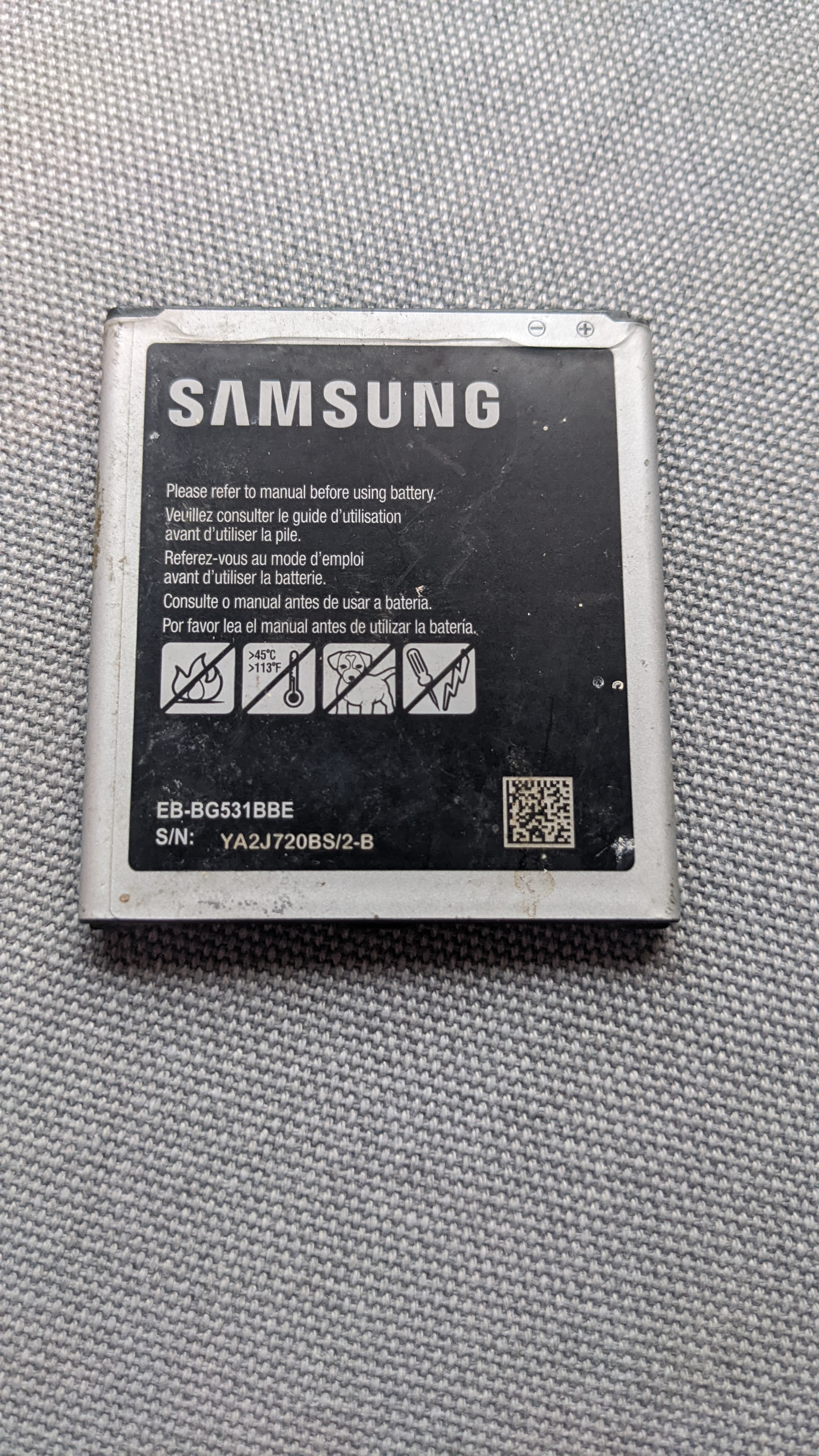
Ever since Sony commercialized the first consumer lithium-ion cell in 1991, the material chosen for the anode has remained virtually identical: synthetic or natural graphite. Graphite was selected not because it possessed extraordinary energy storage capabilities, but because it was stable, abundant, electrically conductive, and structurally forgiving. Microscopically, graphite consists of planar sheets of carbon atoms arranged in a hexagonal honeycomb lattice, bonded together by weak van der Waals forces.
During charging, lithium ions slide neatly between these flat graphene sheets in an orderly electrochemical process known as intercalation. The carbon sheets expand slightly to accommodate the incoming guest ions, but the physical expansion is remarkably modest, typically expanding by no more than eight to ten percent in volume. When the battery discharges, the ions depart smoothly, and the carbon lattice returns to its original dimensions without suffering internal mechanical trauma. Because the structural damage per cycle is minimal, high-quality graphite anodes can endure 1,500 to 2,000 full charge-discharge cycles before their storage capacity drops below eighty percent of their original factory rating.
The fatal limitation of graphite lies in its theoretical stoichiometry. In an ideal graphite lattice, it requires six carbon atoms to host a single lithium ion, forming the intercalation compound LiC6. This rigid chemical ratio imposes a strict, immutable physical ceiling: graphite has a maximum theoretical specific capacity of approximately 372 milliamp-hours per gram (mAh/g). Over three decades of obsessive manufacturing refinement, commercial cell producers pushed graphite electrodes to within ninety-five percent of that theoretical limit. There were simply no more thermodynamic gains left to wring out of the material. To store more lithium in the same physical space, battery scientists had to abandon the gentle process of intercalation and find an anode material that stored lithium through a completely different chemical mechanism.
💥 The Three Hundred Percent Expansion Trap That Crushed Early Prototypes
That candidate material has been known to electrochemists since the late 1960s: elemental silicon. Silicon does not store lithium by politely tucking ions between crystalline sheets. Instead, silicon alloys directly with lithium, forming complex intermetallic compounds that culminate in the chemical phase Li15Si4. In this state, just four silicon atoms can bind with up to fifteen lithium ions.
The resulting numbers are staggering. Pure silicon possesses a theoretical specific capacity of roughly 4,200 milliamp-hours per gram, more than eleven times the capacity of graphite. Even when operating at practical room-temperature potentials, silicon routinely yields well over 3,000 mAh/g. On paper, replacing a graphite anode with silicon should allow a battery to shrink to a fraction of its size or hold enough charge to power a smartphone for an entire week.
Yet for more than thirty years, pure silicon remained one of the most notorious graveyard materials in electrochemistry. The exact mechanism that gives silicon its astronomical capacity is also the mechanism that destroys it: volumetric swelling.
When lithium ions force their way into silicon, the crystal structure undergoes a violent phase transformation. As the alloy forms, the material swells by three hundred to four hundred percent in physical volume. A single grain of silicon expands to four times its original girth during a full charge, then contracts back to its original footprint during discharge. Inside the sealed, tightly wound confines of a smartphone pouch cell, this dramatic breathing causes catastrophic structural failure.
Under the immense stress of repeated expansion and contraction, bare silicon particles quickly crack, shatter, and pulverize into a fine, disconnected dust. Once a fragment of silicon loses physical contact with the copper current collector or surrounding conductive carbon pathways, it becomes electrochemically dead, unable to accept or release electrons. In early laboratory experiments, cells built with unconstrained silicon anodes lost fifty percent of their usable capacity after just twenty to thirty charging cycles.
Even worse than mechanical pulverization is the destruction of the Solid Electrolyte Interphase, commonly known as the SEI layer. When a lithium-ion cell is charged for the very first time at the factory during formation, the liquid electrolyte decomposes against the anode surface, forming a thin, protective passivation film composed of lithium carbonates, fluorides, and alkyl oxides. A healthy SEI layer is a vital guardian: it is electrically insulating (preventing continuous breakdown of the electrolyte) yet ionically conductive (allowing lithium ions to pass through freely).
On a stable graphite anode, the SEI layer forms once and remains mostly intact throughout the life of the battery. But on a pure silicon anode that expands by three hundred percent, the brittle SEI film cracks open like dry earth in an earthquake, exposing fresh, unpassivated silicon to the liquid electrolyte. The electrolyte immediately decomposes again to heal the fissure, consuming active lithium ions and solvent molecules in an endless, parasitic cycle. With every charge, the battery permanently burns through its internal reservoir of lithium and dries out its liquid electrolyte, while the SEI layer thickens into a thick, resistive crust that chokes off ionic flow and drives up internal impedance.
🔬 How Nanoscale Carbon Cages and Nanotubes Solved the Pulverization Crisis
The commercialization of silicon anodes in the 2020s did not occur because someone discovered a magical form of silicon that refuses to expand. The laws of chemical thermodynamics remain non-negotiable: silicon must expand when it alloys with lithium. Instead, the solution came from advanced materials engineering at the nanoscale. Scientists stopped attempting to use monolithic silicon particles and began constructing composite micro-architectures that accommodate expansion internally.
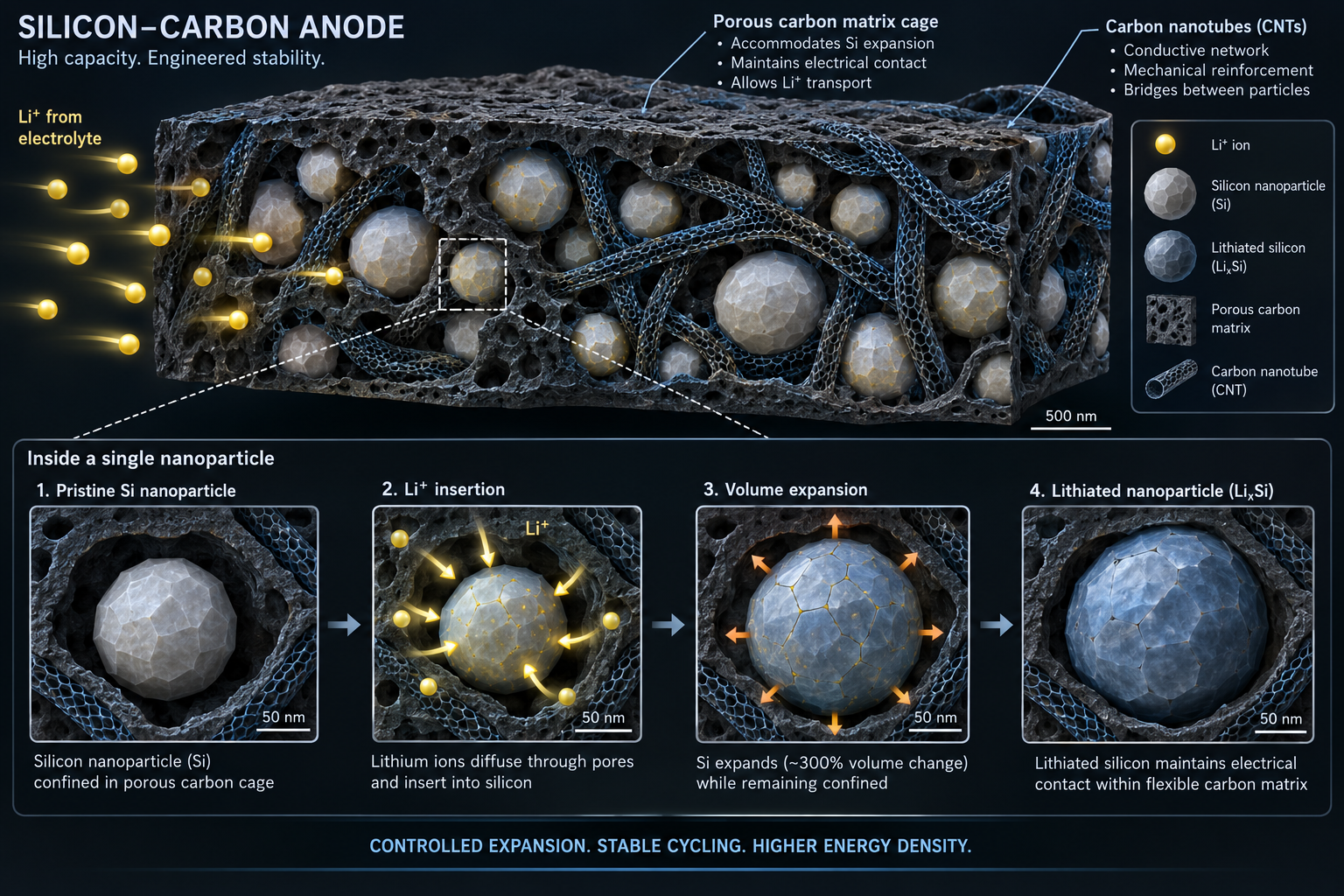
Modern smartphone batteries do not use pure silicon. They use silicon-carbon composites, where silicon represents a carefully calculated fraction, typically between five and fifteen percent by weight, embedded within an engineered carbon matrix. By blending silicon into graphite, manufacturers strike an intentional compromise: they capture a meaningful boost in energy density while relying on the surrounding carbon framework to buffer mechanical strain.
The primary engineering breakthrough involves nano-silicon encapsulation. Using chemical vapor deposition and advanced synthesis techniques, researchers fabricate porous carbon microspheres whose interior cavities are seeded with sub-100-nanometer silicon particles. Crucially, these spherical carbon cages are designed with intentional internal void space, sometimes described as a yolk-shell architecture. When the battery charges, the nano-silicon yolk expands into the empty internal cavity, filling the void without exerting outward mechanical pressure on the exterior carbon shell. The outer boundary of the carbon sphere remains dimensionally stable, shielding the fragile SEI layer from continuous mechanical tearing.
To maintain electrical continuity as the particles breathe, manufacturers weave multi-walled carbon nanotubes (CNTs) throughout the electrode slurry. These microscopic carbon filaments act as an elastic, highly conductive spiderweb that bridges individual active particles. Even if a silicon nanoparticle experiences localized micro-cracking, the resilient nanotube network ensures that every fragment remains electrically bonded to the current collector.
Finally, modern chemical formulations incorporate advanced electrolyte additives, most notably fluoroethylene carbonate (FEC). During the initial factory formation cycles, FEC decomposes preferentially to generate an elastic, highly fluorinated SEI layer dominated by lithium fluoride (LiF). Unlike conventional brittle carbonate films, a LiF-rich passivation layer possesses remarkable mechanical flexibility and superior interfacial adhesion, stretching and flexing alongside the composite particles rather than fracturing under expansion stress.
Through this combination of nanoscale void design, resilient carbon nanotube conduction networks, and fluorinated electrolyte chemistry, materials scientists transformed silicon from an unstable laboratory curiosity into a robust, mass-producible electrode material. In 2026, companies like Sila Nanotechnologies, Group14 Technologies, and domestic Chinese battery giants such as Amperex Technology Limited (ATL) and Sunwoda scaled these composite anodes to produce millions of cells per month.
⚖️ The Unspoken Trade-Off Between Today's Capacity and Tomorrow's Cycle Count
When a consumer unboxes a phone equipped with a 7,300 mAh silicon-carbon battery, the experience feels like an unmitigated triumph. The phone is impossibly sleek, the software runs without artificial power constraints, and the battery percentage drops at an imperceptible crawl. Yet in electrochemistry, there is no such thing as an uncompromised gift. Every gain in energy density borrows against the temporal lifespan of the cell.
The primary compromise of silicon-carbon composite anodes is cycle life retention. While high-grade conventional graphite cells routinely retain eighty percent of their original capacity after 1,500 to 2,000 full charge cycles, early-generation silicon-carbon cells deployed in consumer electronics exhibit accelerated degradation curves. Regulatory filings, technical tear-downs, and comparative laboratory testing reveal that shipping silicon-carbon cells typically achieve between 650 and 1,200 full charge cycles before degrading to the standard eighty percent health threshold.
The underlying mechanism of this accelerated wear is twofold: irreversible particle swelling and progressive lithium trapping. Although porous carbon cages absorb the vast majority of silicon's volumetric breathing, they are not completely immune to mechanical fatigue. Over hundreds of cycles, subtle plastic deformation accumulates across the electrode sheet. Studies published in the Journal of The Electrochemical Society demonstrate that silicon-carbon electrodes experience a permanent, irreversible thickness growth of five to fifteen percent over their operating lifespan, compared to less than two percent in pure graphite cells. This chronic swelling exerts sustained mechanical pressure against the separator, gradually constricting electrolyte channels.
Simultaneously, the continuous micro-fissuring of silicon particles, however minimized by nanotechnology, inevitably consumes active lithium over time. Silicon-carbon cells often display an initial capacity drop of ten to fifteen percent within the first two hundred cycles, after which the degradation curve temporarily stabilizes as the SEI layer reaches a dynamic equilibrium.
For many users, this trade-off is entirely rational and acceptable. Consider the basic arithmetic of daily usage: because a 7,300 mAh battery holds so much energy, an average user only needs to recharge the device once every two days, rather than plugging it in every night. Over a two-year period, a two-day phone undergoes only 365 full equivalent charge cycles. Even if the cell degrades to eighty percent capacity after 800 cycles (roughly four years of real-world use), eighty percent of 7,300 mAh is still 5,840 mAh. That degraded cell still delivers more raw milliamp-hours of usable energy than a brand-new iPhone 17 Pro Max fresh out of the factory box.
However, for power users who drain and recharge their devices daily, or for consumers who intend to keep their smartphones for five to seven years in alignment with modern operating system support windows, the accelerated aging of high-silicon anodes represents a genuine concern. A battery that degrades toward seventy percent health within three years will begin showing unpredictable voltage drops under peak processor loads, manifesting as sudden device shutdowns in cold weather or noticeable interface stutter as power management algorithms throttle clock speeds to protect failing cells.
📱 Why Chinese Flagships Leaped Ahead While Apple and Google Hesitated
The geographical divide in the adoption of silicon-carbon batteries is one of the most striking phenomena in modern consumer electronics. As of late 2026, the global smartphone market has split almost cleanly along geopolitical and supply chain boundaries. Brands anchored in the Chinese hardware ecosystem—OnePlus, Oppo, Vivo, Honor, Xiaomi, and Realme—have embraced silicon-carbon anodes across their entire flagship and premium portfolios. Meanwhile, Western tech titans Apple and Google have maintained a conservative stance, continuing to ship conventional graphite anodes across their core product lines.
This divergence is not an accident of engineering competence; it is a calculated reflection of differing business models, warranty liabilities, and regulatory exposure. Chinese phone manufacturers operate in one of the most intensely competitive consumer markets in the world, where spec-sheet supremacy and noticeable hardware leaps drive rapid upgrade cycles. In domestic Chinese retail environments, a phone offering a 7,500 mAh battery and 100-watt charging holds an undeniable marketing advantage over a competitor stuck at 5,000 mAh. Furthermore, the domestic Chinese battery supply chain—centered around suppliers like ATL, CATL, and BYD—has invested aggressively in localized silicon-carbon synthesis infrastructure, driving down unit costs through sheer manufacturing scale.
Apple and Google, by contrast, operate under profoundly different institutional constraints. Apple ships hundreds of millions of identical iPhones worldwide each year. Any systemic defect, premature battery degradation issue, or unexpected swelling in an iPhone generation would trigger billions of dollars in warranty replacements, global regulatory investigations, and immense reputational damage. Apple has historically prioritized cycle longevity, safety margins, and predictable long-term performance over bleeding-edge raw capacity.
When Apple needed to increase battery life in the iPhone 17 family, it chose a conservative, mechanical path rather than an electrochemical gamble. By eliminating the physical SIM tray across broader international markets, Apple reclaimed internal chassis volume to fit a slightly larger graphite pouch (reaching 5,088 mAh in eSIM-only Pro Max models). Apple also introduced advanced software charging limiters and relies heavily on the industry-leading energy efficiency of its 3-nanometer and 2-nanometer A-series silicon to stretch battery life.
Google has followed a similar conservative trajectory with the Pixel series, holding capacity around 5,100 mAh while relying on Tensor chip efficiency and battery management firmware. Samsung occupies a nuanced middle ground: while Samsung retained graphite anodes for its high-volume Galaxy S26 series, it quietly integrated silicon-carbon material into its Galaxy Z Fold 8 generation. Foldable devices represent the ideal architectural application for silicon-carbon: because foldables are split into two ultra-thin halves where every millimeter of thickness directly impacts ergonomics, the higher volumetric energy density of silicon-carbon allowed Samsung to achieve all-day endurance without making the folded device feel like a pocket dictionary.
⚡ Fast Charging Heat and the Real Stress on Composite Electrodes
The challenge of managing silicon-carbon batteries becomes exponentially more complex when combined with ultra-fast charging protocols. Over the past five years, charging speeds have escalated from modest 18-watt USB Power Delivery rates to blistering 80-watt, 100-watt, and 120-watt proprietary charging systems that can pump empty batteries to full capacity in under twenty-five minutes.
When high electrical current is forced into a battery cell at rapid rates (often exceeding 3C or 4C charging rates), it generates substantial Joule heating. In a conventional graphite cell, lithium ions must queue at the edges of carbon sheets, creating localized current crowding and internal thermal spikes that can exceed 45 degrees Celsius if thermal dissipation is inadequate.
In a silicon-carbon composite cell, high-rate charging introduces a severe mechanical complication. When current flows rapidly, lithium ions alloy with silicon nanoparticles at an aggressive rate, inducing steep concentration gradients across individual particles. The exterior surface of a silicon particle expands rapidly while the core remains unlithiated, creating intense internal shear stress that can cause micro-fractures even within nano-sized grains.
Furthermore, elevated temperatures dramatically accelerate the chemical reactivity between the liquid electrolyte and the active silicon surface. At temperatures above 40 degrees Celsius, the protective fluorinated SEI layer breaks down at an accelerated pace, consuming additional electrolyte and precipitating resistive decomposition products that permanently impair ion transport.
To mitigate these thermal stresses, modern silicon-carbon flagships deploy sophisticated charging management firmware coupled with extensive cooling hardware. Internal battery packs are divided into dual-cell configurations (for example, two 3,650 mAh cells wired in series), allowing the incoming voltage to be halved across each individual pouch. Advanced battery management systems continuously monitor internal cell impedance, throttling charging speeds dynamically as temperatures rise.
However, the laws of physics cannot be completely suspended by software. Subjecting a silicon-carbon phone to continuous 100-watt rapid charging, particularly in warm ambient environments or while playing graphic-intensive games, significantly accelerates the degradation clock. A user who routinely fast-charges their device under high thermal loads can expect their battery's health to drop toward eighty percent in as few as 500 to 600 cycles, turning what should have been a four-year battery into an eighteen-month liability.
🛠️ Practical Charging Habits to Keep a High-Silicon Battery Alive for Five Years
For consumers who own or are planning to purchase a smartphone equipped with a silicon-carbon battery, extending cell longevity requires unlearning several outdated habits and adopting a few evidence-based operational routines. Because silicon-carbon electrodes are sensitive to mechanical expansion stress and chemical oxidation at high cell voltages, how you charge your phone matters far more than it did in the graphite era.
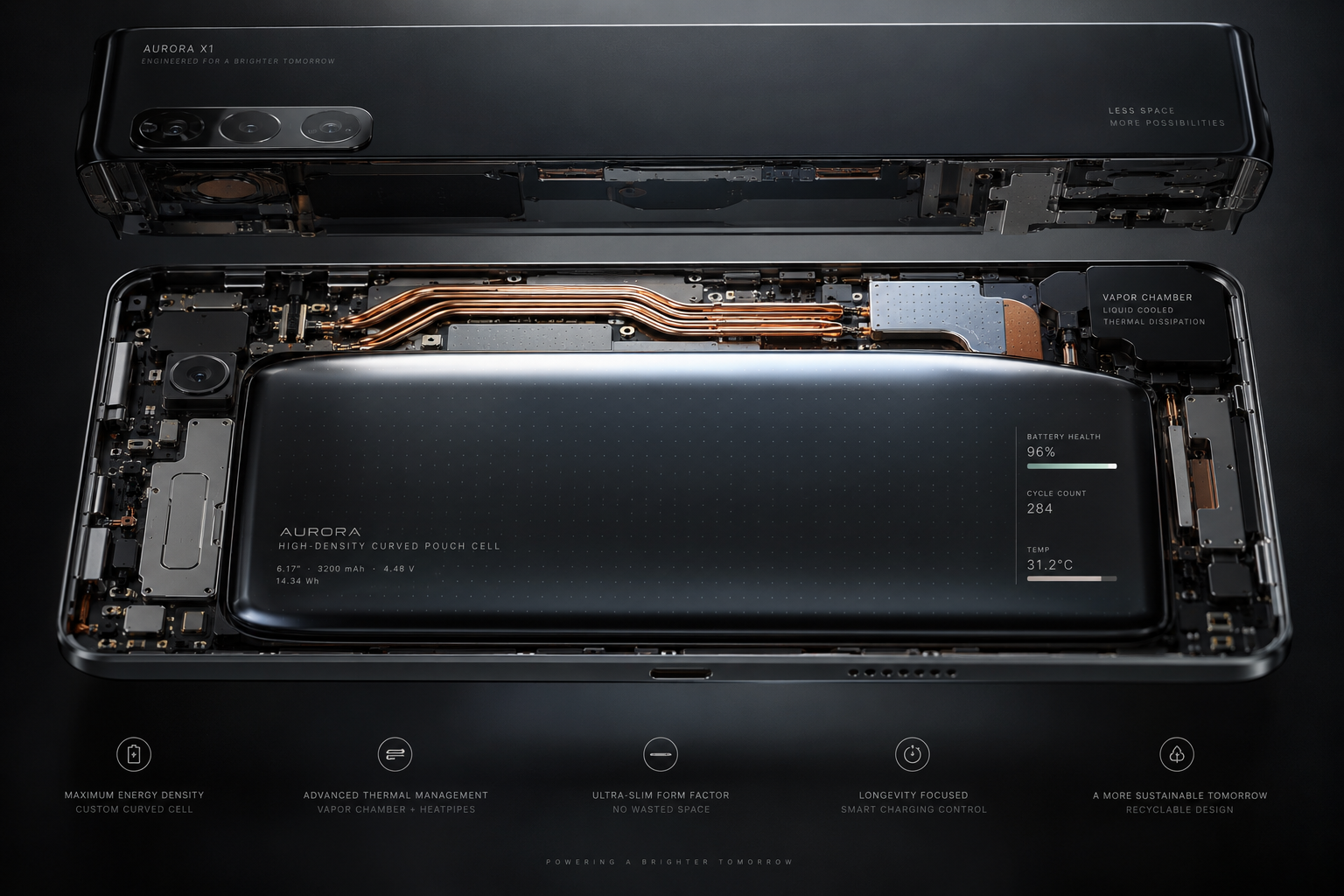
To maximize the working lifespan of a high-silicon battery, engineers recommend four practical operating routines:
- Cap daily overnight charging at 80%: Most modern operating systems now offer native toggles to halt charging when the battery reaches eighty or eighty-five percent capacity. This feature is not a gimmick; it is grounded in solid electrochemistry. When a lithium-ion cell is charged above 4.35 volts (corresponding to roughly eighty-five to one hundred percent state of charge), the physical expansion of silicon reaches its maximum structural strain, and the electrolyte experiences severe oxidative stress against the cathode. By capping daily overnight charging at eighty percent, you keep the cell within its comfortable mechanical and chemical comfort zone, reducing SEI degradation by more than half.
- Avoid deep discharges below 15%: Allowing a silicon-carbon cell to drain to absolute zero forces the silicon particles into extreme contraction, placing tensile stress on the carbon scaffolding and increasing the likelihood of particle detachment. Maintaining battery charge between twenty and eighty percent, often referred to as the forty-sixty rule in industrial battery management, can easily double or triple the total cycle life of the cell.
- Manage thermal exposure during fast charging: Heat is the ultimate catalyst of battery degradation. Avoid charging your phone under a pillow, in direct sunlight on a car dashboard, or inside thick, non-breathable protective cases that trap heat during rapid charging. If your phone supports programmable power supply (USB-PD PPS) charging, consider using a standard 30-watt or 45-watt charger for routine overnight replenishment, reserving 80-watt or 100-watt fast chargers exclusively for emergency situations when you genuinely need a rapid top-up before leaving the house.
- Match charging speed to your ownership horizon: If you upgrade your smartphone every eighteen to twenty-four months, you can enjoy the full, unbridled capacity of your 7,000 mAh battery with rapid charging without losing sleep over long-term degradation; the secondary market will absorb the depreciation before severe wear manifests. But if you view your phone as a durable five-year investment, treating its high-density silicon anode with mechanical and thermal respect will ensure that the freedom of two-day battery life remains a reality long after the original warranty expires.
Sources: Counterpoint Research Global Smartphone Battery Tracker 2026; BatteryDesign.net Technical Analysis; Journal of The Electrochemical Society; NextTechBlog Teardowns; Sila Nanotechnologies Materials Whitepaper.