If you have ever stood inside a major international airport terminal at five in the afternoon, you already know the acoustic assault of the concourse. Hundreds of gate announcements overlap in three languages, echoing off polished granite floors and cavernous glass curtain walls. Passengers pull active noise-canceling headphones over their ears to preserve their sanity, only to rip them off every four minutes in sheer panic, wondering if their boarding group was just called or if their departure gate was moved across the terminal.
For the nearly 1.5 billion people worldwide living with hearing loss, this acoustic environment is not merely unpleasant. It is practically impenetrable. Traditional public address systems project sound indiscriminately into vast, reverberant spaces, where background chatter, jet engine rumble, and architectural reflections turn critical announcements into unintelligible murk.
A fundamental transformation is now underway across European aviation hubs that quietly replaces this century-old acoustic chaos. In early 2026, Frankfurt Airport became the first airport in the world to transmit live gate announcements directly into passengers' own personal earbuds, headphones, and hearing devices. Munich Airport followed closely behind, equipping six boarding gates across Terminals 1 and 2 with the same digital capability.
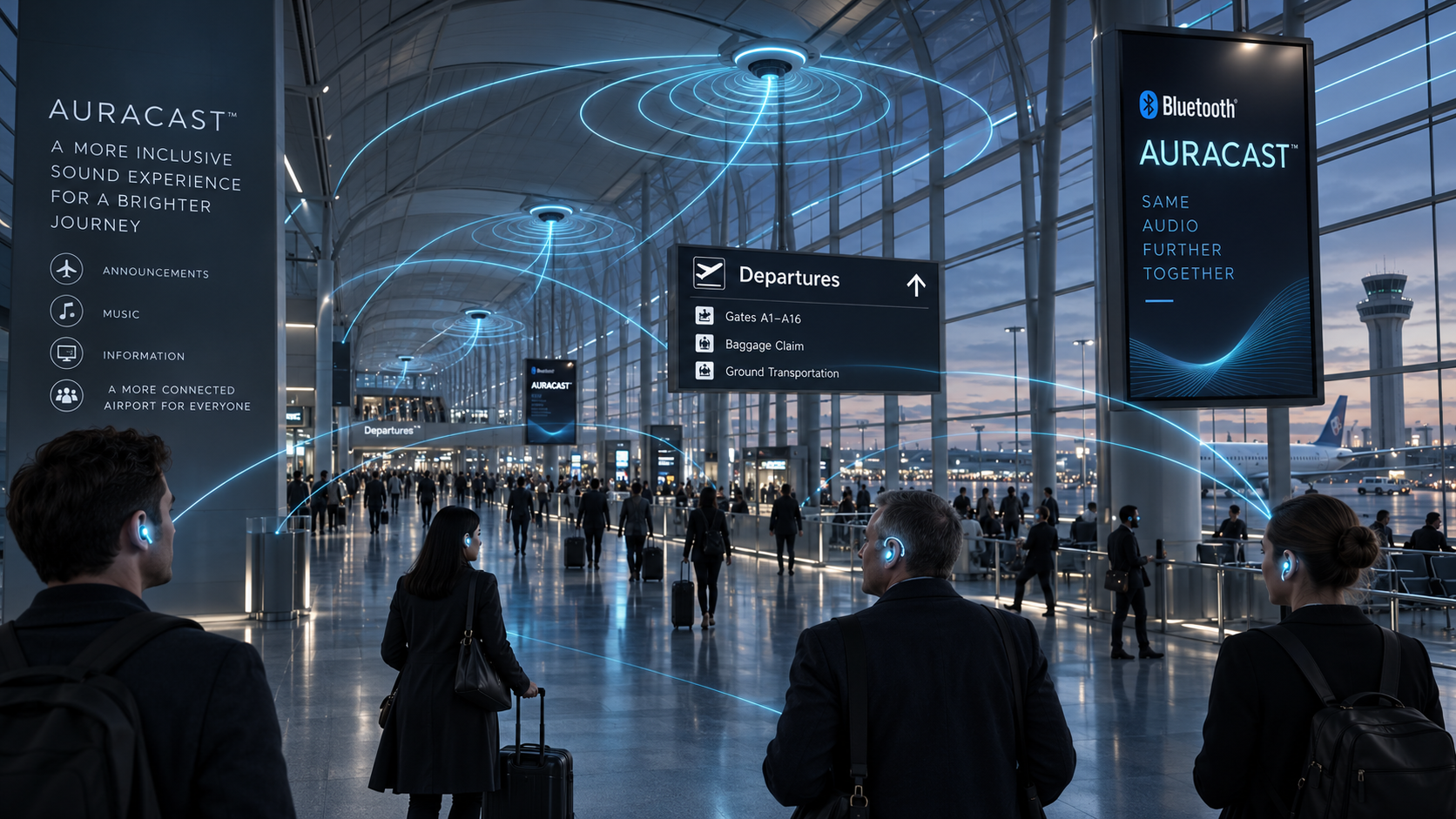
At the heart of this quiet revolution is Bluetooth Auracast, an open wireless broadcast capability built on the Bluetooth Low Energy Audio standard. Rather than shouting into physical space through sixty-watt ceiling horns, the airport converts announcements into a synchronized digital radio stream that anyone can tune into with consumer earbuds or prescription hearing aids. To understand why this shift represents the most significant leap in personal wireless audio since the introduction of Bluetooth in 1999, one must first look at the architectural cage that trapped wireless sound for over a quarter of a century.
📻 The End of the Blaring Terminal Concourse
The modern airport terminal was designed around an acoustic contradiction. Architects engineered massive, soaring spaces with glass, steel, and stone to handle tens of thousands of human bodies, creating an echo chamber with reverberation times often exceeding three seconds. Acousticians then attempted to conquer that reverberation by mounting arrays of directional loudspeakers every few meters, blasting speech at eighty decibels to overpower the ambient drone of air handlers and rolling suitcases.
This brute-force approach has reached its breaking point. As global passenger traffic rebounded and terminal concourses expanded, the density of flight movements turned terminal audio into constant auditory pollution. In response, dozens of major hubs around the world adopted so-called silent airport policies over the past decade, strictly prohibiting general paging calls and limiting announcements exclusively to immediate boarding gates.
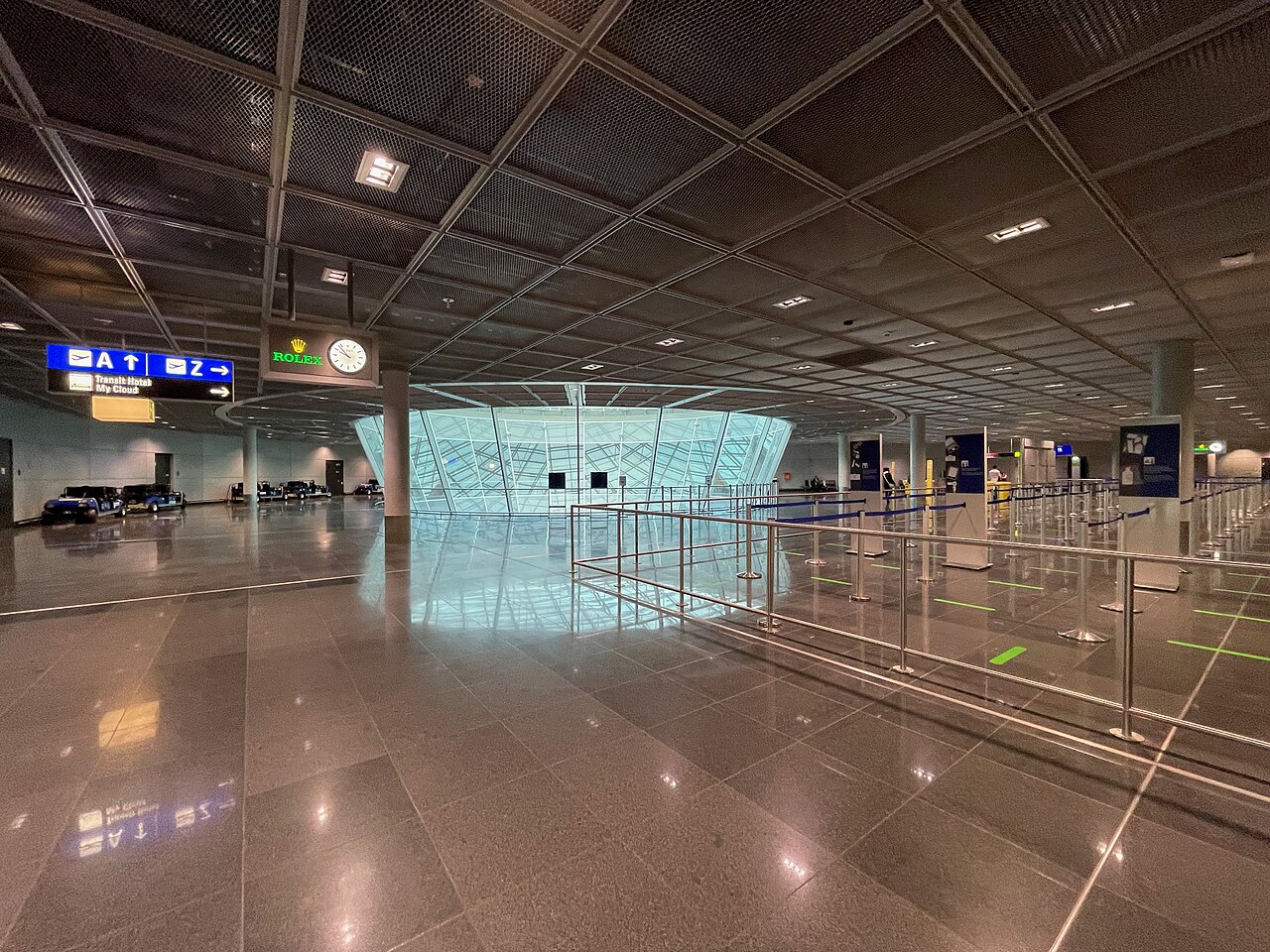
Yet silencing the central speakers created a secondary crisis: traveler anxiety. When passengers cannot hear general announcements, they cluster anxiously around visual display monitors, blocking corridor traffic and creating bottlenecks at check-in desks. Passengers who wear noise-canceling headphones to block out concourse stress routinely miss gate changes, while travelers who rely on hearing aids find themselves stranded between muddy loudspeaker reverberations and unamplified ambient noise.
The deployment of Auracast at Frankfurt Airport's Terminal 1 Gates A16 and A17, followed by Munich Airport's Pier A and Terminal 2 gates, demonstrates that the solution is not choosing between deafening volume and absolute silence. Instead, the solution lies in personalizing public acoustic space.
By routing speech from the airport's automated announcement platform directly into digital transmitters mounted inside gate paging consoles, announcements bypass the physical air entirely. The traveler sitting eighty meters away at a coffee shop hears the gate agent's voice with the pristine intimacy of a studio podcast, rendered directly inside their personal earbuds with zero acoustic distortion and zero terminal reverberation.
🔒 Why Twenty-Five Years of Bluetooth Trapped Us in One-to-One Pairing
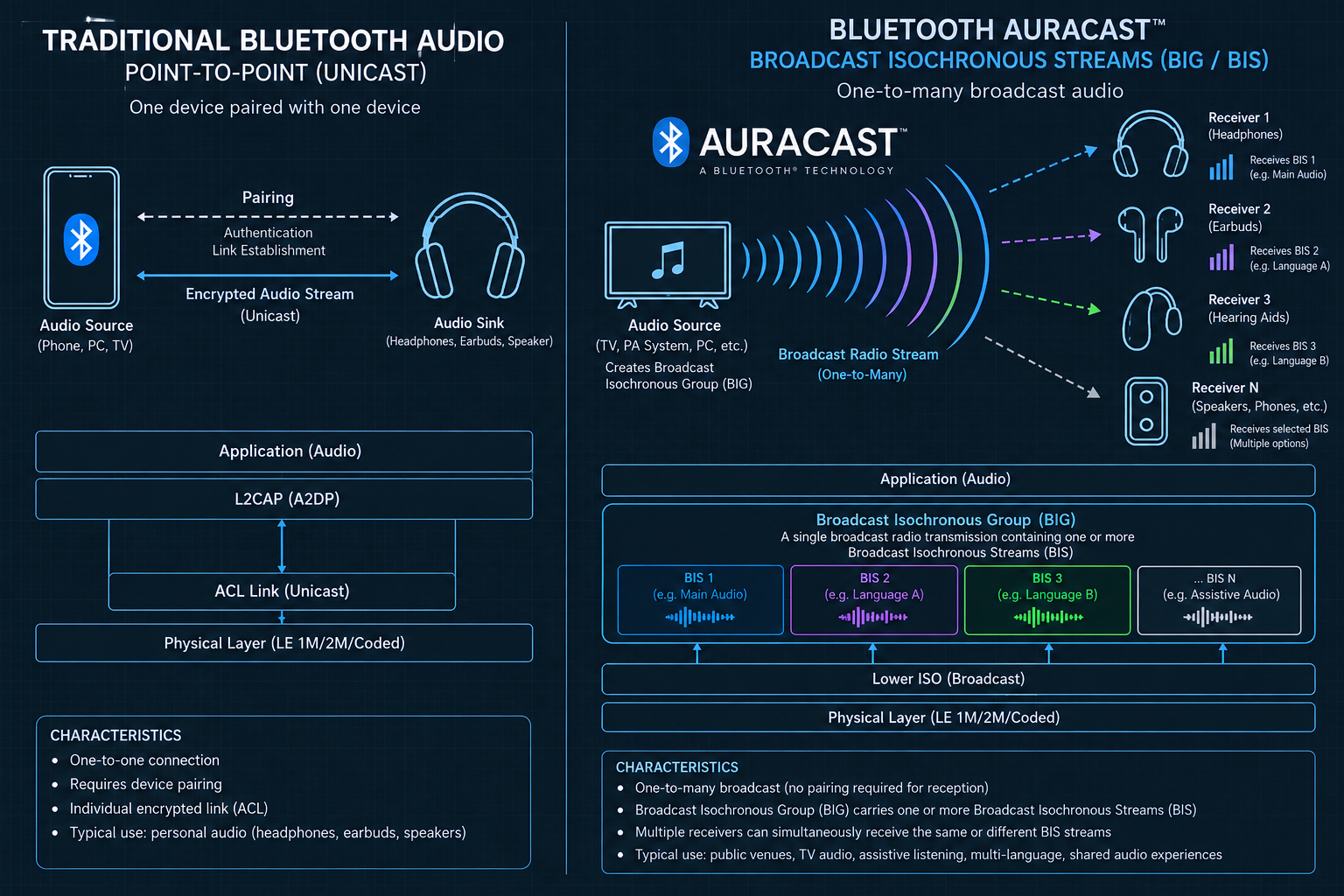
To appreciate why public broadcast audio did not arrive fifteen years ago, we must examine how classic Bluetooth was constructed. When the Bluetooth Special Interest Group ratified the original standard in the late 1990s, the technology was conceived around a single metaphor: the virtual cable.
Classic Bluetooth was designed to replace the physical wire running between a computer and a mouse, or between a mobile handset and an ear-hook mono headset. Every layer of the protocol stack reflected this point-to-point philosophy. Before two devices could exchange a single byte of useful data, they had to engage in an elaborate ritual known as pairing.
Classic Bluetooth (Point-to-Point):
[Source Phone] <======== 1-to-1 Paging & Link Key ========> [Single Earbuds]
                      (Exclusive, Heavy Handshake)

Bluetooth Auracast (One-to-Many):
[Gate Transmitter] ====>> Periodic Isochronous Stream =====>> [Earbuds A]
                   ====>> Periodic Isochronous Stream =====>> [Hearing Aid B]
                   ====>> Periodic Isochronous Stream =====>> [Smartphone C]
                      (Unidirectional, Unlimited Sinks)
During classic pairing, the transmitter and receiver execute an inquiry scan, perform link-key derivation, negotiate security parameters, and establish an exclusive frequency-hopping channel hopping across seventy-nine 1-megahertz channels. Once paired, the relationship is strictly monogamous. The source device becomes the master, the audio accessory becomes the slave, and every single packet sent over the Advanced Audio Distribution Profile requires an explicit link-layer acknowledgment.
If a packet arrives corrupted or collides with ambient Wi-Fi traffic, the receiving earbud sends a negative acknowledgment, prompting the source to retransmit the missing packet. While this acknowledgment loop guarantees reliability for private music playback, it completely collapses when applied to a public audience.
Imagine an airport departure lounge with two hundred travelers waiting to board a flight to Singapore. If a gate transmitter attempted to connect to those two hundred passengers using classic Bluetooth pairing, the radio spectrum would instantly disintegrate. The transmitter would have to establish two hundred separate encrypted connections, maintain two hundred independent clock synchronizations, and process hundreds of thousands of acknowledgment packets every minute. A single interference spike would cause an avalanche of retransmissions, overwhelming the radio buffer and dropping audio connections across the lounge.
Because classic Bluetooth audio was married to bidirectional acknowledgments and exclusive master-slave topologies, true wireless broadcasting remained physically impossible. A public venue could no more broadcast classic Bluetooth audio to a crowd than a television station could establish a separate physical wire to every living room in a city.
⚡ The 20-Millisecond Physics of Isochronous Audio and the LC3 Codec
Breaking free from the virtual cable required reimagining both the radio transport layer and the acoustic compression engine. This breakthrough arrived with the ratification of Bluetooth Low Energy Audio (LE Audio) in the Core Specification Version 5.2, culminating in the Public Broadcast Profile (PBP).
At the core of LE Audio is the concept of Isochronous Channels. In classic Bluetooth, data is either best-effort asynchronous (like file transfers) or synchronous connection-oriented (like low-fidelity telephony voice). Isochronous channels introduce time-bounded data delivery. Audio packets are stamped with an exact time-to-render, allowing transmitters and receivers to coordinate audio reproduction with microsecond precision without requiring a continuous dialogue between them.
Parallel to this radio architecture is the Low Complexity Communication Codec (LC3). For more than two decades, classic Bluetooth audio depended on the Subband Codec (SBC), an aging algorithm from the late 1990s that required high bitrates (typically 328 kilobits per second) to achieve acceptable fidelity, while introducing algorithmic latencies between 100 and 150 milliseconds. When combined with device buffering, classic Bluetooth latency frequently swelled past 200 milliseconds.
In a home living room, a 200-millisecond delay is barely noticeable when listening to recorded music. In an airport terminal, gym, or public auditorium, that same 200-millisecond delay produces an unbearable acoustic catastrophe.
Consider a traveler sitting near a boarding gate. Even if they wear earbuds, low-frequency sound waves from nearby terminal loudspeakers, gate staff voices, and ambient reflections still reach their ear canals naturally. If the digital wireless stream arriving through their earbuds is delayed by 150 milliseconds, their brain perceives two distinct sound events separated by an audible lag. The resulting acoustic clash causes severe echo, vocal doubling, and comb filtering, destroying speech intelligibility.
The Low Complexity Communication Codec resolves this physical barrier by operating on ultra-compact framing intervals of 7.5 or 10 milliseconds. At a bitrate of just 32 kilobits per second per channel, LC3 delivers higher speech clarity and perceptual audio fidelity than legacy SBC at three times the data throughput. Crucially, total algorithmic and transport latency drops into the range of 20 to 30 milliseconds.
Because human psychoacoustics cannot distinguish audio arrivals separated by less than 30 milliseconds as separate echoes (a psychoacoustic threshold known as the Haas effect), a passenger listening to an Auracast stream perceives the gate agent's amplified voice as perfectly aligned with their direct visual and acoustic cues. There is no disorienting lag, no hollow acoustic hollows, and no cognitive fatigue.
📡 Inside the Public Broadcast Profile: BIG, BIS, and the Architecture of Open Radio
To broadcast synchronized audio to an unlimited audience without handshakes or acknowledgments, the Bluetooth SIG created an elegant two-tier logical structure: the Broadcast Isochronous Group (BIG) and the Broadcast Isochronous Stream (BIS).
Within an Auracast transmitter, the incoming audio signal (whether derived from an analog microphone, an IP paging console, or an automated digital text-to-speech engine) is digitized and fed into independent LC3 encoding instances. Each logical audio stream forms a Broadcast Isochronous Stream.
For a standard airport gate announcement, the transmitter creates a single mono BIS or two synchronized stereo streams (left and right channels). Multiple streams sharing a common time base are then bound together into a single Broadcast Isochronous Group.
Isochronous Transmission Hierarchy:
+=============================================================+
| Broadcast Isochronous Group (BIG)                           |
|  +=======================================================+  |
|  | BIS 1: English Gate Audio (Standard Quality, LC3)     |  |
|  +=======================================================+  |
|  | BIS 2: German / Multilingual Gate Audio (LC3)         |  |
|  +=======================================================+  |
|  | BIGInfo: Isochronous intervals, subevents, bursts     |  |
+=============================================================+
The fundamental magic of a BIS is that it operates strictly downstream. The transmitter broadcasts isochronous packet data bursts over forty physical 2.4-gigahertz radio channels using pseudo-random channel hopping sequences. Crucially, the transmitter never listens for an acknowledgment. It does not know whether three people or thirty thousand people are tuned in, and its power consumption remains completely identical regardless of listener density.
To allow receiving devices to find and lock onto these audio packets, the transmitter broadcasts two vital control structures:
- The Basic Audio Announcement (BASE): Transmitted via periodic advertising trains, the BASE defines the codec configuration, sampling frequency (such as 16 kHz or 24 kHz for Standard Quality voice, or 48 kHz for High Quality audio), frame duration, channel allocation, and presentation delay.
- The BIGInfo Descriptor: Embedded directly inside the Periodic Advertising with Response (PAwR) protocol, BIGInfo gives receiving radios the exact mathematical timetable: the hopping interval, subevent offsets, payload sizes, and encryption status.
Under the Public Broadcast Profile (PBP) assigned with Service UUID 0x1856, transmitters operating in public spaces are bound by strict interoperability rules. They must broadcast an unencrypted Standard Quality (SQ) stream using 16 or 24 kilohertz sampling rates, guaranteeing that even power-constrained hearing aids can decode the announcement without exhausting their micro-batteries. If the venue chooses, it may simultaneously broadcast a parallel High Quality (HQ) 48 kilohertz stereo stream for high-end consumer headphones within the same BIG.
Because receiver radios synchronize directly to the BIGInfo timing grid, tuning into an Auracast channel is functionally identical to tuning a car stereo into an FM radio station. The listener's device passively intercepts the radio bursts, reconstructs the audio buffer, and decodes the speech. No pairing code is exchanged. No device address is logged. Complete listener privacy is preserved by physical design.
🏛️ Retiring the 1938 Telecoil: A Massive Leap for 1.5 Billion People
While tech enthusiasts view Auracast as a convenient way to share a playlist or listen to a silent airport screen, for the global audiology community, Auracast represents the most transformative assistive listening advance in nearly ninety years.
Since 1938, the primary technology for transmitting direct audio into hearing aids has been the telecoil, commonly known as a T-coil. A telecoil is an ultra-fine copper wire wrapped around a metallic core inside a hearing aid. When an auditorium, theater, or airport counter installs an induction loop (a literal physical copper cable running around the perimeter of the room or under the carpeting) and pumps amplified audio current through it, the cable generates an electromagnetic field that induces a tiny electrical current inside the hearing aid's telecoil.
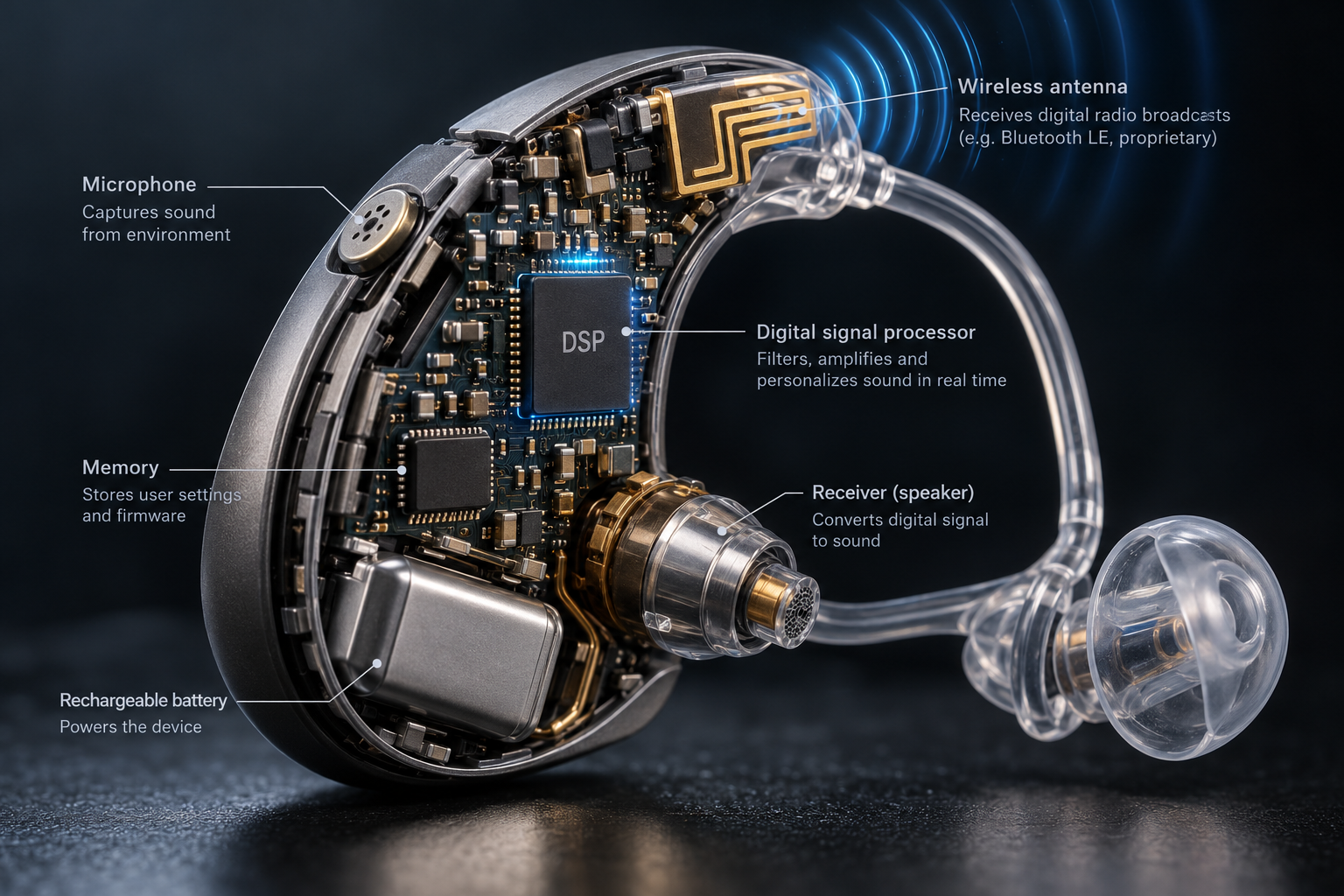
While induction loops provided an invaluable lifeline for millions of individuals with severe hearing loss throughout the twentieth century, the technology suffers from profound physical liabilities:
- Immense Installation Expense: Retrofitting a copper induction loop under existing marble flooring or security checkpoints at an international airport costs tens of thousands of dollars per gate, often requiring structural disruption.
- Electromagnetic Interference: Because telecoils operate purely on low-frequency electromagnetic induction, they pick up stray fields from electrical conduits, fluorescent light ballasts, subway third rails, and elevator motors, producing a relentless 50-hertz or 60-hertz background hum.
- Magnetic Spillover: Electromagnetic fields cannot be contained by architectural walls. An induction loop at Gate A16 spills its magnetic field into Gate A17, causing cross-talk where a passenger hears boarding calls for two completely different flights simultaneously.
- Monophonic, Low-Fidelity Audio: Telecoil systems are strictly analog and monophonic, cutting off sharply above 5 kilohertz and offering no capability for stereo separation or dynamic language selection.
Auracast eliminates every single one of these physical bottlenecks in one stroke. Because it operates in the digital 2.4-gigahertz radio band with sophisticated CRC error checking and frequency hopping, it is entirely impervious to electrical hum and mains interference.
Because radio propagation can be precisely tuned through transmitter power attenuation, airport engineers can limit an Auracast gate cell to a crisp twenty-meter radius around the boarding desk, preventing signal spillover into neighboring departure gates.
Most critically, Auracast enables multichannel audio within the same physical footprint. A single transmitter can broadcast English on BIS 1, German on BIS 2, and Japanese on BIS 3. A passenger selecting Gate A16 can choose their native language from their smartphone screen, receiving high-fidelity digital audio rendered directly by their hearing aid processor.
🛫 Frankfurt and Munich: What Happens When an Airport Goes Truly Silent
Theory became operational reality in January 2026, when Fraport AG launched the world's first live airport Auracast deployment at Frankfurt Airport's Terminal 1.
Rather than tearing up terminal floors or deploying racks of expensive new audio servers, project lead Sittig Technologies integrated Auracast transmitters directly into their existing PAXModular IP paging stations. These compact hardware units were already installed at every boarding gate to manage agent microphones and digital display feeds.
By incorporating Auracast transmitters into the existing IP hardware, automated announcements generated by Frankfurt's PAXGuide central flight information system are fed simultaneously into the physical gate speakers and the wireless Auracast broadcast. Gate agents making manual boarding calls simply speak into their standard gooseneck microphone; the audio is digitized, encoded via LC3, and beamed instantaneously over the concourse.
Following Frankfurt's successful proof of concept, Munich Airport rolled out Auracast across six departure gates in July 2026, targeting Pier A gates (A42 to A45) in Terminal 1 and Gates G31 and G32 in Terminal 2. Munich paired the radio rollout with visible signage featuring dynamic QR codes printed on gate information totems and boarding podiums.
The behavioral impact inside the test gates was immediate. Travelers with Auracast-compatible consumer earbuds (including modern Samsung Galaxy Buds, Google Pixel Buds, and high-end Sony and Sennheiser headphones) were able to listen to music or watch video streaming on their personal tablets without fearing they would miss their boarding call. When a priority boarding announcement was triggered, the Auracast stream cleanly broke through or blended into their audio stream, delivering crystal-clear instructions.
For travelers wearing prescription hearing aids developed by GN Hearing and Cochlear, the difference was profound. Rather than straining to decipher garbled loudspeaker announcements bouncing off glass boarding bridges, the spoken instructions appeared directly inside their auditory canal with pristine clarity.
📱 The Smartphone as Broadcast Assistant: QR Codes, Pins, and Frictionless Tuning
One of the most elegant architectural decisions in the Bluetooth LE Audio specification is the separation between the audio sink and the broadcast assistant.
Earbuds and hearing aids are physically tiny devices. They do not possess graphical user interfaces, touchscreens, or keyboards. How, then, does a traveler sitting at a busy airport terminal instruct their tiny wireless earbuds to tune into Gate A16 instead of the airport sports bar next door?
The solution is the Broadcast Assistant profile, implemented inside the user's smartphone operating system. Modern Android releases (from Android 13 onward) and the latest iOS platforms include native Auracast Assistant capabilities.
The connection workflow requires zero manual Bluetooth pairing and zero link negotiation:
Broadcast Assistant Tuning Flow:
1. User scans QR code at Gate A16 using smartphone camera
   (or opens Settings -> Bluetooth -> Find Broadcasts)
2. Smartphone scans Bluetooth Extended Advertisements (Service UUID 0x1856)
3. Smartphone retrieves BASE parameters and BIGInfo timing table
4. Smartphone instructs connected Earbuds/Hearing Aids via BASS (Broadcast Audio Scan Service)
5. Earbuds directly synchronize radio receiver to Gate A16 BIS stream
6. Audio plays instantly with microsecond synchronization
Because the smartphone acts purely as a remote control, it does not retransmit or proxy the audio data itself. The heavy lifting of receiving and decoding the radio packets is handled directly by the Bluetooth chipset inside the earbuds or hearing aid. Once synchronized, the traveler can turn off their smartphone or put it in their pocket; the earbuds continue to receive the gate broadcast uninterrupted.
For venues requiring access control (such as a museum charging admission for an audio tour or a gym requiring membership to tune into television monitors), Auracast provides an optional Broadcast Code. The broadcast assistant prompts the user for a four-to-sixteen-character PIN, derives the decryption key locally, and hands it securely to the earbuds, allowing encrypted private broadcasts to run over the identical open radio architecture.
🌐 The Shared Acoustic Future of Public Architecture
The commercialization of Auracast across international aviation hubs signals a much wider transition in how modern society conceives public acoustic space.
For more than a century, public communication was defined by the loudspeaker: a shared acoustic wave forced upon everyone within physical earshot, whether they wanted to hear it or not. The digital age initially fractured that shared space into total acoustic isolation, as millions retreated into private headphone bubbles.
Auracast constructs a bridge between those two extremes. It offers the collective shared experience of public radio combined with the precision, clarity, and autonomy of personal audio.
In the coming decade, as LE Audio silicon becomes universal across consumer hardware, this architecture will redefine everyday environments:
- Gyms and Sports Bars: Hundreds of patrons can watch dozens of overhead screens simultaneously, tuning their personal earbuds to whichever game or commentary they prefer without blaring background noise.
- Multilingual Auditoriums and Houses of Worship: A live speaker's words can be simultaneously translated into five languages, each streamed on an independent BIS channel within the same room, eliminating clumsy rented headset systems.
- Public Transit and Train Platforms: Commuters waiting for delayed trains can receive localized carriage announcements directly through their headphones while listening to podcasts.
- Museums and Art Galleries: Visitors can walk freely through an exhibition hall, with their broadcast assistant automatically handing off audio narration from one gallery transmitter to the next based on proximity.
The era of shouting into the concourse is coming to a close. As airports from Frankfurt to Munich demonstrate, the future of public sound is quiet, personalized, and universally accessible. Through an open radio stream ticking twenty milliseconds at a time, the physical world is finally learning to speak directly to our ears.
Sources: Bluetooth Special Interest Group (Bluetooth SIG) LE Audio Specifications and Public Broadcast Profile; Fraport AG Press Office; Sittig Technologies PAXGuide Architecture Documentation; GN Hearing Accessibility Research.