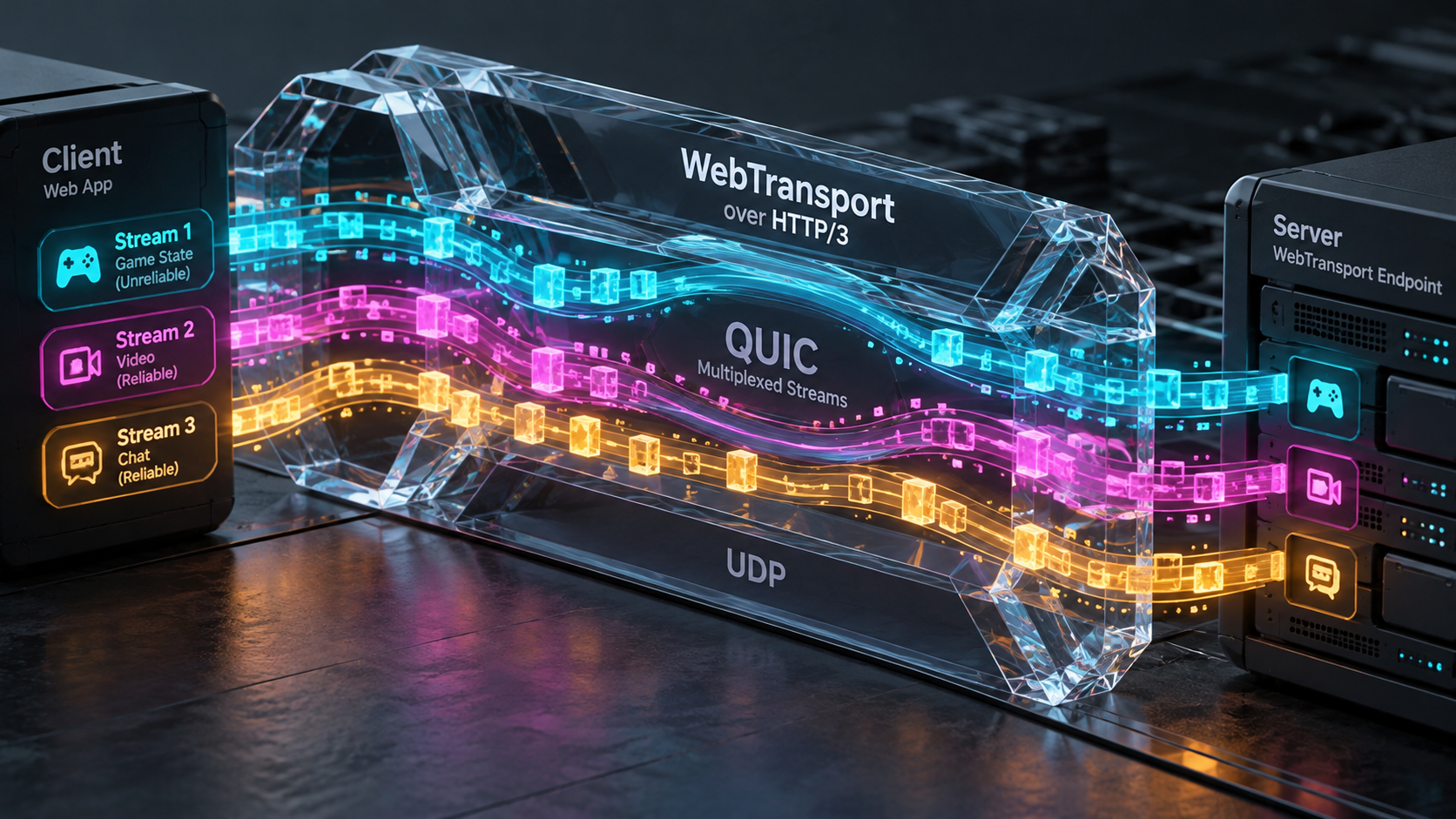
For fifteen years, the interactive web has operated on a convenient collective fiction. When you drag a shared cursor across a Figma canvas, place a bid in an online auction, or send a message in a team chat, the application feels immediate and responsive. The interface presents a smooth illusion of real-time presence. Underneath that interface, however, almost every modern collaborative tool has relied on a protocol standardized in December 2011: WebSockets, codified under RFC 6455. WebSockets did something revolutionary for its era. It liberated web developers from the agonizing inefficiencies of HTTP polling and long-held Comet connections, providing a persistent, full-duplex transmission channel over a single socket.
Yet WebSockets inherited a fatal architectural compromise from the foundation upon which it was constructed. It runs exclusively over Transmission Control Protocol (TCP). TCP was engineered in an era of wired copper cables, telnet terminals, and bulk file transfers. Its core promise is total, uncompromising reliability through strict in-order byte stream delivery. If an application sends bytes A, B, and C, the operating system kernel on the receiving end will refuse to deliver byte B or byte C to user space until byte A has been received and verified intact.
On a flawless fiber-optic desktop connection, this contract goes unnoticed. But modern software does not run on flawless fiber-optic desktops. It runs on smartphones riding underground commuter trains, tablets switching between hotel Wi-Fi access points, and laptops connected over congested cellular networks. In those real-world environments, packets drop routinely. And when a single TCP packet drops on a WebSocket connection, the entire interactive illusion shatters. Every independent stream of data flowing through that connection halts dead in its tracks. A critical text message, a document edit, or a video keyframe must sit frozen in the kernel buffer, waiting for the retransmission of an obsolete cursor coordinate that was sent forty milliseconds ago and no longer matters to anyone.
This architectural paralysis is known as Head-of-Line (HoL) blocking. For more than a decade, software engineers treated it as an unavoidable law of internet physics. Teams built increasingly baroque client-side workarounds, maintained parallel connection pools, or wrestled with the crushing infrastructure complexity of WebRTC data channels.
Now, that compromise has reached its expiration date. With the formalization of WebTransport over HTTP/3 by the World Wide Web Consortium (W3C) as a Candidate Recommendation and its standardization within the Internet Engineering Task Force (IETF), the web platform is quietly undergoing its most significant transport-layer transition in two decades. By discarding TCP in favor of QUIC over UDP, WebTransport solves the fundamental friction of real-time computing. It allows developers to interleave reliable multiplexed streams alongside completely unreliable, out-of-order datagrams over a single encrypted connection. The era of the monolithic WebSocket pipe is coming to an end.
⚡ The Illusion of Instantaneous Speed on an Aging Pipe
To understand why WebSockets became a bottleneck, one must look closely at how the web platform handled real-time communication before its arrival. In the late 2000s, building an interactive web application was an exercise in aggressive deception. Because HTTP/1.1 was fundamentally a half-duplex request-response protocol, a client had to initiate every single exchange. If a server had new data to push, such as a new chat message or a stock price update, it had no native mechanism to reach out to the browser.
Developers resorted to hack after hack. Periodic polling bombarded servers with empty HTTP GET requests every two seconds, generating enormous header overhead and wasting mobile battery life. Long polling kept HTTP requests hanging open until the server had data, only to close the connection and immediately force the browser to initiate a new handshake. Techniques like Forever Frames and Comet streaming exploited hidden iframe elements and multipart MIME responses to trickle data continuously down an open connection. Each of these tricks consumed valuable server threads, bloated network traffic with redundant HTTP cookie headers, and suffered from unpredictable proxy buffering.
When RFC 6455 standardized WebSockets in December 2011, it felt like magic. A browser could issue a standard HTTP GET request with an Upgrade: websocket header. Once the server responded with an HTTP 101 Switching Protocols status code, the underlying TCP connection was hijacked and transformed into a bidirectional, full-duplex conduit. The protocol framed data with a lightweight two-to-ten byte header, doing away with the repetitive megabytes of cookie and caching headers that accompanied standard HTTP requests.
For simple client-server interactions, WebSockets delivered everything it promised. Chat rooms, live dashboards, and push notifications flourished across the internet. The entire modern software-as-a-service landscape was erected upon this single architectural primitive. Frameworks like Socket.io and native browser WebSocket APIs became standard toolkit entries for every frontend and fullstack developer.
The single-socket paradigm, however, imposes severe structural constraints during network packet loss:
- Packet 1 (Chat Message): Reliable in-order delivery. Status: Delivered directly to the web application.
- Packet 2 (Mouse Coordinates): Ephemeral transient stream. Status: Delivered directly to the web application.
- Packet 3 (Document Edit): Critical state transaction. Status: Dropped in transit by a congested Wi-Fi router.
- Packet 4 (Audio Telemetry): Real-time fresh-or-nothing data. Status: Frozen inside the operating system kernel buffer behind Packet 3.
However, as browser applications evolved from simple text messaging into rich, real-time operating environments, the demands placed upon that single socket exploded. Modern web applications do not send one category of data; they send dozens of competing streams simultaneously. A digital whiteboard like Miro or Figma streams live mouse cursor positions from twenty collaborators, vector shape transformation coordinates, presence indicators, real-time audio telemetry, and transactional document state changes that must be persisted to a database.
Under WebSockets, all of these heterogeneous data streams are forced through a single TCP byte stream. This means every piece of data inherits the identical delivery semantics: strict, sequential, guaranteed ordering. If a user moves their mouse rapidly across the screen, the application emits dozens of coordinate packets per second. If packet number 42 is dropped by an over-saturated Wi-Fi router, the TCP stack refuses to deliver packets 43, 44, or 45 to the web application until packet 42 is successfully retransmitted.
The tragedy is that packet 42 is completely worthless by the time it arrives. The user's cursor has already moved to the coordinates in packet 45. Yet, because TCP cannot distinguish between an ephemeral mouse coordinate and an unalterable financial transaction, it holds the entire pipeline hostage. In severe network conditions, this causes visible interface stutter, audio crackling, and input lag. The user experiences the application as slow or buggy, unaware that the real culprit is an architectural mismatch fifty years in the making.
🛑 The Invisible Freeze of Head-of-Line Blocking
The technical term for this phenomenon, Head-of-Line blocking, describes any queue where the head item prevents all subsequent items from moving forward. In networking, Head-of-Line blocking exists at multiple layers of the Open Systems Interconnection (OSI) model, but its manifestation in TCP is particularly insidious.
TCP achieves reliability through sequence numbers and cumulative acknowledgments. Every byte transmitted across a TCP connection is assigned a sequential 32-bit sequence number. The receiver's operating system maintains a sliding window buffer. As segments arrive, the receiver verifies their checksums and places them in order. If segment 10 arrives, followed by segment 12, the receiving kernel acknowledges receipt up to byte 10. Segment 12 is placed into a reassembly buffer, but it cannot be read by the application. The TCP stack will not trigger a readable event on the socket until segment 11 arrives.
- Step 1: Sender emits Seq 10. Result: Arrives intact and is delivered directly to user space.
- Step 2: Sender emits Seq 11. Result: Dropped in transit due to transient radio interference.
- Step 3: Sender emits Seq 12. Result: Arrives intact but is held frozen in kernel reassembly buffer.
- Step 4: Sender emits Seq 13. Result: Arrives intact but is held frozen in kernel reassembly buffer.
To recover segment 11, the sender must wait for either a retransmission timeout (RTO) or three duplicate acknowledgments (Fast Retransmit). On a typical wireless connection with a round-trip time (RTT) of 60 milliseconds, this recovery process consumes anywhere from 80 to 250 milliseconds. During that quarter-second interval, the browser application receives absolute silence from the socket.
When the lost segment finally arrives, the kernel drains its reassembly buffer all at once. The web application receives a sudden, bursty firehose of queued data: segment 11, segment 12, and segment 13 arrive simultaneously in a single turn of the event loop. The visual result on screen is familiar to anyone who has used web collaboration software on a mobile connection: a collaborator's cursor freezes for half a second, then teleports abruptly across the screen.
In high-concurrency systems, the impact of Head-of-Line blocking compounds exponentially. Consider a multi-tenant cloud application where a single WebSocket connection multiplexes messages across multiple logical channels. If one channel experiences high throughput and drops a packet, every unrelated channel on that connection is stalled.
The mathematical reality of packet loss makes this problem unavoidable. On typical cellular networks (4G LTE and 5G mid-band), transient packet loss rates between 0.5% and 2.5% are completely standard. They do not indicate a broken connection; they are normal consequences of radio interference, multipath fading, and cell tower handoffs. If an application sends 100 WebSocket messages per second over a connection with a 1% packet loss rate, the user will experience an average of one Head-of-Line blocking stall every single second. Under TCP, reliability and latency are in direct, zero-sum opposition.
🧱 Why Fifteen Years of WebSocket Hacks Hit a Wall
Software engineers are nothing if not resourceful, and the history of real-time web development over the past decade can be read as a catalog of increasingly desperate attempts to bypass TCP's inherent rigidity.
The most straightforward workaround was opening multiple parallel WebSocket connections. If an application required both low-latency cursor tracking and reliable document synchronization, the engineering team simply opened two distinct WebSocket sockets: one dedicated to ephemeral presence updates, and one dedicated to critical state changes. If the presence connection suffered a dropped packet and froze, the document state connection could theoretically continue unimpeded.
In practice, this pattern introduced severe operational penalties:
- Resource Exhaustion on the Client: Every active WebSocket connection requires its own TCP control block, transmission buffers, receive buffers, and TLS cryptographic context. On mobile devices, maintaining five or six active WebSocket sockets significantly accelerates battery drain and memory pressure.
- Connection Limits and Middlebox Interference: Web browsers strictly limit the number of simultaneous persistent connections they will establish to a single origin. Furthermore, network middleboxes, corporate proxies, and mobile carrier gateways frequently terminate or aggressively throttle multiple persistent connections originating from the same device.
- Server-Side File Descriptor Starvation: On the backend, supporting tens of thousands of concurrent users becomes twice or three times as expensive. Each client that opens three WebSocket connections consumes three separate TCP sockets, tripling the number of open file descriptors, epoll registrations, and memory allocations required by the server infrastructure.
- Lack of Global Congestion Control: Multiple parallel TCP sockets do not cooperate; they compete against each other for the user's available bandwidth. When network congestion occurs, both sockets back off independently, often exacerbating packet loss and jitter rather than resolving it.
Recognizing the limits of multiple WebSockets, ambitious engineering teams turned to the only other low-latency protocol available in browsers: WebRTC.
The operational hurdles of deploying WebRTC for client-server communication are formidable:
- Signaling Overhead: Requires an external WebSocket or HTTP server to negotiate peer connections.
- NAT Traversal Burdens: Demands STUN server queries and costly TURN relay servers when symmetric corporate NATs block direct paths.
- Session Handshake Complexity: Enforces multi-step Session Description Protocol (SDP) offer and answer exchanges before data can flow.
- Non-Standard Backend Architecture: Requires specialized media gateway servers capable of terminating SCTP over DTLS over UDP, bypassing standard web reverse proxies.
WebRTC was created for peer-to-peer audio and video calling, but its RTCDataChannel API offered an intoxicating capability: it allowed developers to send data over UDP using the Stream Control Transmission Protocol (SCTP) wrapped inside Datagram Transport Layer Security (DTLS). RTCDataChannel could be configured for unreliable, unordered delivery. If a packet dropped, it was simply discarded, eliminating Head-of-Line blocking entirely.

However, adopting WebRTC to solve client-server data transfer was akin to buying an entire airport just to park a car. WebRTC is notoriously complex:
- Signaling Complexity: WebRTC provides no native mechanism to initiate a connection. Developers must build a separate signaling channel to exchange Session Description Protocol (SDP) offers and answers.
- NAT Traversal Overhead: WebRTC assumes a peer-to-peer topology. Establishing a connection requires Interactive Connectivity Establishment (ICE), querying STUN servers to discover public IP mappings, and falling back to costly TURN relays when symmetric NATs block direct communication.
- Server Architecture Mismatch: Traditional web servers (NGINX, Envoy, Node.js, Go) were built to handle HTTP and TCP sockets. Terminating thousands of SCTP-over-DTLS-over-UDP WebRTC data channels on a centralized backend requires specialized, fragile media-server infrastructure that few engineering organizations have the resources to build and maintain.
For nine out of ten development teams, WebRTC was simply too complex, too brittle, and too expensive. The web remained trapped in a binary dilemma: tolerate the latency spikes of WebSockets, or drown in the operational complexity of WebRTC.
🚀 How QUIC and HTTP/3 Reinvented Network Streams
The breakthrough that liberated the web from this trap did not begin in the application layer; it began at the transport layer. In 2012, engineers at Google began experimenting with an experimental protocol named Quick UDP Internet Connections (QUIC). The goal was ambitious: rebuild the transport foundation of the internet from scratch, replacing TCP with a modern, encrypted-by-default, multiplexed protocol running over user-space UDP.
After years of real-world deployment across Google services and rigorous debate within the IETF, QUIC was formally standardized in May 2021 as RFC 9000, accompanied by HTTP/3 in RFC 9114.
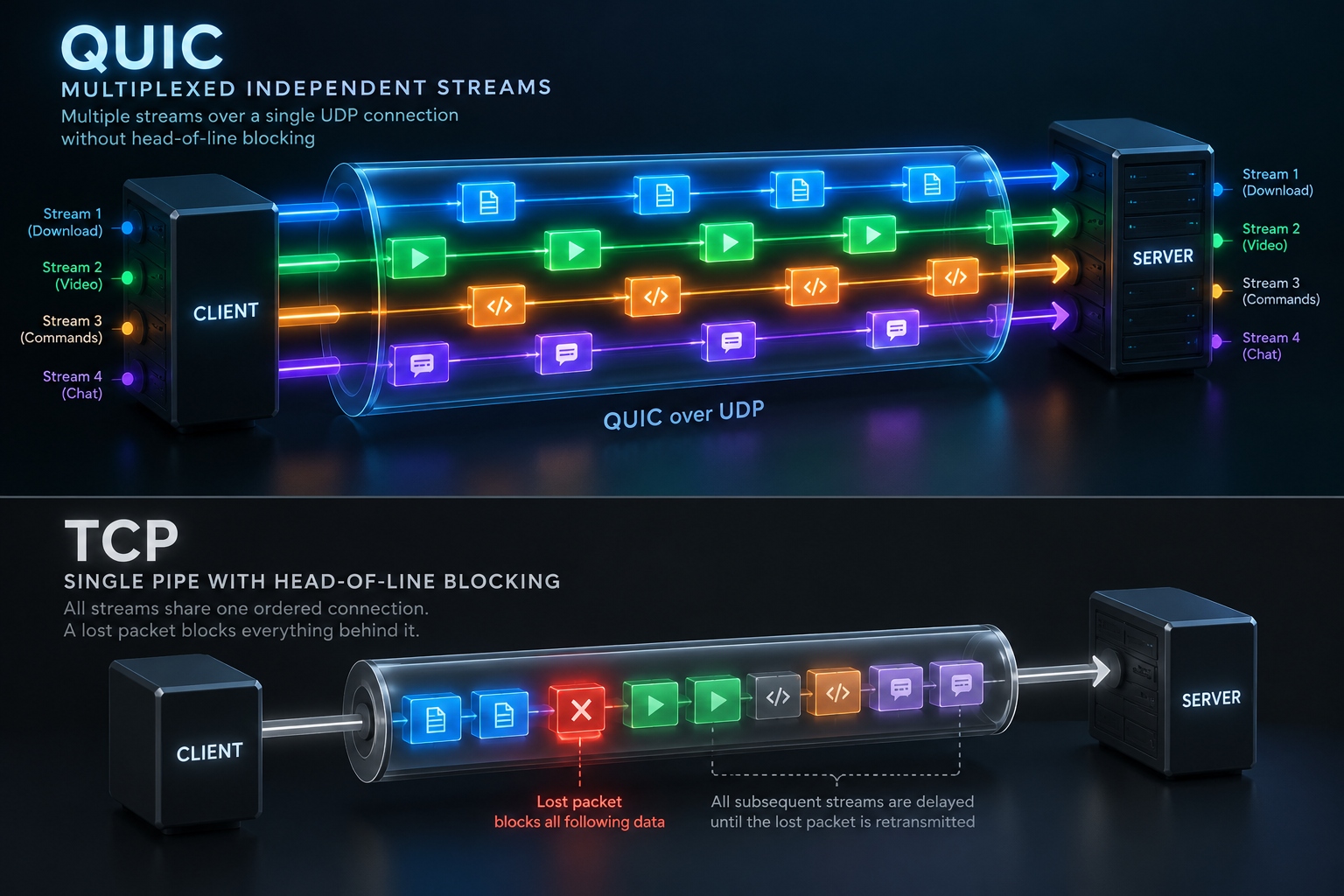
QUIC fundamentally rethinks how connections and streams relate to each other. In TCP, the connection and the stream are the exact same thing: a single, monolithic sequence of bytes. In QUIC, the connection is merely an encrypted container that negotiates keys and manages congestion, while individual streams are lightweight, independent logical entities multiplexed inside that container.
The independence of logical streams under QUIC alters how packet loss affects the application:
- Stream 1 (Team Chat): Transmits Frame 1, Frame 2, and Frame 3. State: Delivered immediately to the chat view.
- Stream 2 (Document Edit): Transmits Frame 1, drops Frame 2, and transmits Frame 3. State: Only Stream 2 pauses to await retransmission of Frame 2.
- Stream 3 (Presence Telemetry): Transmits Frame 1, Frame 2, and Frame 3. State: Delivered immediately without waiting for Stream 2.
Because each QUIC stream maintains its own independent sequence numbering and flow control, Head-of-Line blocking across streams is physically impossible. If Stream 2 drops a packet, the receiving QUIC stack halts delivery only for Stream 2. Stream 1, Stream 3, and every other stream operating over that same connection continue delivering data to user space without a single microsecond of hesitation.
Furthermore, QUIC embeds Transport Layer Security (TLS 1.3) directly into its transport handshake. Where a standard HTTPS or secure WebSocket connection requires a TCP three-way handshake followed by a multi-round-trip TLS negotiation, QUIC combines cryptographic key exchange and transport parameter negotiation into a single round trip. On repeat visits, QUIC supports Zero Round-Trip Time (0-RTT) connection resumption, allowing a client to send encrypted application payload data in its very first packet.
With QUIC established as the bedrock of HTTP/3, the missing piece was a clean, native browser API that exposed these low-level capabilities directly to JavaScript without the baggage of standard HTTP request-response semantics. That API is WebTransport.
📦 The Ephemeral Freedom of WebTransport Datagrams
WebTransport, specified by the W3C WebTransport Working Group and the IETF WEBTRANS Working Group, is the direct architectural successor to WebSockets. It is not an incremental patch to RFC 6455; it is an entirely new communication primitive designed specifically to harness the multiplexed power of HTTP/3 and QUIC.
Where a WebSocket object offers only a single send() method and a single onmessage event handler, a WebTransport instance exposes three distinct delivery mechanisms over a single connection:
- **Bidirectional Streams (
createBidirectionalStream)**: Reliable, ordered, two-way channels. Either the client or the server can initiate a stream. Data written to the stream is guaranteed to arrive intact and in sequential order within that specific stream, but it will never block any other stream on the connection. - **Unidirectional Streams (
createUnidirectionalStream)**: Reliable, ordered, one-way channels. Ideal for fire-and-forget uploads such as sending telemetry snapshots, file chunks, or logging beacons, as well as server-to-client broadcasts. - **Datagrams (
datagrams)**: Unreliable, unordered, lightweight message packets. A datagram is sent as an independent UDP packet capped at the network path Maximum Transmission Unit (MTU), typically around 1,200 to 1,400 bytes. Datagrams do not retransmit upon packet loss and do not enforce arrival ordering.
// Minimal WebTransport initialization in modern browsers
const transport = new WebTransport("https://realtime.example.com:443/wt");

// Wait for the secure QUIC handshake to complete
await transport.ready;

// 1. Sending an Ephemeral Datagram (Fresh-or-Nothing)
const datagramWriter = transport.datagrams.writable.getWriter();
const cursorPayload = new Uint8Array([120, 240, 18, 42]);
await datagramWriter.write(cursorPayload);
datagramWriter.releaseLock();

// 2. Opening an Independent Reliable Stream (Does not block datagrams or other streams)
const stream = await transport.createBidirectionalStream();
const streamWriter = stream.writable.getWriter();
const docChange = new TextEncoder().encode(JSON.stringify({ op: "insert", text: "hello" }));
await streamWriter.write(docChange);
streamWriter.releaseLock();
The introduction of native datagrams represents a profound paradigm shift for web application design. In real-time collaborative environments, vast quantities of data are inherently ephemeral. If a user moves their mouse, adjusts a volume slider, or turns their camera in a 3D canvas, only the most recent coordinate matters. If packet loss delays that update by 150 milliseconds, that coordinate is historical waste; the user has already executed three subsequent movements.
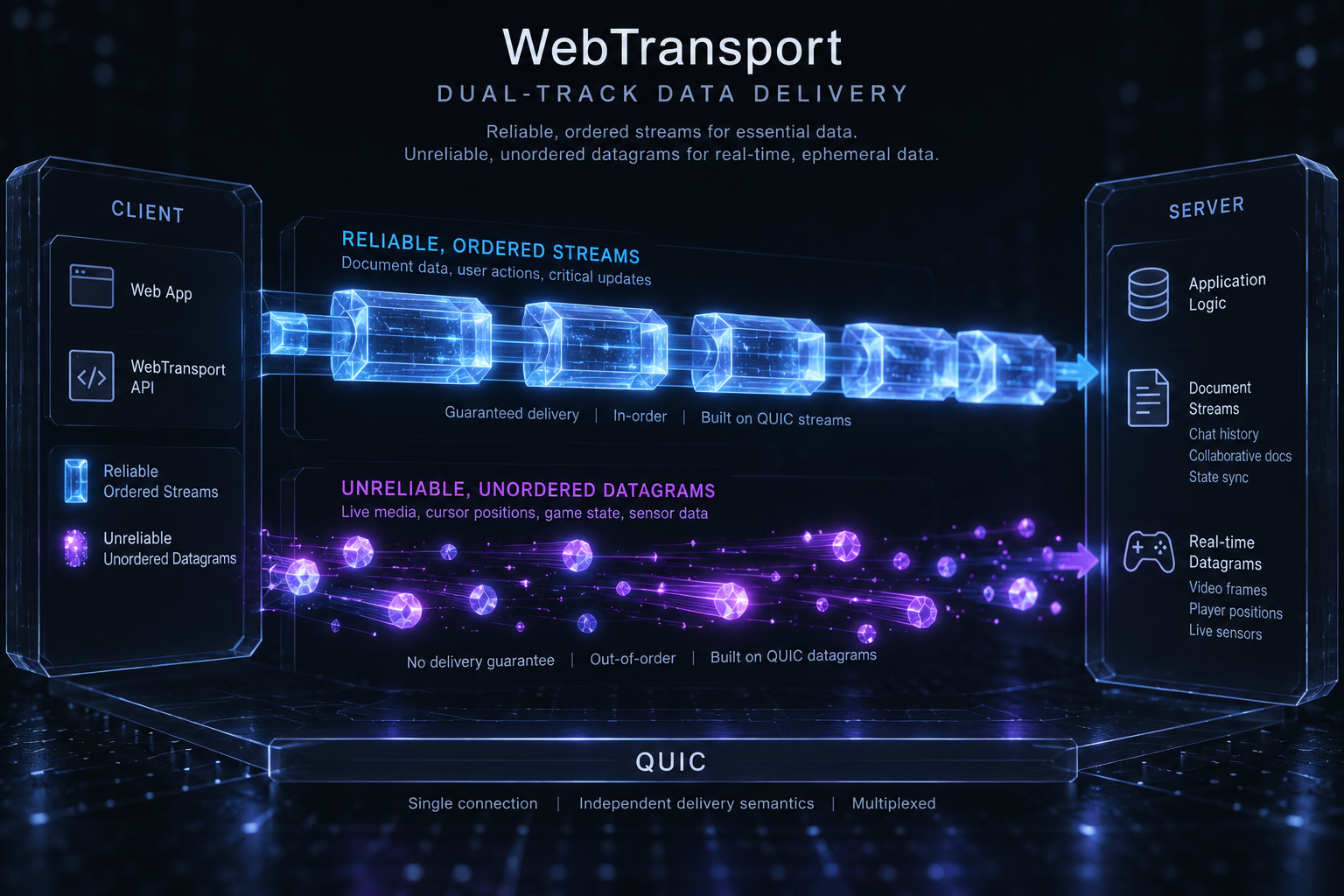
Under WebSockets, developers had no way to express this ephemerality. Every mouse move had to be guaranteed and delivered sequentially. With WebTransport datagrams, an application sends fresh coordinates as unacknowledged datagrams. If a packet drops, the receiver simply ignores it and renders the next packet that arrives. Jitter disappears, interface lag drops to the physical minimum permitted by the speed of light, and the network is spared the burden of pointless retransmissions.
Meanwhile, critical actions that must never be lost, such as saving a document, transferring money, or sending a chat message, are routed through independent reliable streams on that exact same WebTransport session. The application achieves the latency profile of UDP alongside the ironclad reliability of TCP, managed seamlessly by a single unified congestion control engine.
🔄 Surviving Cell Tower Handoffs Without Disconnecting
Beyond eliminating Head-of-Line blocking, WebTransport inherits another transformative architectural capability from QUIC: Connection Migration.
In traditional networking, a TCP connection is immutably defined by a four-tuple: source IP address, source port, destination IP address, and destination port. If any single element of this four-tuple changes, the operating system kernel considers the connection terminated.
Every smartphone user experiences the frustration of this limitation daily. You walk out of your office building while participating in an interactive workspace or watching a live video feed. As you step onto the sidewalk, your smartphone disconnects from the office Wi-Fi network and switches to 5G cellular data. The moment this handoff occurs, your device acquires a completely new IP address.
To a WebSocket connection, this IP change is fatal:
- The operating system sends a TCP RST (reset) packet or simply stops acknowledging incoming packets.
- The browser triggers an
oncloseoronerrorevent on the WebSocket object. - The web application must detect the failure, back off, initiate a brand-new DNS resolution, execute a fresh TCP three-way handshake, complete a TLS negotiation, send an HTTP upgrade request, authenticate the user session from scratch, and replay state.
- During this reconnection dance, which typically takes between two and five seconds, the user is greeted with a modal spinner or a disconnected banner. Any unacknowledged messages sent during the transition are lost or duplicated.
QUIC and WebTransport solve this problem by decoupling connection identity from IP addresses. Instead of relying on the network four-tuple, a QUIC connection is identified by an opaque, cryptographically random 64-bit Connection ID (CID) chosen during the initial handshake.
- Initial State: Connected via Office Wi-Fi (IP 192.168.1.45) with Connection ID 0x8a9f3b12.
- Transition Event: User walks outside; device disconnects from Wi-Fi and associates with 5G cellular.
- New Network State: Connected via 5G Cellular (IP 10.142.78.210) carrying identical Connection ID 0x8a9f3b12.
- Server Verification: Packets arrive from the new cellular IP. Server verifies cryptographic signature and updates its return path instantly with zero socket teardown and zero application disruption.
When your smartphone transitions from Wi-Fi to cellular data, the browser simply emits its next QUIC packet from the new cellular IP address, carrying the existing Connection ID. When the backend server receives this packet, it inspects the Connection ID, verifies the cryptographic authenticity of the packet header, and immediately updates its internal routing table to send return packets to the new cellular IP address.
The transition happens in user space in a matter of milliseconds. The web application experiences zero socket disconnect events, zero state invalidations, and zero interface interruptions. To the end user, the transition is completely invisible. For mobile-first interactive applications, connection migration alone justifies the retirement of WebSockets.
🛠️ What Developers Must Measure Before Abandoning WebSockets
Despite the overwhelming architectural superiority of WebTransport, moving production infrastructure away from WebSockets is not a task to be undertaken blindly. Protocols are engineering compromises, and WebTransport introduces its own set of operational constraints that every engineering team must evaluate before writing migration code.
The most critical barrier remains network middlebox interference with UDP. Because TCP has dominated the public internet for half a century, vast swathes of enterprise firewalls, hotel captive portals, and corporate security gateways are aggressively configured to block or rate-limit outbound UDP traffic on non-standard ports. Many corporate networks permit UDP only for port 53 (DNS) and block everything else to prevent data exfiltration.
- Condition 1 (UDP Port 443 Reachability): Confirm client networks permit outbound UDP on port 443 without throttling.
- Condition 2 (Automated Fallback Pipeline): Establish seamless fallback to WebSockets over TCP when UDP is blocked.
- Condition 3 (Ingress Proxy Readiness): Deploy ingress proxies such as Envoy, Caddy, or Cloudflare with native QUIC support.
- Condition 4 (Certificate Compliance): Maintain valid Web PKI TLS certificates; self-signed certificates require custom fingerprint options.
- Condition 5 (Datagram MTU Discipline): Keep all individual datagram payloads strictly under 1,200 bytes to avoid path fragmentation.
Extensive telemetry from major content delivery networks indicates that approximately 3% to 7% of enterprise and restricted consumer networks actively block UDP traffic on port 443. If an application supports only WebTransport, that fraction of users will simply be unable to connect.
Therefore, the golden rule of modern real-time architecture is dual-stack deployment with automated fallback:
// Robust real-time connection manager with progressive fallback
async function connectRealtimeService(endpointUrl) {
  // Check browser capability first
  if ("WebTransport" in window) {
    try {
      const transport = new WebTransport(endpointUrl);

      // Enforce a strict connection timeout (3.5 seconds)
      const timeoutPromise = new Promise((_, reject) =>
        setTimeout(() => reject(new Error("WebTransport UDP Timeout")), 3500)
      );

      await Promise.race([transport.ready, timeoutPromise]);
      console.info("Connected via WebTransport over HTTP/3 (QUIC)");
      return { type: "webtransport", handle: transport };
    } catch (err) {
      console.warn("WebTransport connection failed or blocked. Falling back to WebSocket.", err);
    }
  }

  // Graceful fallback to legacy WebSocket over TCP
  const wsUrl = endpointUrl.replace(/^https:/, "wss:").replace(/^http:/, "ws:");
  const socket = new WebSocket(wsUrl);
  await new Promise((resolve, reject) => {
    socket.onopen = resolve;
    socket.onerror = reject;
  });

  console.info("Connected via legacy WebSocket over TCP");
  return { type: "websocket", handle: socket };
}
A second critical consideration is backend readiness. Terminating WebSockets is trivial in almost every modern language runtime. In Node.js, Go, Rust, or Python, spinning up a WebSocket server requires a handful of lines of code. Terminating WebTransport over HTTP/3 requires an ingress infrastructure that natively supports QUIC. While modern reverse proxies like Envoy, Caddy, and Cloudflare now offer robust HTTP/3 termination, legacy NGINX deployments and classic cloud load balancers often require significant upgrades before they can handle QUIC streams effectively.
Finally, developers must discipline themselves regarding datagram payloads. Unlike WebSocket frames, which can theoretically span megabytes (though doing so is bad practice), WebTransport datagrams must fit inside the network path MTU. If a developer attempts to write a 4,000-byte datagram to transport.datagrams.writable, the browser will throw an error or the underlying QUIC layer will drop it. Datagrams are strictly intended for compact, bite-sized state updates. Anything larger must be dispatched over a dedicated unidirectional or bidirectional stream.
🌐 The Architectural Foundation of the Post-TCP Web
The standardization of WebTransport marks the formal arrival of the post-TCP web. For fifteen years, the developer community operated under the assumption that the fundamental constraints of browser networking were immutable: if you wanted security and reliable delivery, you accepted TCP's Head-of-Line blocking; if you wanted low latency, you wrestled with WebRTC or built native desktop applications.
WebTransport destroys that false dichotomy. By bringing the multiplexed elegance of QUIC into standard browser JavaScript, it elevates the web platform to parity with custom native networking stacks used by high-end multiplayer gaming engines and financial exchanges.
The benefits will ripple across every sector of digital interaction:
- Collaborative Workspaces: Digital whiteboards, document editors, and design suites will eliminate the mysterious input stutter that plagues mobile and rural users. Ephemeral mouse movements and presence broadcasts will travel over datagrams, while document CRDTs (Conflict-free Replicated Data Types) flow through independent, unblockable streams.
- Cloud Gaming and Interactive Streaming: Interactive web video platforms using WebCodecs and WebAssembly can stream video chunks and audio frames over independent QUIC streams while receiving user control inputs via low-latency datagrams, slashing perceived input delay to near-zero.
- Financial Trading and Auction Platforms: Tickers and live order book updates can be broadcast with sub-millisecond precision, ensuring that a transient dropped packet on an inactive market depth stream never stalls the execution of a market order.
- Generative AI and Agentic Streaming: As AI agents stream tokens, function calls, and multi-modal audio responses simultaneously to users, WebTransport allows token text streams to flow independently from audio rendering pipelines, ensuring smooth speech synthesis even under imperfect network conditions.
WebSockets will not disappear overnight. Hundreds of thousands of production systems run quietly and effectively on RFC 6455, and for straightforward text chat or low-frequency notifications, TCP remains entirely adequate. But for the frontier of software engineering, where applications are immersive, collaborative, multi-modal, and mobile, WebSockets is now legacy infrastructure. The future of real-time computing has moved to HTTP/3, and the web is never going back.
Sources and Primary References:
World Wide Web Consortium (W3C), WebTransport Candidate Recommendation Snapshot (30 July 2026): https://www.w3.org/TR/2026/CR-webtransport-20260730/
Internet Engineering Task Force (IETF), WebTransport over HTTP/3 (draft-ietf-webtrans-http3): https://datatracker.ietf.org/doc/draft-ietf-webtrans-http3/
IETF RFC 9000: QUIC: A UDP-Based Multiplexed and Secure Transport: https://www.rfc-editor.org/rfc/rfc9000.html
IETF RFC 9221: An Unreliable Datagram Extension to QUIC: https://www.rfc-editor.org/rfc/rfc9221.html
MDN Web Docs, WebTransport API Architecture & Specifications: https://developer.mozilla.org/en-US/docs/Web/API/WebTransport_API
Google Chrome for Developers, Experimenting with WebTransport: https://developer.chrome.com/docs/capabilities/web-apis/webtransport