
Bank Indonesia stood in front of eight banks on August 17, 2026, and announced that starting October 1, small merchant QRIS transactions up to Rp500,000 will carry zero payment fees. That single sentence, buried in a longer press release about a new domestic credit card, is the one small business owners in Indonesia actually need to read.
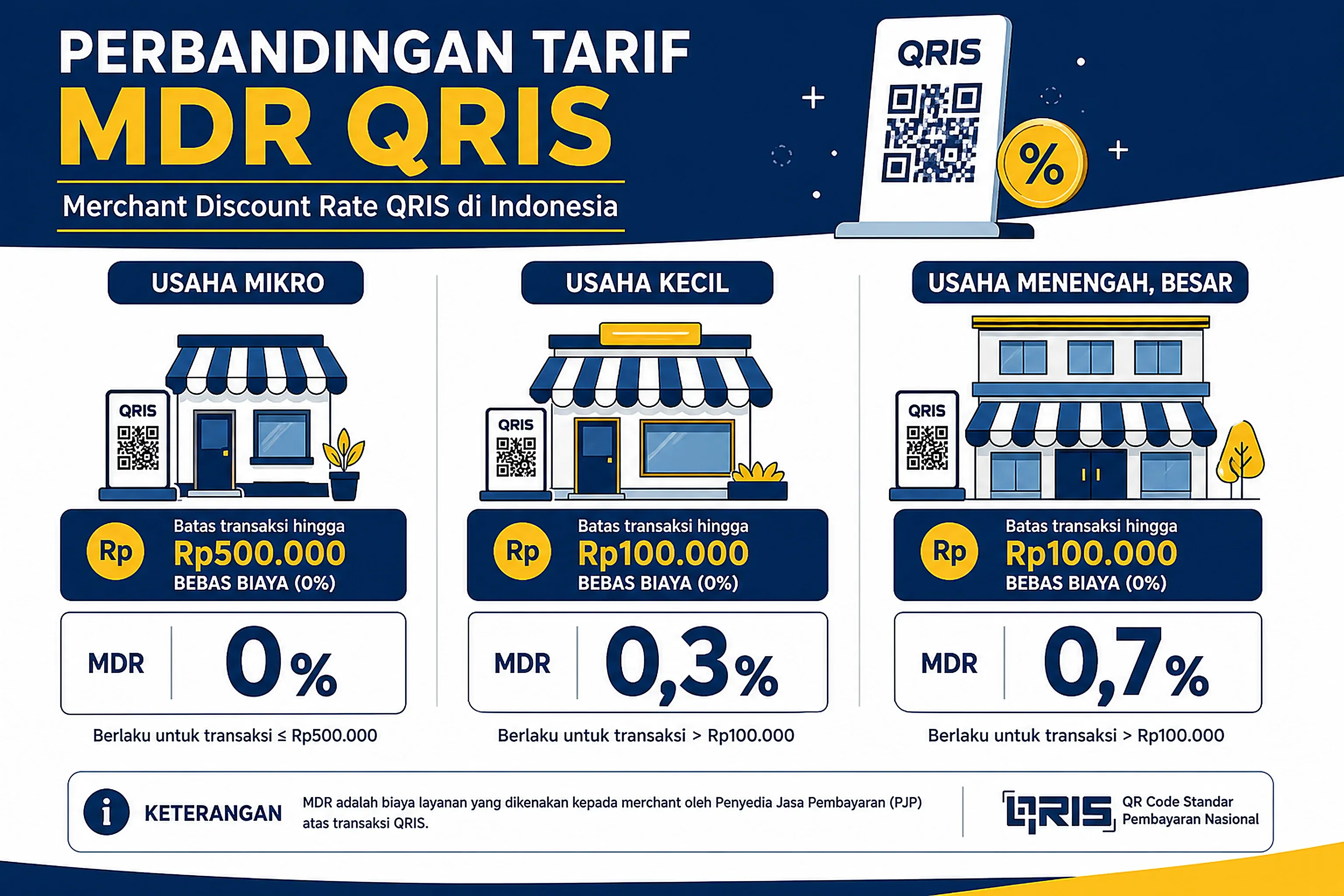
The policy is called Merchant Discount Rate (MDR), the fee a payment service provider deducts from every QRIS sale. Under the current 0.3 percent rate for micro merchants, a Rp500,000 sale already loses Rp1,500 before the seller even counts the money. Multiply that across a busy month and the fee stops being a rounding error. Bank Indonesia's acting governor, Destry Damayanti, framed the expansion as part of a "pro-growth" payment strategy timed to Indonesia's 81st Independence Day. For the owner of a warung, a food stall, or a small online shop, it reads simpler: fewer pesos taken off the top on the transactions that matter most.
Key numbers at a glance:
- Effective date: October 1, 2026.
- Micro merchants (UMI): 0 percent MDR up to Rp500,000, unchanged from the current policy.
- Small, medium, and large merchants: new 0 percent MDR band up to Rp100,000, down from 0.7 percent.
- QRIS users as of June 2026: 65.77 million, with 6.23 million new users added in the first half of 2026 alone.
- QRIS merchants: 44.86 million, of which 96.68 percent are UMKM.
- QRIS transaction volume, first half of 2026: 12.55 billion transactions worth Rp1.12 quadrillion, up 93.92 percent year-on-year.
📋 What Bank Indonesia Actually Announced
The announcement came from a press release published on bi.go.id on August 17, 2026, titled "Kartu Kredit Indonesia dan Kebijakan MDR 0%." It bundled two things together: the retail-segment launch of Kartu Kredit Indonesia (KKI), a new domestic credit instrument that eight payment service providers (BCA, Mandiri, BNI, BRI, CIMB Niaga, Permata, Bank Mega, and BSI) began issuing the same day, and an expansion of the MDR 0 percent policy for QRIS transactions.
Destry Damayanti framed the announcement around a growth-first payment philosophy that also strengthens national economic resilience and competitiveness.
Ryan Rizaldy, head of Bank Indonesia's Payment System Policy Department, added that the goal was straightforward: reduce merchant cost burdens while pushing broader QRIS acceptance. Reporting from Antara News on the same day confirmed the specifics: the free-fee threshold for micro merchants stays at Rp500,000, and a new zero-fee band for small, medium, and large merchants covers transactions up to Rp100,000, up from the existing 0.7 percent rate on those same low-value sales.
💰 The Fee Table That Actually Matters
Numbers do more work than adjectives here, so this is the complete published schedule, effective October 1, 2026.
Regular merchants, split by size:
- Micro merchants (UMI): 0 percent MDR on transactions up to Rp500,000; 0.3 percent on anything above that threshold.
- Small, medium, and large merchants (UKE/UME/UBE): 0 percent MDR on transactions up to Rp100,000; 0.7 percent above that threshold.
Special-category merchants get their own bands:
- Education merchants: 0 percent up to Rp100,000; 0.6 percent above it.
- Fuel stations (SPBU): 0 percent up to Rp100,000; 0.4 percent above it.
- Public service, government-to-people, and people-to-government transactions (social assistance, tax payments, passports, nonprofit donations): 0 percent, with no upper threshold noted.
The MDR is a cost charged to the merchant, not the customer. Bank Indonesia's release repeats that constraint explicitly: the fee "sepenuhnya ditanggung oleh merchant dan tidak boleh dibebankan kepada konsumen atau pembeli," fully borne by the merchant and never passed on to the buyer. A seller who has been quietly adding a QRIS "convenience fee" to customer bills is already breaking that rule, and the policy expansion does not create a new excuse to start.
📈 Why Bank Indonesia Is Doing This Now
The timing was not accidental. The announcement landed at an Independence Day ceremony, and Bank Indonesia's release explicitly called the fee cut "hadiah kemerdekaan untuk masyarakat," an independence day gift for the public. But the substance sits on real adoption numbers, not just symbolism.
Bank Indonesia's own release states that QRIS usage reached 65.77 million users by June 2026, with 6.23 million of those signing up in the first half of the year alone. QRIS now reaches 44.86 million merchants, and 96.68 percent of them are classified as UMKM (micro, small, and medium enterprises). Transaction volume for the first half of 2026 hit 12.55 billion transactions worth Rp1.12 quadrillion, a 93.92 percent year-on-year jump in nominal value.
Put plainly: QRIS is no longer a pilot program. It is the default way tens of millions of small merchants get paid, and Bank Indonesia's fee cut is a bet that removing friction on the smallest transactions will keep that adoption curve climbing rather than plateauing once market saturation sets in among merchants who already accept QRIS but grumble about the fee on every low-ticket sale.

🏪 What Changes for a Small Business Between Now and October 1
Nothing changes immediately. The current MDR schedule, 0.3 percent for micro merchants above Rp500,000 and 0.7 percent for other categories above Rp100,000, stays in force until September 30, 2026. The new zero-fee bands take effect October 1, 2026.
Between now and then, three practical actions are worth taking:
- Confirm your merchant category with your QRIS payment service provider. The fee bands differ for UMI versus UKE/UME/UBE, and misclassification means paying a rate that no longer applies to you once the policy shifts. A quick message to your bank or payment aggregator asking to confirm merchant category and MDR tier costs nothing and prevents a billing dispute later.
- Recalculate your effective margin on low-ticket items. A food stall selling Rp15,000 servings that previously lost 0.7 percent of every QRIS sale to MDR will, from October, keep that fee at zero as long as it falls under the small-merchant Rp100,000 threshold or the micro-merchant Rp500,000 threshold. That reclaimed margin is real money, even if it looks small per transaction.
- Do not add a QRIS surcharge to customer prices. Some merchants, confused about who pays the MDR, have quietly tacked on a "biaya QRIS" line at checkout. Bank Indonesia's rule is explicit that the fee sits with the merchant. A customer-facing website, price list, or point-of-sale sign that shows a QRIS surcharge is now visibly out of step with the central bank's own published policy, and correcting it before October avoids an awkward conversation with a customer who has read the same news.
🧾 What a Real QRIS Receipt Already Shows
QRIS transactions are not a hypothetical. Millions happen every day at convenience stores, warungs, and street stalls across the country, and the receipt a customer walks away with already records the payment method, the merchant, and the timestamp: the exact data trail Bank Indonesia's MDR policy is built to run through.
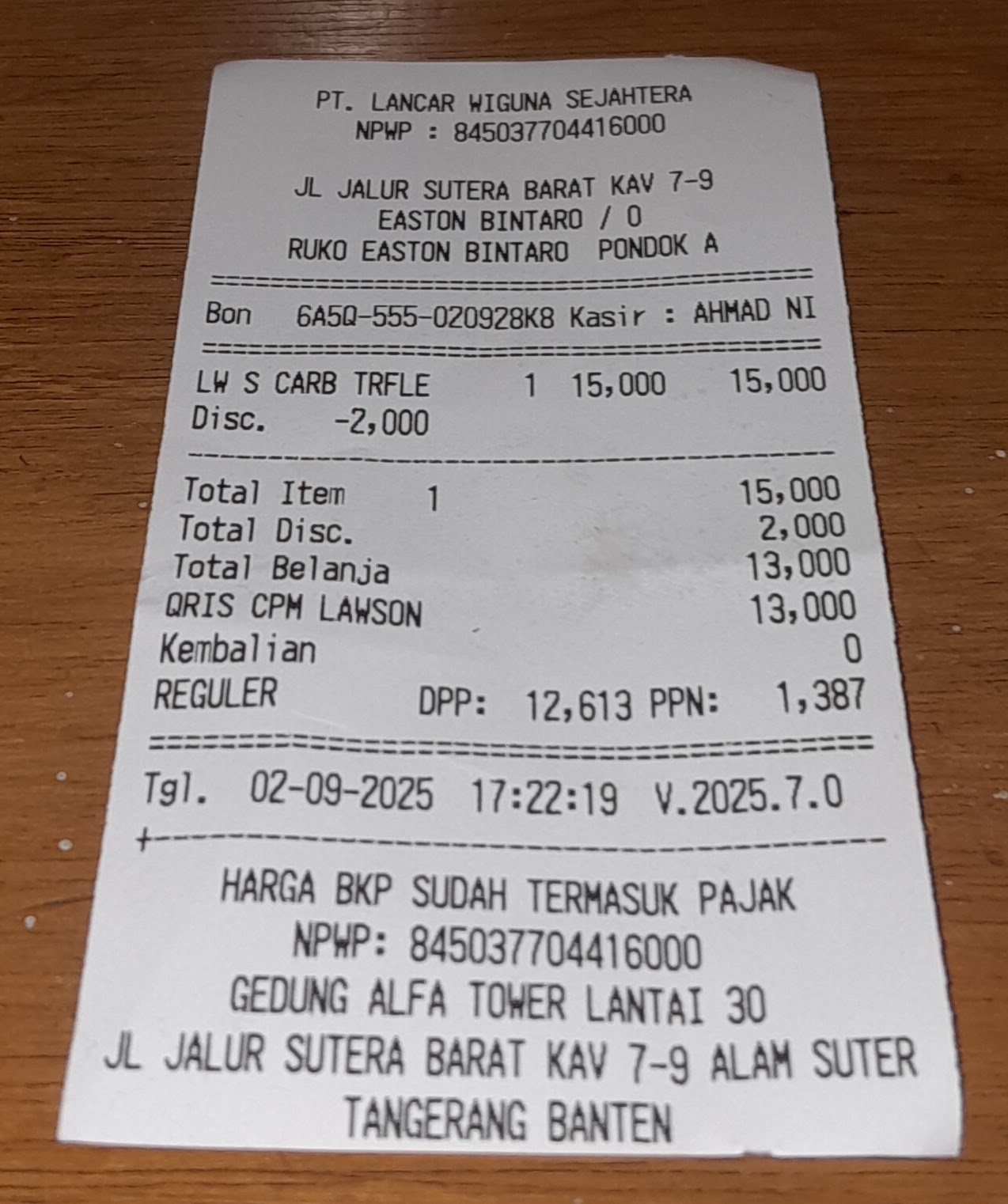
That receipt format is a small but useful reminder of what actually changes on October 1 and what does not. The QR code, the scan-to-pay flow, and the instant confirmation a customer sees on their banking app stay identical. What moves is a number the customer never sees: the percentage the merchant's bank deducts before the money lands in the merchant's account. Bank Indonesia is not asking any business to change its checkout process, retrain staff, or install new hardware. The fee schedule sits entirely on the back end, between the payment service provider and the merchant.
🏦 Kartu Kredit Indonesia: The Other Half of the Announcement
The MDR cut arrived bundled with the retail launch of Kartu Kredit Indonesia, a domestically processed deferred-payment card that funds purchases through QRIS, either by scan or tap. Eight banks issued the card starting August 17, and Bank Indonesia says BSI is developing a Sharia-compliant version.
For a small merchant, KKI matters less directly than the MDR cut, but it is not irrelevant. If KKI adoption grows the way Bank Indonesia hopes, it adds another category of QRIS-based payment volume flowing through the same merchant terminals and QR codes small businesses already use. A merchant does not need to do anything to accept a KKI-funded QRIS payment beyond what they already do to accept a QRIS payment from a bank account or e-wallet: the QR code interface stays the same on the customer's end.
🧮 Running the Numbers on a Real Small Business
Abstract percentages are easy to skim past, so it helps to run them against an actual business type. Take a small coffee stand selling an average of 150 cups a day at Rp18,000 each, with roughly 70 percent of customers paying by QRIS. Every one of those transactions already falls well under the Rp500,000 micro-merchant threshold, so this stand moves entirely into the free tier once the policy takes effect. At the previous 0.3 percent rate, the daily QRIS fee load on 105 transactions of Rp18,000 worked out to roughly Rp5,670 a day, or close to Rp170,000 a month. From October 1, that entire amount disappears for this business.
Now take a slightly larger operation: a small restaurant with an average ticket of Rp85,000, doing 60 QRIS transactions a day and registered as a small-category merchant (UKE) rather than micro. Because Rp85,000 sits under the Rp100,000 threshold that now applies to small and medium merchants, those transactions also move to zero MDR from October, saving roughly Rp3,570 a day at the previous 0.7 percent rate, or close to Rp107,000 a month. That is not life-changing money for a business with real overhead, but it compounds over a year into a four-figure Rupiah sum a small operator can put toward inventory, staff hours, or simply improved margin.
The math changes for a business whose average ticket regularly exceeds the relevant threshold. A boutique clothing store with an average sale of Rp350,000 will still pay MDR on most of its QRIS volume, because most individual transactions clear the Rp100,000 (or Rp500,000, if registered as UMI) cutoff. For that category of business, the fee cut matters mainly at the margins: a customer buying a single accessory under the threshold pays fee-free, while a customer buying a full outfit still generates the standard MDR charge on the full amount.
🕰️ How This Fee Threshold Compares Globally and Historically
This is not the first time Bank Indonesia has adjusted the free-fee threshold for micro merchants. The zero-percent MDR band for micro merchants on transactions up to Rp500,000 has existed in some form since QRIS's early rollout years, largely to encourage the smallest sellers, street vendors, warung owners, market traders, to adopt digital payment without absorbing a fee on every sale. What changed on August 17 is the extension of that same zero-fee logic to a second, previously untouched category: small, medium, and large merchants, who up to now paid the full 0.7 percent MDR on every QRIS transaction regardless of size.
That distinction is worth sitting with. Bank Indonesia is not simply lowering an existing rate; it is creating an entirely new fee-free lane for merchant categories that never had one before, provided the transaction stays under Rp100,000. A mid-sized retailer selling phone accessories, phone credit, or inexpensive daily goods for under Rp100,000 per sale stands to benefit in a way that category of merchant has not previously experienced under QRIS.
Indonesia is not alone in wrestling with QR payment fee structures. Singapore's PayNow and Thailand's PromptPay are both widely known for near-zero merchant fees on small transactions, part of why QR adoption in those markets grew quickly once launched. Malaysia's DuitNow QR has followed a similar low-fee path for local merchants. None of these systems are identical to QRIS in structure, and this article does not have a verified, current fee schedule for each to publish a direct rate comparison, but the regional direction is consistent: central banks across Southeast Asia have treated low or zero merchant fees on small QR transactions as a lever for pushing adoption past early-stage plateaus.
Bank Indonesia's tiered MDR bands, scaling by merchant size and transaction value rather than a single flat rate, reflect a specific choice: keep the system self-funding through fees on larger transactions and bigger merchants while subsidizing the smallest and most price-sensitive sellers through zero-percent bands. The August 17 announcement is the clearest signal yet that Bank Indonesia intends to keep narrowing that fee gap for small business rather than holding it steady.
⚠️ What This Policy Does Not Fix
A fee reduction is not a guarantee of instant settlement, and it is not a fix for the connectivity gaps that still affect QRIS acceptance in parts of Indonesia outside major cities. Bank Indonesia's release does not address settlement speed, dispute resolution timelines, or offline QRIS reliability, and small merchants who have experienced delayed fund transfers from their payment service provider should not expect this specific announcement to change that experience.
It is also worth being precise about scope. The zero-fee band for non-micro merchants tops out at Rp100,000, a limit that matters for a mid-sized retail store or service business where average transaction values commonly exceed that threshold. A furniture shop or an appliance retailer accepting QRIS for a Rp2 million sale will still pay the 0.7 percent MDR on the portion of that transaction structure that Bank Indonesia's tiered system applies to. The relief is real, but it is concentrated at the low end of the transaction-value spectrum, which is exactly where micro and small merchants tend to sit.
🔍 How to Verify Your Own Merchant Rate
Because MDR rates are set and collected by individual payment service providers operating under Bank Indonesia's framework, not by Bank Indonesia directly, a merchant's actual invoice depends on which bank or fintech issues their QRIS terminal or app. The practical verification steps:
- Check your monthly merchant statement from your QRIS provider (bank or payment aggregator) for the MDR line item and compare it against the published schedule after October 1.
- If your statement shows a rate that does not match your merchant category's published tier, contact your provider's merchant support line directly. Do not assume the discrepancy will self-correct.
- Keep the Bank Indonesia press release (or a screenshot of the official fee table) on hand as a reference when raising a billing question, since it is the primary source your provider is obligated to follow.
A related, less obvious step: confirm which merchant category your business is actually registered under. Bank Indonesia's four categories, UMI (micro), UKE (small), UME (medium), and UBE (large), are typically assigned by the payment service provider at onboarding based on declared revenue or business registration documents, not chosen freely by the merchant. A home-based food business that grew past micro-enterprise thresholds without updating its registration might still be billed at UMI rates, which sounds beneficial until the business needs to prove its scale for a loan application, a supplier partnership, or a government support program that checks the same registration data. Getting the category right protects both the fee calculation and the paper trail a growing business will eventually need.
📊 The Broader Digital Economy Push Behind This Announcement
The MDR cut does not exist in isolation. It sits inside a larger policy document Bank Indonesia calls the Blueprint Sistem Pembayaran Indonesia 2030 (Indonesia Payment System Blueprint 2030), a multi-year roadmap aimed at expanding financial inclusion and reducing transaction friction across the archipelago. The August 17 announcement explicitly ties both the MDR expansion and the Kartu Kredit Indonesia launch to that blueprint, along with the government's Asta Cita economic program.
That framing matters for a small business trying to read the signal correctly. This is not a one-off promotional discount that might get reversed in six months if adoption targets are hit early. It is a structural piece of a stated multi-year policy direction that treats near-zero-cost digital payment access for small merchants as infrastructure, comparable to how a government treats rural road access or electrification, something the state subsidizes because the returns show up in aggregate economic activity rather than in a single line item. A small business owner deciding whether to invest time in setting up proper QRIS acceptance, training staff on it, or migrating away from cash-only operations can reasonably treat this fee direction as durable rather than temporary.
💬 What This Means for a Website and Digital Storefront
A merchant's price list, checkout page, or WhatsApp catalog that references payment fees should be reviewed against this schedule before October 1. If your website currently states a flat QRIS fee or a note explaining why prices differ for QRIS versus cash, that copy needs an update reflecting the new zero-fee threshold, both for accuracy and because a customer who has read this same news will notice an outdated fee notice quickly.
Beyond the copy update, this is also a reasonable moment for a small business running its own digital storefront to confirm that its checkout flow displays the QRIS code clearly, that payment confirmation messaging matches what customers actually receive, and that any manual reconciliation process between the website's order records and the bank's settlement report is documented somewhere other than one person's memory. None of that is mandated by the policy change, but a fee cut that expands QRIS's cost advantage is also a nudge toward treating the payment flow as infrastructure worth maintaining, not an afterthought bolted onto a static page.

The policy itself takes effect October 1, 2026. Between now and then, the actionable step for any small business owner is simple: confirm your merchant category, recalculate your margin on transactions under the relevant threshold, and make sure nothing in your pricing or website contradicts a rule that just became easier to follow.
For an owner who has been putting off QRIS acceptance because the fee felt like too big a bite out of a thin margin, the August 17 announcement is a concrete reason to revisit that decision. The new zero-fee threshold makes digital payment acceptance considerably cheaper than it was a year ago, particularly for businesses with small ticket sizes that were previously hit hardest by a flat-percentage MDR. 1garis Studio will keep tracking this payment policy and what it means for small businesses running their own digital storefronts.
Sumber: Bank Indonesia (bi.go.id), Antara News, Kompas.com, KompasTV, Sindonews, 17-19 Agustus 2026.