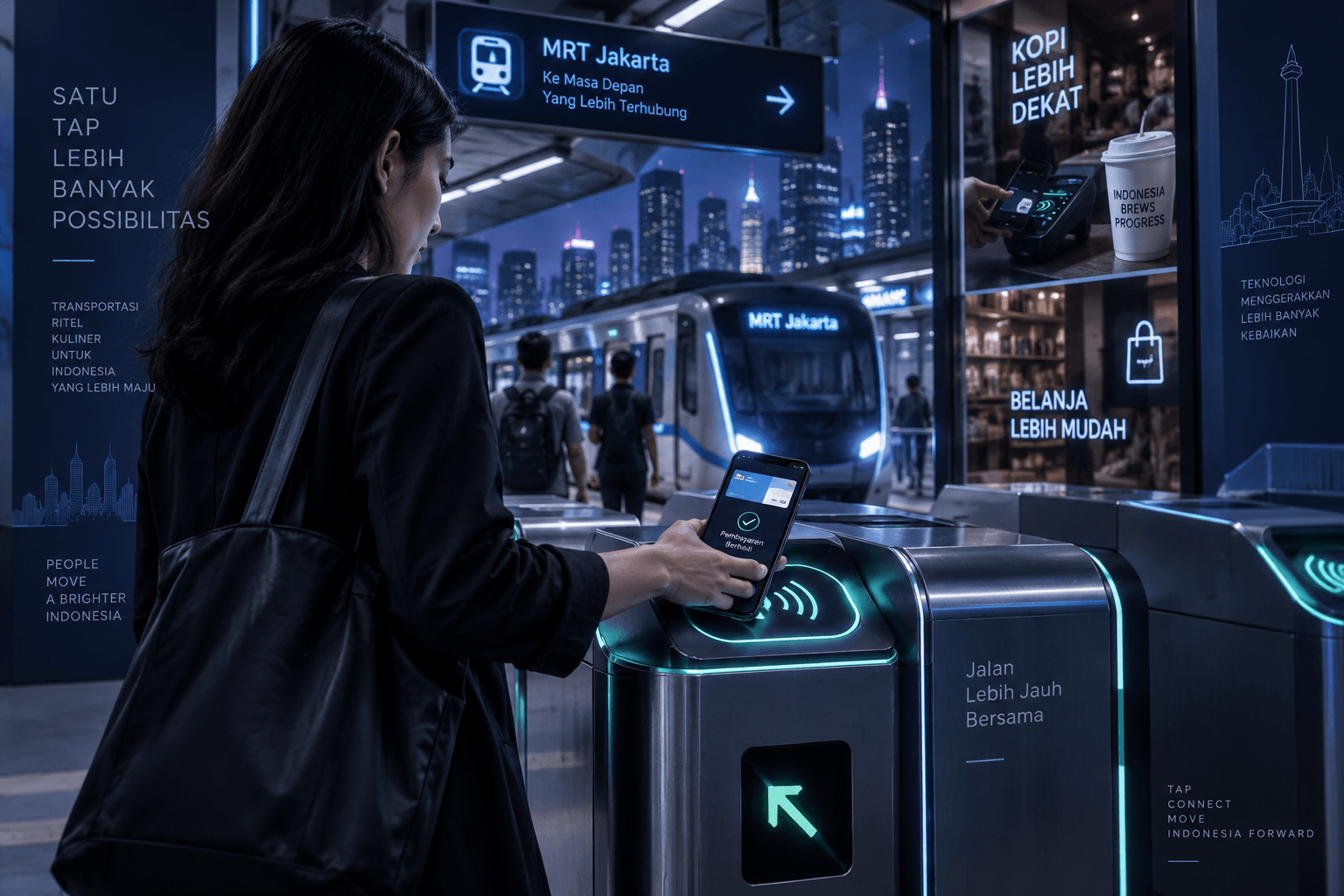
Every weekday morning between seven and nine, the subterranean concourse of Bundaran HI Station in Central Jakarta turns into a high-stakes study in queue mechanics. Thousands of commuters surge upward from the underground platforms, their footsteps echoing against polished granite, converging on the stainless-steel turnstiles that guard the exit toward the city's financial corridor. For years, passing through those gates meant performing an awkward physical choreography. Commuters dug through backpacks for laminated smart cards issued by state-owned banks, or stopped in their tracks to unlock smartphones, open a digital wallet application, wait for an optical camera to initialize, and steady a glowing screen under an overhead barcode scanner. If an office worker's screen brightness was set too low, if morning glare reflected off the turnstile glass, or if a passenger's hands trembled while stepping forward, the gate remained stubbornly shut. A single hesitation rippled backward through the crowd, turning a fluid pedestrian stream into an irritated, shoulder-to-shoulder bottleneck.
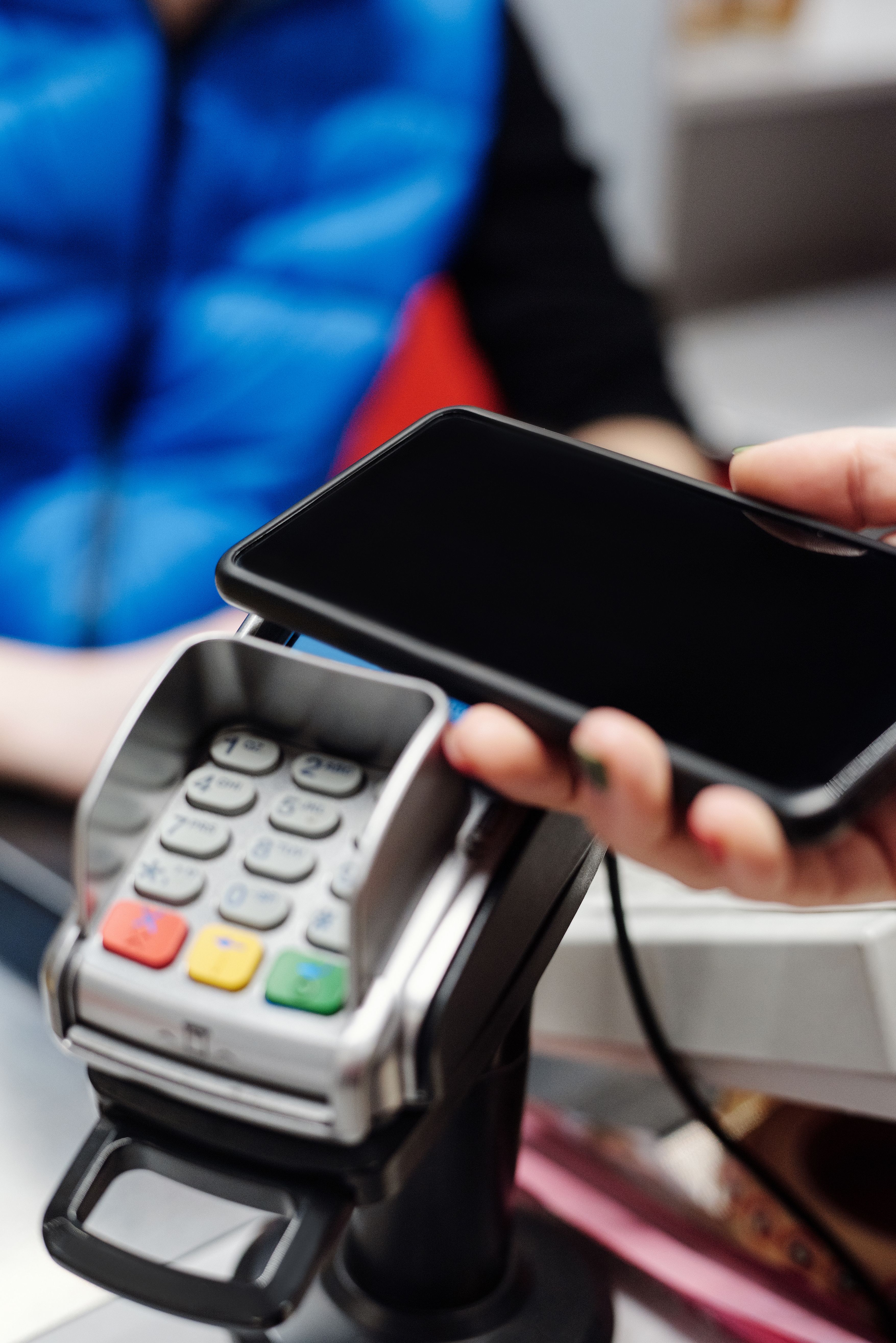
In transit engineering, this friction is measured in fractions of a second. A modern commuter rail turnstile must process between thirty and forty passengers every minute to prevent dangerous platform crowding. Optical camera scanning, regardless of how advanced the underlying computer vision algorithm claims to be, struggles to clear passengers faster than three to five seconds per transaction. Across forty thousand daily travelers, those lost seconds accumulate into hours of collective municipal paralysis. The introduction of QRIS Tap across Jakarta's mass transit infrastructure changed that equation overnight. By pressing an Android smartphone within four centimeters of the turnstile sensor, the mechanical barrier swings open in approximately 0.3 seconds. Commuters glide through without waiting for a camera to focus or an optical sensor to decipher a two-dimensional grid of pixels.
Yet behind that seamless physical gesture lies an audacious engineering feat and a fascinating geopolitical platform contrast. The system does not rely on a newly constructed, proprietary banking network, nor does it require transit operators to overhaul their clearing arrangements with financial institutions. Instead, Indonesian engineers and payment architects accomplished something remarkably elegant: they took the existing, universally deployed Quick Response Code Indonesian Standard (QRIS) payload and redirected its digital transit path. Rather than printing pixels onto an illuminated liquid crystal display for a camera lens to photograph, the system packages the exact same financial transaction data into standard radio packets and fires them across an electromagnetic field using Near Field Communication (NFC).
Even more striking is the sharp divide visible at the turnstiles. While owners of entry-level and mid-range Android devices tap their phones and step briskly onto the concourse, owners of high-end Apple iPhones are frequently forced to step aside, reaching for traditional plastic prepaid cards or fumbling with legacy optical scans. The technical reality behind this discrepancy is not a limitation of radio frequency physics or microchip manufacturing. It is the direct consequence of divergent operating system philosophies: Android's long-standing support for open Host-based Card Emulation (HCE) running directly in software, contrasted against Apple's tightly guarded, commercially restricted Secure Element architecture. Understanding why this radio handshake succeeds in a third of a second illuminates how modern contactless payments work, how national payment rails evolve, and how corporate platform boundaries shape everyday urban life.
⚡ The Concourse Bottleneck and the Physics of Transit Gates
To appreciate why contactless radio frequency technology dominates mass transit worldwide, one must first dissect the physical failure modes of optical barcode scanning at scale. Visual QR codes, specifically the Merchant-Presented Mode (MPM) where consumers scan a static counter sticker and the Customer-Presented Mode (CPM) where a merchant scans a dynamic barcode generated on a consumer's handset, represented an extraordinary leap forward for retail commerce across Southeast Asia. By eliminating the necessity of expensive magnetic stripe point-of-sale terminals and merchant acquiring hardware, QRIS democratized digital payment across millions of micro, small, and medium enterprises from street food stalls in Yogyakarta to boutique cafes in South Jakarta.
However, mass transit turnstiles operate under entirely different physical constraints than retail checkout counters. When a patron buys a cup of coffee, a three-second transaction delay is completely imperceptible. When ten thousand passengers disembark from two arriving trains simultaneously at a transfer hub like Dukuh Atas, a three-second delay per person causes catastrophic passenger compression on stairwells and escalator landings. Optical scanning at turnstiles suffers from what transit systems engineers classify as variable optical latency. The mechanical turnstile scanner must capture a sharp image of a dynamic barcode displayed on an active glass screen. This process requires adequate ambient contrast, correct focal distance, precise planar alignment, and sufficient display luminance.
Consider the physical steps involved in an optical transit transaction. A passenger approaches the turnstile, activates their phone screen, unlocks the operating system via fingerprint or facial recognition, launches a specific banking or transit application, navigates to the payment tab, generates a dynamic QR code token, and holds the glass face-down toward the scanner lens. At that junction, multiple environmental variables intervene. If the morning sunlight pours through a station skylight onto the scanner glass, ambient glare washes out the camera sensor. If the commuter has engaged battery-saving mode, the phone screen dims automatically, reducing the contrast ratio between the dark modules and light background of the QR matrix. If the passenger moves their hand too quickly while walking through, motion blur distorts the image capture, forcing the optical decoder to reject the frame and retry on the subsequent exposure cycle.
In empirical testing conducted across high-density metro systems in Tokyo, London, and Singapore, optical QR code turnstiles exhibit an average gate clearance time ranging from 2.5 to 4.2 seconds, with a first-attempt failure rate exceeding twelve percent during peak congestion periods. By contrast, dedicated contactless transit cards operating on high-frequency radio bands consistently clear turnstiles in under 300 milliseconds with failure rates below 0.5 percent. For Jakarta's MRT and commuter rail networks, which were engineered to accommodate expanding ridership across a metropolitan area of thirty million people, relying permanently on optical camera scanning was an operational dead end. The turnstiles required the instantaneous velocity of radio waves.

The challenge confronting Bank Indonesia and the Indonesian Payment System Association (ASPI) was how to achieve sub-second transit transaction speeds without fragmenting the national payment ecosystem. Historically, contactless transit solutions required closed-loop smart cards, such as Bank Mandiri's e-Money, BCA's Flazz, BNI's TapCash, and BRI's Brizzi. While these physical cards deliver rapid turnstile clearance, they suffer from deep consumer friction: users must remember to top up balances through specific automated teller machines or NFC-equipped handsets, funds remain trapped on individual plastic cards without cross-platform interoperability, and lost cards mean permanently lost balances. Recreating that fragmented architecture on mobile phones would have defeated the entire founding philosophy of QRIS, which unified the nation's splintered digital wallets behind a single interoperable standard. The breakthrough came from recognizing that the QR code itself was never the magic; the magic was the underlying transaction payload.
📻 How 13.56 MHz Radio Induction Outruns the Camera Sensor
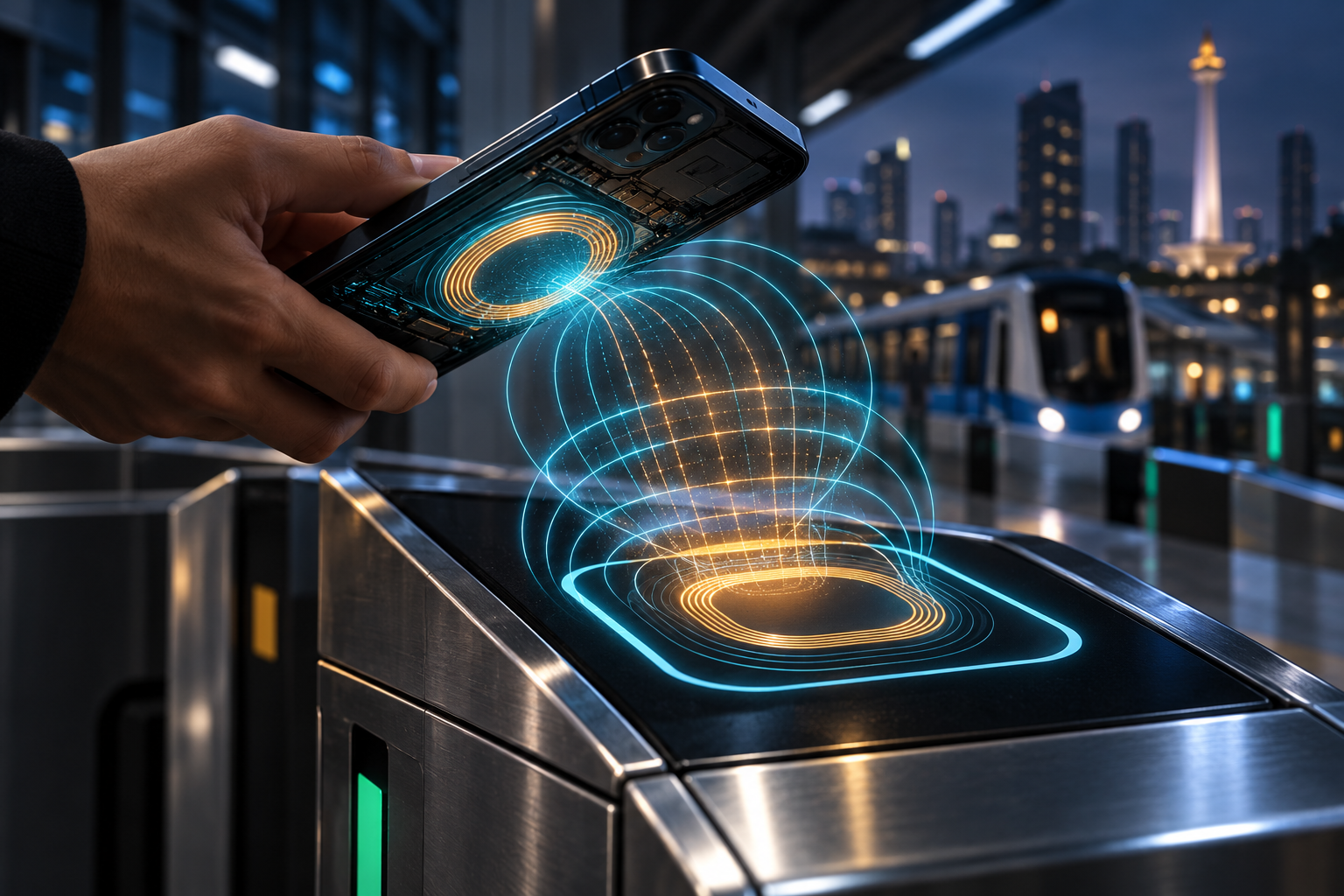
The transition from visual optics to radio waves shifts the transaction medium from the electromagnetic spectrum of visible light (approximately 400 to 700 terahertz) down to high-frequency radio emissions centered precisely at 13.56 megahertz. This frequency band is the global foundation of Near Field Communication, governed internationally by the ISO/IEC 14443 and ISO/IEC 18092 standards. Understanding the speed of QRIS Tap requires examining the electromagnetic physics of inductive coupling that takes place the moment a phone approaches an antenna coil embedded beneath the turnstile's acrylic surface.
An NFC interaction is not a broadcast transmission like Wi-Fi or cellular LTE, where signals radiate broadly through space across dozens or thousands of meters. Instead, NFC operates almost entirely within the reactive near-field zone, where the physical distance between antennas is significantly smaller than the wavelength of the carrier frequency (which at 13.56 MHz is approximately 22.1 meters). The turnstile gate reader houses a primary inductive antenna loop continuously driven by alternating current. This active current generates a localized, alternating magnetic field that oscillates thirteen million five hundred and sixty thousand times per second, extending roughly four to five centimeters into the air above the reader surface.
When a commuter brings an NFC-enabled smartphone into this invisible oscillating field, the magnetic flux lines penetrate a microscopic loop antenna coiled beneath the smartphone's rear casing or integrated directly into its glass backplate. Through Faraday's law of electromagnetic induction, this changing magnetic field induces a tiny alternating voltage across the smartphone's antenna terminals. In passive smart cards, this induced voltage is rectified into direct current to physically power up the card's microchip from a dead state. In a modern smartphone, which already possesses an active internal battery, the induced field immediately alerts the device's onboard NFC controller chip via hardware interrupt.
The communication that follows does not rely on complex software handshakes or heavy network stack negotiations. At 13.56 MHz, the reader and handset establish bidirectional communication using load modulation. When the phone transmits data back to the turnstile reader, it does not broadcast its own independent radio wave. Instead, the phone's NFC controller dynamically switches an internal resistive or capacitive load across its antenna coil. By changing its own load impedance, the smartphone subtly alters the electrical current drawn from the reader's primary magnetic field. The turnstile reader detects these minute variations in its own primary coil as amplitude variations, demodulating them into raw digital ones and zeros.
This entire physical layer establishment, encompassing field detection, anti-collision polling (ensuring that if two cards are nearby, the reader isolates the intended target), transmission protocol selection (ISO/IEC 14443 Type A or Type B), and carrier synchronization, transpires in fewer than fifty milliseconds. Unlike an optical camera that must wait for mechanical autofocus actuators, exposure adjustment, sensor readout, image binarization, and perspective transformation, the NFC radio channel is operational and exchanging binary frames almost at the speed of electrical conduction. By the time the commuter's hand has descended halfway toward the target icon on the turnstile, the physical layer is already fully established and awaiting application data.
🧩 Smuggling QRIS Customer Payloads Across the APDU Protocol
Once the electromagnetic channel is humming at 13.56 MHz, the core architectural question emerges: what data actually travels across that air interface? This is where the engineering ingenuity of QRIS Tap diverges dramatically from conventional proprietary transit systems such as London's Oyster card, Hong Kong's Octopus, or traditional closed-loop e-money schemes. Rather than developing an entirely new banking clearing protocol, the Indonesian payment architects realized that the national infrastructure already possessed an extraordinary, battle-tested asset: the QRIS Customer-Presented Mode (CPM) specification.
In standard retail QRIS CPM, a user generates a dynamic barcode on their phone screen. This barcode is not an arbitrary string of text; it is a standardized data structure formatted according to the EMVCo QR Code Specification for Payment Systems. When parsed, this payload contains structured data elements: an application template identifier, the globally unique payment service provider identifier, the user's temporary cryptographic payment token, an account alias or masked virtual account number, an issuance timestamp, transaction counter values, and a digital signature generated by the payment provider's backend server. In an optical retail environment, an electronic data capture (EDC) terminal or optical scanner reads these data tags visually, bundles them into an ISO 8583 financial message, and routes the packet through national switching institutions like PT Alto Network, PT Artajasa Pembayaran Elektronis, PT Rintis Sejahtera (PRIMA), or PT Jalin Pembayaran Nusantara.
QRIS Tap performs a brilliant act of protocol adaptation: it decouples the EMVCo QRIS CPM payload from its visual graphical carrier and maps it directly onto the ISO/IEC 7816-4 smart card application protocol. In the world of smart cards and payment terminals, communication occurs through discrete command-and-response packets known as Application Protocol Data Units (APDUs). An APDU command structure consists of a mandatory four-byte header (Class byte CLA, Instruction byte INS, Parameter 1 P1, and Parameter 2 P2), followed by optional length indicators and data fields.
The sequence of this radio handshake unfolds across discrete protocol phases:
- Induction Phase (< 50 ms): The turnstile reader generates a 13.56 MHz alternating magnetic field. As the smartphone approaches within four centimeters, the field induces current in the handset antenna, initiating ISO 14443-4 anti-collision and link selection.
- Application Selection (< 30 ms): The terminal transmits an APDU
SELECT AIDcommand targeting the registered Indonesian national transit payment applet. The smartphone verifies the application identifier and responds with the status bytes90 00(success). - Cryptographic Extraction (< 120 ms): The terminal issues a
GET DATArequest. The smartphone retrieves the pre-calculated, digitally signed QRIS CPM token and returns it over load-modulated radio frames. - Barrier Actuation (~ 300 ms total): The gate processor parses the token, performs local cryptographic verification, and fires the physical turnstile relay.
When the phone touches the turnstile's field, the terminal acts as an APDU client. It immediately transmits a SELECT AID (Application Identifier) command. This command tells the smartphone's NFC subsystem: "I am a transit payment terminal looking for the official Indonesian national contactless payment applet." The registered payment application running on the smartphone inspects the incoming AID, verifies that it matches its registered configuration, and returns an APDU success status word, historically denoted by the hexadecimal bytes 90 00 (meaning "Operation Successful").
Immediately following this acknowledgment, the turnstile terminal issues a read command, typically a GET DATA or READ RECORD instruction. The smartphone's payment application intercepts this request, retrieves its active, pre-calculated QRIS CPM payload, formats the payload as an APDU data field, appends the closing 90 00 status word, and transmits the bytes across the load-modulated radio link. The entire data exchange consists of only two or three APDU round-trips. By avoiding verbose XML or JSON transport layers and transmitting compact binary structures directly over the low-level ISO-DEP (ISO Data Exchange Protocol), the data exchange completes in less than one hundred and fifty milliseconds.
The profound consequence of this architecture is complete backend continuity. When the turnstile terminal receives the QRIS CPM payload via NFC, its onboard processor does not need to know or care whether the bytes arrived through an optical camera sensor or an inductive radio antenna. The terminal extracts the exact same EMVCo-compliant cryptographic tokens, packages them into the identical ISO 8583 message format, and routes them to the clearing switch through existing banking pipelines. Bank Indonesia and payment service providers did not have to reconstruct the settlement rails, rewrite risk engines, or deploy separate clearing houses for contactless transit. They merely changed the final four centimeters of data transmission.
📱 Inside Android Host-Based Card Emulation
Executing smart card APDU exchanges on a mobile device historically required a specialized hardware component known as a Secure Element (SE). In traditional mobile contactless implementations from the early 2010s, the cryptographic keys and payment applets resided entirely within a tamper-resistant hardware microchip. This Secure Element was either embedded onto the smartphone's motherboard (eSE), baked into a specialized microSD card, or hosted directly on the cellular operator's SIM card (UICC).
Under the legacy hardware Secure Element model, third-party software developers and financial institutions faced an insurmountable gatekeeper problem. If an Indonesian bank or digital wallet company wanted to enable contactless payments on a customer's smartphone, it had to negotiate complex commercial agreements with mobile network operators (Telkomsel, Indosat, XL Axiata) or hardware manufacturers (Samsung, Sony) to provision cryptographic applets into the physical chip's encrypted partitions. The operational complexity of managing SIM-based applet lifecycles across dozens of handset models and competing carriers strangled mobile contactless adoption for years.
Google obliterated this structural bottleneck in Android 4.4 KitKat by introducing Host-based Card Emulation (HCE). HCE completely decoupled card emulation from physical hardware chips. Instead of routing incoming NFC radio frames directly from the NFC radio controller to a hardware Secure Element via a single-wire protocol, Android introduced an operating system routing table that intercepts incoming APDUs and forwards them directly to the main application processor where standard software applications execute.
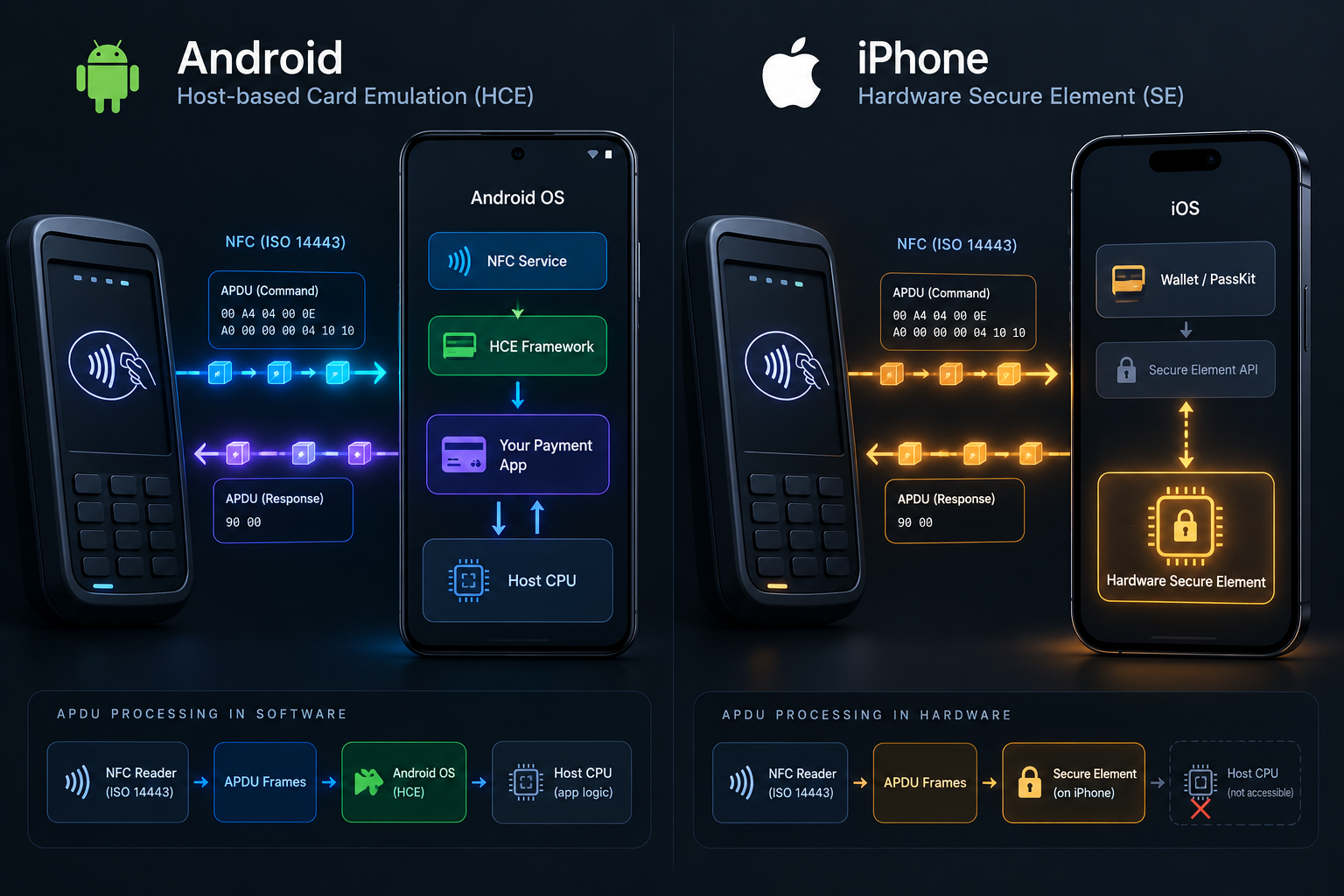
In the modern Android architecture, any payment application certified by national regulatory authorities can register a specialized background component known as a HostApduService. In the application's configuration manifest, the developer declares an XML metadata file listing the exact Application Identifiers (AIDs) that the application is authorized to handle. When the user selects their preferred contactless payment application in the Android system settings, the operating system registers those AIDs in a kernel-level NFC routing table.
The operational flow inside an Android device during a QRIS Tap transaction illustrates the elegance of this design:
- Carrier Detection: The handset enters the turnstile's 13.56 MHz electromagnetic field. The smartphone's NFC controller hardware (such as an NXP or Broadcom chipset) wakes up and negotiates ISO/IEC 14443-4 link parameters with the turnstile.
- AID Inspection: The turnstile transmits the APDU command
00 A4 04 00 [Length] [AID]. The NFC hardware controller passes these raw bytes across an internal digital bus (such as I2C or SPI) to the Android operating system kernel. - Intent Dispatching: The Android
NfcServicedaemon parses the AID from the APDU payload. It queries its internal registry of installed and active HCE services, identifies the user's selected banking or transit wallet, and dispatches the raw command to that application'sHostApduService. - Software Execution: The payment application's process executes the callback method
processCommandApdu(byte[] commandApdu, Bundle extras). Operating inside the security boundaries of the Android application sandbox, the app verifies the session state, retrieves or dynamically generates the signed QRIS CPM token, and constructs the response APDU bytes. - Radio Transmission: The method returns the response byte array directly to the system. The Android NFC daemon transmits the bytes back through the NFC hardware controller, which alters its antenna impedance to deliver the data across the air to the turnstile.
Because this transaction occurs entirely in software running on the host CPU, application developers possess absolute flexibility. They can refresh cryptographic payment tokens in the background while the phone is connected to cellular data, store rolling counter keys in the application's encrypted shared preferences, and present dynamic tokens without relying on hardware provisioning agreements. Whether a consumer carries an entry-level smartphone costing under two million rupiah or a flagship folding device, if the handset contains an NFC radio and runs a modern version of Android, it possesses the identical software capability to act as a contactless transit token.
🔒 Why the iPhone Remained Behind Apple's Walled Garden
If the underlying radio protocol is a global ISO standard and the financial payload is universal, why do iPhone users in Jakarta find themselves unable to tap their devices at MRT turnstiles with the same ease as Android users? The explanation lies not in silicon physics, but in corporate business strategy, platform gatekeeping, and differing regulatory environments.
Every iPhone manufactured since the iPhone 6 in 2014 possesses a sophisticated NFC controller and a dedicated hardware Secure Element. However, for a decade, Apple maintained absolute, monopolistic control over those components. On iOS, the NFC radio was not exposed as a general-purpose, software-addressable peripheral in the manner of Android's HCE. Instead, Apple hardwired the NFC controller's card emulation capabilities exclusively to its own proprietary Apple Pay stack and Apple Wallet application. Third-party developers were permitted only restricted access through the CoreNFC framework, which allowed iPhones to read passive NFC tags or interact with external smart accessories, but explicitly blocked incoming card emulation from a payment terminal.
The structural difference between the two platforms centers on how incoming radio frames are routed once received by the handset hardware:
- Android Open Routing (Host-based Card Emulation): When the 13.56 MHz carrier hits the smartphone's NFC chip, the controller routes raw APDU bytes directly across an internal hardware bus to the Android kernel
NfcService. The kernel checks its registered AID routing table and hands the data directly to the user's selected banking or transit application sandbox (HostApduService), requiring under 150 milliseconds for the complete software path. - Apple Walled Routing (Hardware Secure Element): When the carrier hits the iPhone's NFC chip, card emulation is intercepted at the hardware level by the physical Secure Element. The operating system explicitly blocks third-party applications from emulating payment cards unless granted a commercial Apple SE Entitlement, complete with paid fee structures, accredited laboratory audits, and remote applet injection via Apple servers.
Under Apple's traditional model, the only path for a bank or transit authority to enable contactless payments on an iPhone was to integrate directly into Apple Pay. This integration requires financial institutions to execute bilateral commercial agreements with Apple, establish token service provider (TSP) connections with Mastercard or Visa, and pay Apple a percentage fee on every transaction (typically around 0.15 percent for credit cards and half a cent for debit cards in Western markets). Because Apple Pay has never officially launched in Indonesia, and because QRIS is a sovereign national debit-and-account switching rail rather than an international credit card scheme, Apple Pay integration was never an applicable solution for Jakarta's mass transit infrastructure.
In response to antitrust investigations by the European Commission and the enforcement of the European Union's Digital Markets Act (DMA), Apple was forced to alter its global stance. In mid-2024, Apple announced that beginning with iOS 18.1, it would open the iPhone's NFC chip and Secure Element to third-party developers through a new program known as the NFC & SE Platform Entitlement. Under this framework, authorized third-party applications can utilize the iPhone's hardware Secure Element to provision contactless cards, transit passes, corporate keys, and payment credentials.
However, a critical examination of Apple's developer terms reveals why this announcement has not yet translated into universal QRIS Tap support on Indonesian iPhones. Apple did not implement open Host-based Card Emulation. Instead, Apple maintained its hardware-centric Secure Element architecture and wrapped it in a formidable web of bureaucratic and commercial conditions. To access the SecureElementCredential framework on iOS, an Indonesian payment provider or transit operator cannot simply write code and push an update to the App Store. The organization must:
- Execute a binding commercial contract with Apple and sign non-disclosure agreements.
- Onboard corporate identities through the Apple Business Register.
- Apply for and be granted a specific, restricted entitlement (
com.apple.developer.secure-element-credential). - Undergo rigorous third-party security audits by Apple-accredited evaluation laboratories.
- Develop, sign, and distribute proprietary Java Card applets that must be compiled and cryptographically injected into the iPhone's physical Secure Element via Apple's remote provisioning servers.
- Pay associated transaction and licensing fees determined by Apple's commercial agreements.
- Operate within territories explicitly approved and activated by Apple in iOS point releases.
When Apple initially published the geographic rollout schedule for the NFC & SE Platform, Indonesia was notably absent from the first and second tiers of supported nations. While users in Australia, Brazil, Canada, Japan, New Zealand, the United Kingdom, and the United States gained theoretical access in iOS 18.1, developing nations were relegated to later roadmaps spanning iOS 18.4 and beyond.
This regulatory asymmetry prompted Bank Indonesia to initiate high-level diplomatic and regulatory discussions with Apple's regional leadership and global headquarters. Bank Indonesia Governor Perry Warjiyo and payment system regulators recognized that leaving iPhone users permanently excluded from the national contactless transit rail would create a bifurcated digital society. The central bank has advocated for direct access to the handset's radio hardware so that national payment standards can operate equitably across all citizens regardless of which corporate logo adorns their mobile device. Until those negotiations conclude and Apple formally provisions the necessary cryptographic entitlements for Indonesian banking identifiers, the iPhone remains an expensive spectator at Jakarta's transit turnstiles.
🚇 Inside the Commuter Pulse at Dukuh Atas and Bundaran HI
The theoretical elegance of radio protocols and software architecture is ultimately validated by the physical human reality of urban transit stations. Nowhere is this validation more striking than at Dukuh Atas, Jakarta's primary multimodal transit nexus. Here, the North-South line of MRT Jakarta intersects with the Jabodebek LRT, the KRL Commuterline, the Airport Rail Link, and the Transjakarta bus rapid transit network. During the evening peak between five and seven, tens of thousands of workers converge on these transit subterranean passages, creating a dense, continuous flow of human movement.
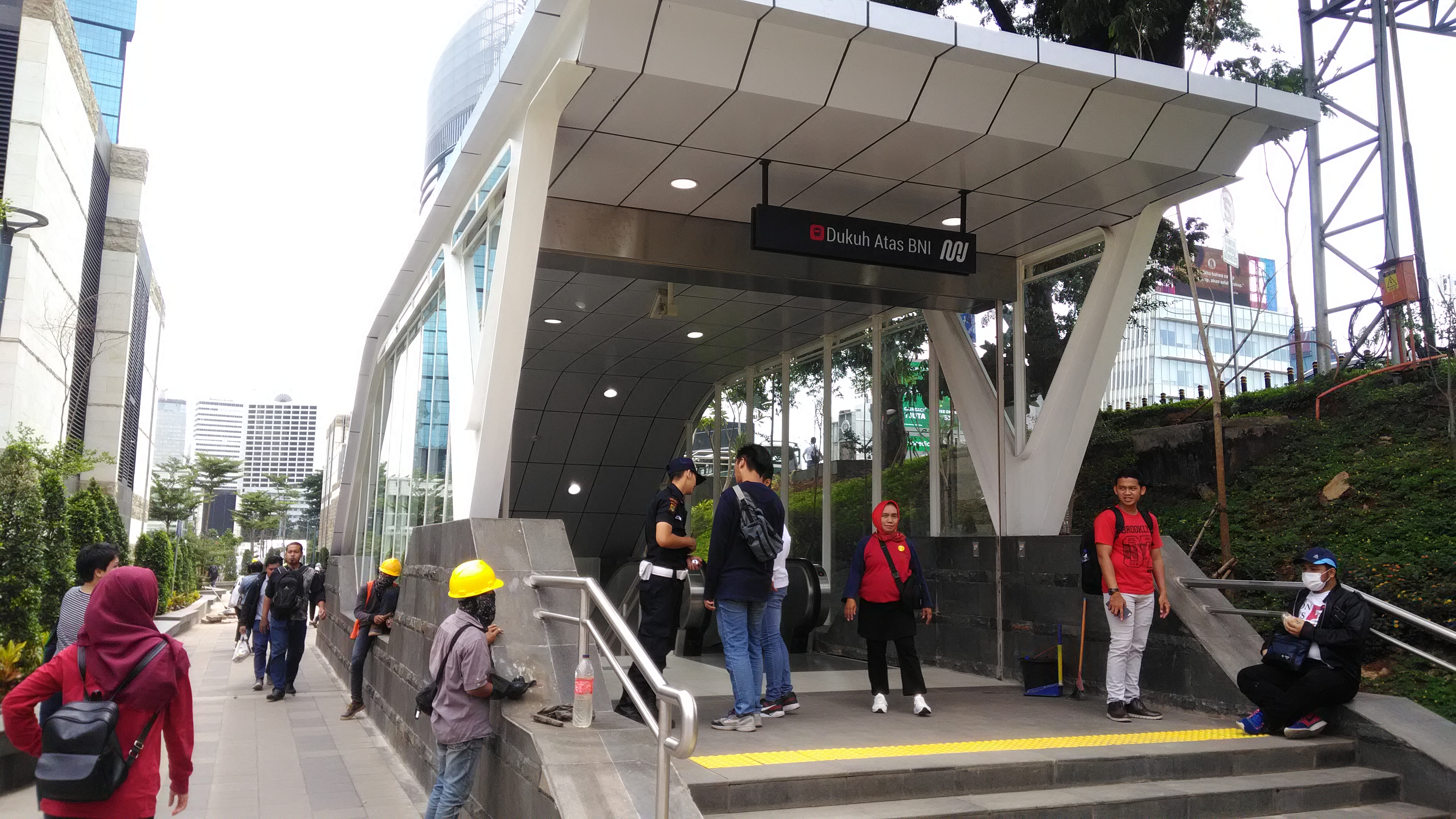
In March 2025, Bank Indonesia, in close coordination with the Ministry of Transportation and the Provincial Government of DKI Jakarta, launched the showcase deployment of QRIS Tap at Bundaran HI and Lebak Bulus stations, extending integration across Damri bus fleets and RoyalTrans premium suburban shuttles. The operational mandate was straightforward: measure real-world passenger throughput, observe failure edge cases, and evaluate the stability of the national switching network under instantaneous transaction bursts.
The telemetry collected from these deployments confirmed the radical efficiency of the radio link. At peak hours, turnstiles equipped with QRIS Tap NFC readers achieved sustained throughput rates of thirty-two passengers per minute per gate, closely approaching the theoretical maximum throughput of dedicated plastic smart cards (thirty-four to thirty-six passengers per minute). By contrast, adjacent gates operating solely on optical QR code scanners languished at twelve to fourteen passengers per minute, generating visible queues that spilled backward across the station concourse.
Commuter feedback revealed qualitative improvements that never appear on engineering protocol diagrams. In Jakarta's humid tropical climate, condensation on smartphone screens or protective glass screen protectors frequently rendered optical QR scanning erratic. Commuters carrying umbrellas, briefcases, or shopping bags struggled to position their devices at the precise focal distance required by optical camera lenses. With QRIS Tap, physical orientation is largely irrelevant. Because the 13.56 MHz magnetic field radiates spherically around the turnstile antenna, a commuter can tap the top, side, or back of their smartphone against the acrylic target, or even hold the device two centimeters above the surface without touching it, and the electromagnetic coupling establishes instantly.
Furthermore, the expansion of QRIS Tap beyond rapid transit into hospital outpatient registration at RSUD Tarakan, RSCM Kencana, and RSPAD Gatot Soebroto Paviliun Kartika demonstrated the cross-sector utility of the standard. In healthcare environments where hygiene and physical contact are primary concerns, contactless radio handshakes eliminate the necessity of handling paper queue tickets, passing payment cards back and forth with registration clerks, or touching shared point-of-sale keypads. The same digital token that clears an underground subway barrier registers an outpatient arrival in under half a second.
💳 Offline Risk Engines and Transaction Thresholds in the Real World
Achieving a 0.3-second transaction at a transit turnstile introduces an acute financial engineering dilemma: how does the system maintain rigorous security and prevent fraudulent account draining when the transaction must conclude before an online banking server can execute a full database round-trip?
In standard online retail transactions, an electronic payment terminal connects across the public internet to an acquiring bank, which queries a national switch, which routes the request to an issuing bank, which verifies account balances, deducts funds, and transmits an authorization approval back to the merchant. This entire round-trip network transit time rarely completes in under 800 milliseconds, and in congested cellular environments can easily exceed two to three seconds. If a transit turnstile waited for an online banking host to confirm that an individual commuter possessed five thousand rupiah before unlocking its barrier, the passenger would collide chest-first with a locked steel gate.
The solution implemented across global mass transit systems and adapted for QRIS Tap is the deployment of hybrid transaction risk engines combined with asynchronous offline data processing. To maintain absolute physical velocity at the gate, the turnstile terminal executes what the EMVCo standard classifies as Offline Data Authentication (ODA) using fast cryptographic primitives.
When the commuter's smartphone transmits its QRIS CPM payload via APDU frames, the payload contains a cryptographically signed transaction certificate generated by the issuing bank or digital wallet backend when the token was refreshed. The turnstile terminal, which maintains an offline cache of verified public root certificates issued by the national payment authority, performs immediate local asymmetric verification. The terminal validates:
- That the digital signature was executed by a certified Indonesian Payment Service Provider (PJP).
- That the token's expiration timestamp has not elapsed.
- That the cryptographic transaction counter inside the payload has incremented sequentially, proving that the token has not been intercepted and replayed from an earlier transaction.
- That the device's masked account identifier does not appear on the transit operator's locally synchronized hotlist of suspended, blocked, or delinquent accounts.
If these four cryptographic checks pass, the turnstile immediately fires its mechanical relay, unlocking the barrier and recording a local transaction receipt. The entire mathematical validation occurs in the terminal's local microprocessor memory in less than seventy milliseconds. Only after the commuter has passed safely through the barrier does the turnstile batch the transaction receipt and forward it asynchronously across a dedicated fiber-optic network to the clearing switch for actual monetary settlement against the commuter's bank account or digital wallet balance.
To mitigate credit risk and protect consumers against unauthorized contactless deductions in crowded environments, Bank Indonesia and ASPI established stringent architectural safeguards. For transit and low-value retail transactions, QRIS Tap enforces a strict per-transaction ceiling (typically set at a maximum of one million rupiah without requiring a personal identification number or biometric confirmation). Transactions exceeding this threshold require the smartphone application to prompt for biometric authentication (fingerprint or facial scan) or PIN entry before releasing the payment payload across the radio interface.
Additionally, Android's HCE implementation includes built-in operating system security barriers. By default, Android disables Host-based Card Emulation when the smartphone's screen is completely locked and dark, preventing surreptitious pocket-skimming attacks using portable NFC readers. A commuter must awaken the device screen, demonstrating conscious physical intent, before the operating system permits the HostApduService to respond to external APDU polling commands. These layered physical, cryptographic, and behavioral controls ensure that the elimination of optical friction does not come at the expense of systemic financial integrity.
🌐 The National Transit Rail and What Comes Next for Contactless Indonesia
The successful deployment of QRIS Tap across Jakarta's rail and bus networks marks a definitive turning point in Indonesia's digital economic infrastructure. What began in 2019 as a national campaign to replace physical cash with standardized two-dimensional barcodes has matured into a sophisticated, multi-modal payment fabric capable of bridging optical and radio frequencies without fragmenting underlying settlement channels.
The strategic trajectory outlined by Bank Indonesia and the Ministry of Transportation envisions a unified national transit ticketing architecture spanning thirteen provinces. As QRIS Tap rolls outward from Jakarta's initial showcases to encompass the full commuter rail footprint of Jabodetabek, the Yogyakarta-Solo electric rail line, regional BRT systems operating under the Teman Bus banner, toll road electronic toll collection plazas, and municipal parking networks, the boundary between specialized transit cards and general-purpose digital banking accounts will effectively dissolve.
For consumers, the practical implications are transformative. The daily commuter is no longer forced to juggle five different plastic cards issued by competing commercial banks, maintain fragmented balances across disparate closed-loop accounts, or monitor physical card expiration dates. The smartphone becomes a universal transit pass and debit token, drawing funds directly from savings accounts, server-based electronic money, or linked credit facilities at the user's discretion.
For the broader technology industry, the story of QRIS Tap offers profound architectural lessons. It demonstrates that technological evolution does not always require dismantling existing infrastructure to build speculative new paradigms from scratch. By treating the established QRIS CPM payload as an abstract data container and adapting its transmission from optical photons to inductive radio waves, Indonesian software engineers unlocked world-class transit speeds while preserving a multi-billion-dollar national clearing investment.
The remaining frontier is the resolution of platform equity. As regulatory scrutiny over mobile platform monopolies intensifies across the European Union, the United States, and emerging Asian economies, the pressure on walled-garden gatekeepers to offer unencumbered access to hardware radio peripherals will only grow. When the day arrives that an iPhone can converse as freely with a Jakarta transit turnstile as a domestic Android handset, it will not be because a corporate platform voluntarily opened its gates, but because sovereign national payment standards and the undeniable physics of commuter transit left it no other choice.
Sources: Bank Indonesia Official News Release No. 27/58/DKom (QRIS Tap Launch & Implementation), DANA Indonesia Engineering Documentation (Host-Based Card Emulation & APDU Protocol Specification), Google Developers Android Open Source Project (NFC HCE Architecture), Apple Developer Technical Documentation (NFC & SE Platform Entitlements), International Organization for Standardization (ISO/IEC 14443 & ISO/IEC 7816-4 Standards), and Indonesian Payment System Association (ASPI) Regulatory Guidelines.