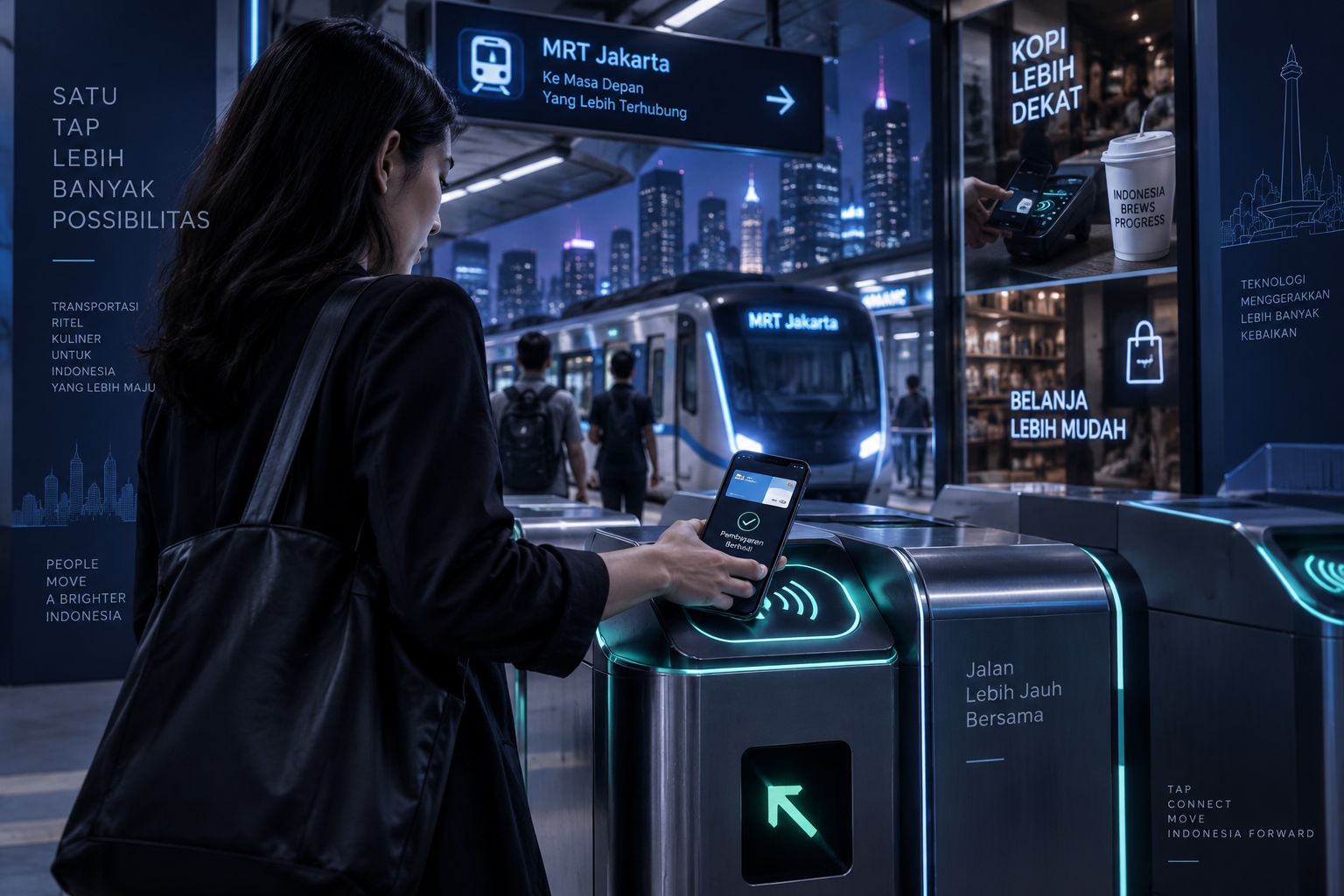
QRIS Tap asks you to do something deceptively ordinary: open a payment app, authorise a transaction and bring your phone close to a terminal. The movement looks much like using a contactless card. Yet the success of that movement depends on a chain of agreements between a phone, an operating system, a payment provider and a merchant or transport operator. Owning a phone with NFC is only one link.
Bank Indonesia launched QRIS Tap on 14 March 2025. Its current public guidance distinguishes single payments from entry-and-exit transactions and describes initial availability through Android payment applications. For someone preparing to catch a train or pay at a checkout, those distinctions matter more than the promise of a faster gesture. This is a field guide to what the gesture actually requires, what the official documents establish and what still needs checking with your provider.
🚉 The gate is where the promise meets the passenger
Imagine arriving at a station with enough money in a banking account and a phone you know has NFC. You have used that phone to read a card balance before. It is reasonable to expect the next step to be simple. But reading a card, presenting a payment credential and asking a transport system to calculate a fare are different tasks. A successful experience requires the correct service at both ends of the interaction.
The Bank Indonesia launch release provides a useful historical baseline. It named Bundaran HI and Lebak Bulus MRT stations, Royaltrans services, selected DAMRI services, parking locations and several hospitals among the initial uses. It also described further expansion as a subsequent phase. That release is evidence of the launch programme, not a current directory of every working gate. A planned location and an operating location should never be treated as interchangeable.
For a passenger, the practical unit of compatibility is a particular journey. Does the station accept QRIS Tap through the app you use? Does the destination support the corresponding exit process? Are there operator instructions about entering and leaving with the same payment method? These questions should be answered before a busy journey rather than discovered while other passengers wait behind you.
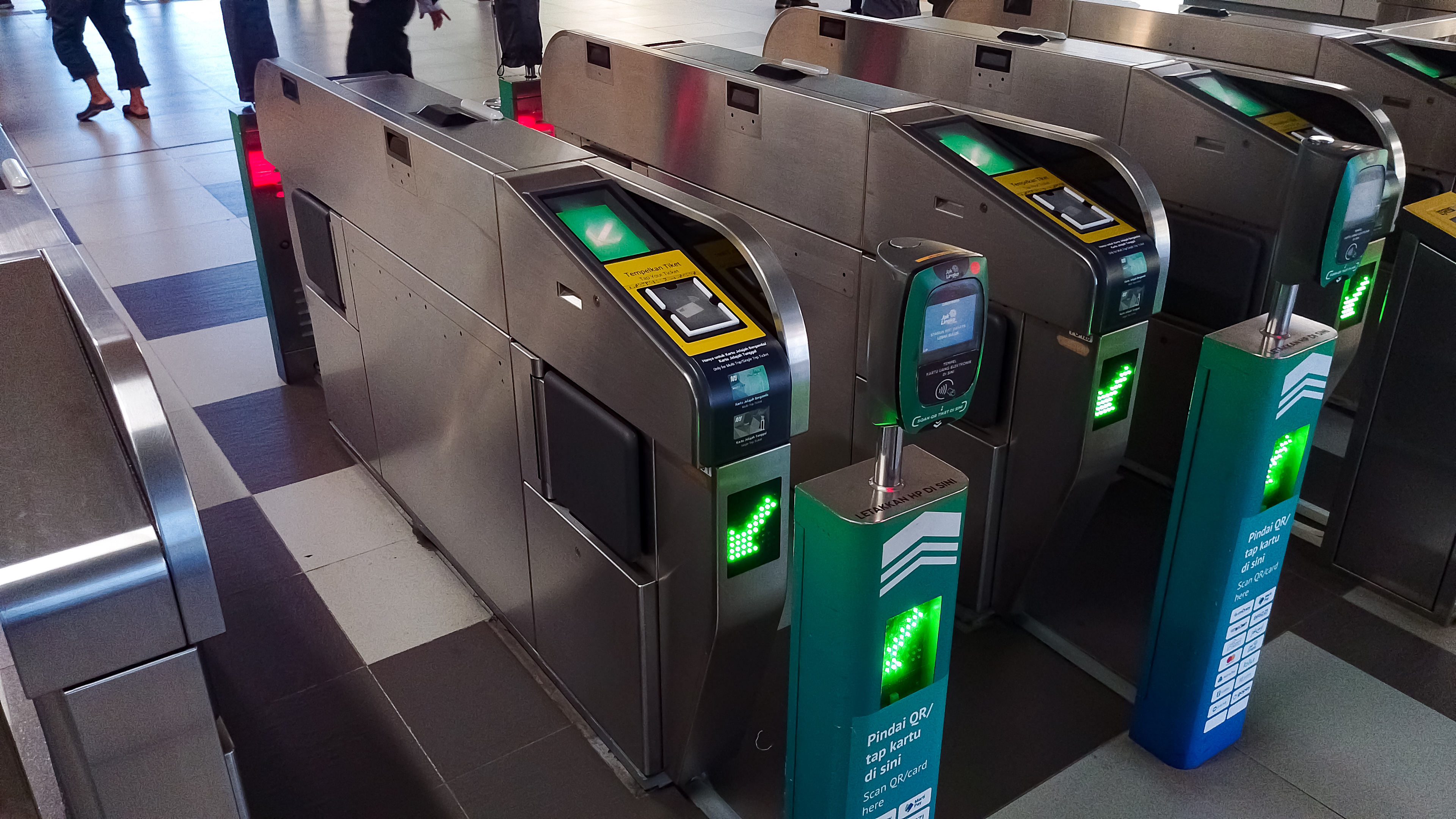
The photograph below records physical ticket gates in the Jakarta MRT system. Its source describes different payment readers, including a validator supporting QR transactions. It does not prove that every reader in the photograph has QRIS Tap enabled. That distinction is worth keeping visible: a photograph of a machine can show its shape and placement, but a service's acceptance rules come from the operator and provider.
There is no need to turn this into a contest between cards and phones. A working card can be a sensible backup while a new payment route is being checked. The useful question is whether your chosen method can complete the actual trip. A more impressive phone does not answer that question by itself, and a familiar payment logo does not replace a route-specific instruction.
📡 A familiar payment standard gets a different interface
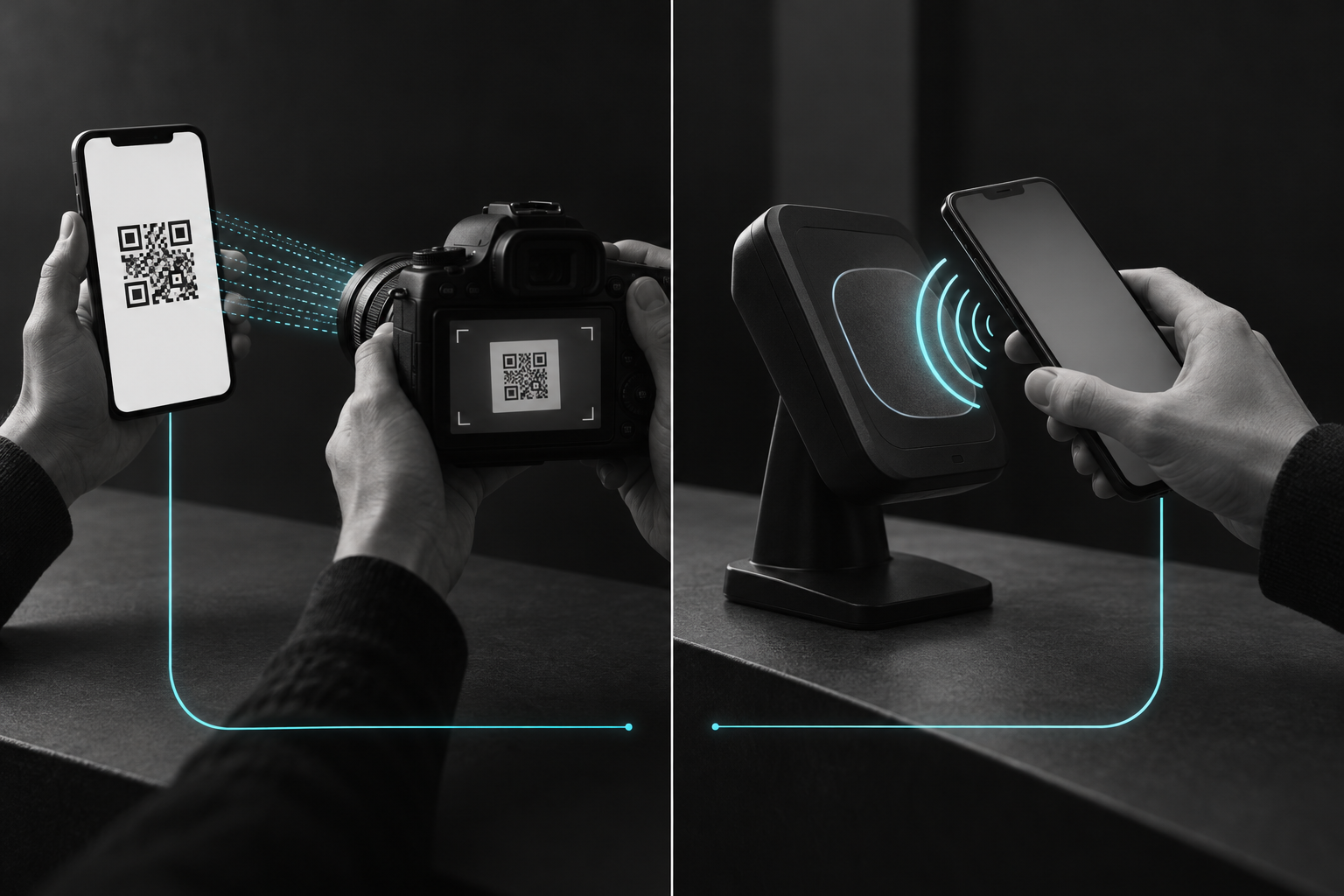
QRIS Tap belongs to the QRIS ecosystem even though there need not be a visible QR code in the transaction. Bank Indonesia's December 2024 trial release explains the relationship clearly: the service uses the messaging standard previously developed for QRIS Consumer Presented Mode, or CPM, while changing the interface to NFC. The name therefore identifies a payment framework, not a requirement to use a camera.
In consumer-presented QR payments, the customer presents a code for the merchant to scan. In the QR payments many people associate with a printed counter sticker, the customer instead scans the merchant's code. These are different directions of presentation. Treating every QR transaction as the same action makes the move to tapping unnecessarily confusing. The party presenting the payment data and the medium carrying it are separate questions.
NFC supplies a short-range radio interface. The phone and a compatible reader communicate when brought close together. An optical code has to be captured as an image; an NFC exchange does not require a camera to frame that image. This explains the change in the physical gesture without proving an exact end-to-end transaction time. App preparation, authorisation and service processing remain part of the experience.
Jaringan PRIMA's July 2025 explanation also describes QRIS Tap as combining QRIS CPM with NFC. It promotes rapid transactions and gives a figure below 0.3 seconds. That is the provider's stated performance claim, not a stopwatch result from this article. Readers should not interpret it as the time required to unlock a phone, find a menu, enter an authorisation and finish every possible payment under every network condition.
This is where a narrow claim is more useful than a grand one. NFC removes the optical scanning step from this payment interface. It does not establish that cameras have become obsolete, that all printed QR codes will disappear or that radio communication eliminates every cause of delay. At a small shop, scanning a printed code may remain entirely adequate. At another location, a supported tap may be preferable. The payment context decides which benefit matters.
📱 NFC hardware does not make every app a payment card
Bank Indonesia's FAQ says a user needs an NFC-capable device and an account with a provider offering QRIS Tap. It describes the initial service as available through mobile banking and payment apps on Android smartphones. It also says availability for other operating systems will be announced when ready. That is a service-specific statement. It is more precise than saying that any phone with a contactless symbol can participate.
Android's official developer documentation helps explain why the app layer matters. Android 4.4 and later offer host-based card emulation, known as HCE. In this architecture, data can be routed to the phone's host processor rather than directly to a separate secure element. An application can implement a service that communicates with an NFC reader. The operating system also has rules about selecting the appropriate service.
Those capabilities are general Android architecture. They are not public proof that every QRIS Tap bank uses an identical implementation. The distinction prevents a common leap from a platform feature to an assumed payment product. A developer document can explain what software is able to do; a provider's instructions establish what that provider has actually made available to a customer.
Android documentation also separates device support from application behaviour. Apps can check whether HCE is present, register application identifiers and manage which service a reader selects. Payment-category apps have foreground or default-app conditions. The engineering details need not become a passenger's checklist, but they explain why simply enabling an NFC switch cannot substitute for activating the right payment feature.
A phone that reads a transit card is demonstrating a reader function. A phone that participates in a supported payment exchange is performing a different role. The same antenna may be involved, but the software and service arrangement differ. When troubleshooting, ask what function is failing rather than treating every NFC use as a single universal capability.
Before buying a device specifically for QRIS Tap, check the bank or wallet's device requirements and the relevant app instructions. Do not use a generic product specification as your only evidence. Hardware specifications, software availability and payment-provider participation need to line up. If the provider cannot confirm a particular device or app version, that uncertainty belongs in the purchase decision rather than being dismissed as a minor detail.
🍎 The iPhone question needs a service answer
An iPhone can contain NFC hardware without a particular Indonesian payment app offering QRIS Tap. That is the simplest way to understand the apparent contradiction. A component's presence says something about the device. A functioning payment service says something about permissions, implementation, commercial arrangements and deployment as well. These are not competing descriptions of the same fact.
Apple's NFC & SE Platform documentation describes APIs introduced with iOS 18.1 for authorised developers to support secure contactless transactions within compatible apps. The platform uses the Secure Element, Secure Enclave and Apple servers. Its documentation lists eligible uses, territories, agreements, approval steps and testing requirements. This is a managed integration path, not an instruction that any downloaded payment app can immediately behave as a contactless card.
The documentation also describes selecting an eligible default contactless app, initiating transactions and authenticating the user. Developers must request access and meet the requirements for the capability they intend to offer. Those conditions show why a hardware comparison alone cannot settle a service availability question. They do not establish which QRIS Tap providers have completed a particular integration or what their launch dates might be.
For now, the defensible advice rests on Bank Indonesia's published QRIS Tap guidance: check the supported Android route and wait for a provider or regulator to announce another operating system's actual availability. Do not substitute speculation about an upcoming iOS version, an unofficial workaround or an unrelated international wallet for that confirmation. A phone's ability to make one kind of NFC payment does not guarantee another.
It is tempting to call this a simple story of an open platform and a closed platform. That label leaves out important details. Android also has application-routing and default-service rules. Apple has a documented access process for eligible integrations. The relevant issue for a reader is narrower and more actionable: can the specific app, on the specific device, perform the specific payment here? The answer must come from the deployed service.
🔓 Authorise first, then bring the phone to the reader
Bank Indonesia describes a sequence that starts inside the payment application. Open mobile banking or another supported payment app, enter the QRIS menu, choose QRIS Tap, select the source of funds, authorise the transaction and bring the phone to the merchant's terminal. The exact screens depend on the provider. The sequence is useful because it separates preparing a payment from physically presenting the phone.
Preparation is the part you can do deliberately. Confirm that NFC is enabled, the app contains the feature and the selected account or funding source is the one you intend to use. Read the provider's instructions before approaching a terminal for the first time. If you cannot find QRIS Tap in the app, a successful ordinary QR scan does not prove that the tap feature is active.
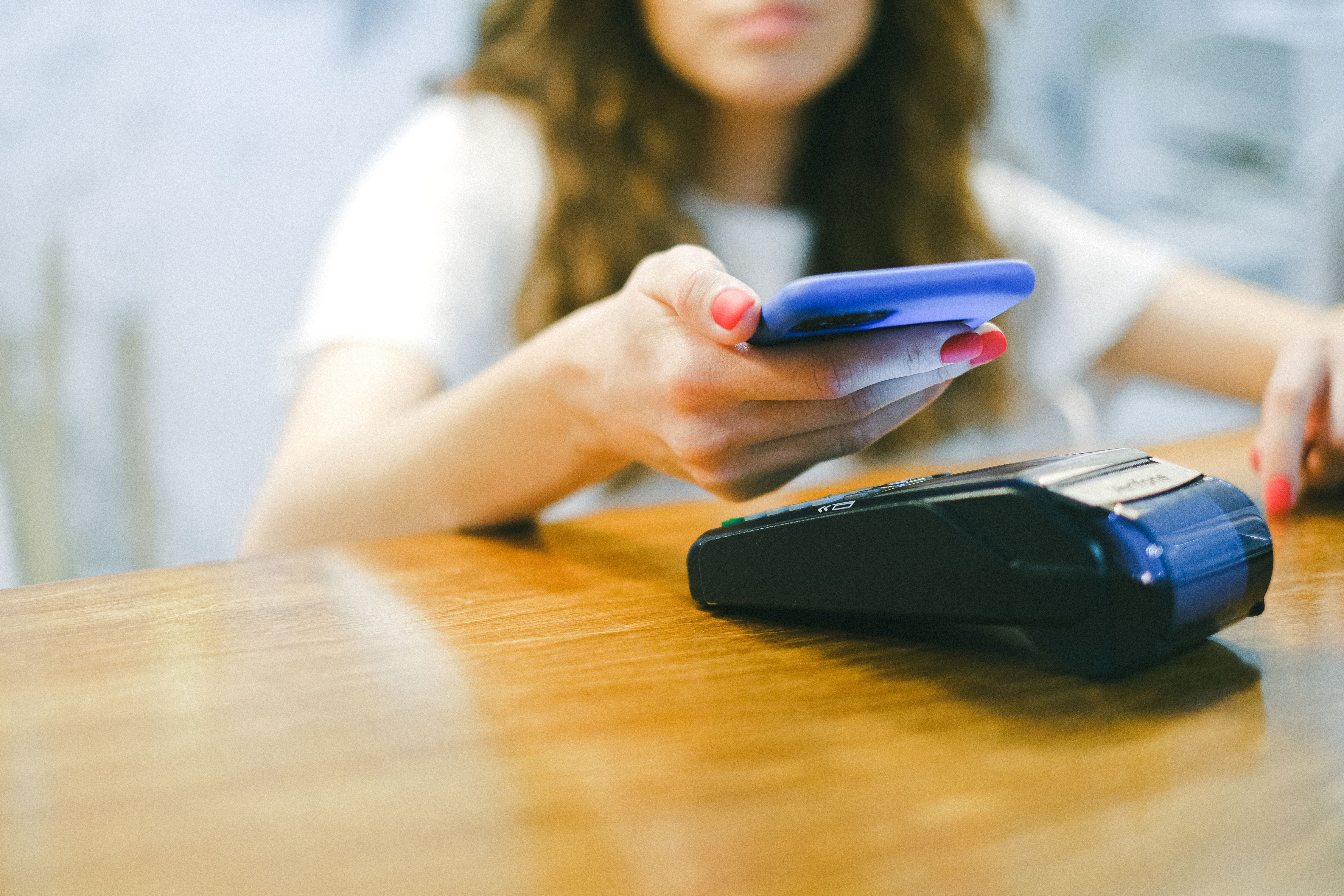
At the terminal, follow the reader's placement instructions and look for the service's transaction result. A physical tap is an attempt, not proof of payment. If the app and terminal give conflicting information, pause and ask the merchant or operator to check rather than assuming the sound or movement completed the financial transaction. The distinction matters whether the method is a card, a code or a phone.
Here is a practical pre-journey check rather than a claim about every provider's exact interface:
- Confirm that your device and operating system meet your provider's QRIS Tap requirements.
- Check that the feature appears in the app and that its setup instructions are complete.
- Confirm the intended funding source and enough available funds for the transaction.
- Verify that the merchant or transport operator explicitly accepts QRIS Tap for your use case.
- Know where to obtain help if entry, exit or the payment result is unclear.
- Keep a working alternative for an unfamiliar route or location.
These checks are deliberately ordinary. They do not require knowing an application identifier or radio protocol. They turn a broad promise into observable conditions. A payment method becomes convenient when its instructions fit the reader's actual situation, not when the user has to infer hidden compatibility rules from a list of device specifications.
🔁 Entering and leaving are different payment events
Bank Indonesia distinguishes Single Tap from Tap In Tap Out. Single Tap is designed for a one-off payment with a fixed price. Tap In Tap Out supports dynamic fare calculation based on distance, time and user profile in services such as public transport and parking. In the second case, recording the beginning and end of a journey contributes to the calculation. An entry interaction alone is therefore not the whole service.
This distinction changes how to read the word “accepted”. A shop may need only to process the displayed purchase amount. A transport system may need to associate an entry with an exit and apply its tariff rules. The radio interaction is only part of that task. Readers should check the operator's instructions about the payment method used at both ends and the procedure for an incomplete journey record.
Bank Indonesia's October 2025 explanation presents Tap In Tap Out as an extension of QRIS into public transport. It is useful background for understanding the product's purpose. It should still be read with its date attached. A historical article cannot tell you whether a specific station reader is working today, whether a particular app has changed its flow or whether a service disruption affects your trip.
For a first attempt, avoid experimenting when you are late or navigating an unfamiliar interchange. That is practical advice, not a measured claim about error rates. Give yourself room to read the signage and ask an operator about the exit procedure. If the entry succeeds but the exit does not, follow the operator's recovery process rather than repeatedly changing payment methods and hoping one will settle the record.
The purpose of a travel payment system is a completed journey with an intelligible charge. An elegant entry gesture is only one moment in that journey. Good instructions should make the destination, the applicable fare and the recovery route as understandable as the tap itself. That is a useful standard for evaluating the service without inventing performance figures or judging it by a promotional demonstration alone.
🏪 A printed QR code and an NFC terminal can coexist
There is no reason to assume QRIS Tap makes a merchant's printed QR code worthless. The printed code and the supported NFC terminal provide different interfaces within a payment ecosystem. One can be suitable for a counter where customers have time to scan; the other can offer a different presentation method at a equipped checkout. Their usefulness depends on the merchant's setting and customers.
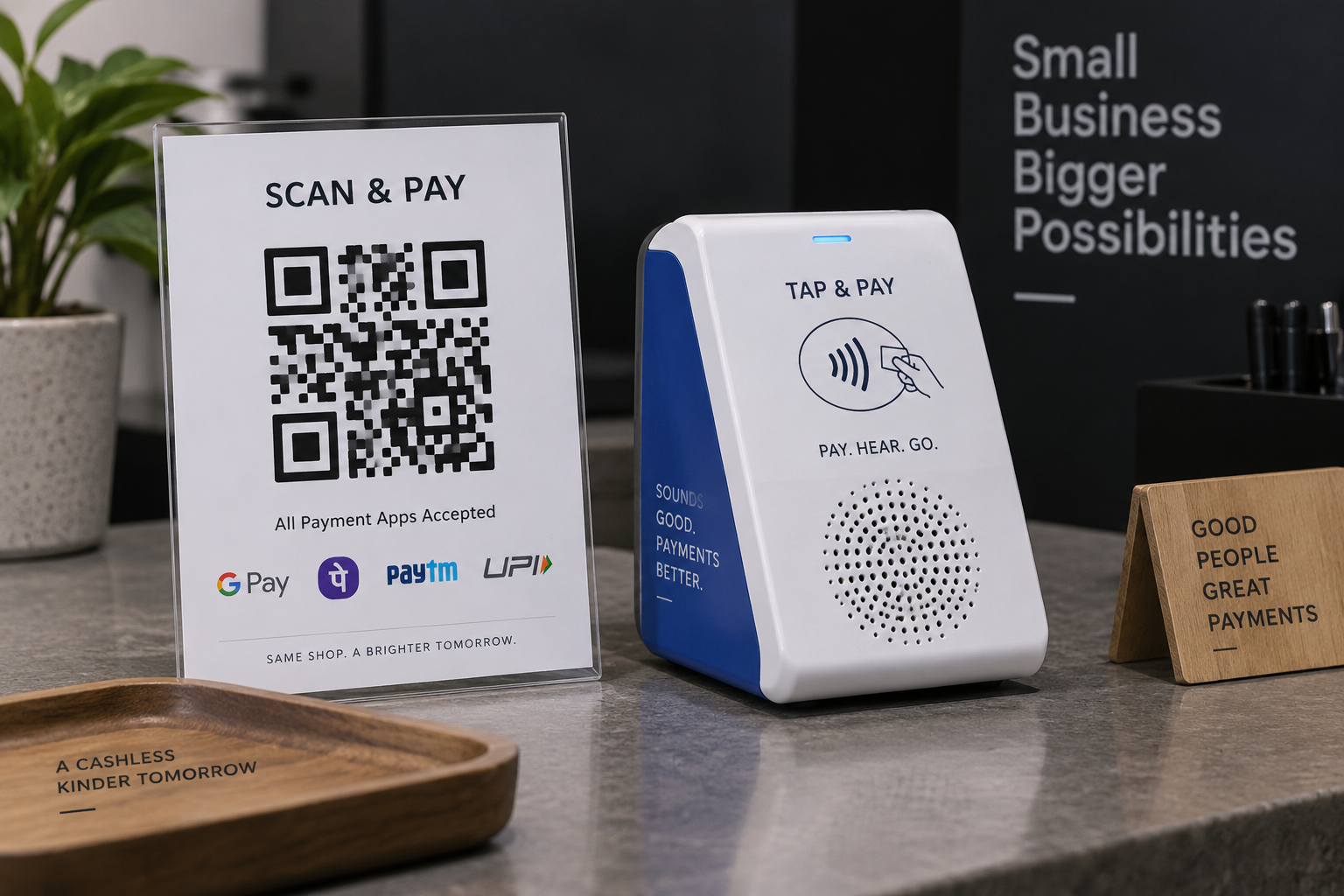
Bank Indonesia says QRIS Tap can be used at merchants with NFC-capable payment terminals that also have the QRIS Tap feature. Both parts of that sentence matter. An NFC reader is not sufficient evidence of the application-level payment service. A contactless terminal configured for another network may need a separate provider-supported arrangement. Merchants should ask their acquirer about actual acceptance rather than treating the hardware symbol as universal permission.
The launch release says users are not charged a transaction fee for QRIS Tap. It gives a zero-percent Merchant Discount Rate for the BLU and PSO categories and places other merchant categories under the applicable QRIS scheme. That is an attributed policy description from the launch document. It is not a complete present-day quote for terminal rental, service subscriptions, connectivity or every merchant category's charges.
A responsible purchase discussion should separate those costs. Ask what equipment is supplied, what service is activated, what ongoing charges apply and how settlement and disputes are handled. Get the current terms from the provider. This article does not offer a terminal price or a return-on-investment estimate because the reviewed sources do not establish those figures for a particular merchant's proposed installation.
For a retailer, keeping both interfaces can be a reasonable design choice if the provider supports it. Customers arrive with different phones and different apps. Offering an additional method should not turn a previously workable transaction into a compatibility test the customer was never warned about. Clear signage can say which tap service is accepted while preserving a familiar scanning option.
🧾 What the official sources prove, and what they do not
Bank Indonesia's trial release establishes the relationship between QRIS CPM messaging and the NFC interface. Its launch release establishes the date, initial examples and described fee policy. Its FAQ sets out user requirements, initial operating-system support and the distinction between fixed and dynamic payment uses. Jaringan PRIMA adds a participant's explanation of the user flow. Android and Apple documentation explain general platform capabilities. Each source answers a different question.
None of these sources gives this article grounds to claim universal offline payment, guaranteed queue reductions or an exact security protocol for every participating provider. NFC is a communications interface. It does not by itself tell us how every bank generates payment credentials, checks balances, handles an interrupted exchange or resolves a disputed fare. Those details require product-specific documentation or provider confirmation.
The same caution applies to availability counts. Bank Indonesia's public page labels its provider list as of December 2025. A reader can use that list as a starting point, but should not treat it as an exhaustive October 2026 inventory. The appropriate final check is the current app and the provider's own instructions. Keeping the reference date visible is more honest than presenting a historical list as live operational data.
There is also a distinction between demand and verified product facts. Recent coverage of GoPay's QRIS Tap presentation at FEKDI shows the subject remains in public discussion. That attention is a reason to explain the service. It is not evidence for every adoption statistic, cross-border claim or transport deployment mentioned in surrounding coverage. The article's practical advice rests on the narrower primary-source record.
A reader should expect uncertainty to be labelled rather than filled with an impressive technical story. We can explain why hardware, software and acceptance need to align without inventing the internals of a proprietary payment flow. That boundary makes the explanation more useful: it directs a real question to the organisation that can actually answer it.
🧭 The useful upgrade is a payment you can finish
The strongest case for QRIS Tap is practical. It offers another way to present payment data within Indonesia's QRIS ecosystem and supports different transaction contexts. For a reader, the next step is to check a supported app, a suitable device and a participating destination. You do not need to buy a phone merely because a new payment gesture looks attractive in a demonstration.
If your current method works, test the new one in a setting where you can recover calmly. If you are choosing a new phone, request service-specific compatibility rather than relying on an NFC specification. If you operate a checkout, confirm the provider's acceptance and support terms before buying equipment. Each decision begins with a different question; none is answered by the word “contactless” alone.
QRIS Tap changes the interface, but the reader's standard can stay simple: the payment should have a clear result, the trip should have a usable exit and the charge should make sense. Until those conditions are established for your app and destination, keep a working alternative. The gate should open because the whole service is ready, not because the phone happens to contain an antenna.
Sources: Bank Indonesia's QRIS Tap FAQ, 14 March 2025 launch release, 20 December 2024 trial release and October 2025 Tap In Tap Out explanation; Jaringan PRIMA's 18 July 2025 guide; Android's host-based card emulation documentation; Apple's NFC & SE Platform documentation. Source dates and service availability should be checked before travel or purchase.