
Every single day, across millions of browser sessions, an unspoken transaction takes place on the modern web. You arrive at an independent news publication to read an analysis of financial markets, navigate to an ecommerce storefront to purchase replacement running shoes, or open a developer portal to consult technical documentation. Before the main content fully renders, an overlay materializes, politely requesting a single piece of personal text: your email address. It promises a morning newsletter dispatch, a ten percent discount voucher on your first transaction, or an unlocked whitepaper.
For more than two decades, web users were encouraged to view this exchange as localized, transactional, and finite. You hand over an email address to a specific business so that business can deliver a specific communication to your inbox. The implicit mental model was simple: if you eventually grow weary of the correspondence, you click the unsubscribe link at the footer of an email, close the browser tab, and the relationship terminates. Your contact details remain bounded within the merchant's private customer database.
That reassuring mental model, however, is a carefully curated fiction. Behind the clean text input boxes, elegant CSS typography, and friendly submit buttons of thousands of mainstream websites sits a sprawling, multi-billion-dollar shadow apparatus known to the digital marketing industry as identity resolution. In this post-cookie architectural landscape, your email address is not treated as a communication endpoint; it is harvested as a universal, permanent biometric key. Long before you even decide whether to press the enter key or complete your transaction, specialized third-party JavaScript libraries quietly intercept the characters you type. They transform your email into a cryptographic hash, transmit it across global ad tech auctions, and mint a persistent digital tracking token that follows your browsing behavior across every phone, laptop, and tablet you own for decades.
On October 19, 2026, Apple and the WebKit engineering team dropped a technical guillotine on this entire ecosystem. In a landmark architectural intervention authored by John Wilander, Charlie Wolfe, and Matthew Finkel, Apple confirmed that Safari 27 across iOS, iPadOS, macOS, and visionOS now systematically blocks network access to identity resolution infrastructure. Rather than continuing an endless game of cat-and-mouse with cookie permissions or script obfuscation, Safari severed the network wire at the operating system socket layer. To understand why this quiet update sent shockwaves through the global advertising technology sector, one must examine how the modern web turned a simple text field into a permanent surveillance clearinghouse.
📬 The Newsletter Form That Quietly Became a Passport Agency
When major browser engines began dismantling third-party cookies between 2017 and 2024, privacy advocates briefly celebrated what appeared to be the dawn of a cleaner internet. Third-party cookies were the crude, noisy tracking mechanism of the early web: small files planted in your browser cache by external ad servers that broadcasted your digital footprint across every site displaying their ad banners. As Apple’s Intelligent Tracking Prevention (ITP) and Mozilla’s Total Cookie Protection walled off cross-site storage and partitioned caches, the digital advertising industry faced an existential revenue cliff.
Yet commercial surveillance does not surrender merely because a browser engine deprecates a legacy storage header. Instead of retreating, the tracking industry engineered what they branded as the addressable web. If browsers refused to store arbitrary third-party identifiers in the client sandbox, ad tech companies realized they could persuade websites to collect genuine, user-supplied identity markers directly. And of all the personal data points a modern human possesses, nothing matches the persistent utility of a personal email address.

Unlike a third-party cookie, which could be cleared by emptying browser cache or using private browsing mode, an email address is remarkably permanent. Studies conducted by consumer privacy researchers indicate that the average internet user maintains their primary personal email address for ten to twenty years. It is tied to their banking records, their tax filings, their flight bookings, their social media accounts, and their family communications. Furthermore, unlike a smartphone hardware identifier that resets when you trade in a handset, your email spans across your office laptop, your personal tablet, your home television, and your mobile phone.
To exploit this permanence, identity vendors developed lightweight script libraries that publishers and digital merchants embed directly into their website source code. When a visitor enters an email address into a field—whether to read an investigative article, claim a ten percent discount voucher, or download a technical manual—the tracking script activates. In many aggressive implementations, the script does not even wait for the user to press the enter key or click submit; it reads the Document Object Model (DOM) input value keystroke by keystroke or listens for the input element losing focus. Within milliseconds, that personal address is funneled away from the publisher's direct control and into a global identity resolution pipeline.
The publisher rarely develops this tracking mechanism in-house. Instead, they integrate turnkey software development kits provided by third-party identity resolution clearinghouses. In marketing pitch decks delivered to online publishers, these clearinghouses make an alluring promise: by simply installing a three-line JavaScript tag on newsletter forms and login dialogues, the publisher can transform anonymous web visitors into addressable advertising inventory. Even if the visitor never clicks an advertisement or buys a paid subscription, the mere act of entering an email allows the publisher to monetize that reader's global profile across real-time programmatic ad bidding exchanges.
🔐 The Reversible Illusion of the SHA-256 Hash
The core technical defense presented by ad tech firms has always rested on a single cryptographic buzzword: hashing. When companies like The Trade Desk, LiveRamp, ID5, OpenX, and Criteo describe their identity resolution technologies, their marketing literature and privacy whitepapers invariably reassure publishers and regulators that they never transmit or store plain-text email addresses. Instead, they run the string through a mathematical hashing function, most commonly SHA-256, producing a fixed 64-character hexadecimal string.
In corporate compliance briefings, industry spokespeople routinely claim that this cryptographic transformation renders the email anonymous. It is an argument designed to soothe corporate legal departments and evade strict definitions of personally identifiable information under data protection frameworks. In the reality of applied computer science, however, calling a hashed email anonymous is a profound technical falsehood.
A cryptographic hash function is strictly deterministic: the input string [email protected] will produce the exact same hexadecimal digest every single time it is computed anywhere on earth. Because email addresses adhere to strict syntactic formatting rules and a finite namespace of popular domain providers such as Gmail, Outlook, and Yahoo, the entire universe of likely email addresses is computationally vulnerable. Any entity with modest computing power can construct precomputed lookup tables—known in cybersecurity as rainbow tables—or utilize high-speed graphics processing units to calculate billions of potential email hashes per second. Reversing a SHA-256 email hash back into its original plain-text address is not a theoretical cryptographic breakthrough; it is a routine commodity process executed in seconds.
Even when vendors apply proprietary salts or multi-tiered encryption keys to create proprietary identifiers such as Unified ID 2.0 (UID2) or RampID, the fundamental architecture remains unchanged. The identifier is purposely designed to be stable, persistent, and universally recognizable across participating networks. The hash or encrypted token serves as a pseudo-anonymous bridge that allows dozens of disparate commercial databases to speak the same language about the exact same human being.
🕸️ Inside the Multi-Merchant Identity Graph
Once this identifier reaches the identity vendor’s servers, it is merged into what the industry calls an identity graph. An identity graph is an immense relational database that acts as a central digital dossiers registry. It does not merely record that a specific token visited a cooking blog; it continuously connects disparate digital breadcrumbs into a unified profile.
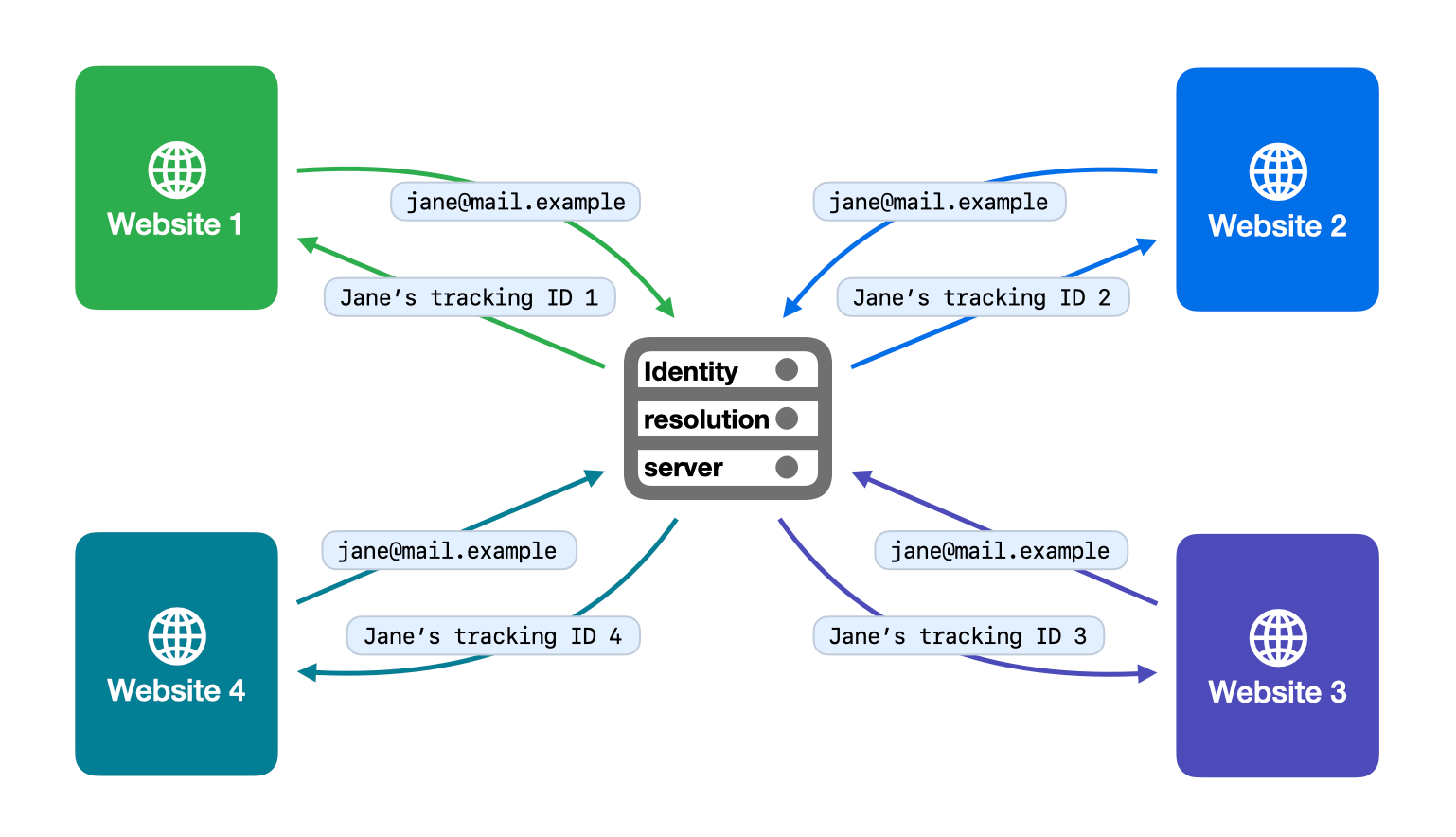
The graph associates your primary email hash with your secondary work email, your residential Wi-Fi network's public IP address, your mobile device's geographic transit patterns, and your historical purchase transactions across dozens of independent merchants. Through this mechanism, every isolated newsletter box on the internet becomes a reporting sensor for an invisible global clearinghouse.
The economic power of the identity graph lies in its compounding scale. When an identity vendor signs up hundreds of publishers and thousands of retail storefronts, the graph grows denser with every click. If you use your personal email to buy pet food on Site A, and your work email to register for a software webinar on Site B, the clearinghouse looks for deterministic or probabilistic links between them. If both sessions ever originated from the same residential IP subnet within the same twelve-hour window, or if a third mobile app ever reported both identifiers from the same physical GPS coordinate, the identity graph links the two emails permanently. What started as two separate, isolated professional interactions becomes fused into a singular, unerasable commercial dossier.
🛒 The Fiction of First-Party Customer Trust
To understand why this infrastructure violates the fundamental privacy contract of the internet, one must draw a firm line between first-party personalization and third-party syndication.
First-party personalization is the normal, expected operation of the web. When you log into an online bookstore, you expect that bookstore to remember the titles sitting in your digital shopping basket, maintain your shipping preferences, and recommend literature based on your past purchases with that specific vendor. The relationship is direct, transparent, and bounded. You provided your credentials to the bookstore, and the bookstore uses those credentials solely within the perimeter of its own service.
Identity resolution destroys this boundary by introducing a predatory third party that acts as an uninvited clearinghouse between businesses that have no direct commercial relationship with one another. Consider the operational reality documented by Apple's WebKit engineers. A consumer visits an online sporting goods boutique looking for winter boots and enters their email address at checkout. Simultaneously, that same consumer visits an independent running website during their lunch break and logs in to read equipment reviews.
Under normal web security models governed by the Same-Origin Policy, the sporting goods store cannot inspect the browsing history of the running publication, and the running blog has no access to the customer records of the retailer. Neither party can spy on the other. But because both sites embed the same third-party identity resolution infrastructure, the central identity resolver bridges the gap. The resolver recognizes the identical email hash across both domains, links the browsing sessions within its internal identity graph, and matches the user's intent. Minutes later, the running blog displays retargeted advertising for the exact pair of boots viewed on the sporting goods storefront.
📱 The Cross-Device Trap You Never Consented To
The consumer never agreed to this cross-site surveillance. When they submitted their email address to the apparel store, they intended to receive shipping updates, not to broadcast their physical lifestyle interests to dozens of advertising auctioneers. Unsubscribing from the apparel store's mailing list or logging out of the running forum does nothing to erase the identity graph entry stored on the resolver's remote servers. The tracking identifier remains permanently etched into the vendor's commercial database, linking past actions to future browsing sessions indefinitely.

Furthermore, identity resolution completely obliterates the distinction between devices. Because modern users regularly log into personal accounts on desktop workstations, mobile phones, and shared family tablets, the identity graph seamlessly joins those separate pieces of hardware into a single behavioral cluster. If you browse a sensitive medical diagnosis on your private laptop, an identity resolver that has previously linked your home IP address and email to your mobile device can auction advertising targeting that specific vulnerability to your smartphone later that evening.
This cross-device linking occurs silently in server-to-server synchronization pools, far beyond the reach of standard ad-blocking browser extensions. Users are left completely powerless: clearing cookies on the phone does nothing because the phone is linked to the laptop via the underlying email hash stored on the resolver's remote cluster.
🧱 Why CNAME Cloaking and Script Sandboxing Failed
For several years, browser privacy engineering focused on containing these abuses through structural sandboxing. Browsers restricted access to local storage mechanisms, prevented third-party scripts from reading document cookies, and randomized device canvas parameters to defeat algorithmic fingerprinting.
The identity resolution industry, however, consistently adapted by shifting their ingestion points. When client-side storage was blocked, tracking vendors instructed publishers to employ first-party cloaking. Under this workaround, known as CNAME cloaking, publishers created DNS aliases such as id.publisher.com that routed tracking requests through their own subdomains before forwarding the payloads to third-party identity brokers.
To the browser's security filters, the network traffic appeared to be first-party communication, effectively bypassing client-side origin controls. Ad tech engineering teams celebrated this technique as an impenetrable shield against browser privacy features. If the browser could not distinguish between a genuine first-party API call and a tracking beacon, the tracking would continue unabated.
🛡️ Safari 27 and the Socket-Level Network Guillotine
Recognizing that syntactic filters and script sandboxes were fighting a losing war of attrition, Apple’s WebKit security team executed a fundamentally different maneuver in Safari 27. The technical strategy is outlined with surgical clarity in their October 19, 2026 publication:
Rather than attempting to inspect the complex, encrypted payloads traveling inside HTTP requests or guessing whether a particular script parameter represents a hashed email, Safari 27 enforces network-level domain blocking directly at the operating system network stack across iOS, iPadOS, macOS, and visionOS.
When Safari renders a web page, the browser cross-references all outbound network connection targets against a cryptographically maintained registry of known identity resolution infrastructure. If an embedded script, image beacon, or asynchronous fetch() call attempts to initiate a network handshake with a recognized identity resolution domain—such as servers operated by LiveRamp, ID5, or The Trade Desk—the browser terminates the connection immediately.
This architectural intervention operates with brutal efficacy:
- Socket-Level Execution: The network connection is severed before any transmission of data occurs. The HTTP request never leaves the client device, meaning your email address, its cryptographic hash, and your device metadata cannot be transmitted to the broker's servers.
- Immunity to Parameter Obfuscation: Because the block is applied at the destination domain level, tracking vendors cannot evade detection by renaming URL parameters, altering JSON payload structures, or compressing tracking payloads into binary streams.
- Defeating First-Party Cloaking: WebKit’s network inspection traces reverse DNS resolutions and canonical host records. If a publisher uses a CNAME record to disguise an identity broker’s endpoint under a custom first-party subdomain, Safari resolves the underlying target host and blocks the connection if it terminates at identity resolution infrastructure.
- Zero Policy Exceptions: The WebKit architecture grants no exceptions for industry self-regulatory initiatives or proprietary consent frameworks. The block is applied unconditionally across all browsing sessions by default.

By severing the transport pipe entirely, Safari transforms identity resolution from an invisible, ubiquitous background process into an inert block of broken JavaScript. The web page continues to load normally, the user can still read the article or submit their form, but the downstream monetization pipeline that covertly broadcasted their identity to third-party ad exchanges collapses into silence.
The technical elegance of domain-level blocking lies in its finality. In previous eras of web privacy battles, ad tech firms could deploy obfuscated code or websocket tunnels to slip tracking data past browser heuristic filters. When the browser drops the socket connection at the domain level, however, the transport protocol itself fails. The JavaScript code running on the web page simply receives a network error or a connection reset. The browser does not negotiate; it refuses to speak to the identity resolver under any circumstances.
💥 The Panic Inside the $600 Billion Ad Tech Machine
The commercial consequences of Apple’s domain-level intervention were immediate and profound. Within hours of the iOS 27 and macOS 27 general availability rollouts reaching scale in mid-October 2026, programmatic advertising exchanges began recording catastrophic drops in addressable inventory across Apple platforms.
According to telemetry data analyzed by digital publishing intelligence platforms, programmatic ad buyers rely heavily on identity resolution tokens to justify premium bids on open-web inventory. When an ad server can match an incoming impression to a verified identity graph profile with a known purchase history, the cost-per-mille (CPM) bid for that ad slot can reach five to ten times the rate of an untracked, contextual impression.
With Safari 27 dropping network requests to UID2 and RampID endpoints, millions of high-value Apple users abruptly went dark on ad tech dashboards. For the ad exchanges, an impression originating from a Safari browser was suddenly stripped of its identity credentials, reverting to an unprofiled, anonymous session. Programmatic bidding algorithms designed to target specific demographic segments or past web behaviors simply refused to bid, causing immediate revenue contractions for publishers who had built their digital business models around identity resolution.
Industry reactions ranged from desperate engineering workarounds to furious public condemnations. Within days of the rollout, engineering representatives from major ad tech conglomerates began filing urgent bug reports on the public WebKit bug tracker, claiming that Apple’s domain blocks were breaking critical website infrastructure and disrupting legitimate measurement services.
Trade associations representing digital advertisers and ad tech intermediaries issued statements accusing Apple of anti-competitive behavior. They argued that by dismantling third-party identity resolution while simultaneously expanding its own first-party ad network and private search arrangements, Apple was creating an uneven playing field. Industry lobbyists insisted that initiatives like Unified ID 2.0 represented open, transparent, and privacy-conscious alternatives to Big Tech monopolies, providing publishers with the independent monetization tools required to fund open journalism.
Yet Apple’s WebKit team remained uncompromising. In their published technical rationale, Apple pointed out that user consent under traditional ad tech models was an elaborate fiction. When an ordinary person enters their email address to subscribe to a local community newsletter or purchase a pair of running shoes, they are never presented with a clear, intelligible explanation that their email will be converted into a persistent tracking key distributed to hundreds of commercial brokers. Consent notices buried inside eighty-page privacy policies do not represent meaningful consumer understanding. By severing network access to identity resolvers, Apple aligned its browser behavior with the reasonable expectations of the human beings sitting in front of the screen.
The commercial fallout extends far beyond individual publishers. Identity resolution had become the foundational financial architecture for retail media networks, programmatic demand-side platforms, and data management conglomerates. Billions of dollars in corporate acquisitions over the past five years were predicated on the assumption that hashed emails would provide a permanent, unblockable foundation for post-cookie addressability. Apple's domain-level block has effectively demolished that assumption, demonstrating that any business model reliant on covert tracking in the browser exists purely at the pleasure of the platform vendor.
📮 Hide My Email and the Future of Intentional Identity
The showdown over identity resolution in Safari 27 marks the definitive end of the post-cookie transitional era. For five years, the advertising technology complex convinced itself that the elimination of third-party cookies was merely a technical bump in the road—an inconvenient engineering migration from client-side storage tokens to server-side email hashing. Safari’s aggressive domain guillotine has shattered that complacency, proving that the underlying conflict is not about cookies at all. It is about whether third-party corporate entities have a fundamental right to construct universal surveillance graphs of human activity across the open web.
For ordinary consumers, this development brings immediate, tangible relief. Every time you enter your email into a web form using Safari 27, you are no longer involuntarily minting a universal advertising passport. Your identity stays contained within the first-party relationship you actively chose to establish.
Furthermore, the technological ecosystem is increasingly providing consumers with active tools to reinforce this architectural boundary. Services like Apple’s Hide My Email, Mozilla’s Firefox Relay, and Proton Pass allow individuals to generate unique, random forwarding email addresses on the fly for every individual website they visit. When a user submits an alias such as [email protected] instead of their personal name-based email, the entire foundation of identity resolution crumbles. Even if an identity broker manages to intercept that address, the token is mathematically useless for cross-site matching because no other website on earth will ever receive that exact same string. The identity graph is starved of its connective tissue.
For digital publishers, boutique software studios, and independent web creators, the lessons of Safari 27 are equally urgent. Building a digital business upon third-party ad tech tracking scripts has always been a Faustian bargain. In exchange for pennies of programmatic advertising revenue, websites surrendered their most valuable asset—the trust of their readers and their direct audience relationships—to opaque intermediaries who captured the lion’s share of the economic surplus.
The collapse of identity resolution demonstrates that the only sustainable path forward on the modern web is intentional, first-party value creation. Websites that succeed over the coming decade will not be the ones that embed sixteen invisible identity trackers to auction off their readers' attention to the highest bidder. Success will belong to businesses and publishers that offer authentic editorial excellence, build transparent subscription models, utilize privacy-preserving contextual advertising, and treat their visitors' personal contact information with the inviolable respect it deserves.
When you enter your email into a box on the web, it should be an invitation to converse, not a permission slip to be hunted across the digital world. With Safari 27, the browser has finally begun enforcing that simple, humane truth at the network wire.
Sources: WebKit Engineering Documentation: Blocking Identity Resolution Infrastructure (Apple Inc., Oct 19, 2026); WebKit Tracking Prevention Policy (WebKit Open Source Project); PPC Land Industry Report on Safari 27 Identity Infrastructure Blocks; AdExchanger Market Analysis on Post-Cookie Addressability; Apple Support Documentation on Hide My Email Architecture; IETF RFC 9110 HTTP Architecture and Network Privacy Principles.