
For more than a decade, the standard tutorial on building a modern website began with a single, seductive line of HTML: copy a link tag from Google Fonts or another hosted font repository, paste it into the document head, and instantly gain access to thousands of elegant typefaces without touching a single local asset. Web agencies, software startups, and independent digital publishers embraced this pattern as gospel. The underlying promise seemed unbeatable: third-party content delivery networks possessed edge servers across every continent, browser vendors supposedly maintained a shared global cache where popular fonts like Roboto, Open Sans, or Inter were downloaded once and reused across millions of disparate domains, and engineering teams saved the operational headache of converting, hosting, and licensing raw OpenType files.
That consensus has now completely unraveled. Over the past several years, foundational shifts in browser security architecture, international data privacy jurisprudence, and web performance measurement have transformed hosted third-party web fonts from a convenient design shortcut into an active liability. Today, the most meticulously engineered digital products, design-led editorial platforms, and privacy-conscious web applications refuse to load their typography from external CDNs. Instead, they treat typography as a first-class, self-hosted software asset, deployed directly alongside their HTML, stylesheets, and compiled JavaScript.
This transformation is not merely a philosophical preference for self-reliance; it is driven by hard engineering metrics and legal boundaries. When browser engines introduced cache partitioning to prevent cross-site user tracking, the fabled performance benefit of a shared global font cache vanished overnight. Simultaneously, Core Web Vitals penalized the inevitable network latencies, connection handshakes, and layout shifts inherent in chaining external style sheets to font binaries. When European courts subsequently ruled that dynamic IP address transmission to third-party font servers violates privacy regulations without prior explicit consent, the operational equation settled permanently. With the standardization of variable WOFF2 fonts, which compress an entire family's weights and widths into a single lightweight binary, self-hosting has transitioned from an arduous specialized routine into the definitive architectural standard of modern web craftsmanship.
🌐 The illusion of the shared browser cache
To understand why the web font ecosystem fractured, one must examine the foundational assumption that sustained third-party font hosting throughout the 2010s: the shared HTTP cache. In the early architectural era of the web, browser caches operated globally across all visited origins. If a visitor navigated to a news website that loaded the Open Sans regular weight from a public CDN, the browser downloaded the font binary, validated its HTTP caching headers, and stored the asset in an origin-agnostic disk cache. When that same visitor subsequently visited your e-commerce storefront, portfolio site, or client dashboard thirty minutes later, your website theoretically enjoyed a zero-latency font load. The file was already residing in memory, sparing the user a round-trip network request.
This architectural model rested on an innocent assumption about web security that modern security researchers systematically dismantled. A shared, cross-origin cache enables sophisticated timing attacks and cross-site user profiling. By measuring how quickly a specific asset loads in an isolated browser tab, a malicious script running on an arbitrary domain can deduce whether a user has recently visited specific third-party websites. If a particular corporate portal, health clinic, or political organization embeds an obscure web font from a public repository, a tracking script can probe the browser cache for that exact URL. If the asset resolves in two milliseconds rather than one hundred milliseconds, the script infers prior visitation with remarkable statistical accuracy.
Furthermore, dynamic third-party font requests transmit sensitive user identifiers directly to the hosting infrastructure. Every time a browser initiates an HTTP request for a remote font stylesheet or WOFF2 binary, the transmission inevitably carries the visitor's public IP address, precise user-agent string, and the HTTP referer header revealing the exact page URL being visited. This stream of ambient metadata allows the CDN operator to reconstruct detailed user browsing histories across millions of participating websites without placing a single tracking cookie.
Faced with these fundamental privacy and security vulnerabilities, the major browser vendors acted decisively. Apple’s WebKit team led the transition by implementing partitioned caching in Safari. Google Chrome followed suit in version 86, partitioning its HTTP cache by top-level site origin. Mozilla Firefox implemented Network Partitioning shortly thereafter. Under partitioned caching, an asset cached during a visit to one website is isolated inside a private partition inaccessible to any other origin.
The practical impact on web fonts was immediate and total. Even if fifty million websites all link to the exact same Roboto stylesheet on a public CDN, a user’s browser must download that file anew on every distinct top-level domain they visit. The global cache is dead. The primary technical argument for surrendering typographic infrastructure to third-party providers evaporated, leaving web creators with all of the operational risks and none of the purported caching advantages.
⚡ The hidden performance penalty of third-party CDNs
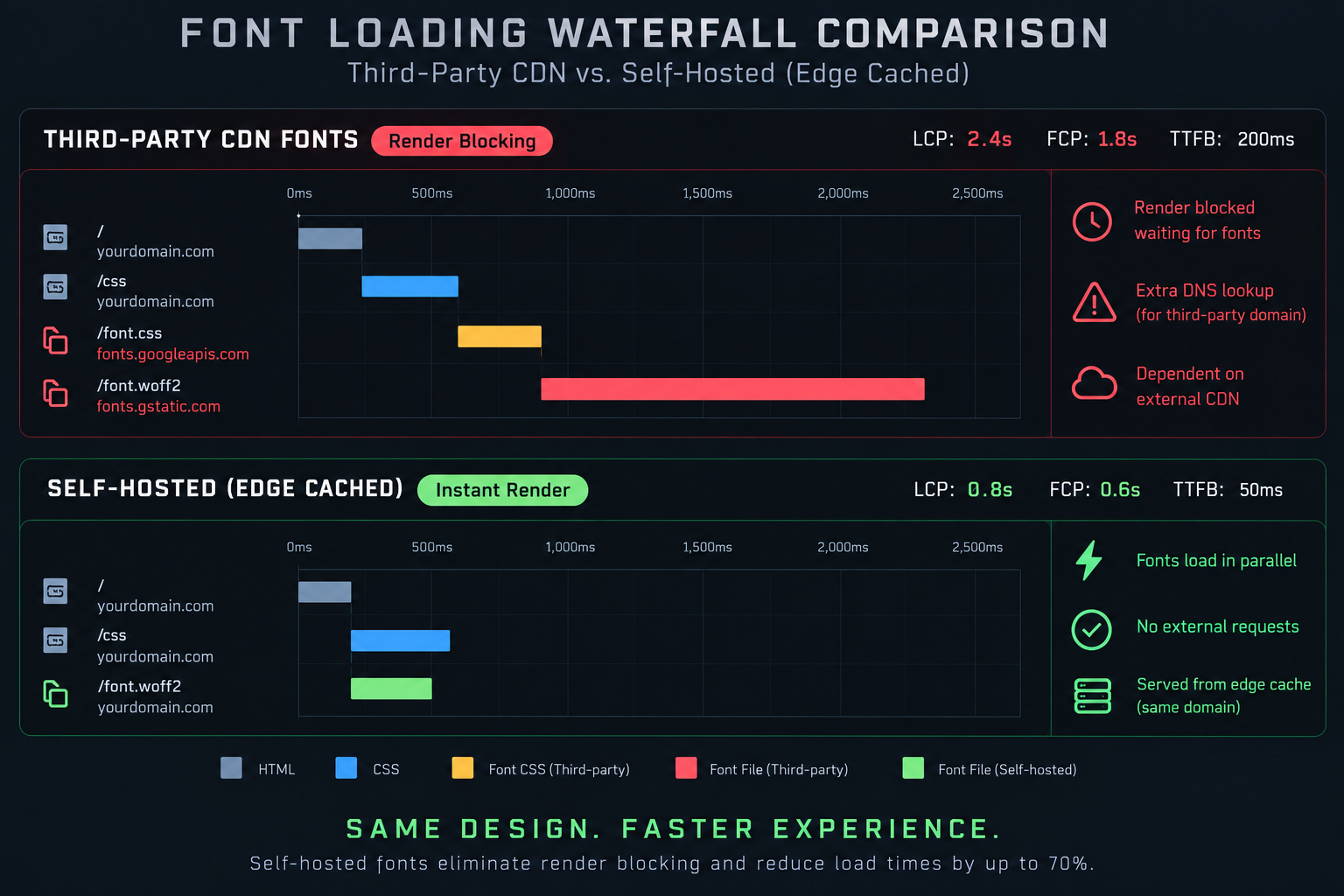
Stripped of cross-site caching, hosted font providers must compete on raw network efficiency, where their architectural design introduces inescapable latency penalties. When an engineering team embeds a hosted font through a standard stylesheet link, they inadvertently initiate a multi-step dependency waterfall that blocks the browser’s critical rendering path.
Consider the network choreography triggered by a typical hosted font implementation. The browser parses the initial HTML document and encounters an external stylesheet reference pointing to an external domain. Before the browser can even discover what font files are required, it must perform a domain name system (DNS) resolution for that remote host, establish a transmission control protocol (TCP) connection, and execute a cryptographic transport layer security (TLS) handshake. In high-latency mobile network conditions, this initial handshake sequence alone can consume between one hundred and three hundred milliseconds.
Once the connection is established, the browser downloads the CSS file. Only upon parsing that stylesheet does the layout engine discover the @font-face declarations containing the actual URLs for the font binaries. Crucially, hosted providers frequently serve their font binaries from an entirely separate sub-domain or secondary CDN infrastructure to optimize static asset streaming. This architectural split forces the browser to execute a second round of DNS resolution, TCP negotiation, and TLS verification against the asset domain before the first byte of the actual typeface can be requested.

During this extended network negotiation, the browser faces an agonizing visual choice: flash of unstyled text (FOUT) or flash of invisible text (FOIT). If the developer specifies font-display: swap, the browser renders the text immediately using a fallback system typeface such as Arial or Times New Roman. Seconds later, when the remote font binary finally arrives from the external CDN, the layout engine swaps the typefaces. Because the glyph metrics, character widths, ascenders, and descenders of the custom font rarely match the system fallback perfectly, this late swap causes paragraphs to reflow, headlines to break onto new lines, and interactive buttons to shift position.
In modern front-end engineering, this visual instability is measured directly by Google's Cumulative Layout Shift (CLS) metric, an essential Core Web Vital that directly affects search rankings and user retention. Alternatively, if the developer omits font-display: swap or uses font-display: block, the browser hides the text completely until the font arrives, producing an empty, ghost-like page that severely degrades Largest Contentful Paint (LCP).
Self-hosting typography completely dismantles this dependency chain. When font files reside on the same origin or are distributed via the website’s primary edge infrastructure (such as Cloudflare, Fastly, or AWS CloudFront), the browser downloads the typeface over an already established, warm HTTP/2 or HTTP/3 connection. There are zero additional DNS lookups, zero redundant TLS handshakes, and zero cross-domain connection overheads. By preloading the primary self-hosted font binary in the HTML head via a preload resource hint for /fonts/brand-font.woff2 as font type woff2, the asset begins streaming concurrently with the site's critical CSS, rendering fully styled typography on the first visual paint.
⚖️ The legal watershed: When font loading became a liability
While front-end architects debated network waterfalls and Core Web Vitals, the legal landscape shifted violently beneath third-party font delivery. On 20 January 2022, the Landgericht München I (Munich Regional Court) issued a landmark judgment (Case 3 O 17493/20) that fundamentally altered the compliance posture of website operators throughout the European Union and across global companies serving European citizens.
The case centered on a website owner who embedded Google Fonts dynamically using the standard remote link method. A visitor discovered that upon loading the page, their personal IP address was automatically transmitted to Google’s servers in the United States without their knowledge, prior informed consent, or a defensible legal basis under the General Data Protection Regulation (GDPR).
The Munich court ruled unambiguously against the website operator. In its detailed reasoning, the court established three crucial legal principles:
First, dynamic IP addresses constitute personal data under Article 4(1) of the GDPR because they can be linked to an identifiable individual through internet service provider records.
Second, the automatic transmission of this personal data to a third-party server located in a non-adequate jurisdiction (the United States) without explicit user consent constitutes an unauthorized disclosure and a direct violation of the user's personality rights.
Third, and most importantly for engineering teams, the court explicitly rejected the website operator’s defense of legitimate interest under Article 6(1)(f) of the GDPR. The court stated that dynamic embedding of external fonts cannot be justified as an overriding legitimate operational interest because a technically equivalent, privacy-preserving alternative exists and is readily accessible to any website operator: downloading the font files and hosting them locally on the site's own servers.
"The appeal of self-hosting is simple: control. When you host fonts on your own infrastructure, you cut out the reliance on a third-party CDN and keep all font requests entirely first-party. This is a big deal for teams working under strict data residency rules or privacy laws like GDPR."
The court awarded injunctive relief and statutory damages, but the commercial ramifications extended far beyond the nominal fine. The ruling catalyzed an aggressive wave of automated legal demand letters across Germany, Austria, and broader European jurisdictions. Thousands of small businesses, creative agencies, and independent websites received formal cease-and-desist warnings demanding statutory compensation for unauthorized IP disclosure caused solely by a single remote font link.
For design agencies and corporate engineering departments, the verdict clarified an uncomfortable reality: outsourcing typographic delivery to a third party creates an uncontainable compliance exposure. Attempting to solve this problem by placing web fonts behind a consent banner creates an absurd user experience, where an unstyled website renders in generic system typography until a user clicks an accept button on a privacy modal. The only legally sound, operationally elegant solution is to eliminate third-party transmission entirely. By self-hosting fonts, the user's connection never touches an external surveillance entity, rendering the entire data transmission question legally moot.
🗜️ How variable fonts changed the byte equation
If the privacy and network arguments against third-party CDNs were so compelling, what prevented widespread self-hosting during the earlier eras of responsive web design? The answer lies in the punishing file weight of traditional static font families.
Historically, a comprehensive typographic hierarchy for a sophisticated publication, brand identity, or enterprise application required an enormous collection of discrete font files. A proper editorial palette might demand an ultra-light weight for delicate subheadings, a regular weight for running body prose, an italic variant for citations, a medium weight for user interface navigation labels, a bold weight for section headers, and an extra-bold weight for promotional calls to action. In the world of static fonts, every single weight and style combination requires a separate binary file.
Under this static paradigm, delivering four distinct weights with matching italics meant downloading eight separate font files. Even with standard WOFF compression, each file typically weighed between thirty and fifty kilobytes. Shipping a rich typographic palette across a digital property easily added three hundred to four hundred kilobytes of blocking assets to the initial page load. Faced with this payload penalty, engineering teams either compromised on visual hierarchy by limiting designs to just two static weights (typically 400 regular and 700 bold), or relied on external repositories that claimed to optimize font delivery dynamically.
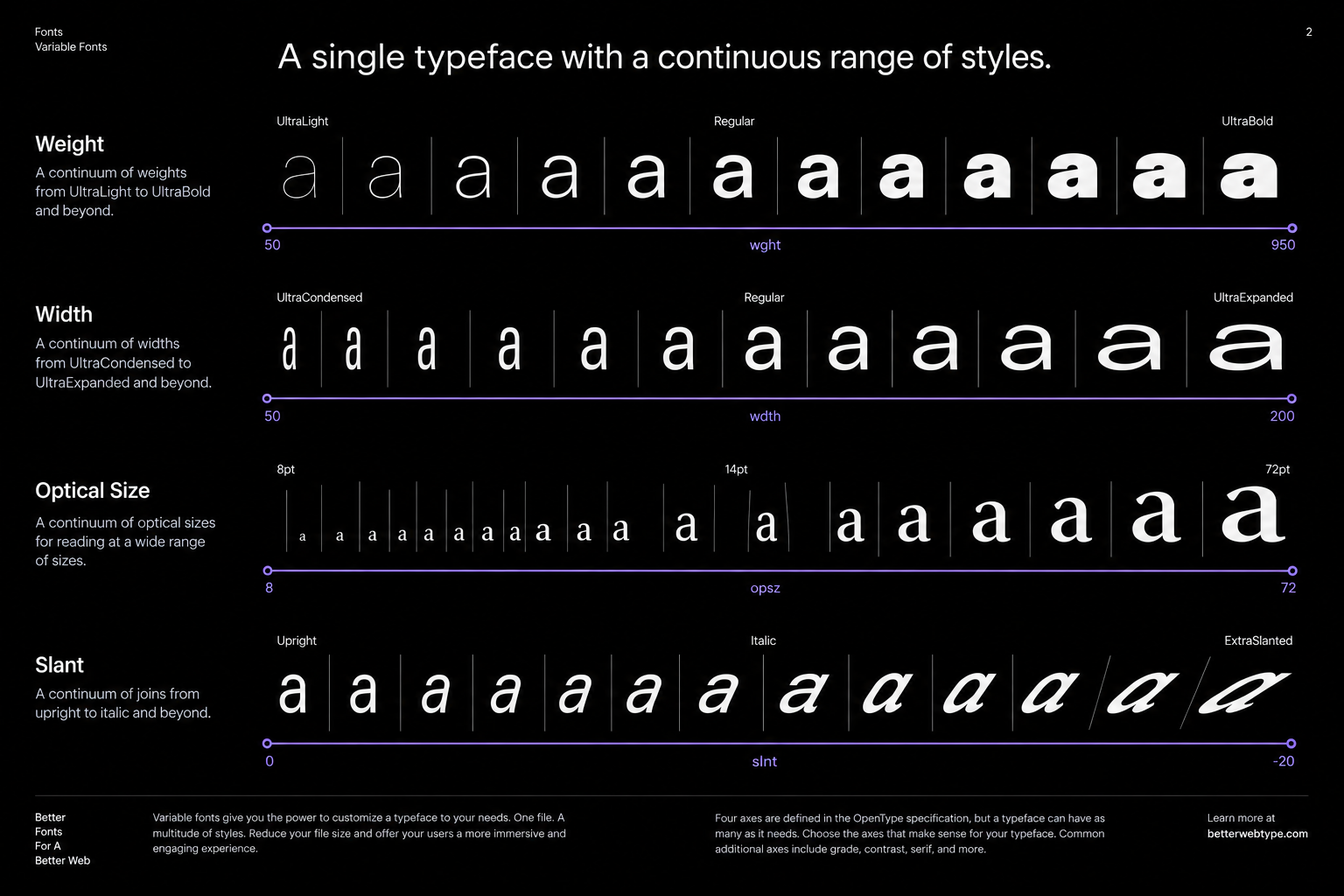
The advent of the OpenType Font Variations specification, universally supported across all modern browsers since the late 2010s, fundamentally changed the physics of digital typography. Instead of storing independent, pre-baked outlines for every weight, a variable font encapsulates an entire design continuum within a single binary file.
At the core of variable font technology is the mathematical concept of variation axes. Type designers define master outlines along with coordinate deltas that dictate how vector control points shift as a parameter varies. The OpenType specification establishes five registered standard axes:
wght: Font Weight, governing the thickness of character stems, typically ranging continuously from 100 to 900 or 1000.wdth: Font Width, controlling the horizontal proportions and condensed or expanded character set.slnt: Slant, allowing programmatic oblique shearing without synthesizing broken letterforms.ital: Italic, handling true cursive alternate glyph substitutions when transitioning from roman to italic.opsz: Optical Size, automatically modifying character contrast, x-height, and spacing depending on whether the text is rendered as small mobile captions or grand billboard display titles.
In addition to registered axes, type designers can define arbitrary custom axes, providing granular programmatic control over serif lengths, ascender heights, or decorative flourishes.
The byte savings realized by this architecture are extraordinary. A single variable font file containing an infinite spectrum of weights from hairline thin to ultra heavy typically measures between forty and eighty kilobytes when compressed with modern WOFF2 (Brotli) compression. In exchange for the file size of roughly one and a half static fonts, the front-end developer gains instantaneous, infinite typographic flexibility. There is no longer any need to choose between design nuance and web performance; a single self-hosted asset serves every editorial and functional requirement across the entire application interface.
🎨 Mastering typography without layout shift
Having a lightweight variable font file on your own server solves the transport problem, but front-end engineers must still address the rendering mechanics inside the browser window. Without careful font loading orchestration, even a self-hosted asset can cause visual layout shift as the browser reconciles system fallbacks with the incoming custom typeface.
The foundation of robust typographic rendering in modern CSS begins with the @font-face declaration. When declaring a variable font, the developer specifies the supported axis ranges directly within the standard CSS descriptor properties rather than relying on legacy vendor prefixes:
@font-face {
  font-family: 'Cabinet Grotesk Variable';
  src: url('/fonts/cabinet-grotesk-var.woff2') format('woff2-variations'),
       url('/fonts/cabinet-grotesk-var.woff2') format('woff2');
  font-weight: 100 900;
  font-stretch: 75% 125%;
  font-style: normal;
  font-display: swap;
}
The font-weight: 100 900 syntax informs the browser's layout engine that this single file satisfies any font-weight rule falling within that range. When a stylesheet requests font-weight: 450 for subtle balance on high-DPI screens or font-weight: 620 for an interactive hover state, the browser interpolates the vector glyphs smoothly without fetching an additional asset or executing synthetic faux-bold stretching.
To eliminate the jarring layout shift that historically plagued font-display: swap, modern CSS introduces font metric override descriptors: size-adjust, ascent-override, descent-override, and line-gap-override. These descriptors allow developers to alter the physical geometry of a system fallback font to match the custom web font down to the exact pixel.
Consider a common scenario where a website uses a modern geometric sans-serif for its headings and body text, with system-ui or Arial as the initial fallback. Because Arial features a lower x-height and narrower letterforms, switching from Arial to the custom font causes paragraphs to expand vertically, pushing the entire page content downward.

By defining a customized fallback @font-face rule with metric overrides, the developer can normalize the fallback’s bounding box:
@font-face {
  font-family: 'Fallback-System';
  src: local('Arial');
  ascent-override: 95%;
  descent-override: 25%;
  line-gap-override: 0%;
  size-adjust: 102%;
}

body {
  font-family: 'Cabinet Grotesk Variable', 'Fallback-System', sans-serif;
}
When the browser renders the initial paint using Fallback-System, the text occupies the exact vertical and horizontal space that the final web font will claim. When the self-hosted variable font finishes streaming and swaps into place, the letter shapes change smoothly, but the page layout does not move a single millimeter. The Cumulative Layout Shift score remains pristine at absolute zero, delivering a reading experience that feels as stable and deliberate as ink on printed paper.
Furthermore, variable fonts unlock dynamic typographic responsive design through CSS clamp(). Instead of managing discrete media queries that abruptly jump font sizes across arbitrary breakpoints, designers can bind optical size and weight directly to viewport dimensions or container widths:
h1 {
  font-size: clamp(2.5rem, 5vw + 1rem, 5rem);
  font-variation-settings: 'wght' clamp(600, 400 + 0.3vw, 850),
                           'opsz' clamp(24, 18 + 0.5vw, 72);
  line-height: 1.1;
  letter-spacing: -0.02em;
}
As the reader resizes their browser window or rotates their mobile device, the typography responds continuously, subtly increasing in weight and tightening letter spacing on larger viewports while gracefully opening character apertures on smaller screens to preserve effortless legibility.
📦 The modern self-hosting toolchain and workflow
The historic resistance to self-hosting web fonts was often rooted in tooling friction. A decade ago, converting desktop TrueType or OpenType files into web formats required navigating archaic command-line utilities, managing messy directories of EOT, SVG, TTF, and WOFF files, and manually writing dozens of lines of repetitive @font-face CSS.
The contemporary front-end ecosystem has completely transformed this workflow through automated, version-controlled developer tooling. For teams building with open-source typefaces, projects such as Fontsource have revolutionized web font management. Rather than downloading raw zip archives from external websites, developers install typefaces directly from npm as structured, versioned dependencies:
npm install @fontsource-variable/interIntegrating the font into an application requires a single import statement in the root layout or global stylesheet:
import '@fontsource-variable/inter';Behind the scenes, the package manager resolves optimized WOFF2 files, bundles them into the application’s static asset pipeline, generates automated content hashes for immutable cache invalidation, and writes modern @font-face rules using proper font-display and unicode-range declarations. The entire process integrates seamlessly into modern continuous integration and deployment pipelines without manual asset handling.
For commercial and proprietary brand typefaces, tools like glyphhanger, subfont, and FontTools empower engineering teams to subset custom font binaries with mathematical precision. Subsetting strips out unused unicode ranges, obscure currency symbols, or unused language glyphs that are unnecessary for the site's target audience. A standard 200-kilobyte Latin commercial font can frequently be subset down to twenty-five kilobytes, preserving complete visual integrity while drastically reducing memory overhead.
Modern web frameworks have formalized this architectural philosophy into built-in platform primitives. Next.js, Nuxt, Astro, and Remix now incorporate automated font optimization modules that automatically download, self-host, and inline critical font definitions during the production build step. When a developer specifies a typeface, the framework automatically fetches the binary, places it in the static output directory, computes exact metric overrides for system fallbacks, and injects zero-layout-shift CSS directly into the HTML document stream. Self-hosting is no longer an advanced optimization reserved for specialized performance consultants; it is the default, out-of-the-box behavior of the modern web stack.
🛠️ Bulletproof caching, CORS, and edge delivery
Deploying fonts to your own infrastructure provides total architectural control, but it also means your engineering team owns the delivery configuration. A self-hosted font that is misconfigured can undermine user experience through unnecessary cache revalidations, cross-origin resource sharing (CORS) failures, or geographical latency.
The first golden rule of self-hosted font infrastructure is immutable caching. Because font files are static binary assets whose internal glyph tables never change during a release lifecycle, they should be served with permanent, aggressive cache headers. Font files must incorporate a version identifier or content hash in their file path (for example, /fonts/brand-sans-v3.a8f2c.woff2).
With hashed asset paths, your web server or edge CDN configuration should apply an immutable cache-control policy:
Cache-Control: public, max-age=31536000, immutableThis directive instructs the browser and intermediary edge caches to store the binary for an entire year and guarantees that the client will never send an HTTP conditional 304 Not Modified revalidation request during subsequent navigation. The font is stored in the browser's local storage permanently; only an explicit change in the asset filename will trigger a fresh network fetch.
The second critical operational factor is the configuration of Cross-Origin Resource Sharing headers. Under the W3C CSS Fonts specification, browsers strictly enforce CORS rules for all web font requests, even when the font is referenced from a standard stylesheet. If your static assets are served from a dedicated content delivery subdomain (such as cdn.example.com or assets.example.com) while your HTML loads from example.com, the browser will refuse to render the font unless the asset server returns appropriate CORS headers:
Access-Control-Allow-Origin: *
Access-Control-Allow-Methods: GET
Timing-Allow-Origin: *
Omitting Access-Control-Allow-Origin results in a silent font rendering failure in modern browsers, causing the page to fall back abruptly to default system typography while logging cryptic security violations to the developer console. Adding Timing-Allow-Origin ensures that synthetic monitoring tools and Real User Monitoring (RUM) scripts can measure the exact network performance and download duration of font assets.
Finally, web teams must ensure proper MIME type registration. Font binaries must be served with the standardized MIME type font/woff2. Serving WOFF2 assets with generic application/octet-stream or legacy application/x-font-woff types can prevent the browser's network layer from applying internal optimizations, such as priority stream multiplexing over HTTP/2 and HTTP/3.
To maximize delivery speed across a globally distributed audience, self-hosted font assets should be deployed directly to edge server networks. When font binaries are cached at edge nodes located geographically close to the end user, round-trip latency drops to single-digit milliseconds. The combination of an edge-cached, immutable WOFF2 variable font and HTML preloading delivers typographic rendering speeds that no centralized third-party repository can match.
🧭 The architectural verdict: Owning your brand foundations
Typography is not an auxiliary decorative layer applied to a digital interface; it is the foundational material through which users comprehend your ideas, evaluate your credibility, and interact with your software. When an organization delegates the hosting of its primary typographic assets to an external corporate repository, it surrenders control over its performance benchmarks, creates unnecessary legal vulnerabilities, and compromises the privacy of its visitors.
The historical rationale for third-party font hosting has completely dissolved. The shared global browser cache is an obsolete relic of an insecure web architecture. The performance promise has been inverted: external CDNs now impose latency penalties, render-blocking connection overheads, and layout shifts that damage Core Web Vitals. The legal reality is unambiguous: transmitting visitor IP addresses to remote servers without consent violates international privacy standards and exposes businesses to regulatory action.
Simultaneously, the technical barriers to self-hosting have vanished. Variable fonts provide complete stylistic freedom in compact, high-efficiency binaries. Modern CSS primitives allow developers to eliminate layout shifts with mathematical accuracy. Automated toolchains and modern web frameworks have reduced self-hosting configuration to simple, version-controlled commands.
The cleanest, most resilient websites on the modern internet have reached an architectural consensus: typography belongs to the creator. By bringing font assets into your own repository, hosting them on your own edge infrastructure, and serving them as first-party software assets, you protect your users' privacy, guarantee bulletproof performance, and reclaim absolute ownership over your brand's digital presence.
Sources: W3C WOFF File Format 2.0 Recommendation; W3C CSS Fonts Module Level 4; MDN Web Docs Variable Fonts Guide; HTTP Archive Web Almanac Fonts Research; Fontsource Open Source Typography Ecosystem; Monotype Engineering Best Practices for Self-Hosting Web Fonts; Landgericht München I Urteil vom 20.01.2022 (Az. 3 O 17493/20).