For nearly a decade, the most ambitious software product in personal transportation lived under a name that promised what its own operating manuals warned it could never deliver. When Tesla introduced Full Self-Driving in October 2016, it invited car buyers across the world to imagine a vehicle that would navigate parking lots, suburban intersections, and cross-country freeways without human hands on the wheel. In promotional keynotes and social media broadcasts, the software was framed not merely as an advanced suite of cameras and neural networks, but as an imminent leap toward complete automotive autonomy. Even when the company added the parenthetical qualifier "Supervised" to the product title in the United States, the grand promise remained anchored to that original, uncompromising label.
On European highways, that ten-year marketing sprint has finally run out of runway. In early October 2026, Tesla quietly altered the product catalog across its European web portals, redirecting addresses that once spoke of Full Self-Driving to a new and significantly more modest title: Tesla Assisted Driving. In Germany, Spain, Slovakia, and the Netherlands, the promise of full self-driving has been officially dismantled into the language of driver assistance. The transformation was not the result of a sudden engineering redesign or a whimsical corporate pivot. It was the price exacted by European regulators who refused to let an aspirational brand name override the strict legal definitions of roadway safety.
🚗 The transatlantic collision of branding and law
The gap between Silicon Valley marketing and automotive regulation has rarely been exposed with such procedural clarity. For American drivers, the software suite sold for ninety-nine dollars a month as Full Self-Driving (Supervised) has long occupied an ambiguous cultural space. Customers understood that the vehicle could guide itself through highway interchanges and navigate complex city turns, but they were also repeatedly warned by small on-screen disclaimers that they remained entirely in control. If an obstacle appeared suddenly or the car misread a temporary construction lane, the driver was expected to intervene within milliseconds.
In Europe, regulators from Berlin to Rome viewed that ambiguity not as clever product positioning, but as a dangerous consumer hazard. Consumer protection authorities and highway transport ministries argued that pairing the phrase "Full Self-Driving" with a system that demands constant human vigilance created cognitive dissonance. Drivers were being encouraged to buy an experience of autonomy while simultaneously shouldering the total legal responsibility of an attentive operator. In the United States, that contradiction was contested through lawsuits and regulatory warnings; in Europe, it became an absolute barrier to market entry.
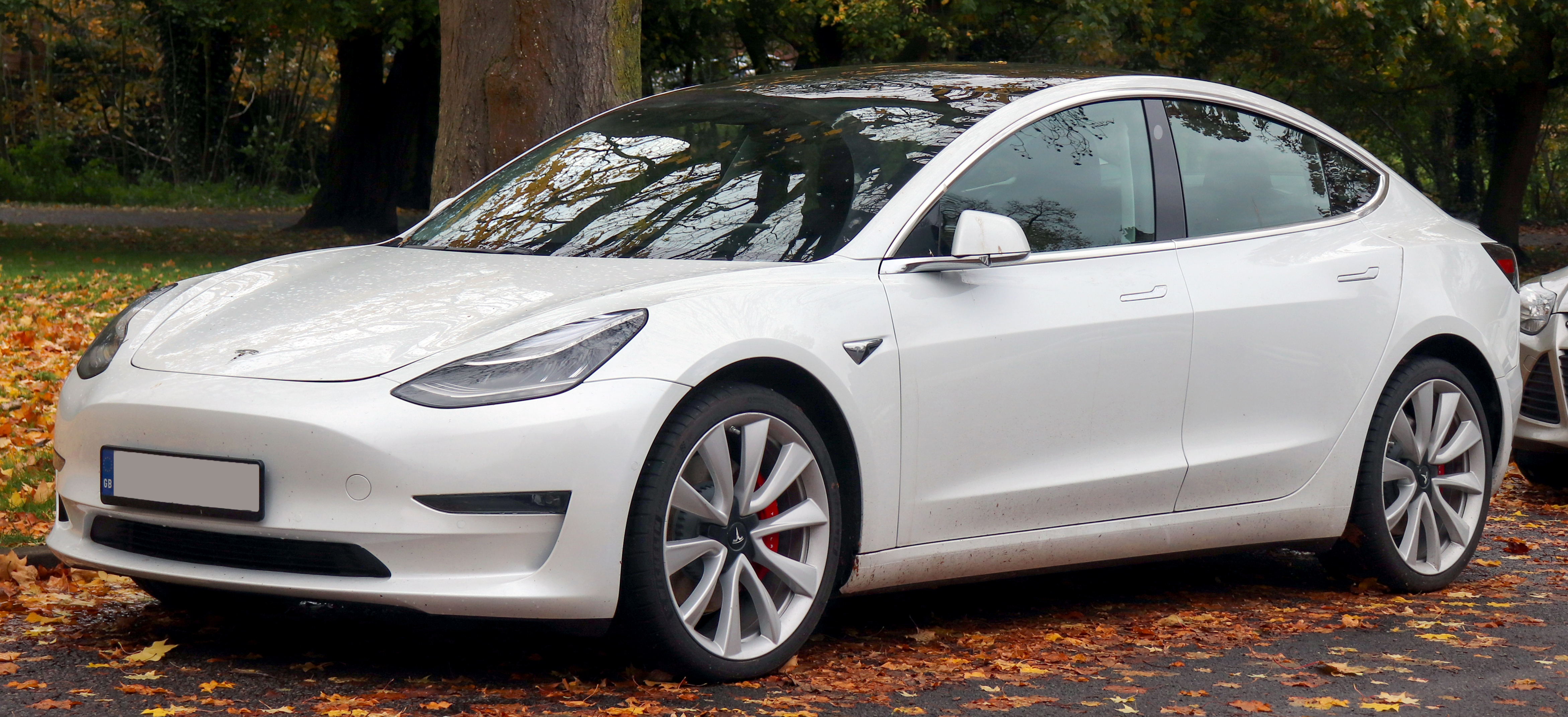
The photograph below captures a Tesla Model 3 navigating the physical streetscape where these competing standards collide. To an observer watching from the curb, a modern electric vehicle operating in urban traffic moves with quiet, mechanical poise. Cameras mounted behind the windscreen and across the vehicle pillars track cyclists, pedestrian crossings, and lane markings in real time. Yet whether that journey is described as autonomous navigation or assisted cruising is far more than a debate over vocabulary. It is the defining boundary of modern automotive law.
When Tesla sought European type approval to deploy its end-to-end neural network driving stack across the continent, it encountered a regulatory apparatus built on pre-market verification rather than post-market recall. European type-approval frameworks do not permit manufacturers to release developmental software onto public roads under the assumption that customer vigilance will catch the edge cases. Every function that touches steering, braking, and acceleration must conform to established international agreements. In confronting that machinery, Tesla discovered that the word "Self-Driving" was an insurmountable obstacle to continent-wide deployment.
🏢 Germany draws a hard line at the vocabulary of autonomy
The decisive turning point arrived through confidential bilateral negotiations between Tesla executives and the German Federal Ministry of Transport, known as the Bundesministerium für Verkehr or BMV. Germany is not merely the largest automobile market in the European Union; it is the institutional heart of European vehicle engineering and regulatory precedent. Any technology seeking adoption across the European Union requires German acquiescence, either through direct advocacy or diplomatic neutrality within the Technical Committee on Motor Vehicles.
During meetings conducted in September 2026, German transport officials presented Tesla with an unambiguous choice. Germany was prepared to support the continent-wide clearance of Tesla's driving software, provided the company abandoned the moniker that German courts and regulators had repeatedly criticized as misleading. Steffen Bilger, Germany's Federal Minister of Transport, made it clear that while Berlin welcomed technological innovation on its roads, it would not tolerate a product title that distorted the true division of labor between the computer and the human behind the wheel.
Tesla accepted the compromise. Instead of engaging in a protracted legal fight that would delay European deployment indefinitely, the company agreed to replace the Full Self-Driving name across the continent with Tesla Assisted Driving. The formal announcement from the ministry on October 6, 2026, confirmed that Berlin would now actively champion European Union approval ahead of a decisive member-state vote. By conceding the name, Tesla unlocked political backing from the most powerful automotive regulator in Europe.
The concession reveals how commercial urgency reshaped Tesla's corporate strategy. In the United States, Tesla had defended the Full Self-Driving brand against regulatory scrutiny for years, arguing in court that reasonable consumers understood the word "Supervised" as a clear limitation. But Europe offered a massive, affluent customer base that had been waiting for the software since 2019. Faced with the choice between defending a sacred marketing term or unlocking millions of potential subscriptions across the continent, Elon Musk and his leadership team chose market access over semantic pride.
📜 Why the word assisted changes who goes to court
To understand why the German ministry insisted on this name change, one must look past marketing brochures and examine the taxonomy established by the Society of Automotive Engineers, universally known as SAE International. The SAE standard divides vehicle automation into six discrete tiers, ranging from Level 0 with no driving automation to Level 5 with complete, unconditional autonomy. That taxonomy is not an academic exercise; it is the architectural foundation of civil and criminal liability across the global automotive sector.
Under SAE Level 2, often termed partial driving automation, the automated system can control both steering and speed simultaneously. However, the human driver must constantly supervise the system, actively monitor the roadway, and remain ready to take immediate manual control at any instant. Crucially, the driving task has not been transferred to the vehicle. The human remains the sole legal operator of the machine. If a Level 2 vehicle fails to brake for a stationary fire truck or misjudges a lane divider, the driver is held entirely responsible for the resulting impact.
In sharp contrast, true autonomy begins at SAE Level 3 and above. At Level 3, known as conditional automation, the vehicle actually assumes the entire dynamic driving task under defined operational conditions, such as traffic jams on controlled-access highways. When a Level 3 system like Mercedes-Benz Drive Pilot is engaged, the human driver is legally permitted to look away from the road, read a message, or watch an infotainment display. If the vehicle crashes while operating within its approved design envelope, the legal liability transfers from the individual driver to the vehicle manufacturer.
The diagram below illustrates this profound technical and psychological boundary. While the physical sensors and actuators in a vehicle may appear identical across different software configurations, the allocation of human cognitive attention changes completely once a system moves beyond driver assistance.
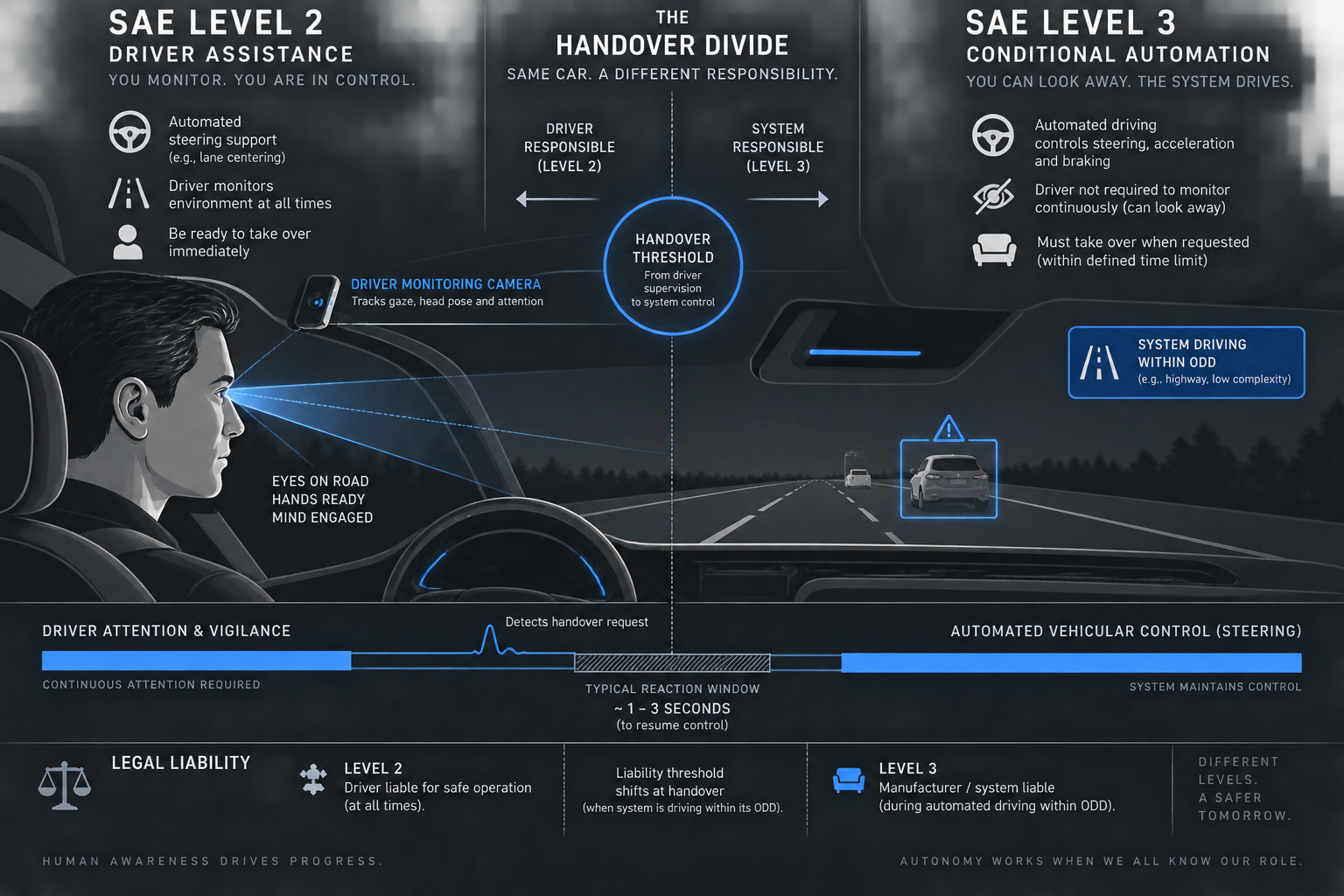
By calling its software Full Self-Driving, Tesla created a persistent illusion that its product belonged to the upper tiers of automation, even while its user agreements strictly bound customers to the legal obligations of Level 2. In courtrooms across North America, plaintiffs in fatal crashes frequently testified that the name had led them to believe the car was capable of handling emergencies on its own. By forcing Tesla to adopt the title Tesla Assisted Driving, European regulators eliminated that ambiguity before it could reach common traffic courts. The name now states the exact legal truth: the machine is an assistant, and the driver remains the only person on trial.
🚨 The ten-percent speed concession and highway discipline
The renaming of the software was not the only concession negotiated during the Berlin meetings. A second, equally revealing condition concerned the velocity envelope within which the software would be permitted to operate. In the United States, Tesla owners have long grown accustomed to a driving profile that adapts flexibly to surrounding traffic, occasionally exceeding posted speed limits by substantial margins to match the flow of aggressive freeway commuters.
When Tesla initially demonstrated its software in the Netherlands earlier in 2026, Dutch regulators observed that the system permitted vehicle speeds up to fifty percent above detected local limits in certain highway conditions. While aggressive speed adaptation is common among human motorists in dense traffic, European regulatory bodies viewed automated speeding as an unacceptable safety violation. How could an administrative agency grant official type approval to a computerized system that systematically violated statutory traffic laws?
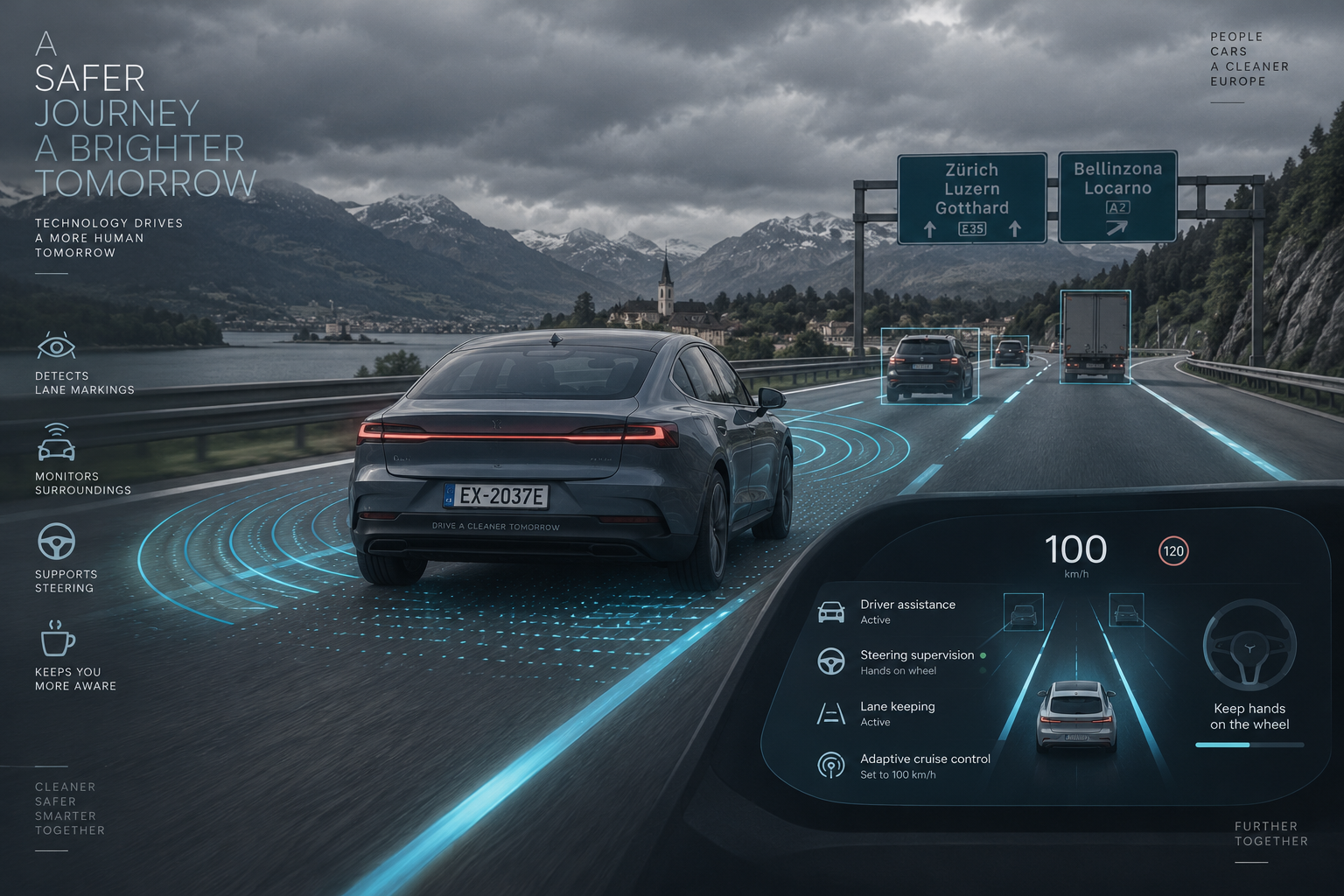
The compromise struck between the German ministry and Tesla established a rigid velocity ceiling. Under the framework agreed in Berlin, Tesla Assisted Driving will be permitted to exceed local speed limits by a maximum margin of ten percent, and only under specific traffic conditions where a modest speed buffer prevents abrupt braking and maintains harmonious traffic flow. The conceptual illustration below shows the interface balance required when an autonomous system must negotiate strict highway velocity boundaries.
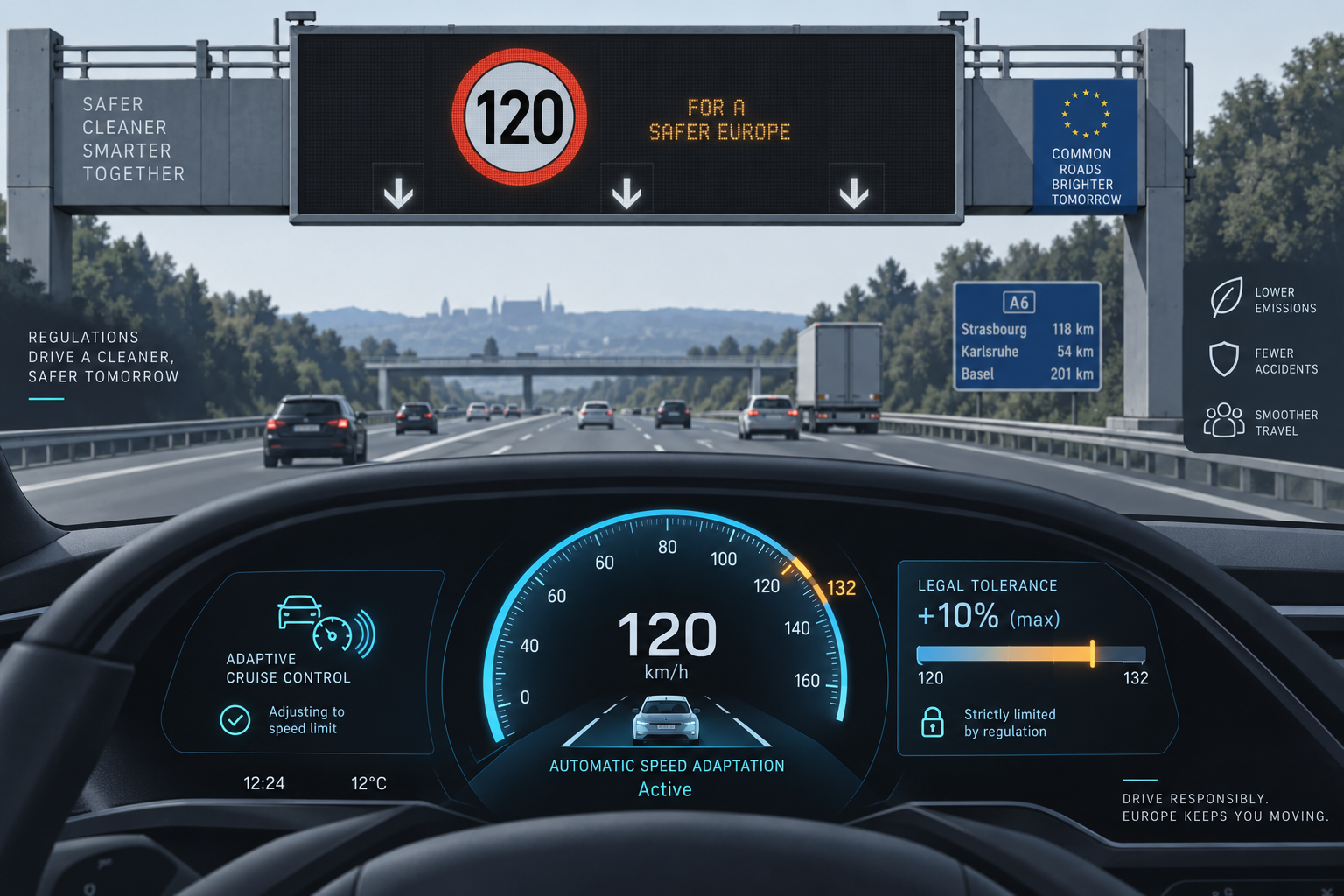
This ten-percent boundary represents a delicate regulatory balance. On German Autobahns and European arterial corridors, a vehicle that brakes abruptly the exact moment a digital speed sign changes from one hundred and twenty to one hundred kilometers per hour can create severe shockwave braking for following traffic. German engineers recognized that a narrow, bounded tolerance allowed the vehicle to merge smoothly and adapt to real-world highway rhythms without violating safety margins.
Yet even this ten-percent threshold has ignited controversy among other European Union member states. Transportation officials in France and Sweden have expressed skepticism, arguing that granting any commercial driver assistance system the authority to deliberately break the speed limit sets a perilous legal precedent. If a Tesla is permitted to travel at one hundred and ten kilometers per hour in a one-hundred-kilometer zone, how can traffic authorities justify penalizing a human driver who does the same? As the European Union prepares for a decisive bloc-wide vote later this year, the speed tolerance rule will serve as a primary battleground for national transport delegates.
👀 Automation complacency and the human monitoring dilemma
Beyond the courtroom and the conference room, the central problem of advanced driver assistance remains the human brain. Decades of human factors research in commercial aviation have established that people are remarkably poorly suited to monitoring automated systems that perform reliably most of the time. When an automated tool executes hundreds of successful maneuvers without error, human attention naturally drifts. Drivers check their smartphones, daydream, gaze at scenery, or lose the situational awareness required to react to sudden anomalies.
This psychological phenomenon, known as automation complacency, is the fundamental flaw of high-capability Level 2 assistance. The better the software becomes at steering and navigating, the more dangerous it becomes when it finally encounters a situation it cannot solve. In a vehicle with primitive cruise control, the driver remains alert because the car cannot steer itself. In a vehicle equipped with advanced neural network assistance, the car mimics human driving so convincingly that the operator feels completely relaxed, exactly until the split-second when an edge case appears.
The photograph below illustrates the physical reality of supervised driving: human hands resting firmly on the steering rim, with cognitive attention anchored on the road ahead. Regardless of how sophisticated the vehicle perception algorithms become, this physical posture remains non-negotiable under European law.
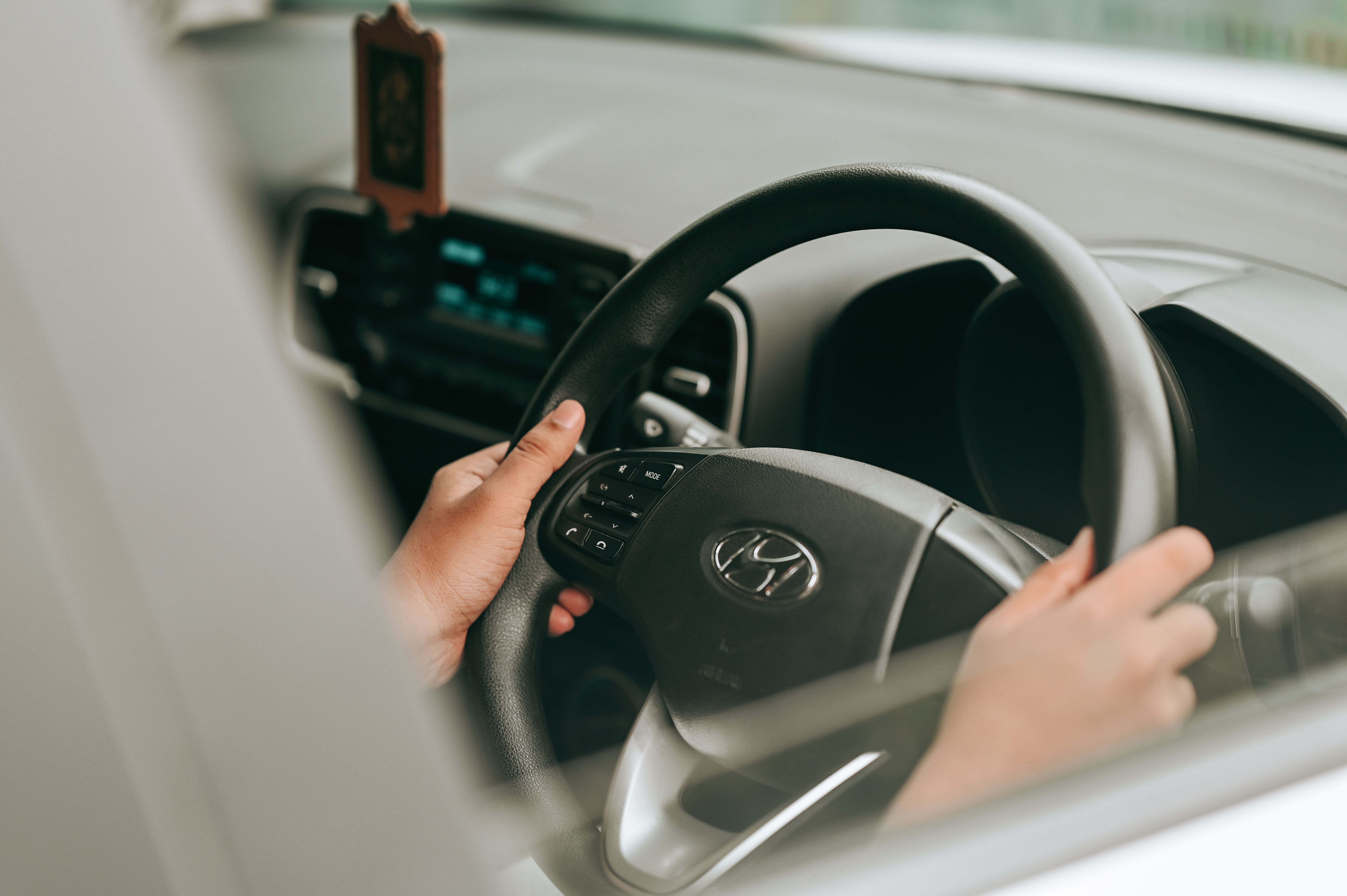
To counteract automation complacency, European safety regulations enforce strict driver monitoring requirements. Under the European Union General Safety Regulation, any vehicle operating advanced assistance systems must incorporate interior optical cameras that track the driver's eye gaze, head position, and eyelid closure. If the camera detects that the driver has looked away from the road for more than a few seconds, the vehicle must escalate warnings immediately, sounding audible chimes and flashing visual alerts before eventually disengaging the system and pulling over safely.
Tesla had initially relied on torque sensors in the steering wheel to detect driver presence, a system that motorists quickly learned to bypass with weighted accessories attached to the wheel rim. In recent years, Tesla activated cabin cameras and integrated strict vision-based attention tracking, penalizing distracted drivers with software strikes that revoke access to the feature for weeks. In Europe, those monitoring systems will not merely be company policies; they will be audited by independent safety testing organizations to ensure that no driver can treat Tesla Assisted Driving as a mobile living room.
🌐 Inside the European regulatory machine from Geneva to Brussels
The journey of Tesla's driving software through Europe cannot be understood without examining the complex institutional architecture that governs vehicle standards across the continent. Unlike the United States, where the National Highway Traffic Safety Administration sets Federal Motor Vehicle Safety Standards and generally allows manufacturers to self-certify compliance before conducting retrospective investigations, Europe operates under the United Nations Economic Commission for Europe, or UNECE.
Based in Geneva, the UNECE World Forum for Harmonization of Vehicle Regulations, known as Working Party 29, establishes binding international regulations adopted by dozens of nations worldwide. In recent years, the UNECE Working Party on Automated, Autonomous, and Connected Vehicles developed UN Regulation No. 171, officially titled Driver Control Assistance Systems or DCAS. Regulation 171 was drafted specifically to bridge the gap between simple lane-keeping assistance and advanced systems that navigate complex arterial environments.
UN Regulation 171 establishes several inviolable principles that directly shaped Tesla's European surrender:
- A Driver Control Assistance System assists the human driver in controlling lateral and longitudinal motion, but never replaces the driver.
- The human driver must remain permanently engaged in the driving task, and the system interface must reinforce that obligation at all times.
- The system must not include marketing names, promotional displays, or interface elements that could mislead the user regarding the system operational capabilities.
- The system must incorporate robust driver engagement monitoring and must prevent operation outside verified design domains.
When Tesla approached European authorities for continent-wide clearance, national regulators evaluated the software against Regulation 171. While smaller member states such as the Netherlands, Lithuania, and Croatia granted preliminary approvals for localized trials, broader approval across all twenty-seven European Union nations requires a qualified majority vote within the Technical Committee on Motor Vehicles in Brussels.
To pass that threshold, a proposal must win the support of at least fifteen member states representing sixty-five percent of the European Union population. Without Germany's backing, reaching that sixty-five percent demographic threshold was mathematically impossible. When Minister Bilger demanded that Tesla abandon the Full Self-Driving moniker, he held the ultimate political veto over the company's European aspirations. Tesla's decision to rebrand as Tesla Assisted Driving was therefore an inescapable consequence of international diplomacy.
📺 What the official demonstrations quietly reveal
Even in the United States, where Tesla continues to sell the software under the Full Self-Driving label, the company's official instructional material has long told a very different story from its promotional bravado. In consumer video guides and software release notes, Tesla's technical writers have consistently framed the product in terms of strict human vigilance.
The official Tesla instructional overview embedded below provides direct visual evidence of that internal contradiction. While the spoken narration describes a vehicle capable of navigating almost anywhere under the driver's active supervision, the fine print and operational instructions make the technical reality unmistakable: the software does not make the car autonomous, and the human driver bears total responsibility for safe operation at all times.
Watching the official demonstration alongside the European regulatory debate clarifies why the rebranding in Germany was so significant. The actual functionality demonstrated in the video has not been eliminated; the car still changes lanes, reads traffic lights, maneuvers around obstacles, and follows satellite navigation routes. What has been eliminated in Europe is the promotional fiction that this capability amounts to self-driving.
By requiring the interface to say "Assisted Driving" rather than "Full Self-Driving," European regulators aligned the vehicle's public title with the instructions already written in its owner's manual. The software is finally being introduced to the public under the exact identity its own engineers documented in the legal disclosures.
🧭 What consumer technology learns when physics meets regulation
The rebranding of Tesla's flagship software in Europe marks the end of an era for the consumer technology industry. For over a decade, Silicon Valley software companies operated under the ethos of moving fast and breaking things, treating consumer software updates as fluid experiments that could outrun traditional administrative oversight. In personal computing, mobile operating systems, and internet services, that approach allowed rapid iteration and unchecked marketing optimism.
When software expands into two-ton steel machinery traveling at one hundred and thirty kilometers per hour on public highways, that playbook collapses. In the physical world, software bugs do not merely trigger application crashes; they endanger human lives. The physical laws of kinetic energy, human reaction latency, and traffic density do not negotiate with software release notes. By forcing Tesla to adopt the title Tesla Assisted Driving, European institutions established that the marketing vocabulary of consumer electronics cannot be imported into public safety infrastructure without scrutiny.
For consumers and prospective car buyers, the European decision provides essential clarity. It strips away years of speculative hype and allows motorists to evaluate driver assistance for what it truly is: an exceptionally capable, mathematically impressive suite of automated driving aids that can ease the fatigue of daily commuting, but one that still demands total human focus. The car will help you navigate the highway, but it will not drive you home while you sleep, it will not turn your commute into productive leisure, and it will not stand beside you in court if something goes wrong.
As the European Union moves toward its decisive regulatory vote in December 2026, the arrival of Tesla Assisted Driving establishes an important global precedent. Other automotive manufacturers developing automated driving systems will no longer be able to hide behind ambiguous branding. The line between driver assistance and autonomous transit has been etched clearly into European law. In the end, Tesla did not lose its technology on the journey to Europe; it simply lost the word that was never true to begin with.
Sources: Bundesministerium für Verkehr (BMV) official release on Tesla driver assistance systems, October 6, 2026; Reuters investigation on European FSD regulatory negotiations, October 9, 2026; TechCrunch transport report by Sean O'Kane, October 9, 2026; Electrek European automotive analysis by Fred Lambert, October 9, 2026; United Nations Economic Commission for Europe (UNECE) UN Regulation No. 171 (Driver Control Assistance Systems - DCAS); Tesla official documentation and video guidelines for Full Self-Driving Supervised.