
🧭 The publishing problem is not a shortage of words
A website can now produce a page, a product description, a help article, a location guide, or a comparison in minutes. That speed changes the economics of publishing, but it does not settle the harder question: what, exactly, is the page saying, and how does the organisation know it is still true?
That question is the reason a fact layer belongs ahead of an AI-content strategy. A fact layer is the maintained system behind public claims: the approved names, definitions, product attributes, policies, prices where applicable, eligibility rules, dates, owners, sources, update history, and relationships among those facts. It is not a writing style guide, and it is not simply a spreadsheet someone once completed. It is the reference point that lets a business publish consistently when pages multiply.
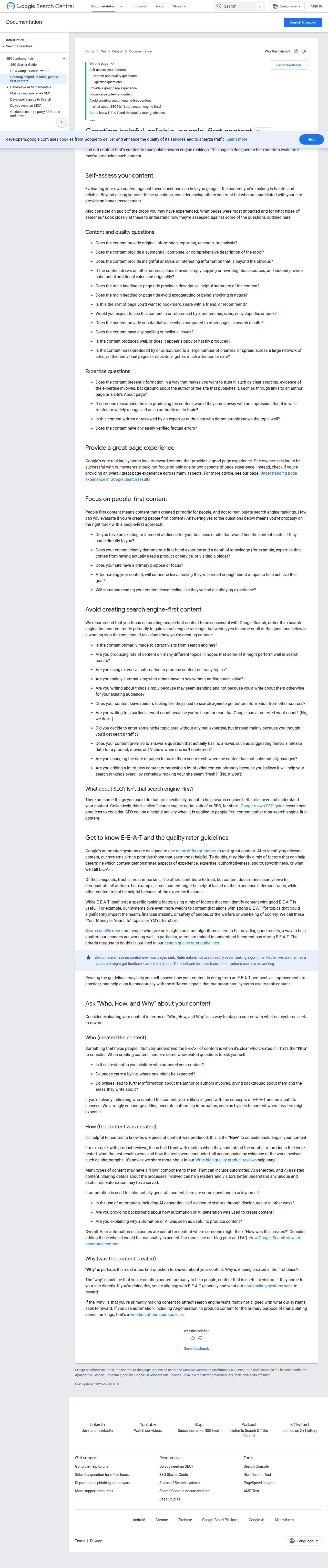
Google’s guidance on helpful, reliable, people-first content offers a useful test. Its automated ranking systems are designed to prioritise content created to benefit people rather than content created to manipulate rankings. The guidance asks publishers to consider who created content, how it was created, and why it was made. Automation, including AI generation, is not presented as a substitute for the purpose of helping a reader.[https://developers.google.com/search/docs/fundamentals/creating-helpful-content]
That distinction matters because AI is extraordinarily good at turning supplied material into readable forms. It can also turn stale, partial, contradictory, or poorly understood material into readable forms. The result may look complete while leaving a customer with the wrong answer. A polished sentence is not evidence that its underlying claim has been checked.
The practical goal is not to ban AI from the editorial desk. It is to give AI and human writers a dependable source of truth. Once a website has that, content generation can become faster without making every new page a fresh fact-finding exercise. Without it, scale mostly increases the number of places where a correction will later be needed.
A fact layer also changes the editorial conversation. Instead of asking, “What else can we publish this week?”, teams can ask, “Which useful questions can we answer from verified information, and which questions reveal a gap we need to resolve?” That is a more durable publishing discipline.
🧱 Build the layer that content can stand on
The phrase “fact layer” can sound technical, but its first version should be understandable to the people responsible for the website. Start with the claims that recur across pages and that readers are likely to act on. A retailer may need product availability, materials, sizing guidance, returns terms, and care instructions. A professional service may need service scope, jurisdictions, intake requirements, named specialists, and contact routes. A newsroom needs publication dates, bylines, source links, corrections, and clear distinctions between reporting, analysis, and opinion.
For each fact, record more than the sentence that appears on the page. Capture the value, its source, the person or team responsible for it, the date it was reviewed, the pages or systems that use it, and any condition that changes its meaning. “Delivery available” is not yet a useful fact if it does not specify where, under what conditions, or where the rule is maintained. “Suitable for everyone” is not a usable claim if the organisation cannot define the limits behind it.
A strong fact layer separates several things that publishing often blends together:
- Verified facts: Statements supported by an authoritative internal record or a primary public source.
- Editorial explanations: Reader-friendly language that interprets a fact without changing it.
- Recommendations: Advice, selections, and comparisons that should identify their basis and revision date.
- Claims awaiting confirmation: Useful questions for which the organisation does not yet have an approved answer.
This separation makes uncertainty visible. That can feel slower at first, especially for a team used to filling every empty field. Yet an explicit “needs review” state is safer than a confident paragraph built from assumption. It gives an editor a clear action and protects the eventual reader from a claim that only sounded settled.
The structure does not need to be elaborate. A governed database, a well-owned content model, or a set of linked records can all work if they make facts traceable and maintainable. What matters is that the information is reusable. A policy should not live as slightly different prose in a footer, an FAQ, a chatbot response, a campaign email, and six AI-generated articles. It should have a canonical record that those surfaces can draw from.
This is also where a team should decide what it will not claim. Broad superlatives, vague promises, and inferred benefits often create the greatest review burden because they have no clear owner. A fact layer should give writers useful constraints: language that is approved, language that needs qualification, and language that should not appear at all.
🔎 Trace each public claim back to its source
A page does not become trustworthy because it has citations sprinkled across it. The more basic requirement is traceability. When a customer, editor, search specialist, or support colleague asks where a statement came from, the answer should be reachable without a hunt through old messages or a memory test.
Build that traceability into the editorial workflow. A claim about an organisation’s own service should point to the owner or operating policy responsible for it. A claim about a standard should point to the standard. A claim about how a search feature works should point to the relevant documentation. If the source changes, the system should make it possible to identify the pages that need an update.
Google advises publishers to self-assess whether content offers substantial value compared with other pages in search results, whether it has quality issues, and whether it appears sloppy or hastily produced. Those are useful editorial questions because they concern the finished experience, not merely the presence of keywords.[https://developers.google.com/search/docs/fundamentals/creating-helpful-content]
The most valuable source records are specific. “Marketing notes” is not a source. “Current returns policy approved by operations” is closer, provided it has a location, an owner, and a review path. “A competitor’s page” may be useful for discovering a reader question, but it is not support for a claim about your own product. Search snippets are prompts for investigation, not evidence to reproduce.
This is especially important when AI is involved. A model may be asked to summarise product notes, but the notes should be attached to a known version or retrieved from the controlled record. A prompt that says “write an accurate article about our offer” does not tell the model what accuracy means. A prompt that supplies a bounded set of reviewed facts, prohibited claims, intended audience, and approved source links gives the work a much firmer foundation.
Traceability also improves corrections. Websites often treat corrections as embarrassing exceptions. In reality, correction is an ordinary consequence of publishing information that changes. A fact layer turns correction from a scavenger hunt into maintenance. If a policy changes, the team can locate the fact record, inspect where it is used, update the affected copy, and leave an editorial history where appropriate.
The reader does not need to see every internal record. They do need to encounter pages whose important claims are coherent, current, and not contradicted elsewhere on the same site. That result depends on the chain behind the sentence.
🧾 Give the editorial desk a real source of truth

Content operations fail when the person writing a page has to assemble truth from fragments. They check a shared drive, a product page, an old campaign, a colleague’s message, a support ticket, and perhaps a previous article. Some fragments conflict. Some have no date. Some were written for a context that no longer applies. At that point, AI does not remove the problem. It can simply accelerate the assembly of inconsistent inputs.
An editorial desk needs a clear handoff. Subject owners maintain operational facts. Editors decide what readers need to know, how much context they need, and how claims should be framed. Legal, compliance, accessibility, product, support, and technical teams contribute where their knowledge is necessary. The website should not force one writer to impersonate all of those roles.
The quote marker belongs here because the useful editorial point is not a slogan about AI. It is accountability. A reader should be able to tell who is speaking on a page when authorship matters, and an organisation should be able to tell who approved the information when it affects a decision. Google’s people-first guidance explicitly encourages publishers to think about who created content, how it was produced, and why it exists.[https://developers.google.com/search/docs/fundamentals/creating-helpful-content]
That can be reflected in small, practical practices:
- Keep named ownership for high-impact facts and pages.
- Store the source and review status alongside the claim, not only in a writer’s notes.
- Set a review trigger for facts that change through policy, inventory, regulation, product releases, or editorial correction.
- Distinguish a verified statement from a draft interpretation before publication.
- Preserve a route for support or readers to flag an error.
The editorial desk should also decide when a page needs original reporting or expert review rather than synthesis. AI may help generate questions, propose an outline, or adapt an approved explanation to different formats. It cannot make an unsupported claim reliable by sounding certain. The choice is not between human writing and machine writing. It is between a workflow that can defend what it publishes and one that cannot.
A fact layer reduces repetitive labour as well. If editors repeatedly answer the same question about a process, that may indicate the need for a maintained canonical explanation. When a campaign requires a tailored angle, the editor can work from the same underlying facts instead of rebuilding the foundation. The writing remains situational; the evidence does not need to be rediscovered each time.
🧠 Let AI work inside evidence, not around it
AI content is most useful when it operates with boundaries. Give it an audience, a job to do, a set of approved facts, source references, a publication format, and explicit limits. Ask it to identify missing information rather than silently bridge gaps. Require it to label material that needs review. In other words, design the prompt and workflow so uncertainty has somewhere to go besides the published page.
This is a better use of automation than asking for endless topic variations. Google states that using automation, including AI generation, primarily to manipulate search rankings violates its spam policies. Its guidance instead frames success around helpful, reliable information created for people.[https://developers.google.com/search/docs/fundamentals/creating-helpful-content]
The editorial implication is straightforward. Do not use a large publishing queue as proof of usefulness. A page should earn its place by resolving a reader’s question with information the organisation can stand behind. Sometimes that is a detailed guide. Sometimes it is a concise answer, a comparison table, a clear policy page, or a correction to an outdated explanation. More content is not inherently more help.
A fact-aware AI workflow can include several checkpoints. Before drafting, retrieve only current approved records. During drafting, constrain the model to those records and ask it to flag missing details. During review, compare the output with the source records, not merely with the prompt. Before publishing, check whether the page is accessible, internally consistent, and marked up where structured information would help systems interpret it.
The decisive shift is this: a model should be allowed to transform evidence, not manufacture it. Transformation includes summarising, adapting tone, organising a long explanation, generating alternatives, and helping editors find ambiguity. Manufacturing occurs when a system fills an unknown with plausible language and the workflow treats plausibility as proof.
That distinction also helps teams choose their AI tasks wisely. Low-risk formatting and drafting can often move quickly. Claims involving money, health, safety, eligibility, policy, or a reader’s consequential decision deserve tighter source control and human review. The fact layer lets the organisation make those choices deliberately instead of applying the same loose process to every page.
The best output may sometimes be a question back to the owner of the information. That is not a failure of automation. It is evidence that the workflow has caught a gap before a visitor has to discover it.
🧪 Test the facts in the interfaces people and machines use

A fact layer is not complete when its records are tidy in a back office. It must survive the journey into the page, the navigation, the search result, the support response, and the assistive technology a visitor uses. Testing should therefore include content accuracy, page experience, accessibility, and structured representation.
W3C’s Web Content Accessibility Guidelines 2.2 describe success criteria as testable statements that are not technology-specific. W3C advises using WCAG 2.2 to maximise the future applicability of accessibility efforts and encourages use of the most current version when developing or updating accessibility policies.[https://www.w3.org/TR/WCAG22/]
That is relevant to a fact layer because inaccessible content is not fully available information. A correct instruction hidden behind an interaction that cannot be operated is not serving every visitor who needs it. A chart without an alternative explanation may leave its evidence unavailable. A form that asks people to repeat information without need creates friction in the path to a factual answer. Accessibility review belongs in the same publishing discipline as source review.
Google describes structured data as a standardised format for providing information about a page and classifying its content. It says structured data can give Google explicit clues about a page’s meaning, and that the markup on a page should describe the content of that page.[https://developers.google.com/search/docs/appearance/structured-data/intro-structured-data]
This last condition is vital. Structured data is not a place to add claims that are absent from the visible page or to create empty pages whose only purpose is markup. The machine-readable description should agree with the reader-facing page. When it does, structured data can express a content model already supported by the fact layer. When it does not, it becomes another source of inconsistency.
Google supports JSON-LD, Microdata, and RDFa for structured data in general, and recommends using the format that is easiest to implement and maintain, noting that JSON-LD is recommended in most cases. It also says valid, properly implemented markup is necessary, while feature-specific documentation determines what Google supports for a given search feature.[https://developers.google.com/search/docs/appearance/structured-data/intro-structured-data]
Testing therefore needs two questions. First, is the markup technically valid and aligned with the relevant documentation? Second, is the underlying fact actually present, current, and approved? A valid script cannot fix an inaccurate price, obsolete author detail, or misleading availability statement. The fact layer is what makes the structured layer worth trusting.
🛠️ Model content so it can be reused without being distorted
Schema.org describes its vocabulary as a collection of shared vocabularies that webmasters can use to mark up pages in ways understood by major search engines. It can be used with Microdata, RDFa, or JSON-LD.[https://schema.org/docs/gs.html]
For a publisher, the important idea is not to add markup everywhere for its own sake. It is to model recurring entities and relationships clearly. An article has a headline, author, date, body, and perhaps a correction note. A product has a name, description, offer information, and attributes. An organisation has a name, contact information, and pages that describe what it does. A person, place, event, or service can appear in more than one context without changing identity each time a new page is written.
Schema.org’s getting-started material explains that Thing is the broadest item type and includes properties such as name, description, url, and image; more specific types inherit properties from broader types.[https://schema.org/docs/gs.html]
That inheritance suggests a useful editorial habit. Begin with the stable identity of the thing you are describing before adding campaign language or page-specific detail. What is it called? What is its canonical page? Which description has been approved? Which image represents it? Which attributes are genuinely known? This reduces the chance that one department calls a service by a different name or describes a product in a way the product team would not recognise.
Microdata remains one way to connect structured information to visible HTML. MDN explains that it is part of the WHATWG HTML Standard and nests metadata within existing web content. Its documentation describes attributes including itemscope, itemtype, and itemprop, and notes that search engines and crawlers can extract and process microdata.[https://developer.mozilla.org/en-US/docs/Web/HTML/Guides/Microdata]
The fact-layer lesson is consistency, not format loyalty. If a team uses JSON-LD, it should be generated from the same reviewed content model that supports visible copy. If it uses Microdata, the item properties should match the visible content around them. If separate teams control the page and its structured data, they need a shared review path or the two versions will drift.
A sensible implementation starts with the entities that are already central to reader decisions. Avoid adding every possible property simply because a vocabulary permits it. Google cautions that Schema.org contains more attributes and objects than Google Search requires, and directs publishers to Google Search Central documentation for definitive Google Search behaviour.[https://developers.google.com/search/docs/appearance/structured-data/intro-structured-data]
Maintainability is the real test. Can the team update the fact once? Can it identify where the fact appears? Can an editor see which version was used? Can a developer render it without hand-copying values into multiple templates? If the answer is no, the organisation has more markup or more copy, but not yet a dependable fact layer.
⚠️ Watch for the places where confidence outruns evidence

The riskiest pages are often the ones that sound easiest to write. A broad FAQ answer may compress many conditions into one sentence. A comparison may imply a conclusion beyond the available evidence. A location page may repeat a service claim that applies only in some places. A generative system may create an elegant transition that quietly introduces a cause, a guarantee, or a benefit no source actually states.
These failures are not limited to AI. Manual publishing has always created them. AI changes the volume and speed, which means small weaknesses can spread through templates, translated pages, campaign variants, and support tools before anyone notices.
A review routine should look for several forms of drift:
- Source drift: The referenced policy, specification, or product record has changed.
- Copy drift: Different pages describe the same fact in incompatible ways.
- Context drift: A statement copied from one audience or region is used where its conditions do not apply.
- Markup drift: Structured data no longer matches the visible page.
- Access drift: A redesign makes a factual explanation harder to perceive or operate.
- Authority drift: No person or team can confirm who owns a claim.
W3C’s WCAG 2.2 conformance requirements address full pages and include variations automatically presented for different screen sizes. The guidance makes clear that responsive variations are part of what must conform.[https://www.w3.org/TR/WCAG22/] For editorial teams, that is a reminder to test the information where people actually encounter it, not only in a desktop preview or content-management form.
Review should be proportionate. A simple evergreen definition may need a light periodic check. A policy, price, medical statement, legal explanation, or time-sensitive announcement needs a more explicit owner and trigger. The goal is not to create bureaucratic delay for every comma. It is to focus scrutiny where an outdated or unsupported claim would affect a real decision.
Teams should also resist the temptation to treat search visibility as proof of accuracy. A page can be discoverable and still be unclear, inaccessible, stale, or wrong. Google says that following structured data guidance does not guarantee that content will appear in rich results.[https://developers.google.com/search/docs/appearance/structured-data/intro-structured-data] That is another reason to make reader value the primary measure. Markup and optimisation should clarify good information, not become a substitute for it.
✅ Publish more only after you can maintain what you publish
The next useful AI-content project may not be another batch of articles. It may be a claim inventory for the pages already live. It may be an ownership map for product facts. It may be a review field in the CMS, a source-link requirement for high-impact statements, or a structured-data audit that checks whether machine-readable details still match visible copy.
Start small enough to complete. Choose a page family with recurring questions and meaningful consequences: service pages, product pages, policy pages, or the help centre. Identify the facts those pages share. Name the source and owner for each one. Mark what is uncertain. Create a way to update the record once and find its published uses. Then use AI to draft from that controlled material, with an editor reviewing the result in context.
This approach does not make content sterile. It gives writers firmer material to work with. They can spend their attention on explanation, structure, examples, clarity, and the reader’s actual problem. They do not have to waste it reconstructing basic truth from scattered documents.
It also makes the organisation more honest about what it knows. A missing fact becomes a visible operational task rather than a blank that a writer is expected to fill. A changing fact becomes a maintenance event rather than an unnoticed contradiction. A structured-data field becomes a representation of a verified record, not a guess encoded for a crawler.
Google’s people-first guidance, its structured-data documentation, Schema.org’s shared vocabularies, MDN’s explanation of Microdata, and WCAG 2.2 all point toward the same practical discipline: make information understandable, maintain it in context, and ensure the page experience does not block people from using it.[https://developers.google.com/search/docs/fundamentals/creating-helpful-content][https://developers.google.com/search/docs/appearance/structured-data/intro-structured-data][https://schema.org/docs/gs.html][https://developer.mozilla.org/en-US/docs/Web/HTML/Guides/Microdata][https://www.w3.org/TR/WCAG22/]
AI can help a website speak more often. A fact layer helps it keep its word.
Sources: https://developers.google.com/search/docs/fundamentals/creating-helpful-content ; https://developers.google.com/search/docs/appearance/structured-data/intro-structured-data ; https://www.w3.org/TR/WCAG22/ ; https://schema.org/docs/gs.html ; https://developer.mozilla.org/en-US/docs/Web/HTML/Guides/Microdata