Yes, a business website still matters. But a website that merely repeats generic information is losing its reason to be visited.
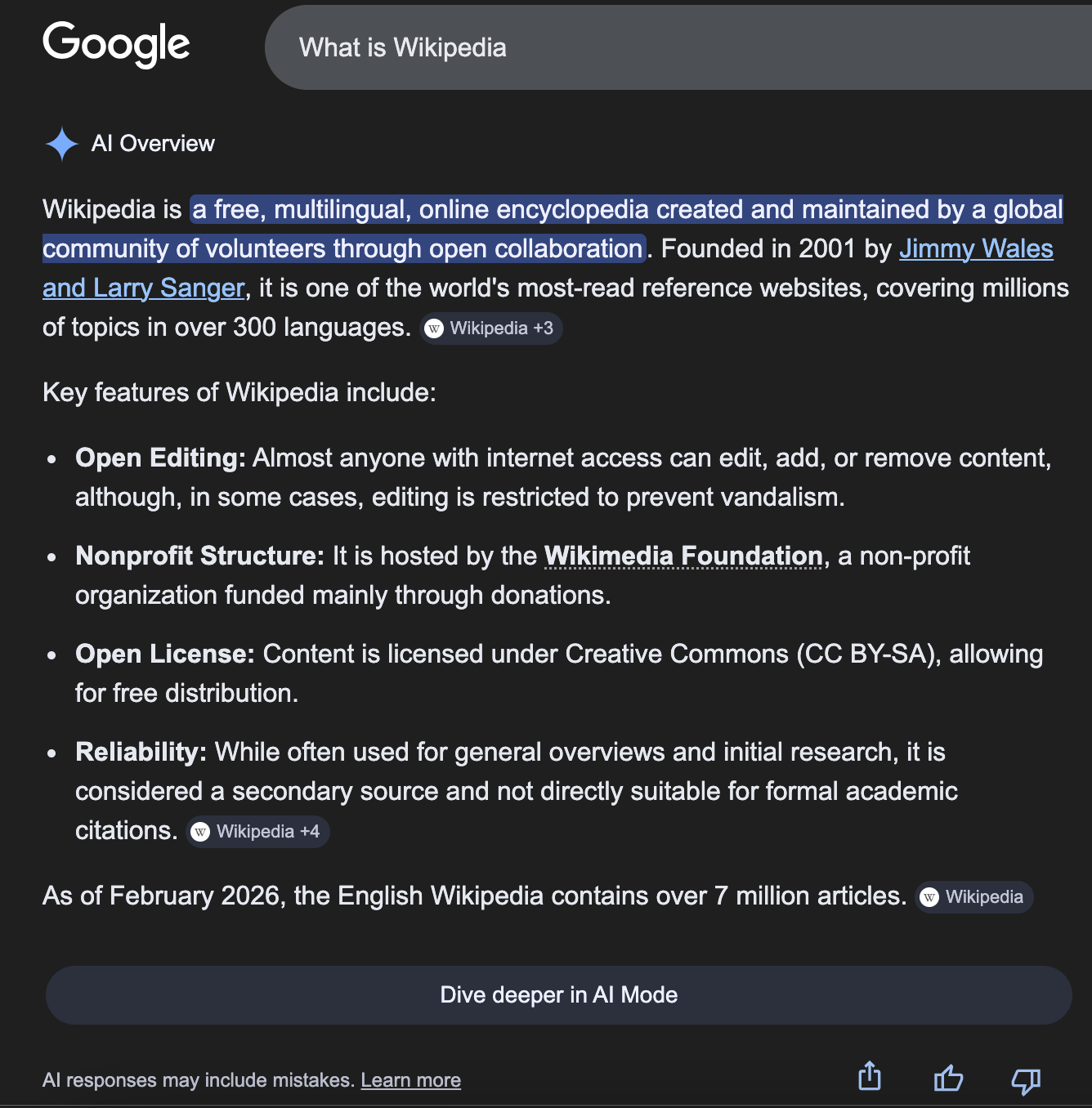
Google can now place an AI-generated summary above traditional results through AI Overviews. A person asks a question, the system assembles an answer, and the search may end before a single website is opened.
For a business owner, it is a little like running a shop on a busy street while samples are handed out on the pavement. The important question is no longer only, “Did people see us?” It is: after seeing the answer, do they still have a reason to come inside?
📉 When an AI summary appears, clicks nearly halve
Pew Research Center examined 68,879 Google searches from a panel of 900 U.S. adults during March 2025. About one in five searches in the study produced an AI summary.
- When an AI summary appeared, users clicked a traditional result in 8% of visits.
- Without an AI summary, traditional-result clicks reached 15%.
- A link inside the AI summary itself was clicked in only 1% of visits.
- Users ended their browsing session after 26% of pages with an AI summary, compared with 16% of pages containing traditional results only.
In plain language: when the answer is already visible, fewer people feel the need to open the source.
The figures come from a U.S. panel during a specific period, so they should not be treated as a universal forecast for every country, industry, or query. But the direction is difficult to ignore: attention may remain in search while fewer visits reach the websites behind the answer.
😵 SEO is not dead, but generic content is running out of breath
The good news is that AI still needs sources.
In its official guidance for generative AI features, Google says these experiences use its core Search systems to retrieve relevant, current pages. Those pages help ground the generated response and can appear as supporting links.
AI does not remove the need for websites. It raises the standard for which websites deserve to become sources.
There is also no secret “put my site into AI” button. Google says no special Schema.org markup is required for generative AI search. The fundamentals remain familiar: the page must be crawlable and indexable, the main content must be accessible, the experience should work well across devices, and the information should be helpful, reliable, and made for people.
Adding the word “AI” 37 times to a landing page is not a strategy either. Robots may be clever, but that does not mean they enjoy being called repeatedly.
🧱 A website must give people a reason to visit
Imagine a clinic website that says:
“We provide the best service with professional staff and modern facilities.”
The sentence is safe. The problem is that hundreds of clinics could use it unchanged. An AI system can summarize it without losing much—because there was not much specific information to lose.
A more useful clinic website answers the questions that shape a real decision:
- Which practitioners are available, and when?
- Which services can be booked?
- What is the price range, or how can someone request an estimate?
- What should a patient prepare before arriving?
- What happens from registration to the end of the appointment?
- Which limits, policies, or eligibility requirements should be understood first?
The same principle applies to studios, restaurants, consultants, contractors, salons, and other service businesses. The more concrete the information, the harder the page is to replace with a generic summary.
🧲 Less traffic is not automatically worse traffic
Not every visit has the same value.
Someone asking “what is a landing page?” may stop at an AI-generated answer. Someone comparing packages, checking a portfolio, reviewing a process, confirming availability, or requesting a proposal still needs a destination.
This shifts the job of a business website:
- from an article warehouse to a source worth citing;
- from a digital brochure to a trust-verification tool;
- from a page of information to a path toward action;
- from chasing every visit to qualifying the right customer.
Cloudflare has also documented a large gap between crawling and referrals from several AI platforms. For June 19–26, 2025, it reported an Anthropic crawl-to-referral ratio of roughly 70,900:1.
Cloudflare included an important caveat: referrals from native applications may not carry a referrer header, which could overstate the ratio. Even with that limitation, the operating lesson is clear: machines can consume a large amount of content without sending a comparable number of visitors.
A website therefore cannot stop at being readable by AI. It must give a person a reason to arrive, trust the business, and act.

🛠️ Three moves businesses can make now
1. Publish what only your business can know
Use first-hand experience, case studies, real customer questions, operating processes, comparisons, original data, and the reasoning behind decisions. Do not release the 47th version of an article already available everywhere and expect an AI system to treat it as a discovery.
2. Build pages that help people make decisions
After explaining the problem, provide the next useful step: view packages, inspect relevant work, understand the process, calculate a requirement, book a time, request an estimate, or contact the right person.
Information without a path forward leaves the customer asking, “Okay… now what?”
3. Keep the technical foundation clean
Pages should load quickly, work on mobile, remain crawlable and indexable, use a clear information hierarchy, and make important details easy to find. Visitors should not have to play hide-and-seek with pricing, availability, or the contact button.
🔑 Key Takeaway
AI Search does not make a business website useless. It makes a generic website easier to skip.
If a page only answers a common question, AI may summarize it without sending many visits. But AI cannot replace a company's real portfolio, transparent process, first-hand evidence, service details, availability, pricing, or transaction path.
The new goal is not simply to collect as many clicks as possible. It is to become a source machines can trust, a destination people choose, and a system that turns attention into action.