
On 11 September 2026, the European Union reached a consequential regulatory milestone that caught many software development teams, hardware manufacturers, and digital product managers off guard. While the broader compliance framework of the Cyber Resilience Act (Regulation EU 2024/2847), including CE marking, conformity assessments, and extensive technical documentation, does not take effect until 11 December 2027, Article 14 of the regulation entered into force immediately. From that date onward, any manufacturer or distributor placing products with digital elements on the European Single Market must formally notify European authorities of any actively exploited vulnerability within twenty-four hours of becoming aware of it.
To facilitate this sweeping mandate, the European Union Agency for Cybersecurity (ENISA) concurrently launched the Single Reporting Platform (SRP), establishing a centralized digital gateway through which security notifications are ingested, routed to designated national Computer Security Incident Response Teams (CSIRTs), and cross-referenced across the European Union. The immediate operational implication for software engineering organizations is profound: the era of discretionary, leisurely vulnerability disclosure is officially over. A security flaw discovered in production that shows evidence of real-world exploitation is no longer merely an internal Jira ticket or a GitHub security advisory; it is now a legally binding regulatory notification event backed by penalties that reach up to 15 million euros or 2.5 percent of worldwide annual turnover.
⏱️ The first binding deadline of the Cyber Resilience Act
When the European Parliament and the Council adopted Regulation (EU) 2024/2847 in late 2024, most corporate compliance officers and development leads noted the December 2027 enforcement horizon. That thirty-six-month transition period was intentionally designed to give device makers, SaaS operators, and software vendors adequate time to redesign legacy build pipelines, generate comprehensive Software Bills of Materials (SBOMs), and undergo formal third-party conformity assessments where required. However, European lawmakers recognized that waiting three years to obtain visibility into active threat campaigns would leave critical digital infrastructure vulnerable to widespread supply chain compromises.
Consequently, the legislative text embedded a dual-timeline architecture. Chapter IV, governing the notification of conformity assessment bodies, took effect on 11 June 2026. Exactly three months later, on 11 September 2026, Article 14 became legally binding across all twenty-seven European Union member states. The reporting obligation applies horizontally across virtually every category of digital product sold or distributed in the EU, ranging from commercial mobile applications and desktop productivity tools to enterprise firewalls, programmable logic controllers, and IoT gateways.
The strategic purpose behind this accelerated deadline is straightforward. European cybersecurity authorities have historically operated with fragmented visibility into zero-day exploitation and targeted intrusion campaigns. By compelling manufacturers to disclose actively exploited weaknesses within hours rather than months, ENISA and the national CSIRT network aim to establish a rapid warning system that protects peer organizations before threat actors can weaponize the same vulnerability across an entire economic sector.
For technical teams, understanding this distinction is essential. Many engineering managers mistakenly assumed that because their products do not yet require a formal CE mark or an accredited security audit, the Cyber Resilience Act does not touch their current sprint planning. In reality, Article 14 applies today. If your software product is accessible to or deployed by users within the European Union, your engineering organization must possess an operational mechanism capable of detecting active exploitation, escalating the finding to executive leadership, and transmitting a structured notification to the Single Reporting Platform within twenty-four hours.
📜 Inside Article 14: What actively exploited actually means
The foundation of compliance under Article 14 rests on a precise legal and technical definition: what constitutes an actively exploited vulnerability? In software engineering and application security, the term vulnerability encompasses a wide spectrum, from theoretical cryptographic weaknesses discovered during academic audits to minor memory safety edge cases flagged by automated static analysis tools. Treating every reported flaw as a mandatory regulatory event would instantly overwhelm both enterprise security teams and European incident handlers with noise.
European lawmakers deliberately circumscribed the scope of Article 14(1) to avoid this trap. The reporting trigger is not the discovery of a bug, nor is it the assignment of a high Common Vulnerability Scoring System (CVSS) score. A vulnerability categorized as CVSS 9.8 critical due to potential remote code execution does not trigger Article 14 if it remains purely theoretical or confined to a controlled security researcher disclosure. Similarly, the public release of a theoretical proof of concept (PoC) on a security blog does not, by itself, mandate a formal filing.
Under the regulatory framework, an actively exploited vulnerability requires credible evidence that a malicious actor has executed unauthorized code, bypassed security controls, or accessed unauthorized data in a real-world environment without the permission of the system owner. Specifically, Article 14 is activated when the manufacturer becomes aware that an attacker is actively leveraging the security flaw in deployed installations of the product. The key operational phrase is "becomes aware." The twenty-four-hour regulatory clock does not start when the threat actor first launches the attack; it starts at the exact timestamp when the manufacturer confirms credible evidence of exploitation through internal intrusion detection telemetry, user incident reports, external threat intelligence feeds, or coordinated vulnerability disclosures.
In parallel with vulnerability notifications, Article 14(3) establishes an equivalent reporting obligation for severe incidents affecting the security of the digital product. A severe incident is defined as any cybersecurity event that has caused, or is capable of causing, severe operational disruption to the product, financial loss to users, physical harm, or the compromise of critical services. For instance, if an attacker leverages an authentication bypass to compromise a medical telemetry device or disrupt an automated industrial heating controller, both the underlying vulnerability and the severe operational incident must be formally reported through the unified gateway.
🏛️ The Single Reporting Platform and the role of ENISA
To prevent manufacturers from having to navigate twenty-seven disparate national reporting portals with conflicting submission formats, Article 16 of the Cyber Resilience Act mandated ENISA to establish, operate, and maintain the Single Reporting Platform (SRP). Launched on 11 September 2026, the SRP serves as the single digital front door for all mandatory notifications generated under the regulation.
The architecture of the platform is designed around secure end-to-end communication and automated routing. When an engineering team submits a notification through the web interface or automated API endpoint, the SRP does not simply store the report in a static database. Instead, the platform automatically routes the notification simultaneously to two key destinations: ENISA itself, which maintains the centralized European threat repository, and the designated national CSIRT acting as coordinator for the manufacturer’s primary establishment in the Union.

The concept of the main establishment is defined strictly within Article 14(7). For companies headquartered within the European Union, the notification is directed to the national CSIRT of the member state where cybersecurity and product engineering decisions are predominantly taken. For international software companies based outside the EU, such as technology firms in the United States, the United Kingdom, or Southeast Asia, the regulation establishes a clear hierarchy: the notification must be filed with the CSIRT of the member state where the manufacturer maintains its largest operational presence by employee headcount, or where its designated EU authorized representative resides.
"Vulnerabilities in digital products are often exploited by threat actors to subvert or hamper critical services. The streamlined reporting and sharing of information on actively exploited vulnerabilities and severe incidents helps to build a more resilient Digital Single Market."
As ENISA Executive Director Juhan Lepassaar emphasized during the platform's inauguration, the objective of the Single Reporting Platform is collective defense. Once a national CSIRT receives an active exploitation alert, it evaluates the severity and assesses whether the product is distributed in other member states. Under Article 16(2), the receiving CSIRT disseminates the advisory to relevant CSIRTs across the Union, enabling cross-border incident responders to alert critical infrastructure operators, healthcare networks, and enterprise users before the exploit spreads widely.
🔄 The 24-hour, 72-hour, and 14-day escalation clock
One of the most challenging aspects of Article 14 for engineering organizations is the rigid, multi-staged timeline enforced for every notification. The regulation rejects the traditional approach where a vendor investigates a breach in private for months and only releases a post-mortem once a complete patch is packaged and deployed. Instead, the Cyber Resilience Act enforces a three-tiered escalation framework designed to balance immediate situational awareness with technical accuracy.
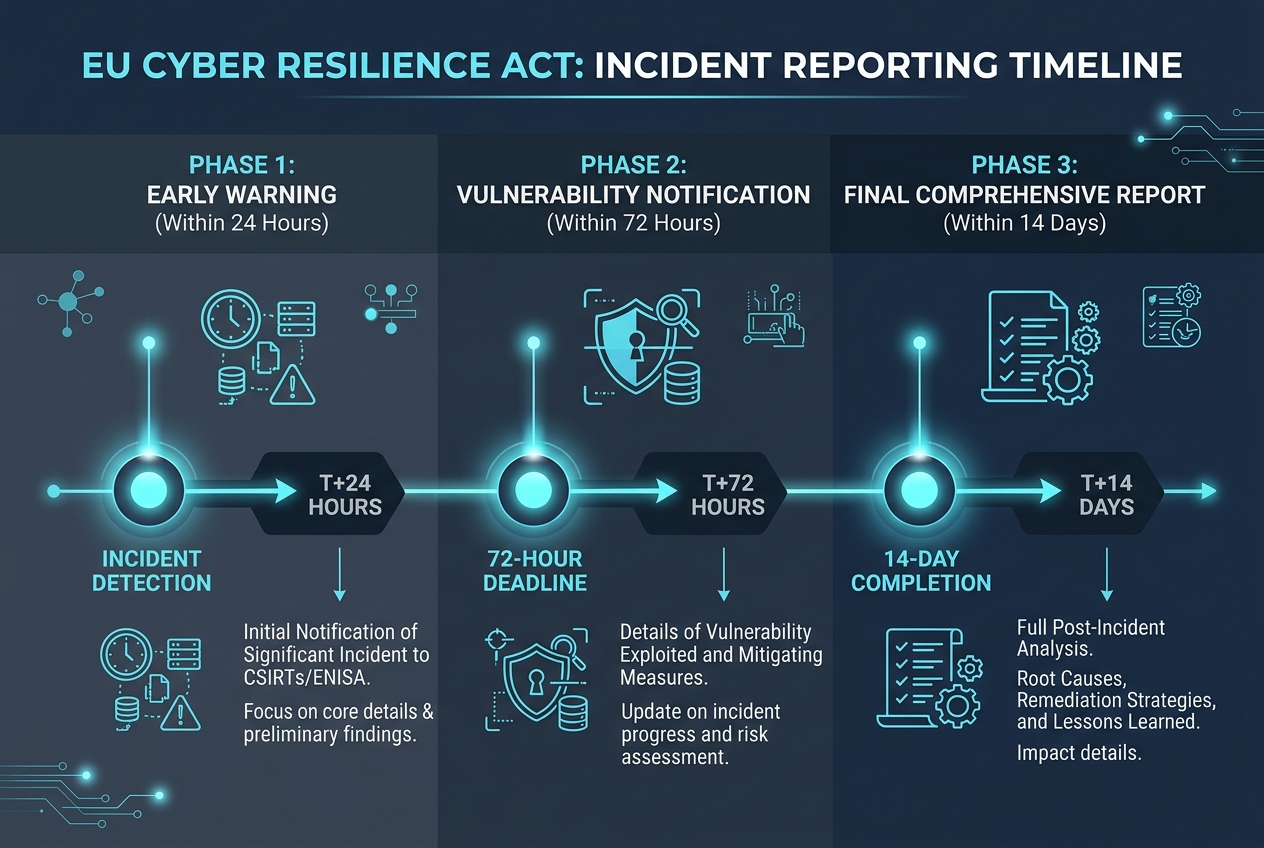
The first milestone is the Early Warning, which must be submitted within twenty-four hours of becoming aware of the actively exploited vulnerability or severe incident. The requirements for this initial submission are intentionally minimal to ensure that technical teams do not delay reporting while conducting root-cause investigations. The early warning must state whether the vulnerability is suspected of being caused by unlawful or malicious acts, indicate whether it appears to have cross-border impact across other member states, and provide basic identifying information regarding the affected product and component versions.
The second milestone is the Vulnerability Notification, due within seventy-two hours of becoming aware. At this stage, the manufacturer must provide significantly deeper technical detail. The submission must include an updated assessment of the vulnerability's severity, a description of the known attack vectors, indicators of compromise (IoCs), and information on any available corrective measures or temporary mitigations, such as configuration changes, firewall rules, or disabled feature flags, that users can implement immediately to protect themselves.
The third milestone is the Final Report, which must be submitted within fourteen days after a corrective or mitigating measure becomes available. For severe incidents under Article 14(3), the final report is due within one month of the initial incident notification. This comprehensive document must contain an exhaustive technical analysis of the vulnerability, an explanation of the root cause, a description of the permanent security patch or software update, and an assessment of how the exploit payload functioned in the wild.
The escalation model is structured into three concrete reporting thresholds:
- 24-Hour Early Warning: Indicates whether the vulnerability is suspected of being caused by unlawful acts, whether it has cross-border impact across EU member states, and basic component identifiers.
- 72-Hour Vulnerability Notification: Delivers updated severity metrics, attack vectors, indicators of compromise, and actionable temporary mitigations for users.
- 14-Day Final Report: Submits comprehensive root-cause analysis, permanent patch details, exploit mechanics, and long-term remediation recommendations.
This three-stage progression enforces a disciplined operational rhythm. If an engineering team discovers an active zero-day on a Friday afternoon, they cannot spend the weekend silently rewriting backend code. The twenty-four-hour early warning clock runs continuously, regardless of weekends, public holidays, or ongoing internal discussions. Failing to submit the early warning within the twenty-four-hour window constitutes an independent legal violation, even if the team successfully patches the flaw within forty-eight hours.
🌐 The retrospective trap: Products already on the market
A critical nuance of the Cyber Resilience Act that frequently catches development teams and legal counsels unprepared is the retrospective scope of Article 14. In standard European product legislation, new regulatory requirements typically apply only to new product models introduced to the market after the effective date of the law. Legacy products manufactured and sold prior to that date are usually grandfathered under previous rules.
The Cyber Resilience Act explicitly breaks with this tradition. Under Article 57 and the transitional provisions of Regulation (EU) 2024/2847, the reporting obligations of Article 14 apply to all products with digital elements within the scope of the regulation that were placed on the market before 11 December 2027, provided that those products are still supported or commercially available.
This legal mechanism creates what security analysts describe as the retrospective trap. Consider a commercial software package, an enterprise content management module, or a connected hardware sensor that your company developed and released in 2024 or 2025. That legacy version will never require a formal CE mark under the 2027 rules unless it undergoes a substantial modification. However, if a security vulnerability in that 2024 codebase is actively exploited in the wild today, and your team confirms that exploitation on or after 11 September 2026, you are legally mandated to submit the twenty-four-hour early warning to the Single Reporting Platform.
The implications for software portfolio management are profound. Organizations cannot limit their CRA preparedness to active greenfield development projects. Product teams must conduct an immediate inventory of every commercially supported product version currently in use across the European market. If an older product version is still receiving security patches or maintenance updates, an incident detection and reporting pipeline must be established for that product line immediately. Conversely, if a legacy product has reached its formal end-of-life and is no longer supported, that lifecycle status must be unambiguously communicated to customers to clarify the boundary of ongoing support obligations.
👥 Open-source software stewards and upstream dependencies
Modern software engineering is built on open-source foundations. A typical commercial SaaS platform or enterprise web application incorporates hundreds of open-source packages, libraries, and frameworks. During the drafting of the Cyber Resilience Act, the relationship between commercial software vendors and individual open-source developers was the subject of fierce debate across the global technology ecosystem.
To protect independent software developers who contribute code to the public commons without commercial intent, European lawmakers introduced the specialized legal category of the Open-Source Software Steward in Article 3 and Article 24. An open-source steward is defined as a legal entity, such as a non-profit foundation, industry consortium, or academic body, that systematically supports the development and maintenance of open-source software intended for commercial activities. Well-known examples include organizations like the Apache Software Foundation, the Eclipse Foundation, the Linux Foundation, and the Python Software Foundation.
Under Article 24(3), open-source software stewards are subject to a tailored subset of Article 14 reporting obligations. If an open-source steward becomes aware of an actively exploited vulnerability within a software package under its governance that is widely integrated into commercial digital products, it must notify the Single Reporting Platform. However, individual volunteer developers who publish code on public repositories without charging fees or providing commercial support are explicitly exempt from direct reporting liability.
For commercial software manufacturers who consume open-source components, this structure introduces a shared responsibility dynamic. Under Annex I and Article 13 of the CRA, the commercial vendor who packages open-source libraries into a paid product remains solely responsible for the end-to-end cybersecurity of the finished application. If a third-party open-source dependency in your product contains an actively exploited zero-day, your organization cannot evade Article 14 by pointing to the upstream maintainer. If the vulnerability is being actively exploited against your application or user base, your twenty-four-hour notification duty is triggered immediately upon confirmation.
🛠️ Building an internal vulnerability triage pipeline
Transitioning from an ad-hoc security response model to a legally defensible twenty-four-hour escalation routine requires software teams to re-engineer their internal vulnerability triage workflows. When a critical security alert arrives, technical staff cannot afford to spend twelve hours debating who has the authority to submit a regulatory filing or searching for the company's login credentials on the ENISA portal.

A resilient internal triage pipeline consists of five concrete operational phases designed to execute smoothly under high-pressure conditions:
Ingestion and Telemetry Monitoring
The first phase establishes continuous monitoring across all potential vulnerability signals. This includes centralizing inputs from external vulnerability disclosure programs (such as security.txt endpoints and bug bounty platforms), internal intrusion detection systems (IDS), Web Application Firewall (WAF) block logs, automated runtime application self-protection (RASP) telemetry, and upstream threat intelligence advisories (such as the CISA Known Exploited Vulnerabilities catalog and national vulnerability databases). All incoming vulnerability reports must be tagged with an exact ingestion timestamp to establish an immutable audit trail.
Threat Verification and Exploitation Confirmation
Once an alert is ingested, the security engineering team must determine whether the report meets the legal threshold of active exploitation. The team assesses whether the report describes a theoretical flaw, an unverified scanner alert, or confirmed exploitation. Evidence of active exploitation includes verified malicious payloads captured in production server logs, unauthorized database modifications, abnormal administrative account creations, or telemetry from endpoint detection and response (EDR) sensors indicating successful lateral movement. If active exploitation is confirmed, the security lead immediately marks the ticket as a CRA Priority 1 incident and records the confirmation timestamp.
Pre-Authorized Escalation and Legal Sign-Off
The twenty-four-hour clock leaves no room for standard executive review cycles. Organizations must establish a pre-authorized Incident Response Working Group comprising the Head of Engineering, the Chief Information Security Officer (or lead security engineer), and legal counsel. This team must operate under a standing delegation of authority that empowers them to submit the standardized CRA early warning to the Single Reporting Platform without waiting for board-level approval or full corporate consensus.
Structured Dispatch to the Single Reporting Platform
The assigned compliance lead logs into the ENISA Single Reporting Platform using corporate multi-factor authentication credentials and completes the early warning template. The filing must clearly specify the designated national CSIRT, the affected software product and version identifiers, the nature of the exploit, and preliminary cross-border impact assessments. Once submitted, the system captures the cryptographic transaction receipt and assigns the formal EU incident tracking ID.
Coordinated Remediation and Mitigating Guidance
While the regulatory notification is transmitted, the software engineering team immediately transitions to containment and remediation. If a complete code fix cannot be compiled, tested, and shipped within seventy-two hours, the team must draft actionable mitigation instructions for customers, such as disabling vulnerable API endpoints, adjusting firewall rules, or applying temporary environment variables. These mitigating steps are included in the seventy-two-hour vulnerability notification to help downstream users safeguard their systems while permanent patches are finalized.
⚖️ National CSIRTs and coordinated disclosure safeguards
A major concern voiced by software developers during the legislative debate surrounding Article 14 was the risk of confidential vulnerability details leaking before a functional patch could be distributed. In software security, premature public disclosure of an unpatched zero-day flaw effectively provides a blueprint for opportunistic threat actors, exposing millions of active installations to automated exploitation before defenders can secure their environments.
Recognizing this critical hazard, European lawmakers incorporated rigorous operational safeguards into Article 16 and delegated acts governing the Single Reporting Platform. The regulation explicitly separates mandatory regulatory notification from public disclosure. When a manufacturer submits an early warning or seventy-two-hour notification to the SRP, the details are transmitted over encrypted channels and classified under strict need-to-know access controls among designated CSIRT coordinators.
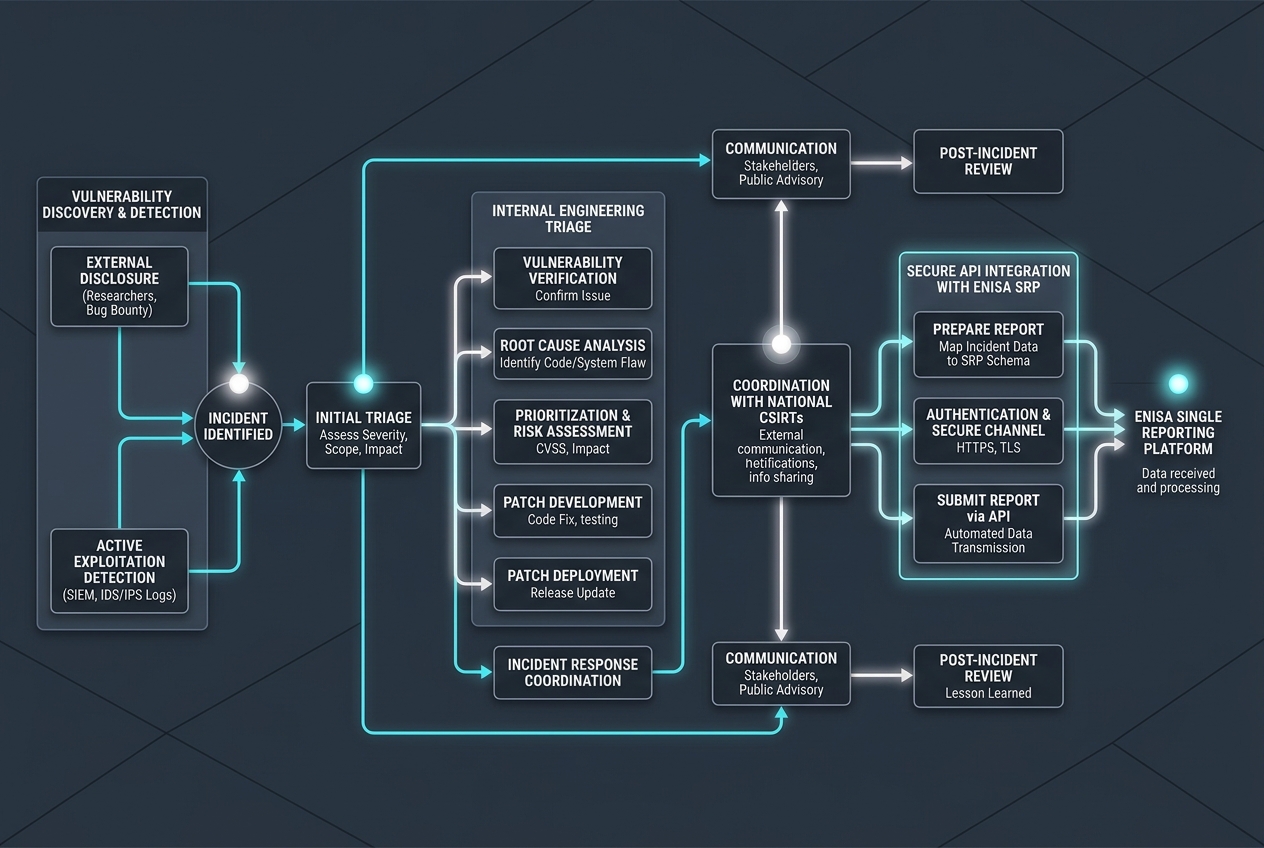
Furthermore, Article 16(2) grants the receiving national CSIRT the legal authority to temporarily delay the wider dissemination of vulnerability details to other member state CSIRTs if there are justified cybersecurity grounds. Specifically, if a manufacturer is actively engaged in a Coordinated Vulnerability Disclosure (CVD) process under national guidelines or Directive (EU) 2022/2555 (NIS2), and immediate dissemination would jeopardize ongoing patch development or expose critical infrastructure to premature attack, the lead CSIRT can withhold the detailed technical parameters until the security update is ready for simultaneous deployment.
Similarly, if an investigation reveals that the Single Reporting Platform itself has experienced an availability impairment or a suspected security compromise, CSIRTs are legally required to suspend automated message dissemination until ENISA confirms that platform integrity and confidentiality have been fully restored. These safeguards ensure that Article 14 functions as a secure intelligence-sharing bridge rather than an involuntary vector for public zero-day disclosure.
⚠️ The operational risk of panic reporting and under-reporting
As software organizations adapt to the reality of Article 14, engineering and compliance leadership must navigate two opposing operational failure modes, each carrying severe organizational consequences: the hazard of panic reporting and the legal liability of under-reporting.
On one end of the spectrum lies panic reporting. When technical teams first confront the threat of 15-million-euro fines and rigid twenty-four-hour deadlines, their natural instinct is often to file notifications for every anomalous log entry, routine brute-force attempt, or scanner probe that touches their public web servers. Submitting hundreds of false-positive filings to the Single Reporting Platform is counterproductive. It dilutes the signal for European incident handlers, consumes engineering hours that should be dedicated to remediation, and creates an unnecessary administrative record that could trigger unneeded regulatory scrutiny into standard operational practices.
On the other end of the spectrum lies the far more dangerous risk of under-reporting or delayed reporting. Some corporate cultures harbor an instinctive resistance to acknowledging security breaches, hoping to investigate internally, contain the attacker quietly, and deploy a patch before anyone notices. Under Article 14, this behavior is a catastrophic legal gamble. If a manufacturer discovers evidence of active exploitation, delays reporting beyond twenty-four hours to conduct a private internal review, and the breach subsequently surfaces through a third-party threat intelligence report or customer leak, the manufacturer faces severe regulatory sanctions for non-compliance, entirely independent of the underlying breach itself.
The only sustainable middle path is establishing clear, objective technical criteria for what constitutes confirmed evidence of active exploitation. When those predefined criteria are met, the filing must proceed automatically and without hesitation. By treating regulatory notification as a standardized, unemotional operational procedure rather than an admission of corporate guilt, organizations can maintain transparency with regulators while focusing their core engineering resources on solving the technical problem.
🧭 Practical checklist: Turning compliance into engineering resilience
Complying with the September 2026 reporting deadline of the Cyber Resilience Act does not require an enterprise to rebuild its entire software architecture overnight. Instead, it requires pragmatic adjustments to existing incident response and release routines. Small development agencies, boutique SaaS providers, and mid-sized product teams can achieve robust compliance by executing a structured four-week operational sprint.
First, establish organizational access to the Single Reporting Platform. Designate primary and secondary administrative contacts within your security and engineering departments. Register your organization on the ENISA SRP portal, verify your corporate credentials, and familiarize your team with the reporting interface, required metadata schemas, and submission endpoints. Having authenticated access in place before an incident occurs eliminates administrative panic during a live security event.
Second, audit your supported software footprint. Create a centralized register of every digital product, mobile application, API service, and hardware firmware version currently made available to customers within the European Union. Confirm the end-of-life status for legacy releases and ensure that monitoring telemetry is actively feeding into your central security logging infrastructure for all supported versions.
Third, update your incident response playbooks with a dedicated CRA escalation path. Embed an explicit twenty-four-hour decision checkpoint into your emergency triage workflow. Document the exact criteria required to confirm active exploitation, define the responsibilities of the Incident Response Working Group, and pre-draft template text for early warnings and seventy-two-hour notifications to minimize drafting friction during a crisis.
Fourth, rehearse the routine through a simulated tabletop exercise. Walk your engineering, product, and legal leads through a realistic scenario involving an active zero-day exploit detected in a production software dependency. Test your team's ability to ingest the alert, verify exploitation telemetry, convene the escalation working group, draft the early warning, and prepare customer mitigating guidance within the twenty-four-hour constraint.
Ultimately, the Cyber Resilience Act’s September 2026 reporting mandate represents a profound transformation in how the global software industry approaches product security. By establishing mandatory transparency around actively exploited vulnerabilities, the regulation forces organizations to move beyond passive security posture assessments and embrace proactive, rapid-response engineering. For software teams that take the initiative to build disciplined incident pipelines today, compliance with Article 14 ceases to be an administrative burden; it becomes a powerful operational advantage that protects customer trust and strengthens long-term digital resilience.
Sources: European Union Regulation (EU) 2024/2847 (Cyber Resilience Act); ENISA Single Reporting Platform Documentation and Terms of Service; European Commission Digital Strategy on the Cyber Resilience Act; EUR-Lex Delegated Regulation on Cybersecurity Grounds for Notification Delay; Directive (EU) 2022/2555 (NIS2).