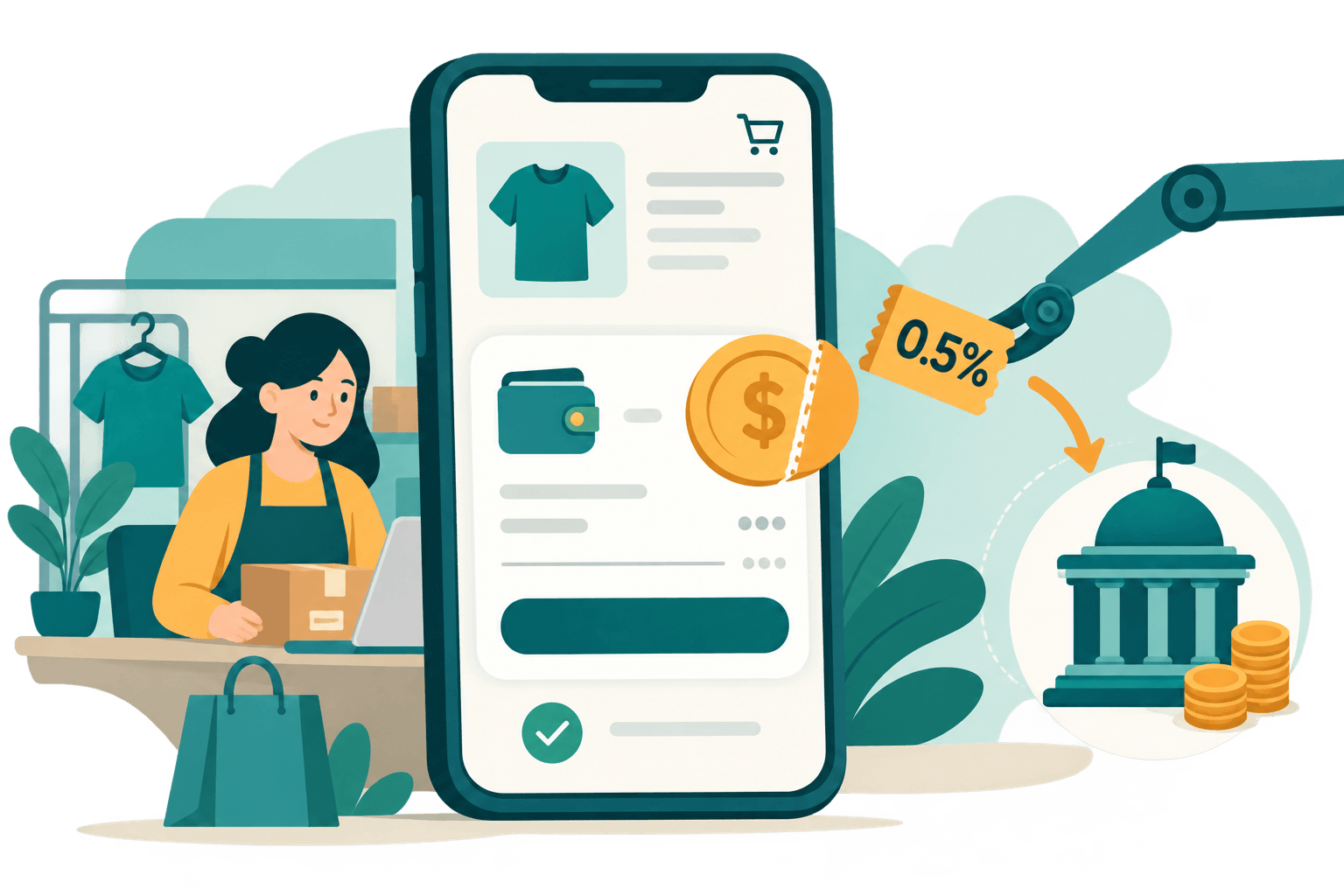
On August 5, 2026, Indonesia's Directorate General of Taxes (DJP) pulled back a rule that had already gone live. Four days after Shopee, Tokopedia, Lazada, and Blibli started withholding a 0.5% income tax on every seller's gross sales, the government hit pause — pushing the mandatory start date from August 1 to November 1, 2026, and ordering marketplaces to refund whatever they had already collected. For the millions of small merchants who sell through those four platforms, this is not an abstract policy footnote. It changes what shows up in a seller's payout this month, and it opens a three-month window that online sellers should not waste.
🔑 Key Takeaways
- DJP suspended mandatory marketplace withholding of Income Tax Article 22 (PPh Pasal 22) on August 5, 2026, four days after it took effect on August 1.
- The new mandatory start date is November 1, 2026. Shopee and Blibli both stopped withholding on August 6 at 00:00 WIB; Tokopedia and Lazada had not issued a matching public notice as of this article's publication.
- Anything withheld between August 1–6 will be refunded to sellers, though DJP has not yet published the exact refund mechanism.
- The withholding rate itself, 0.5% of a seller's gross sales, is unchanged. This is a delay in timing, not a change to the policy's substance, according to DJP.
- Some e-commerce industry players have asked the government to push full implementation to January 2027 instead of November, for more preparation time.
- Sellers should use the delay as planning time, not treat it as a cancellation — the obligation is on track to return.
📜 What Actually Happened, in Order
The story moves fast, so the sequence matters more than any single headline:
- June 11, 2025 — Finance Minister Sri Mulyani Indrawati signed Minister of Finance Regulation (PMK) No. 37/2025, designating marketplaces as official withholding agents for Income Tax Article 22 (PPh Pasal 22) on domestic online sellers' revenue, at a rate of 0.5% of gross turnover. It was promulgated on July 14, 2025.
- August 1, 2026 — The rule took effect. Shopee, Tokopedia, Lazada, and Blibli — the four marketplaces named by DJP — began deducting PPh 22 automatically from seller payouts.
- August 5, 2026 — DJP announced the withholding requirement is suspended until October 31, 2026, with the new mandatory start date set for November 1, 2026. DJP spokesperson Inge Diana Rismawanti said the suspension is meant to protect public purchasing power "in the middle of an economic condition the government is still watching closely," and stressed that "this is not a change to the substance of the policy, only a delay in when it takes effect."
- August 6, 2026, 00:00 WIB — Shopee and Blibli both announced through their seller centers that they had stopped withholding PPh 22, effective immediately. As of this writing, Tokopedia and Lazada had not issued a matching public notice through their own official channels.
- Ongoing — DJP said any PPh 22 already withheld between August 1–6 will be returned to sellers by the marketplaces, though the exact refund mechanism is still pending official DJP guidance. Shopee has told sellers it is waiting on that guidance before announcing its own refund process.
💰 What the Tax Actually Is — and Isn't
PPh Pasal 22 is not a brand-new tax. It is a collection mechanism: instead of a seller calculating and remitting their own income tax obligation at year-end, the marketplace withholds 0.5% of gross sales value automatically, at the point of each transaction, and remits it to the state on the seller's behalf. Income tax on business turnover has applied to online sellers in Indonesia for years under general tax law; what PMK 37/2025 changes is who does the collecting and when.
A simple way to see the math: a seller with Rp20,000,000 in monthly sales through one of the four named marketplaces would see roughly Rp100,000 withheld as PPh 22 for that month, once the rule is active. That amount is treated as a tax credit the seller can offset against their annual income tax filing — it is prepayment, not an extra tax on top of what a seller already owes.
Under PMK 37/2025, a marketplace only has to register as a withholding agent once DJP formally designates it as a "PPMSE" (Penyelenggara Perdagangan Melalui Sistem Elektronik) that meets certain criteria — largely tied to platform size and transaction volume. Sellers do not need to register anything or change their own filing process once the mechanism is active; the deduction happens automatically inside the marketplace's own payout system. That automation is exactly why a four-day live window followed by a sudden suspension is disruptive: sellers had almost no time to adjust their pricing or cash-flow assumptions before the rule flipped off again.
🏛️ Why the Government Reversed Course So Fast
Four days between "live" and "suspended" is an unusually short runway for a tax policy, and it says as much about the current economic backdrop as it does about e-commerce specifically. DJP's own statement ties the reversal directly to household purchasing power — "daya beli masyarakat" — language that has been showing up across several of Finance Minister Purbaya Yudhi Sadewa's recent policy moves, from delayed tax collection announcements to consolidation-related exemptions elsewhere in the tax code. Purbaya has also been monitoring the real-world effect of a separate Rp200 trillion government fund placement into the banking sector, reportedly wanting to see that stimulus show measurable results before layering a new withholding obligation onto small sellers who are still recovering margin after a wave of marketplace admin-fee increases earlier in 2026.
The timing lines up with a broader pattern DJP has described publicly: officials have said for months that implementation was ready from a systems standpoint, but that the final go-live date depended on a signal from the Finance Minister himself. "Itu (implementasi) kita masih menunggu arahan dari yang mendantangani PMK-nya. Kalau kita selalu siap-siap terus, begitu kata beliau (Menkeu) mulai, ya kita mulai," Rismawanti said months earlier, describing DJP's posture as ready-but-waiting. That is effectively what played out — the system went live on schedule, and was pulled back within days on a purchasing-power judgment call from above DJP's own desk.
The Indonesian E-Commerce Association (idEA) welcomed the move. Secretary General Budi Primawan said the four member marketplaces had already built the technical infrastructure — system testing, business process adjustments, seller communication — and that work "will not go to waste" when the policy restarts.

🧭 What the Industry Wants Next
The suspension has not fully settled the debate over timing. Some players in the e-commerce industry have gone a step further than simply accepting the November 1 date — they are pushing for an additional delay, proposing that full implementation start in January 2027 instead. The argument is straightforward: three extra months would let DJP finalize the refund mechanism, let marketplaces complete a second and cleaner round of system testing, and give sellers more structured outreach before deductions resume, rather than repeating the compressed, four-day live period that triggered this suspension in the first place.
Whether DJP grants that request is an open question. What is confirmed is that DJP has signaled willingness to adjust the calendar once already — from July 1 (an earlier informal target discussed by industry) to August 1, and now to November 1 — so a further shift is not out of character for how this policy has been managed. For sellers, the practical lesson is not to anchor hard on any single date on the calendar, but to build a habit of checking official DJP and marketplace channels rather than planning finances around informal timelines.
📅 What Happens Between Now and November 1
For a seller running a small online shop through one of the four named marketplaces, this window is a rare thing in tax policy: advance notice with a hard deadline, even if that deadline has already moved once.
- No PPh 22 deduction on new sales, for now. Payouts from Shopee and Blibli should show gross amounts without the 0.5% withholding starting August 6. Track this carefully against your own bookkeeping so you notice immediately if either platform resumes withholding early or inconsistently.
- A refund is coming, but the mechanism is not final. DJP has confirmed sellers are entitled to get back anything withheld between August 1–6, and marketplaces will announce the process once DJP publishes formal guidance. Do not assume the refund lands automatically without checking your seller dashboard — Shopee has explicitly told sellers to wait for further instructions rather than assume automatic processing.
- The obligation itself is not going away. DJP has been explicit that this is a timing change, not a policy reversal. Sellers should plan cash flow as if the 0.5% withholding will resume on November 1, 2026 — treating the delay as breathing room, not a cancellation.
- Not every marketplace has moved at the same pace. Shopee and Blibli acted quickly and publicly; Tokopedia and Lazada had not issued their own public confirmation as of this article's publication. Sellers on those two platforms should check their own seller center directly rather than assume the same policy applies automatically, since each marketplace communicates its own compliance timeline.
- Industry wants even more time. As noted above, a January 2027 start has been proposed by industry players. Whether DJP agrees to a second delay is still an open question.

🧾 What This Means If You Sell Online
If your business sells through Shopee, Tokopedia, Lazada, or Blibli, three concrete moves make sense right now, regardless of whether November 1 holds or slips further:
- Reconcile your payouts now. Pull your transaction history from August 1–6 and confirm exactly how much PPh 22 was withheld, so you can match it against whatever refund the marketplace eventually processes. Keep a simple spreadsheet or screenshot log — DJP's refund process is new, and having your own records makes any dispute faster to resolve.
- Separate the 0.5% mentally, starting today. Whether or not it is being deducted this month, build it into your pricing and cash-flow planning as a near-certain cost from November 1 onward — or January 2027 if the delay is extended again. A seller who prices assuming the deduction will not resume is setting up a margin surprise later this year.
- Keep your own records independent of the marketplace's. PPh 22 withheld by a marketplace is a credit against your annual income tax obligation, not a replacement for keeping your own bookkeeping. A seller who can produce clean transaction and tax records is in a far stronger position — with DJP, with a bank loan officer, or with an accountant — than one relying entirely on a marketplace dashboard that could change its reporting format at any time.
None of this requires new software or a consultant on day one. It requires treating a three-month reprieve as what it actually is: preparation time, not a policy that disappeared. A business with a real website and its own order and record-keeping system — rather than one that lives entirely inside a single marketplace app — tends to weather exactly this kind of sudden, marketplace-driven policy shift with less disruption, because its records and customer relationships do not depend on one platform's dashboard staying consistent.

📊 A Quick Snapshot for Sellers
To keep the moving pieces straight, here is where things stand as of this article's publication:
- Policy: PMK No. 37/2025, signed June 11, 2025, promulgated July 14, 2025.
- Rate: 0.5% of a seller's gross sales value, withheld automatically by the marketplace.
- Marketplaces named: Shopee, Tokopedia, Lazada, Blibli.
- Went live: August 1, 2026.
- Suspended: August 5, 2026, by DJP announcement.
- Shopee and Blibli stopped withholding: August 6, 2026, 00:00 WIB.
- New mandatory start date: November 1, 2026.
- Refund status: Confirmed by DJP; mechanism not yet published.
- Industry request: Some players have proposed pushing the date further, to January 2027.
⚖️ How This Compares to Other Seller Obligations
PPh Pasal 22 withholding does not exist in isolation. Small online sellers in Indonesia have been navigating a stack of overlapping fiscal and platform-level changes through 2026, and it is worth placing this suspension in that context rather than treating it as a one-off event:
- The UMKM final tax rate (PPh Final 0.5%). Separate from PMK 37/2025, many small sellers already pay a simplified final income tax of 0.5% on turnover under long-standing UMKM tax rules (originally PP 55/2022, later adjusted). The marketplace withholding mechanism is meant to complement, not duplicate, this — but sellers who are unclear on which regime applies to them risk either overpaying or under-reporting.
- Rising marketplace admin fees. Several major platforms raised seller administration fees by as much as 10% earlier in 2026, squeezing margins before this withholding policy was even scheduled to start. That sequencing is part of why idEA and some sellers welcomed the August 5 suspension rather than treating it as a minor scheduling footnote — it landed on top of an already tighter cost environment.
- Global comparisons. Indonesia is not unusual in asking platforms to collect tax at the point of sale; jurisdictions from the European Union to several Southeast Asian neighbors have moved toward similar platform-withholding models for digital marketplace sellers over the past few years, precisely because it is administratively simpler than relying on millions of individual sellers to self-report. What makes Indonesia's rollout notable is less the mechanism itself and more the compressed, four-day live-to-suspended timeline — a pace that even DJP's own public statements suggest was driven by macroeconomic timing rather than a technical failure.
❓ Questions Sellers Are Actually Asking
A few practical questions have come up repeatedly across seller communities and marketplace help centers since August 5:
Do I need to do anything right now? Not urgently. No action is required to receive the suspension; it applies automatically. The one active task is reconciling your own records for the August 1–6 window so you can verify any refund later.
Will the refund show up automatically? DJP has confirmed a refund is owed, but as of publication neither DJP nor Shopee has published the exact process. Sellers should watch their marketplace's official seller center, not third-party summaries, for the specific refund steps once they are announced.
Does this affect sellers on platforms other than the four named marketplaces? PMK 37/2025 designates specific marketplaces meeting DJP's criteria as withholding agents; Shopee, Tokopedia, Lazada, and Blibli are the four currently named. A seller operating outside those platforms, or through their own independent website, is not subject to this specific withholding mechanism — though general income tax obligations still apply regardless of sales channel.
Should I lower my prices now that the deduction has paused? Not on the government's timeline alone. Pricing decisions should reflect actual costs and demand, not a policy window that both DJP and industry groups have described as likely to close again within a few months.
🔎 The Limits of What We Know
DJP has confirmed the suspension, the new November 1 start date, and the refund commitment. What remains unconfirmed publicly, as of this writing: the exact refund mechanism and timeline, whether Tokopedia and Lazada have quietly paused withholding the same way Shopee and Blibli have announced, and whether the industry's request to push implementation to January 2027 will be granted. Sellers should treat November 1, 2026 as the operative planning date until DJP issues a further update, and watch official channels — not social media rumor — for the refund process once it is published.
🧩 Why This Matters Beyond Tax Season
Policy whiplash like this is not unique to Indonesia's e-commerce sector, but it is a useful reminder of a broader pattern small sellers face everywhere digital platforms and government regulation intersect: rules can arrive, apply, and pause within the same week, and the businesses caught in the middle are the ones with the least ability to absorb sudden changes to their cash flow. The sellers who come out ahead in this kind of environment are rarely the ones who guessed correctly about the exact date — they are the ones who kept clean records, diversified beyond a single platform's dashboard, and treated every delay as planning time rather than good news to ignore. That distinction matters more than it sounds: a seller who spends the next three months building a simple bookkeeping habit will absorb November 1 without disruption, while one who waits for a final confirmation before doing anything is likely to be scrambling again when the rule actually returns. For a small business running its own storefront outside the big marketplaces too, the underlying lesson is the same one that shows up in most digital-first businesses — the platforms and policies around you can change on short notice, so the parts you control directly, like your own website, your own records, and your own customer relationships, are worth investing in regardless of what any single marketplace decides next.
This article is based on Indonesia's Directorate General of Taxes (DJP) official announcement dated August 5, 2026, PMK No. 37/2025, and reporting from Liputan6, Media Indonesia, Okezone, Bisnis.com, and Pajakku as of August 9, 2026.