
For nearly a decade, the standard playbook for launching a boutique software house, UI/UX studio, or independent creative consultancy in Indonesia began at a public notary's office. You registered a Commanditaire Vennootschap (CV) or a closed limited liability company (PT), obtained your corporate tax identification number, applied for a tax confirmation certificate, and opted into Government Regulation 23 of 2018, later renewed under Government Regulation 55 of 2022. That single administrative election granted your corporate entity the right to pay a flat 0.5 percent final income tax on gross revenue, up to an annual turnover ceiling of IDR 4.8 billion.
For a software development shop or digital product agency with lean overhead and high profit margins, that 0.5 percent gross turnover rate was the financial engine of small-team solvency. With no heavy capital expenditure, zero physical inventory, and gross margins hovering between 40 and 65 percent, digital agencies operated under an extraordinarily favorable tax arithmetic. If a three-person boutique web studio billed IDR 2.4 billion in custom web applications, client retainer contracts, and cloud architecture consulting across twelve months, its entire corporate income tax bill was exactly IDR 12 million. Accounting was straightforward: total the bank invoices, generate an electronic tax payment code, pay fifty basis points, and file the monthly report.
On April 22, 2026, the Indonesian government fundamentally dismantled that architecture with the enactment of Government Regulation Number 20 of 2026 (PP 20/2026), amending Government Regulation Number 55 of 2022. While public headlines predominantly celebrated that individual micro-entrepreneurs could continue paying the 0.5 percent rate indefinitely, the actual statutory text executed a decisive structural purge. Under the newly amended Article 57, corporate entities formed as CVs, standard multi-shareholder PTs, and partnerships have been formally excised from the 0.5 percent final tax regime.
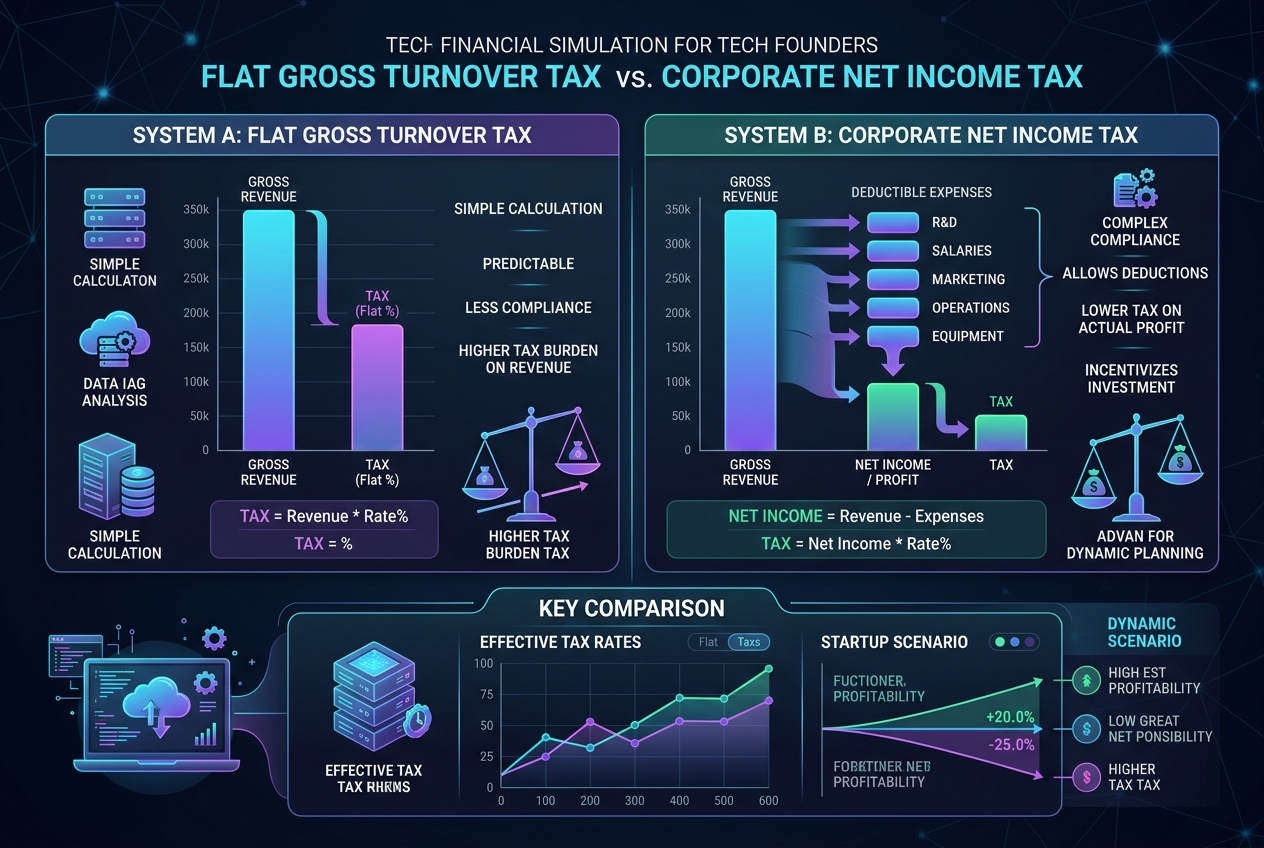
For low-margin retail distributors and traditional supply-chain traders, shifting from a turnover tax to standard net corporate income tax is frequently a relief. But for high-margin digital consultancies and boutique software houses, the math is brutal. When your gross revenue converts into 50 percent net profit, losing the 0.5 percent gross shield and entering standard corporate taxation under Article 17 and Article 31E of the Income Tax Law multiplies your corporate tax burden by more than eleven times. Digital studio founders across Jakarta, Bandung, Yogyakarta, and Bali are waking up to a stark reality: the era of friction-free gross tax calculations is over, and formal corporate accrual bookkeeping is no longer optional.
🏛️ The Regulatory Reset of PP 20/2026
To understand why this regulatory revision landed with such force across Indonesia's creative and tech sectors, one must look at the administrative intent behind the original micro-enterprise tax facilities. When Government Regulation 46 of 2013 introduced the 1 percent gross turnover tax, followed by PP 23/2018 cutting it to 0.5 percent, the policy was designed as an onboarding ramp for informal merchants. The logic was simple: small shopkeepers and local traders lacked the accounting literacy or capital to maintain double-entry bookkeeping, track accrued depreciation, or balance complex ledgers. A nominal gross tax offered immediate legal certainty and brought informal cash businesses into the national tax net.
However, that generous umbrella had structural flaws that institutional planners at the Directorate General of Taxes (DJP) observed over a decade of enforcement. First, the flat turnover tax was blind to profitability. A manufacturing workshop operating on a thin 3 percent net profit margin was forced to pay 0.5 percent of gross revenue, effectively sacrificing more than 16 percent of its real net profit to tax. If that same workshop suffered a loss-making year, it was still compelled to pay 0.5 percent of its gross sales. Conversely, a boutique software studio billing high-value software retainers with 60 percent net margins paid virtually negligible tax relative to its actual economic capacity.
Second, the tax administration observed widespread corporate fragmentation. High-earning professional partnerships, consultancies, and commercial operators routinely formed cascades of CVs or individual shelf companies. As soon as one corporate vehicle approached the IDR 4.8 billion gross revenue threshold, incoming client billings were routed to a newly incorporated sister entity. This allowed profitable operations to perpetually park their business income inside the 0.5 percent final tax bracket while completely evading standard corporate income taxes and the transparent scrutiny of full financial audits.
Government Regulation Number 20 of 2026 was drafted specifically to terminate these distortions. Rather than adjusting the headline tax rate, which remains locked at 0.5 percent, the regulatory apparatus tightened the gatekeeping criteria. The official explanatory notes of PP 20/2026 state that legal entities such as CVs, standard limited liability companies, and partnerships possess institutional governance and legal identity distinct from individual founders. Under commercial law, these entities are mandated to maintain orderly corporate accounting. Consequently, the government concluded that shielding commercial legal entities behind an informal gross-turnover calculation was incompatible with national tax equity and corporate transparency.
The new regulation establishes an unambiguous dividing line. Moving forward, the 0.5 percent final income tax is strictly restricted to three narrow classes of domestic taxpayers: individual entrepreneurs (Wajib Pajak Orang Pribadi), individual single-shareholder limited liability companies (Perseroan Perorangan), and cooperatives. Standard corporate vehicles, including CVs, firm partnerships, and conventional multi-shareholder PTs incorporated after April 22, 2026, are immediately disqualified from using the 0.5 percent final tax facility.
⚖️ Who Stays in the 0.5 Percent Sandbox and Who Is Kicked Out
The immediate challenge facing digital agency founders, indie software creators, and studio directors is determining exactly where their legal structure sits under the new classification framework of Article 57 PP 20/2026. The regulatory landscape has split into three distinct compliance tracks.

The first track encompasses individual business operators (Wajib Pajak Orang Pribadi). For individual creators, solo developers running software products, and independent digital service providers operating under their personal identification numbers, PP 20/2026 brings substantial relief. Under previous regulations, individual taxpayers were subjected to a strict seven-year sunset clause. PP 20/2026 eliminated that time limit. Individual taxpayers may now utilize the 0.5 percent final tax rate indefinitely, provided their annual gross turnover does not exceed IDR 4.8 billion. Crucially, the progressive exemption introduced in Law Number 7 of 2021 on the Harmonization of Tax Regulations (UU HPP) remains fully intact: the first IDR 500 million in cumulative annual gross revenue for individual entrepreneurs is completely tax-free.
The second track governs Perseroan Perorangan (PT Perorangan), the single-shareholder micro-company vehicle created under the Job Creation Law. In PP 20/2026, the government recognized PT Perorangan as an eligible subject for the 0.5 percent final tax, granting it the same indefinite timeframe as individual entrepreneurs. However, this inclusion came attached to an aggressive anti-avoidance tripwire embedded in Article 57 paragraph (2) letter b. The law strictly excludes any PT Perorangan established by an individual who possesses specialized expertise and provides services identical to or in the nature of independent professional services (pekerjaan bebas).
This exclusion directly hits technology and creative consultants. Under tax jurisprudence and statutory definitions (Article 56 paragraph 4), independent work includes IT consultants, software system architects, legal advisers, accountants, and commercial designers. If a senior full-stack engineer or an experienced brand strategist establishes a PT Perorangan where they are the sole director, sole shareholder, and sole deliverer of specialized advisory services, the entity is disqualified and forced into standard corporate taxation, preventing professionals from incorporating corporate shells merely to arbitrage professional income tax rates.
The third track applies to conventional business entities: Commanditaire Vennootschap (CV), Firma, conventional Perseroan Terbatas (PT) with two or more shareholders, and Village-Owned Enterprises (BUMDes). For these entities, any CV or PT established on or after April 22, 2026, cannot elect into the 0.5 percent final tax regime. From day one of operations, they must calculate corporate income tax based on taxable net income under Article 17 paragraph (1) letter b, utilizing the statutory small-business tax reduction granted under Article 31E of the Income Tax Law.
Existing CVs and PTs that were incorporated before April 22, 2026, and were actively paying the 0.5 percent rate under PP 55/2022, are granted a finite grace window. Under Article II of PP 20/2026, these legacy entities may continue using the 0.5 percent final tax only until the remainder of their original statutory term expires: a maximum of four tax years for CVs and three tax years for PTs from registration. Once that clock runs out, or if annual gross turnover breaches IDR 4.8 billion, they transition permanently to standard net-profit corporate taxation with no option to return.
📊 The High-Margin Trap: A Financial Simulation for Digital Agencies
To appreciate why this regulatory shift represents an operational pivot for small digital firms, one must run the exact financial simulations that tax consultants are presenting to studio directors.
Consider a boutique digital product studio organized as a CV in Jakarta, comprising a UI/UX lead, a technical architect, and a client relations director. The firm delivers custom web platforms, web applications, and ongoing infrastructure retainers for corporate clients. Over twelve months, the studio bills an aggregate gross turnover of IDR 3,000,000,000 across its client base.
Because digital software and design studios do not purchase physical raw materials or bear logistics costs, their operating expense profile is lean. Suppose the studio operates with the following annual cost structure:
- Cloud infrastructure, server hosting, and SaaS subscriptions (AWS, Vercel, Figma, GitHub, Google Workspace): IDR 180,000,000.
- Shared studio office lease, high-speed fiber internet, and workspace utilities: IDR 240,000,000.
- Junior developer and freelance production contractor fees: IDR 360,000,000.
- Equipment depreciation, marketing expenses, accounting retainers, and office overhead: IDR 120,000,000.
- Total operating overhead: IDR 900,000,000.
Before compensating the three founding partners, the business generates an operating surplus of IDR 2,100,000,000 on its IDR 3,000,000,000 revenue, representing a 70 percent gross operational margin. In many small CVs, the partners historically chose not to run formal monthly payroll for themselves through formal PPh 21 withholding systems, relying instead on informal draws or year-end profit shares.
Under the old 0.5 percent final income tax regime (PP 55/2022):
The tax calculation was elementary.
- Gross Revenue: IDR 3,000,000,000.
- Final Tax Rate: 0.5%.
- Total Annual Corporate Tax Payable: IDR 15,000,000.
The studio paid IDR 1,250,000 per month through electronic billing codes.
Now, examine the reality under PP 20/2026, where this newly formed CV is barred from the 0.5 percent regime and must calculate its tax liability under standard corporate taxation utilizing Article 31E of the Income Tax Law. Article 31E states that domestic corporate taxpayers with annual gross turnover up to IDR 50,000,000,000 receive a 50 percent discount on the standard corporate tax rate of 22 percent, applied to the portion of taxable income derived from turnover up to IDR 4.8 billion. This results in an effective corporate net income tax rate of 11 percent.
If the studio continues its past administrative practice of not deducting formal, commercially reasonable salaries for the three founding partners, its net profit before corporate tax is calculated simply as Gross Revenue minus Documented Operational Overhead:
- Gross Revenue: IDR 3,000,000,000.
- Deductible Operating Overhead: IDR 900,000,000.
- Taxable Net Profit (Penghasilan Kena Pajak): IDR 2,100,000,000.
- Corporate Tax Rate (Article 31E: 50% x 22%): 11%.
- Total Annual Corporate Income Tax Payable: IDR 231,000,000.
Under the new framework, the studio's annual tax liability rockets from IDR 15,000,000 to IDR 231,000,000. That is an absolute surge of IDR 216,000,000, representing a 1,440 percent increase in corporate tax liability.
Now compare this outcome with a traditional trading company: a local distributor of commercial building hardware, also incorporated as a CV, generating the exact same IDR 3,000,000,000 in annual turnover. Because the distributor purchases inventory, its cost of goods sold consumes IDR 2,600,000,000. Warehouse rent, logistics delivery fleet, and administrative staffing consume an additional IDR 310,000,000.
- Gross Revenue: IDR 3,000,000,000.
- Total Deductible Expenses: IDR 2,910,000,000.
- Taxable Net Profit: IDR 90,000,000 (a 3 percent net profit margin).
- Under old 0.5 percent gross tax: Paid IDR 15,000,000 (nearly 17 percent of real net profit).
- Under PP 20/2026 Article 31E: Corporate Tax is 11% x IDR 90,000,000 = IDR 9,900,000.
For the physical hardware distributor, PP 20/2026 cuts its tax bill by more than 33 percent. For the high-margin digital studio, the identical reform multiplies its tax bill by more than fifteenfold.
🛡️ The Anti-Fragmentation Fence and the Freelance Catch
When news of PP 20/2026 began circulating through tech community channels, many founders instinctively assumed they could incorporate a Perseroan Perorangan (PT Perorangan) for each individual founder, retain the 0.5 percent final rate, and split client billing across multiple micro-entities.
The legislative architects of PP 20/2026 anticipated this reaction. The statutory text incorporates several anti-fragmentation and anti-avoidance safeguards that make artificial corporate slicing a high-risk gamble.
The primary defensive mechanism is codified in Article 57 paragraph (2) letter e. The regulation mandates that the gross turnover of an individual taxpayer must be aggregated with the gross turnover of all Perseroan Perorangan entities established by that same individual. If the consolidated gross revenue of the individual and their wholly owned companies exceeds IDR 4,800,000,000 in a single tax year, the final tax facility is revoked across the entire portfolio for all subsequent tax years. An entrepreneur cannot run three separate PT Perorangan entities billing IDR 2 billion each to remain below the threshold; the tax system treats the economic owner as a single consolidated revenue unit.
Furthermore, Article 58 paragraphs (2) and (3) enforce economic unity across family households. For tax assessment purposes, the gross business turnover of a husband and wife who execute their tax obligations separately is legally combined to determine eligibility for the IDR 4.8 billion threshold. The revenue of underage children is likewise merged into the parental calculation. If a husband runs a digital agency billing IDR 3 billion and his spouse runs an independent design consultancy billing IDR 2.2 billion, their combined family turnover stands at IDR 5.2 billion, disqualifying both from the 0.5 percent final tax regime in the subsequent tax year.
Even more critical for technology businesses is the professional services barrier in Article 57 paragraph (2) letter b. In regulatory guidance, the government distinguished between a genuine commercial operating business and an incorporated freelancer. If an individual possessing specialized professional skills, such as a software architect, UI designer, or marketing strategist, establishes a single-member PT Perorangan that delivers services identical to their independent professional craft, that company is disqualified from the 0.5 percent final tax regime from inception.
To qualify as a legitimate commercial enterprise eligible for the micro-business facility, the entity must demonstrate independent operational substance. It must employ staff, manage organizational capital, deliver standardized commercial products or services, and operate beyond the personal labor of the single founder. A one-person software consulting vehicle with no staff and no commercial assets other than the founder's personal laptop will fail administrative scrutiny if it claims the 0.5 percent final rate.
🧾 Moving from Turnover Recording to Strict Deductible Bookkeeping
The loss of the 0.5 percent final tax shield forces digital agencies to abandon simple cash-in recording (pencatatan) and implement rigorous corporate accrual bookkeeping (pembukuan). In practical terms, this requires a total transformation in how an agency documents, categorizes, and substantiates its daily operational expenditure.

Under the 0.5 percent final tax regime, the internal expenses of the studio were largely irrelevant for tax filings. The tax authority did not examine whether client dinner receipts were genuine business entertainment, whether laptop purchases were capitalized, or whether cloud server invoices carried proper withholding taxes. The only metric that mattered was gross deposits entering the company bank account.
Under the standard corporate tax regime governed by Article 6 and Article 9 of the Income Tax Law, every rupiah of corporate income tax payable is directly tied to the net profit figure. Reducing taxable profit legitimately requires proving that business expenditures meet the strict legal criteria of costs incurred to get, collect, and maintain taxable income (Biaya 3M).
This statutory requirement immediately exposes common financial weaknesses in digital studios:
- Commingled Founder Finances: Founders routinely pay for cloud infrastructure, client hospitality, software licenses, and travel tickets using personal credit cards, often without submitting formal reimbursement forms, retaining fiscal invoices (Faktur Pajak), or logging vendor receipts. Under formal audit, non-compliant receipts are disallowed as deductible expenses, inflating taxable net profit.
- Withholding Tax Compliance: Every commercial payment made by a corporate entity to third parties triggers domestic withholding tax obligations. When an agency hires an independent freelance illustrator or contract developer, the agency must withhold Article 21 income tax (PPh 21) from the contractor's fee, issue an official withholding slip (Bukti Potong), and remit the withheld tax to the state treasury. When renting studio space from an individual landlord, it must withhold 10 percent final tax under Article 4 paragraph (2). If an agency fails to perform these withholdings, the tax office disallows the underlying rental and contractor expenses during corporate audits.
- Capital Expenditure and Asset Depreciation: High-end workstations, studio camera gear, and server hardware cannot be written off as lump-sum operational expenses in the month of purchase. They must be categorized into statutory asset classes under tax depreciation tables (typically Group 1 assets depreciated over four years at 25 percent per annum under the straight-line method).
Without clean bookkeeping backed by proper fiscal documentation, a digital agency will find its operational expenses disqualified during a tax inquiry. If half of a studio's operational costs are deemed non-deductible due to missing withholding slips or informal receipts, its paper profit swells, triggering crushing tax assessments.
🌐 Offshore Subscriptions and the Digital VAT Compliance Burden
For modern web and software agencies, operational expenditure is dominated by offshore digital infrastructure. Unlike traditional service firms whose outlays consist of domestic utility bills and physical office leases, a technology studio routinely spends tens of millions of rupiah monthly across cross-border SaaS platforms: cloud computing instances on AWS, edge hosting on Vercel, relational databases on Supabase, design workflows on Figma, code repositories on GitHub, and generative model inference tokens via OpenAI and Anthropic.
Under the 0.5 percent final gross tax era, these foreign transactions slipped beneath the radar. Because tax liabilities were calculated strictly on gross customer receipts, tax examiners rarely audited foreign credit card statements. Under standard corporate taxation, however, foreign digital purchases represent a major fiscal friction point that requires precise compliance.
In Indonesia, value-added tax on cross-border digital goods and services is governed by Minister of Finance Regulation Number 60/PMK.03/2022 (PMK 60/2022). Major multinational technology platforms have been appointed as official VAT collectors (Pemungut PPN PMSE). When an Indonesian enterprise subscribes to AWS, Google Cloud, or Microsoft 365, the vendor adds 11 percent Indonesian VAT to the billing invoice, provided the buyer enters their valid Indonesian Tax Identification Number (NPWP) or corporate data.
To substantiate corporate income tax deductions under Article 6 of the Income Tax Law, the agency must retain an electronic commercial invoice or receipt that explicitly displays the buyer's name, corporate tax identification number, and the amount of Indonesian VAT collected. If a studio founder uses a personal account with no corporate tax identification attached, or purchases tools from an unappointed overseas developer that does not collect domestic VAT, the transaction becomes legally complex. Under statutory rules, the domestic company must perform self-assessment and deposit the 11 percent VAT using a Special Tax Payment Slip (Surat Setoran Pajak / SSP) into state coffers to validate the cost as a legitimate corporate tax deduction. Failing to secure fiscal receipts for offshore infrastructure leaves essential cloud expenses vulnerable to disallowance during fiscal audits.
💼 Salary, Dividends, and the Operational Mechanics of Small Corporate Tax
The transition to standard corporate taxation under PP 20/2026 creates an imperative for agency founders to fundamentally rethink how they extract personal income from their business. In a high-margin digital enterprise, the most effective and legally compliant tool for managing corporate taxable net income is the implementation of formal, market-rate founder salaries.
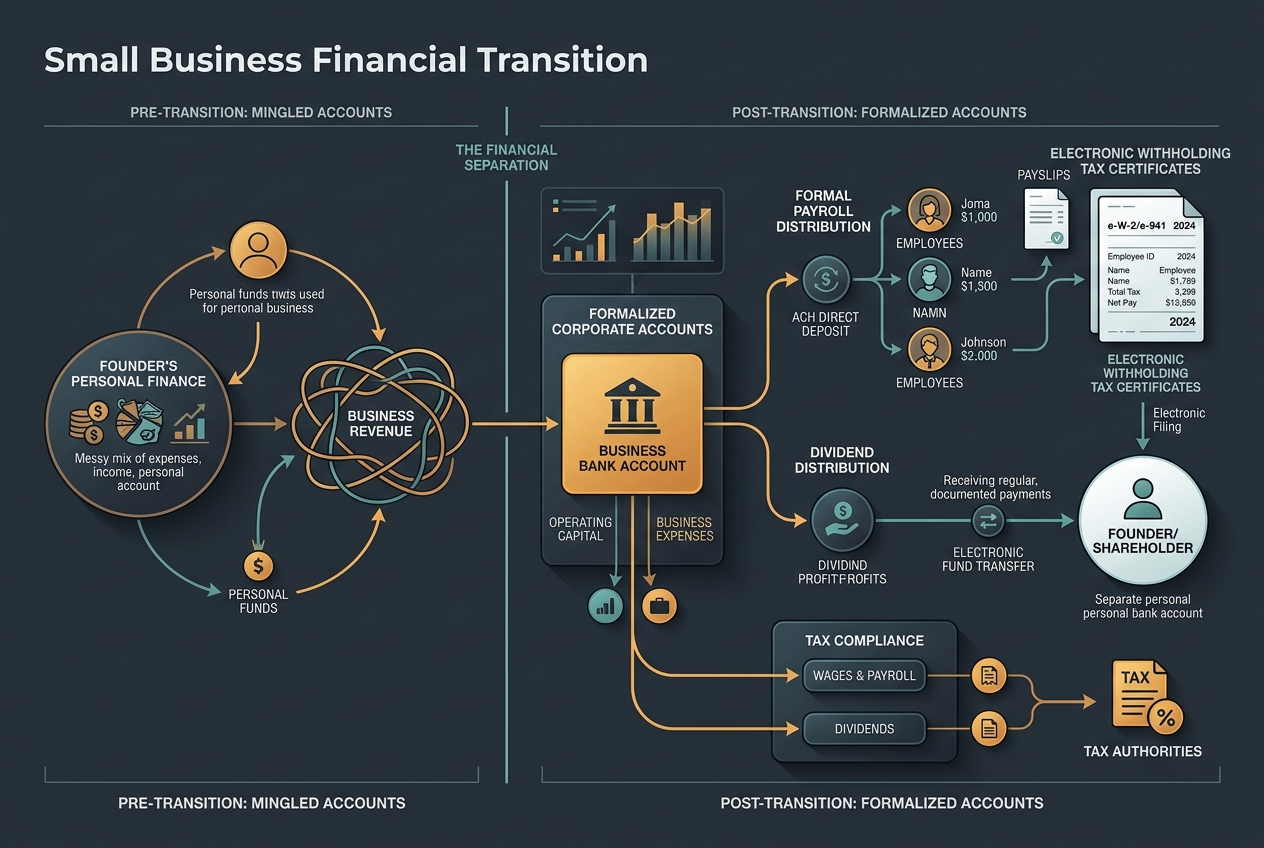
In the financial simulation analyzed earlier, the three founding partners faced a corporate tax bill of IDR 231,000,000 because their entire operational surplus of IDR 2,100,000,000 remained inside the company as unallocated corporate net profit. However, under Indonesian corporate tax law, reasonable compensation paid to company directors, executives, and employees for active managerial and technical services rendered is fully deductible as an operational expense against corporate gross income (Article 6 paragraph 1 letter a UU PPh).
Consider the alternative corporate structuring strategy. Suppose each of the three active founders draws a formal gross executive salary of IDR 35,000,000 per month, reflecting their real market roles as principal architect, design director, and managing partner.
- Combined Monthly Founder Payroll: IDR 105,000,000.
- Annualized Founder Payroll Expense: IDR 1,260,000,000.
- The company implements formal payroll systems, calculates monthly progressive personal income tax (PPh 21), and remits the withholdings to the tax office.
Recalculating the studio's corporate tax return yields an entirely different balance sheet:
- Gross Annual Revenue: IDR 3,000,000,000.
- General Operational Overhead: IDR 900,000,000.
- Deductible Executive Payroll Expense: IDR 1,260,000,000.
- Total Deductible Operating Costs: IDR 2,160,000,000.
- Taxable Corporate Net Profit (Penghasilan Kena Pajak): IDR 840,000,000.
- Corporate Income Tax under Article 31E (11% effective rate): IDR 92,400,000.
By implementing formal founder payroll, the studio's corporate income tax drops from IDR 231,000,000 down to IDR 92,400,000, conserving IDR 138,600,000 in corporate cash reserves.
Of course, tax does not disappear; it shifts from the corporate entity to the individual founders via Article 21 withholding. However, this shift unlocks crucial structural advantages:
- Individual Deductions and Progressive Brackets: Individual tax calculations benefit from Non-Taxable Income allowances (PTKP) and lower starting progressive brackets (5 percent on the first IDR 60 million, 15 percent on the next IDR 190 million).
- Banking and Credit Credibility: For founders personally, having verifiable, tax-paid monthly salary slips and official 1721-A1 withholding certificates dramatically elevates personal creditworthiness, facilitating commercial mortgages, personal financing, or auto loans.
- Clean Separation of Corporate Equity: Any remaining post-tax profit residing in the company after paying the 11 percent corporate tax can either be retained for working capital expansion, invested in research, or distributed to domestic individual shareholders as dividends. Under the Law on Harmonization of Tax Regulations (UU HPP), dividends distributed to domestic individual shareholders are completely exempt from personal income tax, provided the recipients reinvest the funds into qualified domestic financial instruments or business activities within Indonesian territory for a statutory holding period of three years.
This structural equilibrium demonstrates why navigating standard corporate taxation is not purely an exercise in paying higher taxes. It is an evolutionary forcing function that transitions informal creative collectives into mature, institutional digital businesses.
🧭 An Action Plan for Studio Founders Before the Tax Year Closes
The promulgation of Government Regulation 20 of 2026 marks the definitive close of Indonesia's informal digital studio era. Hoping that tax auditors will overlook your corporate vehicle or assuming that a CV remains an untouchable micro-business is an invitation to future financial crisis. Founders, managing partners, and studio financial controllers must execute a structured operational transition before their current tax reporting period closes.
First, conduct an immediate legal entity audit. Inspect your company's corporate establishment deed, your registration date, and your current tax status. If your digital studio was incorporated as a CV or PT prior to April 22, 2026, verify the remaining duration of your statutory transition window under PP 55/2022. If your entity was incorporated after April 22, 2026, recognize immediately that your company is already subject to standard net corporate taxation under Article 17 and Article 31E. Do not attempt to pay 0.5 percent on monthly electronic billing codes; doing so creates an accumulated tax shortfall that will trigger administrative fines and statutory interest penalties.
Second, separate your business and personal financial ecosystems with absolute finality. Close every informal spending loophole. Ensure that all client invoices are settled exclusively into designated corporate accounts. Eliminate personal founder expenses from company bank statements. For every recurring SaaS tool, cloud platform, domain registry, and digital subscription used in commercial delivery, transfer the account billing details to the corporate entity and obtain valid tax invoices that match your corporate tax identification number.
Third, formalize partner compensation through payroll and withholding infrastructure. Sit down with your founding team, determine commercially reasonable market salaries for active partners, and implement standardized monthly payroll. Register your company for corporate payroll withholding systems (e-Bupot 21/26), calculate mandatory monthly progressive withholdings, and ensure timely monthly remittances. Treat founder payroll as an indispensable operational expense that protects both the company's balance sheet and the founders' personal financial compliance.
Fourth, overhaul vendor management and contractor contracting. Draft standardized freelance agreements for all external designers, contract engineers, and specialized contributors. Require every independent contractor to provide their tax identification number (NPWP) or national identity number (NIK), and systematically deduct Article 21 withholding tax from every project milestone payment. Issue electronic withholding slips promptly through the tax authority's integrated digital portal. A contractor invoice unsupported by a formal withholding slip is a future tax liability waiting to detonate during an audit.
Fifth, partner with a qualified tax practitioner or accredited public accountant who specializes in professional service firms and technology businesses. Transitioning from basic cash-flow recording to formal accrual double-entry accounting requires specialized oversight. Your finance stack must reliably generate an accurate balance sheet, a compliant profit-and-loss statement, a fixed asset depreciation schedule, and an integrated fiscal reconciliation report.
The digital studios that thrive in the coming decade will not be those that attempt to hide behind outdated regulatory loopholes. They will be the creative engineering firms that master financial literacy, embrace institutional operational discipline, and build transparent, highly profitable businesses capable of sustaining real long-term growth.
Sources: Government Regulation of the Republic of Indonesia Number 20 of 2026; Directorate General of Taxes (DJP) Official Explanatory Presentation on PP 20/2026; Law Number 7 of 2021 on Harmonization of Tax Regulations (UU HPP); Ministry of Law and Human Rights Regulations on Perseroan Perorangan; Indonesian Tax Consultants Association (IKPI) Technical Analysis 2026.