
On 15 March 2026, the global web reached an quiet infrastructural turning point. Under Ballot SC-081v3 adopted by the CA/Browser Forum, the maximum validity period for publicly trusted TLS server certificates dropped from 398 days to 200 days. While that reduction might seem like a minor administrative adjustment, it is only the first step in a binding roadmap that will cut certificate lifetimes to 100 days in March 2027 and down to 47 days by March 2029. Alongside that lifespan compression, the allowable window for reusing Domain Control Validation data shrinks from 398 days to just 10 days. The practical implication is straightforward: every single renewal will soon demand fresh, cryptographic proof that the domain holder still controls the destination.
For small business websites, boutique agencies, and independent development teams, this transition marks the formal end of manual certificate management. Sticking an annual calendar reminder on a shared team schedule or manually pasting private keys into cPanel every September was already fragile. At 47 days, manual renewal becomes an operational liability that almost guarantees unexpected downtime, security warnings in Chrome and Safari, and lost customer conversions. Automated certificate lifecycle management is no longer an enterprise luxury; it is the default operational baseline for staying connected to the modern web.
⏳ The shrinking lifespan of web trust
To understand where the web is heading, one must examine how far certificate lifespans have fallen over the past two decades. In the early 2000s, commercial Certificate Authorities routinely sold SSL certificates with validity terms of four or five years. A business owner paid once, completed domain verification over an administrative email, and forgot about the web server configuration until the middle of the following presidential term.
That convenience came with immense architectural debt. A certificate is not a badge of honor; it is a cryptographically signed assertion that a specific public key belongs to a specific Fully Qualified Domain Name. When a certificate remained valid for five years, any operational mishap—a leaked private key, an abandoned staging subdomain, an employee departure without key revocation, or a flaw in the CA’s original validation method—persisted for half a decade. The web security community recognized this vulnerability, initiating a steady campaign to compress validity periods.
In 2015, maximum validity fell from five years to 39 months. In March 2018, under CA/Browser Forum Ballot 193, validity was reduced again to 825 days, roughly 27 months. When Certificate Authorities balked at further reductions in 2020, Apple unilaterally announced that Safari would reject any TLS certificate issued after 1 September 2020 with a lifetime exceeding 398 days. Google Chrome and Mozilla Firefox followed within days, effectively codifying the 398-day ceiling across the global internet.
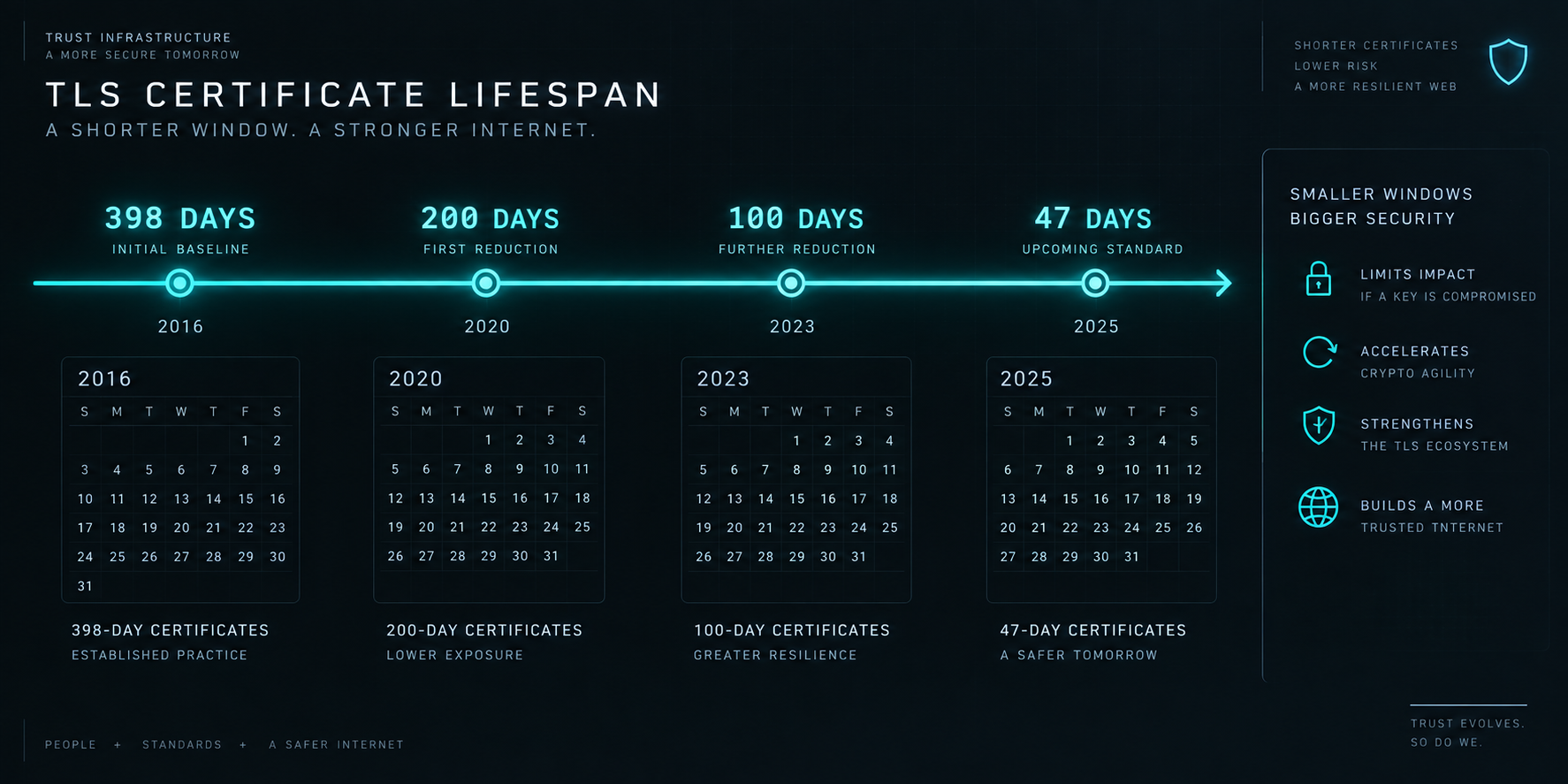
The current transition from 398 days down to 47 days represents the final dismantling of the legacy certificate model. The adopted schedule under Ballot SC-081v3 enforces three distinct thresholds:
- 15 March 2026: Maximum subscriber certificate validity drops to 200 days, with domain validation reuse capped at 200 days.
- 15 March 2027: Maximum subscriber certificate validity drops to 100 days, with domain validation reuse capped at 100 days.
- 15 March 2029: Maximum subscriber certificate validity drops to 47 days, with Subject Alternative Name validation data reuse capped at 10 days.
This timeline establishes a clear trajectory. At 200 days, an organization must renew certificates twice a year. At 100 days, renewals occur quarterly. At 47 days, every certificate on the public web must be replaced every six to seven weeks. Because the validation reuse window drops to 10 days in 2029, a Certificate Authority cannot simply reissue a certificate against historical checks; the domain must actively answer a new validation challenge during nearly every renewal cycle.
📋 Inside Ballot SC-081v3 and the new validation rules
Ballot SC-081v3 represents years of deliberation within the CA/Browser Forum Server Certificate Working Group. The working group brings together major browser root programs—Google Chrome, Apple, Mozilla, and Microsoft—with global commercial and non-profit Certificate Authorities. While previous validity ballots generated contentious debate between commercial vendors seeking multi-year subscription stability and browser engines pushing for rapid crypto-agility, SC-081v3 achieved broad consensus because the automated ecosystem had finally matured.
The ballot amends two critical sections of the Baseline Requirements for the Issuance and Management of Publicly-Trusted TLS Server Certificates: Section 4.2.1, governing validation data reuse, and Section 6.3.2, governing maximum validity periods. The language explicitly links certificate lifetimes with validation freshness.
“Expand Section 4.2.1 to detail the allowed data reuse periods for validation data... and expand Section 6.3.2 to detail a schedule for reducing Public TLS certificate maximum validity periods in coming years, concluding in March 2029.”
In historical practice, Certificate Authorities leveraged validation reuse to smooth over operational friction. If an enterprise proved domain control in January, the CA could issue additional certificates for that domain throughout the year without re-triggering DNS or HTTP verification. Under the new rules, this crutch disappears.
By March 2029, the maximum data reuse period for domain name and IP address validation drops to 10 days. If an automated client requests a renewed certificate 30 days into a 47-day validity cycle, the Certificate Authority will reject the request unless the client immediately completes fresh Domain Control Validation. The entire process must operate without human touchpoints, because asking a systems administrator to update DNS TXT records or verify email links twelve times a year per domain is economically and operationally impossible.
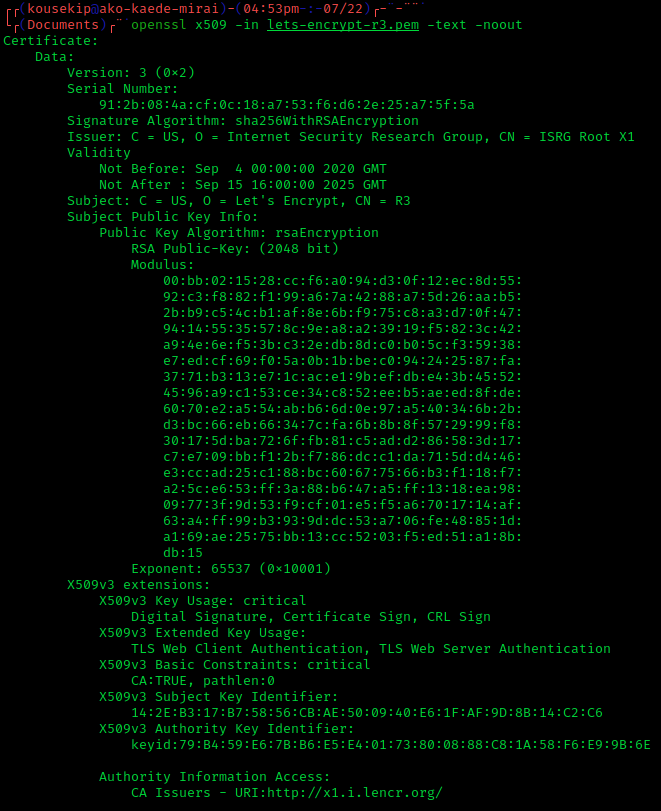
The data collected in Scott Helme's June 2026 Top 1 Million Crypto Analysis illustrates the stark divide already present on the web. Automated, ACME-native authorities such as Let's Encrypt and Google Trust Services already account for 77% of all certificates across the top one million websites, virtually all issuing 90-day certificates. Conversely, traditional commercial authorities like Sectigo, GlobalSign, and GoDaddy continued issuing 398-day certificates to the remaining 15% of sites. The organizations relying on traditional manual procurement are the ones now facing an unyielding operational wall.
🔒 Why the security baseline had to change
To operators outside the cybersecurity sphere, reducing certificate lifespans often feels like unnecessary churn imposed by browser engineers. In reality, the reduction solves fundamental architectural weaknesses in the Public Key Infrastructure of the internet. The primary driver is a stubborn, decades-old reality: certificate revocation does not work reliably at consumer scale.
When a server's private key is stolen, compromised, or exposed through a repository leak, the domain owner is supposed to revoke the certificate. In theory, browsers check revocation status via Certificate Revocation Lists or Online Certificate Status Protocol responders. In practice, both mechanisms fail to protect users. CRL files grow too massive for mobile devices to download before rendering a page, while real-time OCSP lookups introduce latency and leak user browsing habits to third-party CA servers.
Consequently, modern browsers operate on a "soft-fail" model for OCSP: if the CA's responder is slow, unreachable, or blocked by a local network, the browser proceeds anyway to avoid breaking legitimate web traffic. Attackers who compromise a private key can easily block outbound OCSP requests on a target network, rendering the revocation assertion completely toothless.
When revocation cannot be guaranteed, the only reliable security control is expiration. If a compromised certificate expires in 47 days instead of 398 days, an attacker's window of opportunity is reduced by nearly 90%. If an organization loses track of a decommissioned staging server or an old API gateway, the exposed credential will self-terminate in weeks rather than lingering for a year.
Beyond revocation, shorter validity periods enforce crypto-agility. As the computing landscape prepares for post-quantum cryptographic standards, root programs must be able to deprecate obsolete algorithms, retire compromised intermediate authorities, or upgrade hashing standards without waiting two years for legacy certificates to clear the ecosystem. A web that rotates certificates every month can transition to new cryptographic primitives smoothly; a web dependent on annual manual replacements resists every upgrade.
⚙️ The hidden trap of manual renewal calendars
Many small businesses, agencies, and internal IT departments believe they have a functioning certificate management process because their sites have never experienced an outage. Typically, that process consists of an entry in Google Calendar, a shared spreadsheet, or an automated reminder email sent by a domain registrar thirty days before expiration.
This manual paradigm is deceptive because it relies on human continuity. It functions adequately until the exact conditions of small-business reality intervene:
- Personnel turnover: The developer or contractor who originally bought the certificate leaves the company, and the renewal reminder emails go to an unmonitored inbox.
- Corporate payment failures: The credit card on file with the registrar expires, delaying the order while the administrative contact debates invoice approval.
- Staging and secondary drift: The team remembers to renew the primary domain (
example.com), but forgets the subdomains (api.example.com,checkout.example.com, orcdn.example.com), triggering browser blocking screens on critical user funnels. - Weekend and holiday expirations: A certificate expires at midnight on a Sunday, leaving the site inaccessible during peak ecommerce hours while the team scrambles to generate a Certificate Signing Request.
When certificates lasted 398 days, an organization had to navigate this risk gauntlet only once a year. At 47 days, the same manual procedure must be executed eight times a year for every single domain and subdomain in the company's portfolio. The probability of human failure increases exponentially.

Furthermore, the consequences of certificate expiration have worsened dramatically. In modern browsers, an expired TLS certificate does not present a subtle warning icon; it renders a full-page interstitial blocking the user with alarming warnings about potential eavesdropping and data theft. Most non-technical visitors immediately close the tab, assuming the business has gone bankrupt or suffered a malicious breach. For an independent brand, a 24-hour certificate outage causes immediate revenue loss and long-lasting reputation damage.
🔄 ACME and the mechanics of automated issuance
The technological foundation that makes 47-day certificates viable is the Automatic Certificate Management Environment protocol, standardized by the Internet Engineering Task Force in RFC 8555. ACME transforms certificate management from an administrative negotiation into an automated software loop running directly on web servers and edge proxies.
Under ACME, an automated agent communicates with a Certificate Authority without human intervention. The process unfolds across four discrete steps:
- Account Creation and Authorization: The local ACME agent establishes a cryptographic account with the CA, signing all requests with an account key pair.
- Challenge Validation: To prove that the requester truly controls the requested domain, the CA issues an automated challenge. The two most common challenge types are HTTP-01 and DNS-01.
- HTTP-01: The CA instructs the client to place a specific cryptographic token at a well-known path (
http://example.com/.well-known/acme-challenge/{token}). The CA server makes an outbound HTTP request to verify the token. - DNS-01: The CA instructs the client to create a TXT record under
_acme-challenge.example.comcontaining a cryptographic digest. The CA queries the public authoritative DNS to confirm control.
- Order and Issuance: Once the challenge is verified, the client generates a fresh private key and Certificate Signing Request locally. The CSR is transmitted to the CA over an encrypted API. The CA signs the certificate and returns the complete certificate chain.
- Deployment and Service Reload: The ACME agent places the new certificate files into the appropriate server directory and issues a graceful reload signal to the web server daemon, updating the active TLS context without dropping existing user connections.
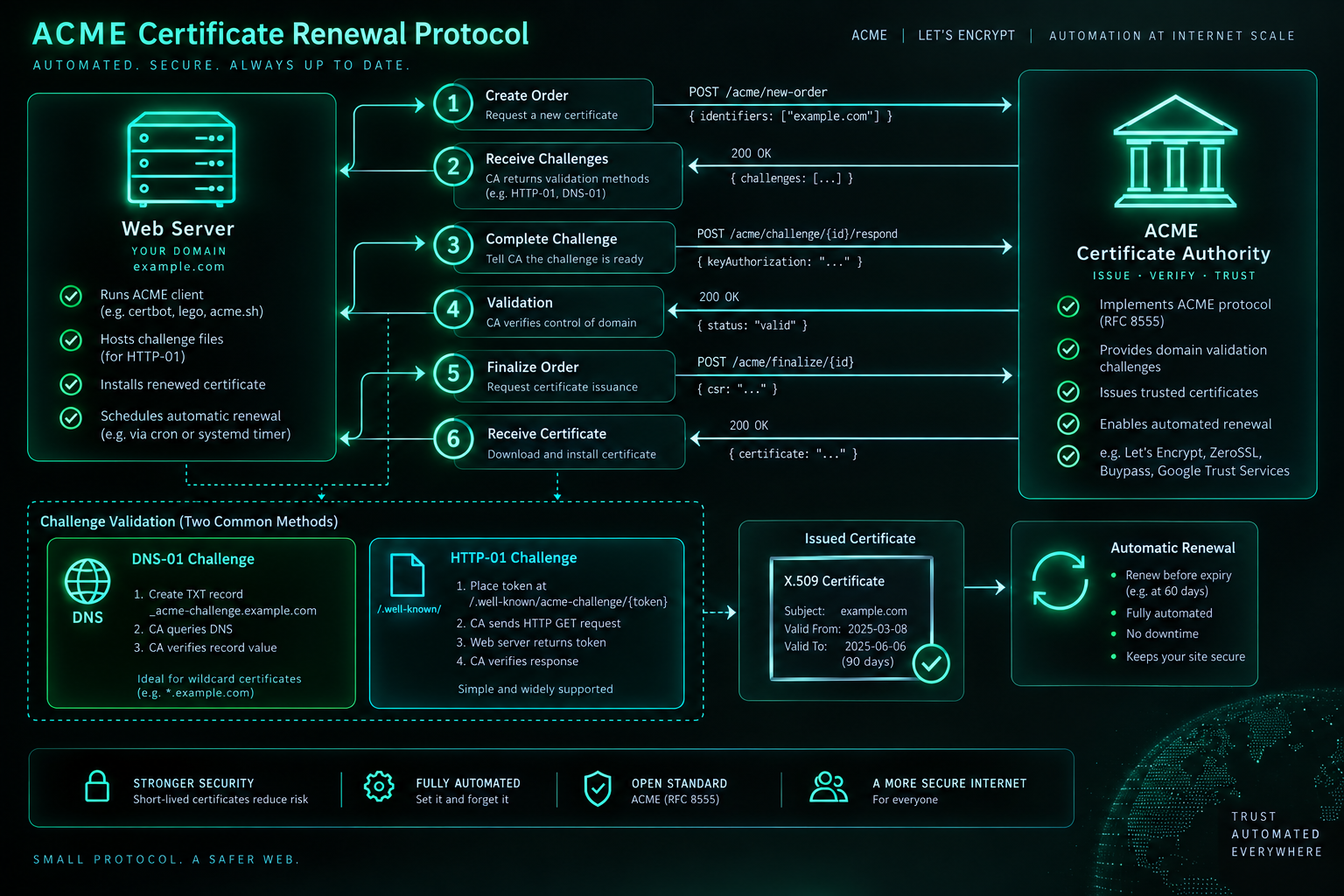
Because ACME agents are designed to attempt renewal well before the expiration deadline—typically when one-third of the validity period remains—the system possesses built-in resilience. If a network blip or upstream CA maintenance causes a renewal attempt to fail at day 30 of a 47-day certificate, the agent simply retries several hours later. The operator never notices, because multiple weeks of valid certificate life remain as a buffer.
🛠️ The tooling landscape for small teams
Automating TLS does not require an enterprise budget or a dedicated security operations team. The open-source ecosystem provides battle-tested tools adapted to almost every hosting environment, from single virtual private servers to containerized microservices and shared hosting.
Modern Web Servers with Native ACME
The simplest architectural approach is adopting a web server that implements ACME natively. Rather than running an external cron job or renewal script, the server handles certificates as part of its core runtime.
- Caddy: Written in Go, Caddy enables automatic HTTPS by default. If an operator specifies a domain name in the
Caddyfile, Caddy automatically obtains a certificate from Let's Encrypt or ZeroSSL, provisions OCSP staples, manages renewals, and handles graceful certificate rotation in memory. For small teams building static sites, reverse proxies, or web applications, Caddy eliminates configuration complexity entirely. - Traefik: Designed as a dynamic cloud-native edge router, Traefik integrates ACME directly into its configuration. When a new containerized service is deployed via Docker or Kubernetes, Traefik detects the service labels, generates the necessary certificates, and routes encrypted traffic automatically.
Standalone ACME Clients
For organizations running traditional web servers such as Nginx, Apache, or OpenLiteSpeed on Linux distributions like Ubuntu or Debian, standalone ACME clients manage the certificate lifecycle alongside the web server.
- Certbot: Maintained by the Electronic Frontier Foundation, Certbot is the most widely deployed ACME client in the world. Certbot features plugins for Nginx and Apache that automatically modify server configuration files, configure HTTP-01 challenges, and install systemd timers that execute renewals twice daily.
- acme.sh: An exceptionally lightweight, pure-POSIX shell script client with zero external dependencies.
acme.shis particularly favored for resource-constrained environments, routers, and workflows requiring automated DNS-01 challenges, featuring native API integrations with over 150 DNS providers including Cloudflare, DigitalOcean, Route53, and Namecheap.
Managed Cloud and Edge Proxies
For teams hosting on platforms like Vercel, Netlify, Cloudflare Pages, or managed cloud balancers (AWS ALB, Google Cloud HTTPS Load Balancing), certificate automation is handled entirely by the cloud provider. These platforms absorb the 47-day transition transparently, renewing edge certificates behind the scenes. However, operators must verify that the connection between the cloud edge and their origin web server is also secured with automated certificates, avoiding the common antipattern of unencrypted or self-signed origin traffic.
📊 Auditing your current certificate posture
Before the 100-day deadline in 2027 and the 47-day enforcement in 2029 arrive, small engineering teams should conduct a rigorous audit of their digital footprint. A thorough inventory prevents unexpected surprises when legacy renewal paths cease to function.
A comprehensive certificate audit requires examining five distinct infrastructural layers:
Primary Web Properties and Landing Pages
Verify that public-facing marketing websites, ecommerce stores, and blogs are managed by an automated client. Check the issuing Certificate Authority and the current validity duration:
openssl s_client -connect example.com:443 -servername example.com < /dev/null 2>/dev/null | openssl x509 -noout -dates -issuerIf the issuer is a commercial CA and the validity span exceeds 200 days, that certificate was issued prior to the March 2026 cutoff. It will remain valid until its stated expiration date, but its replacement cannot exceed 200 days, and subsequent renewals will drop rapidly to 100 and 47 days.
Subdomains, Staging, and Development Environments
Audit all active subdomains, including staging.example.com, dev.example.com, test.example.com, and mail.example.com. Teams frequently automate the root domain while leaving internal or testing environments on manual certificates. When an internal testing domain expires, developer workflows stall and automated integration test suites break.
APIs, Webhooks, and Mobile Application Endpoints
Examine backend API gateways and webhook endpoints consumed by third-party integrations or mobile apps. Mobile operating systems enforce certificate validity strictly. Furthermore, if a mobile application utilizes certificate pinning—an increasingly discouraged practice—short certificate lifetimes will break the application unless the pinning configuration pins intermediate root authorities or public key hashes rather than leaf certificates.
Mail and Communication Daemons
TLS is not restricted to HTTPS. Mail servers running Postfix, Dovecot, or Exim require valid certificates for STARTTLS, IMAP, and POP3. While ACME clients can easily provision certificates for mail hostnames, configuring the automated post-renewal hook to reload mail daemons is critical. Operators can invoke certbot certonly in standalone mode for mail.example.com and specify automated reload hooks for Postfix and Dovecot.
DNS Infrastructure and Automation Permissions
Because DNS-01 challenges represent the cleanest way to provision wildcard certificates and validate servers hidden behind internal firewalls, review the security permissions of your DNS API tokens. Avoid granting root-level access to your entire DNS account. Instead, generate scoped API credentials restricted strictly to editing TXT records under the _acme-challenge prefix.
⚠️ Operational edge cases and common failure modes
While automated certificate management is overwhelmingly reliable, shifting from an annual renewal to an ongoing, monthly renewal cycle exposes edge cases that small teams rarely encountered in the manual era. Recognizing these failure modes allows engineers to build defensive safeguards into their infrastructure.
ACME Rate Limiting
Public Certificate Authorities enforce strict rate limits to protect their infrastructure from runaway automated scripts. For example, Let's Encrypt enforces limits on certificates per registered domain (typically 50 per week) and duplicate certificates (5 per week). In containerized development environments where Docker containers spin up and request fresh certificates upon every launch, a team can easily exhaust their weekly rate limit, locking out production deployments.
The mitigation is straightforward: always configure staging and testing environments to utilize the Let's Encrypt Staging Environment (https://acme-staging-v02.api.pki.goog/directory or Let's Encrypt's staging endpoint). Staging environments issue certificates from untrusted roots but feature substantially higher rate limits, allowing teams to test deployment scripts safely before pointing to production.
HTTP-01 Challenges Blocked by Geo-Firewalls or WAFs
During an HTTP-01 challenge, the Certificate Authority validates the token from multiple geographically distributed vantage points around the world to prevent DNS poisoning and BGP hijacking attacks. If a small business utilizes a Web Application Firewall or Cloudflare firewall rule that blocks inbound HTTP traffic from certain countries or non-browser user agents, the CA's validation probes will receive an HTTP 403 Forbidden or 301 redirect loop, causing renewal to fail.
Ensure that the path /.well-known/acme-challenge/* is explicitly excluded from WAF security rules, rate limiters, bot challenges, and forced HTTPS redirects. The challenge path must answer over plain HTTP on port 80 cleanly.
Stale File Permissions After Server Upgrades
An ACME client typically runs under a dedicated system user or root via a scheduled timer, while the web server runs under an unprivileged user such as www-data or nginx. If an administrator manually copies certificate files or changes directory permissions under /etc/letsencrypt/live/, the web server daemon may lose read access to the newly rotated private keys during renewal, causing the server reload to fail silently while serving the stale, cached certificate.
Always rely on the ACME client's native deploy hooks to manage file placement, and verify that the target daemon possesses appropriate read permissions through group membership rather than opening world-readable permissions.
Unmonitored Renewal Timers
The most insidious failure mode in automated systems is silent failure. A systemd timer or cron job stops running due to an OS upgrade, a corrupted configuration file, or an expired account token, but because the current certificate is valid for another 30 days, nobody notices. Six weeks later, the certificate expires, and the site drops offline.
Automating renewal is only half the battle; teams must also automate certificate monitoring. A lightweight, external monitoring check that queries the live website daily and alerts the team if any certificate has fewer than 15 days of validity remaining provides an indispensable safety net.
🧭 Building a resilient certificate routine today
The migration toward 47-day certificate validity is not a hypothetical future scenario; it is an active regulatory schedule already underway. Waiting until 2029 to abandon manual renewals is a recipe for operational crisis. Small businesses and web engineering teams can achieve complete certificate resilience by implementing a disciplined four-week transition plan.
First, identify every web property, client website, and API endpoint that still depends on manually installed certificates. Replace them immediately with an ACME-compatible workflow. If your current hosting provider does not support automated Let's Encrypt, ZeroSSL, or Google Trust Services certificates through an automated control panel or SSH terminal, make that hosting limitation an explicit evaluation criterion during your next infrastructure review.
Second, test your automated renewal path proactively. Do not wait 30 days to discover whether your post-renewal script reloads Nginx correctly. Run a simulated dry run renewal through your local ACME tool to verify renewal triggers and hook execution before production cycles begin.
Verify that the command completes without errors, that the web server context updates, and that log files record the event accurately.
Third, decouple your certificate lifecycle from individual human responsibilities. Certificate alert notifications should route to a shared team channel or ticketing system rather than an individual developer's personal inbox. Record your domain validation strategy, DNS API scopes, and ACME provider details in an internal infrastructure runbook.
The shift toward 47-day certificate lifespans reflects the broader maturity of the web. Security on the modern internet is not defined by static credentials stored on hard drives for years at a time; it is defined by continuous, verifiable cryptographic agility. By automating your certificate pipeline today, you eliminate a persistent source of human error, protect your brand's digital reputation, and ensure that your web applications remain effortlessly accessible to every visitor who enters your URL.
Sources: CA/Browser Forum Ballot SC-081v3; CA/Browser Forum Baseline Requirements Section 4.2.1 and 6.3.2; Let's Encrypt Certificate Lifetime Rationale and Plans; Scott Helme Top 1 Million Crypto Analysis (June 2026); IETF RFC 8555 (Automatic Certificate Management Environment); Chromium Root Program Policy.